


US Makes Historic Move to Allow Stock Perpetual Contracts, Wall Street Giants Sound the Alarm


- Key Takeaways: The CFTC's approval of US single-stock perpetual futures contracts for listing on regulated exchanges marks the first time crypto-native derivatives mechanisms have entered the traditional US securities market, but Wall Street traditional financial institutions immediately filed lawsuits in response, officially kicking off the regulatory battle.
- Key Elements:
- CFTC Chairman Selig approved single-stock perpetual contracts on November 3, classified as security futures products under the CFMA and subject to the dual regulatory framework of the CFTC and SEC.
- Four platforms—Kalshi, Coinbase, Kraken, and Crypto.com—have completed the full application process and are expected to be among the first to launch, with leverage caps of approximately 6.5-6.7x and minimum margin requirements of about 15%.
- Lighter plans to apply for DCM and DCO qualifications in November; Hyperliquid is exploring a compliant path into the US through a partnership with ICE.
- The CMA, backed by Citadel Securities, Cboe, and others, filed suit in federal court the same day, arguing that perpetual contracts, which have no expiration date, should fall under SEC's exclusive jurisdiction as security-based swaps, and that the CFTC has no authority to approve them.
- SIFMA and Nasdaq also sent letters to the SEC in opposition, warning that thin overnight liquidity could easily lead to price manipulation and retail liquidation risks.
- Wall Street's core motivation is to protect profit sources such as 0DTE options and prevent order flow from being diverted to perpetual contract platforms.
- Whether the CFTC and SEC can withstand the pressure over the next 60 days and whether the court will issue an injunction will determine whether the first batch of products can launch and the compliance prospects of on-chain newcomers.
Original | Odaily (@OdailyChina)
Author | Azuma (@azuma_eth)
American investors are one step closer to legally trading US equity perpetual contracts onshore.
On November 3, US Commodity Futures Trading Commission (CFTC) Chairman Michael S. Selig issued a statement formally approving Equity Perpetual Futures linked to individual US stocks for listing and trading on regulated US exchanges.
For a long time, "perpetual futures" have been a signature innovation native to the crypto market — no expiry date, no need for frequent rollovers, and spot price anchoring through funding rates. With the CFTC giving the green light, this trading product born in offshore crypto markets will officially cross asset boundaries and storm into the tightly regulated traditional US equity market. This means US investors will have the opportunity to go long or short on the stock prices of listed companies such as Apple, Nvidia, and Tesla through perpetual futures without having to directly hold the shares.
For trading platforms that have long sought to bring on-chain derivatives markets to the US, this is undoubtedly a historic breakthrough; at the same time, Wall Street's attitude is one of facing a major threat — as soon as the CFTC's approval landed, the traditional Wall Street finance camp led by Citadel Securities and the Chicago Board Options Exchange (Cboe) swiftly filed a lawsuit in federal court to try to press the pause button.
Regulatory Gate Opens, Four Exchanges First to Get Tickets
According to Selig's statement, these equity perpetual contracts are classified as Security Futures Products under the US Commodity Futures Modernization Act (CFMA) and are deemed approved under the procedures of CFTC Regulation 40.3. This means they are not solely regulated by the CFTC, but are simultaneously subject to the relevant laws and regulatory frameworks of both the CFTC and the US Securities and Exchange Commission (SEC).
Selig stated that in the past, due to the lack of coordination between the CFTC and the SEC, innovative products such as security futures had long been in a regulatory gray area. This year, the two agencies have signed a Memorandum of Understanding (MOU), and this approval is part of their joint effort to promote regulatory coordination.
Although the regulatory direction has been set, not all platforms can immediately list US equity perpetual contracts. According to a summary by Bankless founder David Hoffman, platforms expected to be able to list immediately must simultaneously meet four hard conditions:
- Hold a CFTC-registered Designated Contract Market (DCM) license;
- Clear through a registered Derivatives Clearing Organization (DCO);
- Complete dual registration with the SEC (by submitting Form 1-N to become a notice-registered national securities exchange);
- Have previously submitted rule change applications for equity perpetual contracts during the window from mid-to-late September to early October, and completed the 45-day review period.
Currently, only four platforms across the US have completed the full application process and are expected to receive first-batch approval.
- Kalshi (KalshiEX LLC): As a trailblazer in prediction markets and derivatives, Kalshi, after securing its first BTC perpetual contract in May, submitted its equity perpetual application to regulators at the end of September. According to its filing, Kalshi initially plans to cover 58 popular US equity contracts including Apple, Tesla, and Nvidia, with rules setting a minimum initial margin of 15.50% (equivalent to a maximum leverage of approximately 6.5x), offering a trading window of 23 hours per day, five days per week (6 PM ET Sunday to 5 PM ET Friday), with funding rates settled daily based on observations during regular US equity trading hours.
- Coinbase (Coinbase Derivatives, LLC): Coinbase Derivatives submitted filings to the SEC and CFTC on September 18. Coinbase's proposal adopts a cash-settled design with no actual equity delivery, with trading hours from 8 PM ET Sunday to 5 PM ET Friday, funding rates calculated hourly and settled in cash through margin accounts, and a leverage cap of approximately 6.7x under the statutory 15% minimum margin for security futures.
- Kraken (Bitnomial Exchange, LLC): Kraken submitted rule changes on September 18 through Bitnomial, a derivatives exchange under its parent company Payward. As an important partner for Kraken in the US regulated derivatives market, Bitnomial has set a 15.25% customer margin floor for unhedged positions. Through this channel, Kraken and other mainstream US retail platforms will be able to rapidly distribute onshore equity perpetual products to compliant users.
- Crypto.com (Nadex / OG.com): North American Derivatives Exchange (Nadex, now also operating as OG.com Markets, part of Crypto.com's North American derivatives system), after receiving SEC confirmation of its Form 1-N filing, formally submitted an application to the CFTC on September 24 to add "Rulebook Chapter 16," specifically establishing cash-settled perpetual single-stock futures (Perpetual SFPs) trading and real-time funding rate pricing mechanisms. Notably, Robinhood has recently designated OG.com as its clearing infrastructure partner for prediction markets, meaning the辐射 potential of this license is considerable.
It should be emphasized that obtaining a ticket does not mean any stock can be listed without restrictions. Exchanges still need to comply with the previously submitted listing standards, including the float size, trading volume, pricing reliability of the underlying stocks, and the market's ability to resist manipulation. Simply put, regulators have opened the door, but which specific stocks can become underlying assets for perpetual contracts will be screened by exchanges according to the rules.
Next Wave: Lighter and Hyperliquid Poised to Enter
In addition to the four centralized licensed institutions mentioned above, crypto-native decentralized perpetual contract exchanges (Perp DEXs) are also vigorously advancing their compliance efforts, attempting to grab a share of this trillion-dollar pie.
Among them, Lighter's progress is the most clear-cut.
During the Q3 investor call held on October 21, Lighter founder Vladimir Novakovski stated that the team plans to apply to the CFTC for Designated Contract Market (DCM) status in November, while also applying for Derivatives Clearing Organization (DCO) registration. The former corresponds to the trading venue, while the latter handles post-trade clearing and risk management.
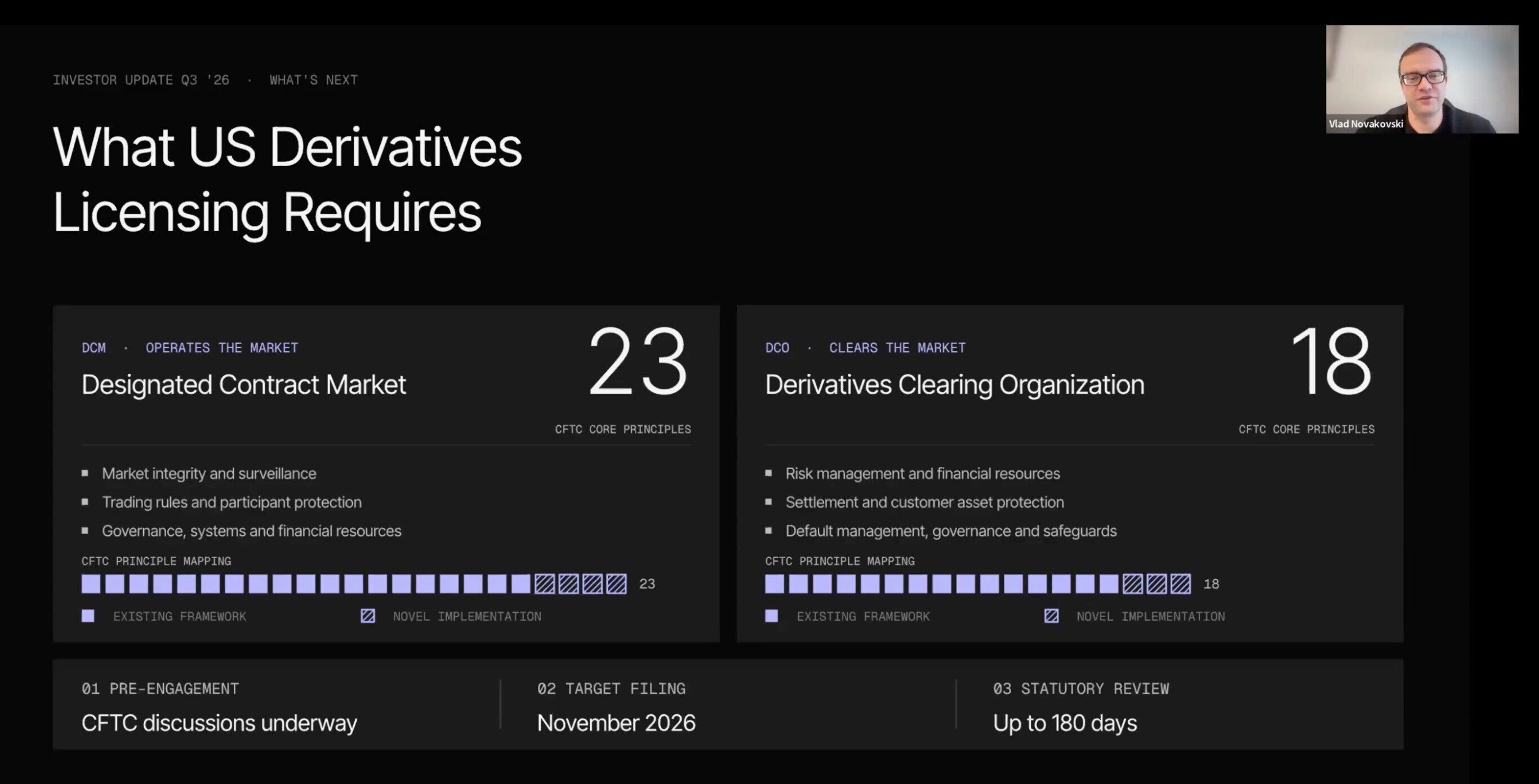
Vladimir stated at the time: "After submitting the application, regulators have a statutory maximum of 180 days for review. Because we have already had extensive engagement with the CFTC in the earlier stages and completed all preliminary preparations, we expect the subsequent review process to proceed very smoothly."
Hyperliquid is also making moves, but its path appears slightly different.
In August of this year, Trump publicly stated that CFTC Chairman Selig was pushing for Hyperliquid to enter the US market in a fully compliant and legal manner. The Hyperliquid Policy Center, a policy lobbying organization closely associated with Hyperliquid, subsequently submitted comments to the SEC and CFTC, arguing that perpetual contracts with futures characteristics should be classified as security futures, thereby allowing exchanges regulated by both agencies to participate in this market.
On October 29, Intercontinental Exchange (ICE), the parent company of the NYSE, announced a partnership with TradeXYZ, a market under the Hyperliquid ecosystem's HIP-3, to establish a regulated perpetual contract market and clearing system based on Hyperliquid in the US. This proposal still requires regulatory approval, but it offers another possibility — Hyperliquid does not necessarily have to directly transform its existing DEX into a US-licensed exchange; it could also establish an independent compliant market through partners while continuing to provide underlying infrastructure.
Wall Street Strikes Back at Light Speed, Demanding CFTC Revoke Approval
However, just as the CFTC opened the door to equity perpetual contracts, Wall Street's counterattack has already arrived.
On November 3, the Capital Markets Alliance (CMA), a lobbying organization supported by Cboe Global Markets, Citadel Securities, and the Healthy Markets Association, filed a lawsuit in the US District Court for the Southern District of New York, seeking to revoke the CFTC's approval of equity perpetual contracts.
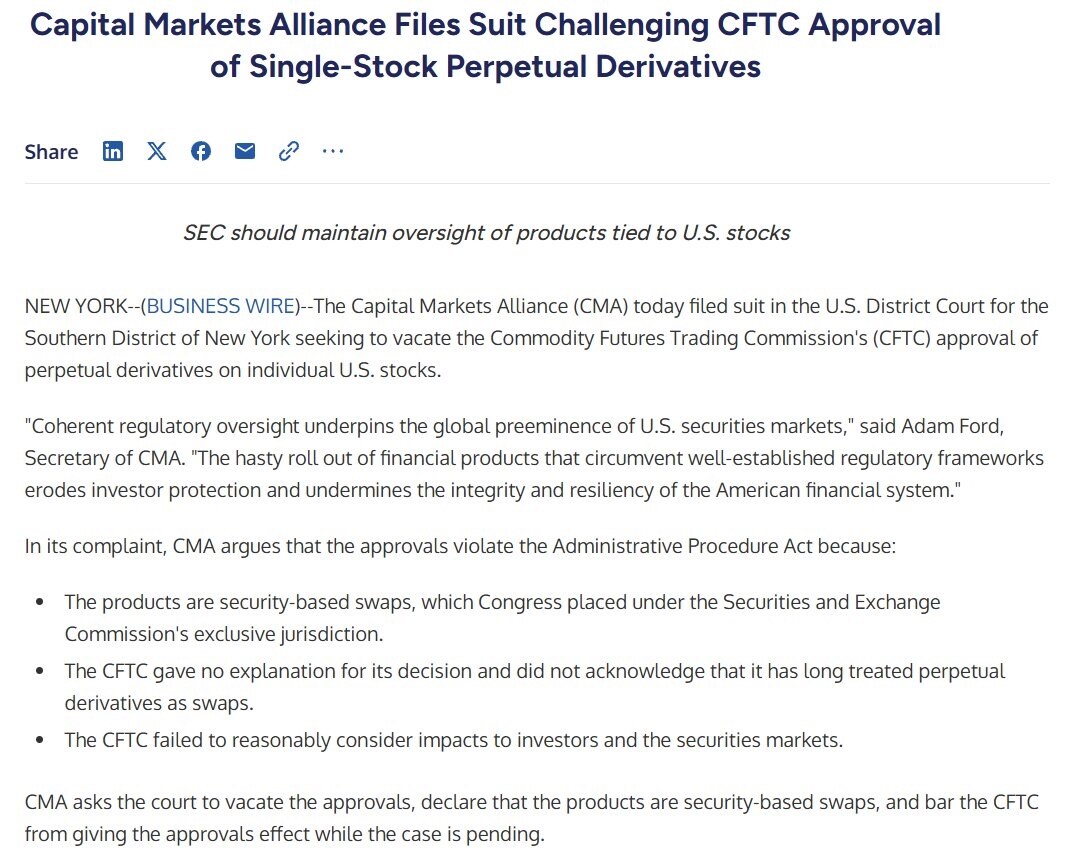
The CMA's core argument is that since perpetual contracts have no expiry date, they do not meet the statutory definition of traditional "security futures," but are legally "securities-based swaps." Under US law, swap products based on single stocks fall under the SEC's exclusive jurisdiction, and the CFTC has no authority to unilaterally approve them.
Additionally, the CMA alleges that the CFTC's decision violates the Administrative Procedure Act (APA), arguing that the CFTC bypassed formal legislative and comprehensive review procedures and hastily launched the products through a 45-day lapse-based automatic effectiveness mechanism. CMA Secretary Adam Ford criticized this, stating: "Hastily launching financial products that circumvent established regulatory frameworks will undermine investor protection and damage the integrity and resilience of the US financial system."
In addition to the CMA that filed the lawsuit, the Securities Industry and Financial Markets Association (SIFMA) and Nasdaq have also recently submitted opposition letters to the SEC, warning that equity perpetual contracts have thin liquidity during overnight trading hours, making them highly susceptible to price manipulation and cascading retail liquidation risks, and calling on the SEC to exercise its statutory authority to urgently repeal the rule changes of these four exchanges within the 60-day window after CFTC approval.
The reason Wall Street is so sensitive is simple: for traditional options and futures giants like Cboe, zero-days-to-expiry options (0DTE) and traditional equity options are their core profit sources. Once "equity perpetual contracts" — which require no rollover, are intuitive to operate, and support near-round-the-clock trading — become widespread on platforms like Coinbase, Kraken, and Kalshi, traditional options markets and market makers' order flow will face serious diversion.
A Clash Destined for the Regulatory History Books
The clash on November 3 is destined to be written into the annals of US financial regulatory history. On one side is the regulator's historic opening, attempting to bring the "perpetual futures" mechanism proven successful in crypto markets into US equities and pull offshore liquidity back onshore; on the other side are Wall Street incumbents like Citadel and Cboe, raising the banner of securities law and building defenses in federal court.
In the next 60 days, whether the CFTC and SEC can withstand pressure from Wall Street, and whether the federal court will issue a temporary injunction, will directly determine whether Coinbase and Kalshi can successfully ring the first "opening bell" for US equity perpetual contracts, and will also determine whether on-chain newcomers like Lighter and Hyperliquid can truly usher in their own "Wall Street moment."





