






波场TRON行业周报:美联储释放偏鹰信号加密市场进入修整,详解全球证券资产链上发行与流通的基础设施Securitize


- 核心观点:本周全球宏观主线转向“通胀反弹与央行偏鹰”,加密市场受美联储加息预期升温冲击冲高回落;资金流向集中于连接传统金融与链上资产的机构级基础设施,Securitize 作为头部RWA代币化平台获5.2亿美元融资。
- 关键要素:
- 美国7月PCE同比3.7%、核心PCE同比3.3%,美联储主席Warsh在Jackson Hole释放偏鹰信号,市场对9月加息25bp预期升至五成以上。
- 下周核心变量转向美国就业数据,9月4日非农报告将决定紧缩预期是否强化;BTC需关注$76,000-$77,000支撑区,跌破或测试$73,000-$75,000。
- 本周加密市场冲高回落,BTC在$76,900-$81,200区间震荡,ETH运行于$2,408-$2,560;美国现货BTC ETF在24-27日持续净流入后于28日转为$2.02亿净流出。
- 融资主线集中于“稳定币金融+RWA/Tokenization+机构级清算托管”,五笔主要融资流向市场基础设施方向,SBI、Bain Capital等传统大型金融资本持续进入。
- Securitize完成5.2175亿美元融资,由ARK、Jump、BlackRock领投,其DS Protocol以模块化架构覆盖数字证券发行、合规验证、分红、治理及二级交易全生命周期。
- 监管方面:美国SEC推进机构加密托管规则修订,泰国就本土Crypto ETF征求意见,日本启动基于区块链的证券结算体系建设,英国FCA更新加密监管过渡安排。
1. Outlook
1. Macro Summary and Future Predictions
This week's macro summary (August 24–30, 2026): This week, the main global macro trading narrative further shifted towards "resurgent inflation—major central banks turning hawkish again—growth resilience coexisting with policy tightening risks." In the US, July PCE data showed both headline and core PCE rising 0.2% month-over-month, with year-over-year readings of approximately 3.7% and 3.3% respectively—inflation remains clearly above the Fed's 2% target. Meanwhile, Fed Chair Kevin Warsh's remarks at Jackson Hole on August 28 explicitly stated that inflation remains "too high," and that recent data is insufficient to prove a substantive improvement in the underlying inflation trend. He indicated that if inflation does not continue to decline, the Fed still has room for further action, leading markets to reprice the probability of another rate hike this year. However, he also acknowledged the overall strength of the US economy, suggesting the current environment is closer to a "decent growth, elevated inflation" policy setting rather than a recession-driven easing cycle. Europe faces similar inflationary pressures, with Eurozone inflation rising to approximately 3.3% year-over-year in August, driven primarily by energy prices, increasing pressure on the ECB to tighten policy further. In Asia, the Bank of Korea raised its benchmark rate by 25bp to 3.00% on August 27, reflecting the renewed tightening trend in global monetary policy. Meanwhile, Middle East tensions, energy prices, and trade frictions continue to constitute tail risks to global inflation. The overall macro environment has clearly shifted from earlier expectations of rate cuts towards a repricing of "higher rates for longer or even further hikes."
Next week's forecast (August 31–September 6): The most critical variable next week will shift from Jackson Hole policy signals to US employment data validation. Markets will sequentially focus on JOLTS job openings, ADP employment, ISM, and most importantly, the August non-farm payrolls report. The core question is whether the labor market can continue to withstand the high-rate environment. As of this weekend, market expectations for a 25bp Fed rate hike in September have risen to over 50%. Therefore, if non-farm payrolls, wage growth, and ISM come in notably strong, this would reinforce the view that "the economy can withstand further tightening," leaving room for US Treasury yields and the dollar to move higher, continuing to pressure high-valuation risk assets. Conversely, if employment deteriorates significantly, it could quickly weaken September rate hike expectations. However, with inflation still above target, the threshold for the Fed to pivot directly to easing remains high. With European inflation heating up again and Middle East geopolitical risks still affecting energy supplies, global markets may continue to experience high volatility next week, with high-rate expectations and growth concerns competing. The macro direction will ultimately depend on whether US employment data is strong enough to support further Fed tightening.
2. Crypto Industry Market Movements and Alerts
This week's market movements (August 24–30, 2026): The crypto market exhibited a clear pattern of rallying then pulling back, with high-level consolidation. BTC began a rebound from around $77,700 on August 24, reaching a daily high near $80,000, and further touched approximately $81,200 on August 25, before oscillating repeatedly within the $78,000–$81,000 range. On August 28, influenced by Fed Chair Kevin Warsh's hawkish signals at Jackson Hole, market expectations for a September rate hike rose markedly, the dollar and Treasury yields strengthened, and BTC fell approximately 3% in a single day, dipping to around $76,900 at its lowest, before stabilizing near $78,000 by the weekend. ETH's trajectory broadly tracked BTC but with weaker elasticity, trading mainly within the $2,408–$2,560 range this week. It closed around $2,483 on August 24, recovered above $2,500 on August 26–27, fell back to approximately $2,443 on August 28, and held around $2,450 over the weekend. On the capital flow front, support was initially fairly strong—US spot BTC ETFs saw sustained net inflows from August 24–27, with approximately $338 million on August 24 and $314 million on August 25—but this flipped to net outflows of roughly $202 million on August 28. ETH spot ETFs also continued their streak of net inflows, indicating that institutional capital hasn't fully exited, but macro policy expectations have once again become the dominant short-term market factor.
Next week's forecast (August 31–September 6): The market is expected to enter a phase of macro-data-driven directional selection, with core pressure coming from the re-intensified rate hike expectations following Jackson Hole and next week's US employment data. Warsh's hawkish stance has already led markets to reprice September policy risk. Therefore, if employment, wages, or other inflation-related data continue to come in strong, Treasury yields and the dollar could push higher, with BTC needing to closely monitor the $76,000–$77,000 support zone. A decisive break below could see further downside testing of $73,000–$75,000. Conversely, if macro data weakens and eases rate hike expectations, while ETF flows resume sustained net inflows, BTC could look to challenge the $81,000–$82,000 resistance zone after firmly reclaiming $80,000. For ETH, near-term focus is on the $2,400–$2,430 support level. Holding this level leaves room for a retest of $2,550–$2,600, but if BTC enters a risk-unwinding phase, ETH and high-beta altcoins are expected to face greater drawdown pressure. Overall, next week is better characterized as a high-volatility, cautious consolidation period. Whether ETF flows turn positive again and whether US employment data further strengthens rate hike expectations will determine whether the market continues its upward breakout or re-enters a phase of interim correction.
3. Industry and Sector Hotspots
Judging from this week's capital flows, the strongest narrative is not a new L1/L2, but rather the "convergence of Crypto and traditional financial infrastructure": RQD represents institutional clearing, custody, and tokenization; Fasset represents stablecoin payments and digital banking; Hivemind represents RWA/institutional asset tokenization; Entropy represents on-chain capital markets and derivatives; and Beldex represents privacy infrastructure for the AI Agent era. Weekly funding data similarly shows that five of eight major funding rounds were concentrated in market infrastructure, on-chain finance, or tokenized assets.
Therefore, if we distill the most important funding trends from August 24–30, 2026, it can be summarized as: capital is clearly concentrating towards "stablecoin finance + RWA/Tokenization + institutional-grade clearing and custody + on-chain capital markets." Moreover, traditional large financial capital such as SBI, Bain Capital, M&G, and ABN AMRO continue to enter the space, indicating that the core narrative of this crypto funding cycle is shifting from pure protocol innovation towards institutional-grade infrastructure that bridges traditional finance, stablecoins, and on-chain assets.
2. Market Hot Sectors and Promising Projects of the Week
1. Overview of Promising Projects
1.1. Analysis of Securitize: Total funding of $521.75 million, led by ARK, Jump, and BlackRock, with participation from notable institutions including Morgan Stanley, Circle, and Aptos Labs—an infrastructure project driving the on-chain issuance and circulation of global securities assets.
- Introduction
Securitize is a globally leading compliant real-world asset (RWA) tokenization platform, specializing in providing end-to-end infrastructure spanning issuance, tokenization, investor onboarding, KYC/AML, asset management, and secondary market liquidity for funds, private equity, credit, real estate, and other securities-class assets. The platform supports mapping traditional financial assets onto blockchain, enabling digital issuance, on-chain management, and global circulation of assets, while enhancing asset liquidity, transparency, and operational efficiency and meeting regulatory requirements across jurisdictions.
Currently, Securitize serves top global financial institutions including BlackRock, Apollo, Hamilton Lane, and KKR, positioning itself as critical infrastructure bridging traditional finance and on-chain capital markets.
- Protocol Mechanism Overview
1. DS Protocol Overall Architecture
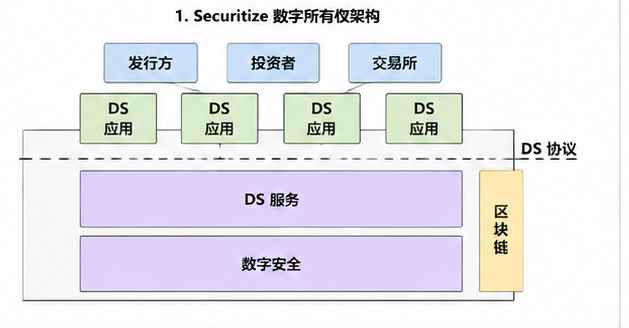
The DS Protocol is Securitize's open digital securities protocol, with the core objective of providing standardized infrastructure covering issuance, management, trading, and lifecycle operations for digital securities. Unlike traditional security tokens that focus solely on asset issuance, the DS Protocol treats digital securities as continuously operating financial products, dividing the entire system into three independent layers—DS Token, DS Services, and DS Apps—decoupling the asset layer, service layer, and business layer from one another, meeting regulatory requirements while improving protocol scalability and long-term upgradeability.
The entire architecture adopts a modular design. The DS Token serves as the core vehicle for digital securities, responsible for asset issuance, holder records, and on-chain transfers, extending ERC20 standards with investor management, permission controls, and compliance verification capabilities. DS Services provides underlying public services including identity authentication, investor registration, compliance checks, and communications, sharing unified data and rules across all digital securities. DS Apps handles specific business logic such as dividends, governance voting, and buybacks, enabling issuers to flexibly extend functionality based on their needs without modifying underlying token contracts.
The defining characteristic of this architecture is the separation of business logic from asset logic. All securities assets maintain a unified standard, while different businesses are implemented through independent Apps calling underlying services. This allows the protocol to rapidly add new financial functions while avoiding impacts on issued assets from business logic upgrades. Additionally, open interfaces allow third-party developers, wallets, exchanges, and custodians to directly connect to the DS Protocol, collectively building the digital securities ecosystem and enhancing the protocol's openness and compatibility.
2. DS Ecosystem
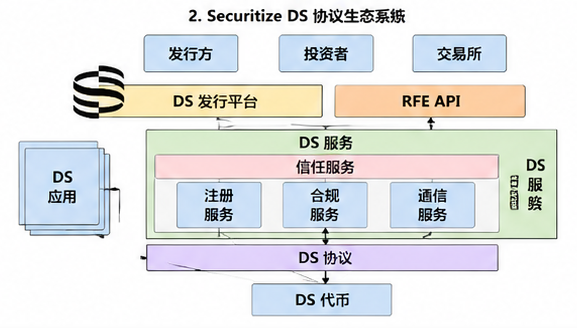
The DS Ecosystem illustrates the collaborative relationships among participants in the digital securities ecosystem. Issuers are responsible for asset issuance and lifecycle management; Investors hold and trade digital securities after completing identity verification; Exchanges, wallets, and custodians handle asset circulation and storage; Third-party developers can build applications such as dividends, governance, and buybacks based on DS Apps. All participants are connected through the identity, registration, and compliance services provided by DS Services, ensuring unified data standards and regulatory rules throughout the entire process of issuance, holding, transfer, and management of digital securities.
Compared to traditional securities systems requiring multiple centralized institutions to cooperatively handle identity, registration, transfer, and corporate actions, the DS Protocol integrates these capabilities into a unified on-chain protocol. Issuers don't need to repeatedly build infrastructure, developers don't need to reimplement compliance logic, and trading platforms don't need to maintain independent investor databases. This substantially reduces the cost of digital securities issuance and operations, providing standardized, sustainably scalable infrastructure for the institutional-grade RWA and digital securities markets.
- Core Components of DS Protocol
1. DS Token
The DS Token is the core asset layer of the DS Protocol and the fundamental vehicle for the entire digital securities lifecycle. Building upon the ERC20 standard, the DS Token adds identity management, compliance verification, and permission control capabilities, enabling it not only to represent securities ownership but also to meet the management requirements of real-world securities markets regarding investor qualifications, transfer restrictions, and regulatory requirements. All securities assets are issued under a unified standard, with different business logic executed through external module calls, avoiding business upgrades affecting the assets themselves.
Each time a DS Token transfer occurs, the Compliance Service is invoked to perform real-time verification of both transacting parties; only addresses meeting regulatory rules can complete asset transfers. Additionally, the token includes built-in functionality such as account freezing, transfer restrictions, investor iteration, and permission management, supporting various digital securities issuance scenarios including equities, fund shares, and bonds, providing a unified data foundation for subsequent dividends, governance, trading, and other applications.
2. DS Services
DS Services constitutes the foundational service layer of the entire protocol, providing unified identity, registration, compliance, and communications capabilities for all digital securities. It also serves as the core hub connecting the asset layer and application layer. All DS Tokens and DS Apps rely on this layer for data queries and business verification, allowing different applications to share unified data standards without redeveloping underlying capabilities.
Trust Service
The Trust Service manages authorization relationships among participants within the protocol, including issuers, exchanges, custodians, and third-party applications. Through a unified trust mechanism, only authorized entities can execute securities issuance, lifecycle management, and trading services, ensuring the security and credibility of the entire digital securities ecosystem.
Registry Service
The Registry Service manages investor identities and on-chain registration information, serving as the core database for compliant digital securities operations. The service records investor KYC/AML status, multiple wallet addresses, and holding relationships, achieving one-to-one correspondence between on-chain identities and real-world identities. It also supports Registry Federation, allowing different issuers to share identity information, avoiding repeated verification by investors across multiple platforms and improving inter-institutional collaboration efficiency.
Compliance Service
The Compliance Service provides real-time compliance verification capabilities for the protocol. During every asset issuance, transfer, and transaction, the system automatically checks investor identity, holding restrictions, jurisdictional regulatory requirements, and securities issuance rules, ensuring all asset flows comply with regulatory frameworks such as Reg D and Reg S. By isolating compliance logic, the protocol can flexibly upgrade rules in response to regulatory changes without modifying already-issued tokens.
Comms Service
The Comms Service establishes a unified communication mechanism between issuers and investors, used for sending dividend notifications, governance votes, corporate announcements, and other lifecycle events. Unlike traditional securities markets relying on email or third-party notification systems, the Comms Service incorporates message management into the protocol framework, enabling corporate actions to execute in sync with digital securities, improving information transmission efficiency and transparency.
3. DS Services Components
DS Services comprises four modules—Trust, Registry, Compliance, and Comms—together forming the protocol's underlying infrastructure. Registry handles identity management, Compliance handles regulatory verification, Trust provides permission control, and Comms enables on-chain message synchronization. Each module operates independently yet collaboratively, providing unified support for digital securities issuance, trading, and lifecycle management. This design ensures the protocol's modular scalability while enabling future additions of new businesses or regulatory rules without affecting underlying asset standards.
4. DS Apps
DS Apps constitute the application layer of the DS Protocol, designed to host various business functions throughout the digital securities lifecycle, such as dividends, governance voting, share buybacks, and asset redemptions. Unlike traditional security tokens that encode all logic into the token contract, the DS Protocol separates these businesses into independent applications. All Apps obtain identity, holding, and compliance information by calling DS Services, then interact with the DS Token to execute specific businesses.
This design grants digital securities a high degree of extensibility. Issuers can freely combine different applications based on product types, and third-party developers can develop new financial services based on open interfaces without redesigning tokens or the underlying protocol. When new corporate actions or financial products are added in the future, deploying a new DS App is all that's required for expansion, significantly reducing development costs while ensuring continued compatibility with historically issued assets.
Overall, DS Token, DS Services, and DS Apps constitute the three-layer architecture of the DS Protocol: DS Token provides the asset standard, DS Services provides underlying common capabilities, and DS Apps provide business functions. The three layers are mutually independent yet collaboratively operational, giving the protocol standardization, modularity, and scalability, providing complete on-chain infrastructure for institutional-grade digital securities and RWA assets.
- Complete Digital Securities Lifecycle
1. Token Issuance
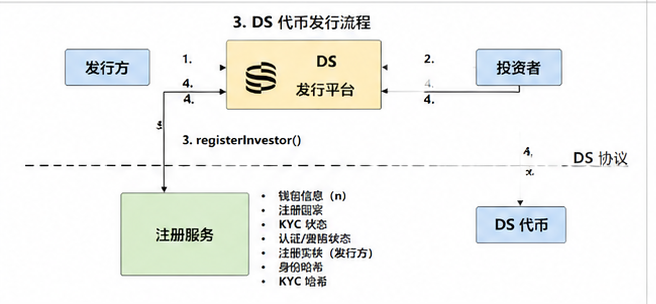
The DS Protocol standardizes the digital securities issuance process, achieving full on-chain management from investor onboarding, asset issuance, to token allocation. Issuers first create digital securities and set issuance parameters, then conduct identity authentication and KYC/AML review for investors through the Registry Service, with only addresses meeting investment qualifications eligible to participate in subscription. Once issuance conditions are satisfied, DS Tokens are minted and allocated to investor wallets, and all investor information, holding records, and issuance status are synchronously updated in the protocol database, providing a unified data foundation for subsequent trading, dividends, and governance.
Unlike traditional securities issuance requiring multiple institutions to separately complete registration, custody, and investor review, the DS Protocol unifies the issuance process under protocol management, creating a complete closed loop of identity verification, asset issuance, and holding registration. This not only reduces issuance costs but also improves asset issuance efficiency and transparency. Additionally, since all securities are issued based on unified standards, newly issued assets can directly integrate with the protocol's existing trading, governance, and corporate action modules without redeveloping underlying functionality.
2. Dividend Mechanism
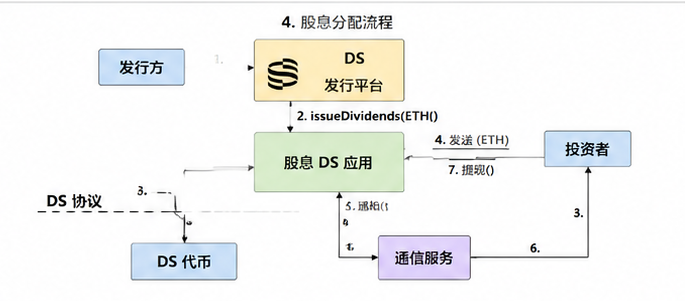
Dividend is one of the most important corporate action modules in DS Apps, used to help issuers automatically distribute cash dividends or other proceeds to holders. After an issuer creates a dividend plan, the system automatically calculates the dividend amount each investor should receive based on the holding snapshot recorded in the Registry Service, and re-verifies investor eligibility through the Compliance Service, ensuring dividend recipients meet regulatory requirements.
After calculation is complete, the Dividend App sends the dividend results to the corresponding investors and issues notifications through the Comms Service. If investors can receive funds normally, the dividend is completed directly; if funds cannot be delivered due to account status, payment failure, or other reasons, the system retains the unclaimed amount, which investors can claim later, without affecting the dividend process for other investors. This design ensures automatic execution of corporate actions while avoiding the inefficiencies of manual accounting and payment in traditional securities markets.
Compared to traditional listed companies relying on registrars,


