AI bubble's canary has just "died"


- Core View: The South Korean stock market has experienced a sharp sell-off first due to the fading AI热潮. The collapse of its semiconductor sector is seen as an early warning signal that global AI assets may be entering a phase of repricing.
- Key Factors:
- South Korea's KOSPI index has fallen by one-third in the past month. Its semiconductor leaders SK Hynix and Samsung Electronics have plunged by nearly 47% and 35% respectively over the same period, becoming the hardest-hit areas of the sell-off.
- The 3x bullish Korea ETF (KORU) has dropped about 78% from its June high, highlighting the amplifying effect of leveraged funds during market declines and the risk of long-term capital erosion.
- During this cycle, the KOSPI had previously led the Philadelphia Semiconductor Index (SOX) on the upside but is now also leading the downside. A divergence has emerged (with the KOSPI back at current levels, the SOX is still about 20% higher), suggesting catch-up downside pressure for the SOX.
- The South Korean government has stated it will "not intervene in the market for now," characterizing the crash as a process of market reassessment. It is considering restricting access to single-stock leveraged ETFs to professional investors only, which has drawn sharp criticism from retail investors.
- Market technical indicators show that although the market has entered oversold territory, panic sentiment and trading volume have not been fully released, and signals for the correction's end remain unclear.
Original Authors: Li Jia, Dong Jing
Original Source: Wall Street News
In the coal mining era, canaries were used to detect dangerous gases early, and their fall often signaled an approaching greater risk.
Today, the South Korean stock market appears to be becoming that "canary" amid the ebbing frenzy of AI.
As one of the most crowded markets in this AI trade, South Korea's semiconductor sector was the first to experience a sharp sell-off.
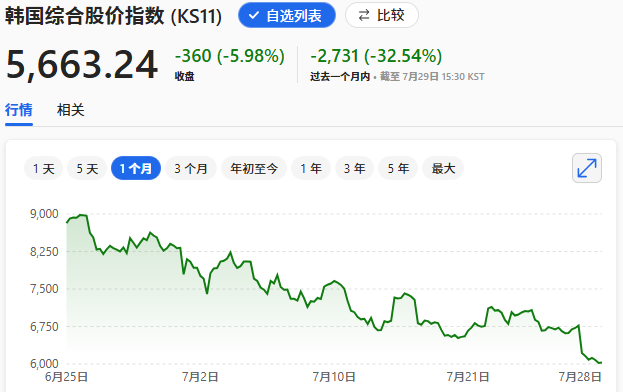
After plunging nearly 11% on the 28th, the KOSPI index fell as much as 13% intraday on the 29th, eventually closing down nearly 6%, shedding a third of its value in the past month.
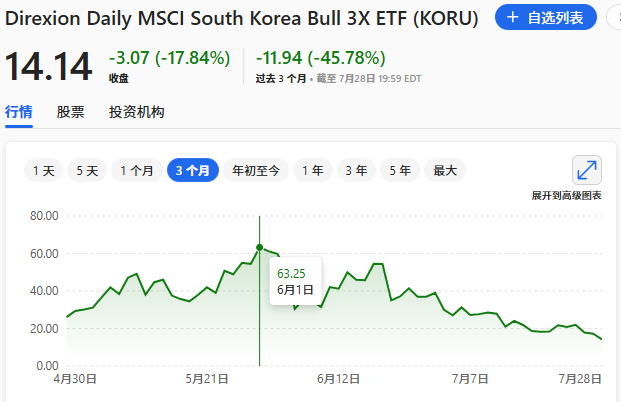
The 3x leveraged KORUS ETF (KORU) has fallen from around $64 in June highs to $14, a cumulative decline of 78%.
The South Korean market was previously one of the strongest beneficiaries of the global AI boom, with assets related to memory chips, HBM, and AI infrastructure drawing concentrated capital inflows.
But now, it is precisely these high-crowding, high-expectation assets that are being sold off first.
Market concerns suggest this may not be just a correction in the South Korean stock market, but an early signal of the AI trade beginning to ebb.
Notably, the KOSPI had led the Philadelphia Semiconductor Index (SOX) higher during this AI cycle and is now also leading the decline. (SOX has already broken below the key support level of 11,200 points overnight).
Now that this KOSPI "canary" has fallen, global investors are beginning to re-evaluate a critical question: Are the high valuations and lofty expectations for AI assets entering a phase of re-pricing?
It's worth noting that, facing massive losses for retail investors and mounting public pressure, South Korea's government has taken a "wait-and-see" approach to market intervention, stating that there is no need to activate a stock market stabilization fund and that the crash isn't solely attributable to leveraged ETFs. This stance has sparked strong backlash from retail investors, who accuse the government of actively encouraging market participation previously, only to deflect blame now.
South Korean Finance Minister Koo Yun-cheol apologized during a parliamentary hearing on Wednesday after lawmakers questioned the hasty introduction of single-stock leveraged ETFs without sufficient due diligence. Meanwhile, Financial Services Commission Chairman Lee Eog-weon stated that regulators are considering restricting access to such products to professional investors and are studying a reduction in leverage multiples.
AI Frenzy Recedes, South Korea Falls as the First Domino
Since its peak on June 22nd, the KOSPI has accumulated a decline of nearly 38%, with the latest round of selling further exacerbating market panic.
During the previous infrastructure investment frenzy, South Korean semiconductor companies were among the biggest beneficiaries. SK Hynix became a market darling thanks to the surge in demand for High Bandwidth Memory (HBM), while Samsung Electronics also benefited from expectations of an expanding AI server supply chain.
But as market risk appetite cools rapidly, capital is starting to exit.
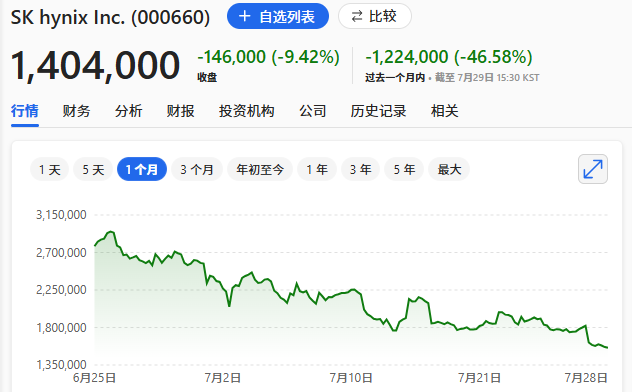
On the 29th, despite SK Hynix's earnings significantly surpassing historical levels, they still disappointed the market, leading to another drop of over 9%, and a nearly 47% decline over the past month. This reflects a deep contradiction in the current tech investment logic—market profit expectations for AI-related companies have been pushed to extremely high levels, where any result that doesn't fully meet expectations can trigger massive sell-offs.
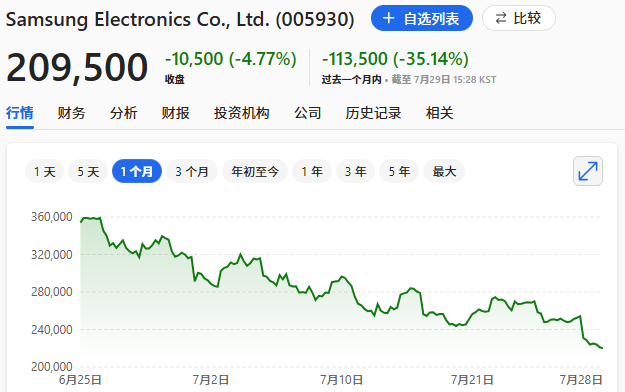
Samsung Electronics has simultaneously lost its 100-day moving average and long-term trend line, plunging 35% in the past month.
"Given the combined weight of SK Hynix and Samsung in the KOSPI, there's nowhere to hide when both stocks fall simultaneously," said Josh Gilbert, Senior Market Analyst at eToro for the Asia-Pacific and Middle East.
The market fears this may not be just a single-market adjustment, but the beginning of AI supply chain trading spreading from core to peripheral assets.
Technical Deterioration, Market Has Yet to See True 'Capitulation'
From a technical standpoint, the KOSPI correction shows no clear sign of ending.
Although the index briefly broke below its 50-day and 200-day moving averages intraday, approaching the long-term trend line that has supported the current bull cycle.

The RSI has fallen to its lowest level since April 2025, indicating oversold conditions. However, historical experience suggests that oversold conditions do not necessarily mean an immediate bottom.
True market bottoms are typically accompanied by more intense panic, surging volume, and a full-blown spike in volatility. Currently, the reaction of the KOSPI volatility index remains relatively limited, suggesting the market structure may not have fully cleared out.
In other words, while prices have clearly corrected, whether the emotional 'final drop' is complete remains uncertain.
Leveraged Capital Trap: KORU Collapse Reveals AI Trade Risks
Leveraged capital is amplifying the downward pressure in the South Korean market.
The 3x leveraged KORUS ETF (KORU) peaked at around $64 in early June and has now fallen to approximately $14, a decline of nearly 80%.
For investors holding such products, the biggest risk is not simply the index decline, but the long-term decay caused by the daily rebalancing mechanism of leveraged ETFs.
These products track daily return multiples, not long-term cumulative returns. When the market experiences choppy declines, the compounding effect continuously erodes the net asset value. Even if the underlying index eventually returns to its previous highs, the leveraged ETF may not recover proportionally.
Leveraged capital that flooded in during the AI rally is now becoming a source of passive selling pressure as the market declines.
South Korea's 'Canary' Warning: The Start of Global AI Asset Repricing?
The market's most pressing question is whether the collapse of South Korean semiconductor stocks will further spread to global chip assets.
Data shows that the KOSPI previously outperformed the Philadelphia Semiconductor Index (SOX), becoming one of the most aggressive representations of the AI trade. Now, while the KOSPI has fallen back to current levels, the SOX remains about 20% higher, creating a notable divergence between the two.
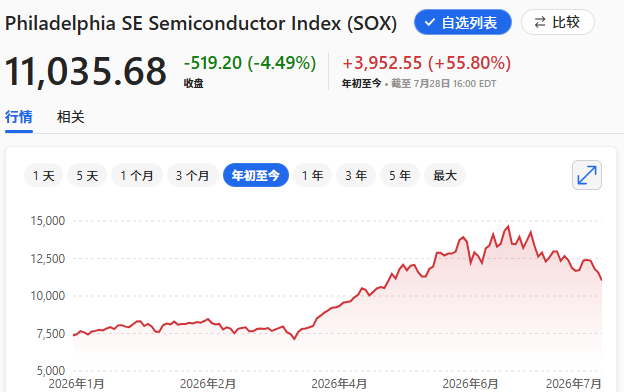
If historical correlations reassert themselves, the global semiconductor index may still face catch-down pressure.
Of course, the South Korean market does not necessarily represent the entire AI industry cycle. The capital expenditure on AI by major US tech companies, cloud computing demand, and advanced chip orders remain the core factors determining industry fundamentals. However, in terms of capital flows, South Korea is becoming a crucial window for observing whether the AI trade is overheated.
If the AI frenzy can still digest valuations through realized corporate earnings, then this is merely a healthy correction. But if capital begins to reassess the AI investment return cycle, then today's violent swings in the South Korean market could mark the beginning of a global repricing of AI assets.
The "canary" has fallen. The market now needs to observe: does it represent localized oxygen deprivation, or is the entire mine losing its air?
South Korea Refrains from Market Intervention, Drawing Sharp Criticism from Retail Investors
According to a report by the JoongAng Ilbo on July 29th, Kim Yong-beom, Chief of the Policy Planning Office at the Presidential Office (accompanying President Lee Jae-myung on a trip to Brazil), stated the government is closely monitoring the market but has not yet reached a stage to activate the Stock Market Stabilization Fund.
He characterized this crash as a "re-evaluation process" in which the market seeks equilibrium, attributing the high volatility of the Korean stock market to structural issues such as active retail trading, an overabundance of derivative products, and the excessive weighting of semiconductor bellwethers. He also distanced the government from responsibility regarding leveraged ETFs, saying "we can't attribute all problems to that one cause."
These comments quickly triggered a strong backlash within South Korean online communities and among investors.
Critics argue that the government actively hyped the market to attract retail investors, only to shirk responsibility by citing 'market self-correction' now that the market has crashed—a contradictory stance.
Online comments echo this sentiment:
"The government encouraged retailers to enter the market, and now that it's crashed, they not only refuse to admit fault but claim it's someone else's problem."
Analysts predict that as market volatility persists, policy accountability pressure from retail investors and the opposition party will further intensify.