The "most uncertain" moment in years—will tonight's Fed deliver a shock?


- Key Takeaway: The Fed is widely expected to hold rates steady tonight, but the market is pricing in a rare rate hike or an extremely hawkish pause, marking the highest level of uncertainty in 20 years. Any shift in decision or language could trigger significant market volatility.
- Key Factors:
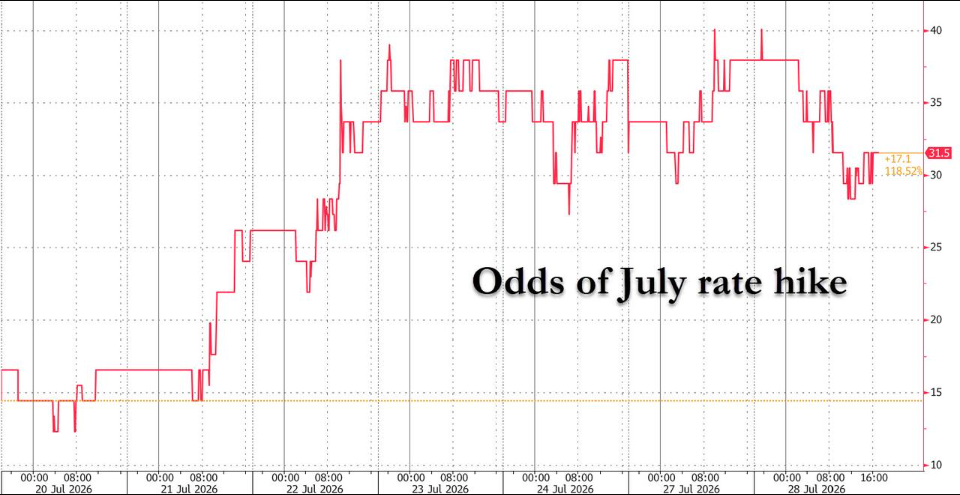
- Market consensus leans toward a pause, yet money markets still price in approximately a 32% probability of a hike, while all 104 surveyed economists predict rates will remain unchanged.
- Softer-than-expected June CPI, weak nonfarm payrolls, and falling oil prices provide data support for a pause, though core inflation remains above target.
- Powell's policy track record is unclear, and his first meeting saw a significantly shortened statement, making any language change this time prone to amplified interpretation.
- Internal Fed divisions are deep, with several officials leaning hawkish. Goldman Sachs expects the statement may acknowledge upside risks to inflation, potentially even seeing 1-4 dissenting votes in favor of a hike.
- A few institutions, like Citadel Securities, are explicitly betting on a rate hike, arguing it would bolster Powell's credibility and end the era of forward guidance.
- Should an unexpected 25 bps hike occur, JPMorgan expects the S&P 500 could fall 1.5%-2%; under a hawkish pause, the index may edge up or decline 0.5%.
Original Author: Zhao Ying
Original Source: Wall Street CN
Tonight's Federal Reserve decision is highly likely to be a "hold," but what the market truly fears is not this baseline scenario, but rather a rare surprise rate hike, or a pause accompanied by sufficiently hawkish rhetoric.
At 2:00 AM Beijing time on July 30th, the Federal Reserve will announce its latest interest rate decision. This meeting has no dot plot or economic forecast updates, and the federal funds rate target range is expected to remain at 3.50%-3.75%. According to a Reuters poll, all 104 respondents forecast no change in rates. However, money markets still imply about a 32% probability of a rate hike this week and have priced in roughly 42 basis points of tightening within the year, making tonight one of the most "uncertain" meetings in recent years.
The uncertainty stems from the tug-of-war between two forces. June's CPI came in broadly below expectations, nonfarm payrolls were weaker than anticipated, and oil prices retreated ahead of the meeting, all providing room for the Fed to wait. Yet inflation remains above target, the situation in the Middle East and oil prices are volatile, several Fed officials have recently sounded hawkish, and coupled with Chairman Warsh not yet establishing a clear policy track record, the market cannot entirely rule out the risk of a rate hike.
Jonathan Pingle, Chief US Economist at UBS, stated that the degree of uncertainty he feels about the upcoming Fed decision is the highest in 20 years – the last time he felt similarly was back when Bernanke had just taken over as Fed Chair. "Warsh will steer policy over the next few meetings, and we know almost nothing about his view on monetary policy."
For investors, risks are concentrated in short-end rates and the immediate reactions of the US dollar and US stocks. According to JPMorgan's Market Intel calculations, if the Fed unexpectedly raises rates by 25 basis points, the S&P 500 could fall 1.5%-2%; a 50 basis point hike might extend the decline to 2%-4%. Even if rates are held steady, a hawkish statement and press conference could limit the rebound in risk assets.
Market Consensus is a Pause, but Pricing is Not Calm
From a traditional forecasting perspective, this decision seems without suspense. According to a Reuters poll, all 104 economists expect the Fed to hold rates steady. Among them, 78 anticipate no rate adjustment for the rest of the year, and only 6 expect a cut.
However, the same survey shows that 66% of respondents believe the likelihood of a rate hike this year is "high," a significant shift from the "low" mainstream judgment in June. Market pricing also indicates investors are paying for tail risk related to hikes. Traders are not only pricing in roughly a one-third chance of a hike this week but are also fully pricing in a 25 basis point hike by September and nearly 50 basis points of tightening by March next year.
Goldman Sachs believes this pricing makes the outcome of this meeting "unusually uncertain." If the Fed raises rates, it would be a rare surprise action in history; if it doesn't, the market would quickly re-evaluate the previously priced-in hike risk. Ian Lyngen of BMO Capital Markets notes that since 2015, traders' average error in predicting the final rate decision on the day before an FOMC meeting has been just 2.4 basis points, but this time the market is more prone to more-than-usual immediate reactions.
Data Supports Waiting, but Inflation Risks Remain
The main reasons supporting a Fed pause come from the latest data. June's CPI, which was lower than expected, diminished the rate hike bets that emerged after Waller's hawkish comments. Waller had indicated that if June's core CPI ran hot, a near-term rate hike should be considered; if the data was cool, he would need to see more similar readings before considering it a clear signal.
The labor market also provides the Fed with more time to observe. June's nonfarm payrolls were weaker than expected, prior months were revised down, resulting in a net two-month revision of -74,000 jobs, compared to a previous net increase of 93,000. While the unemployment rate ticked down slightly, reports suggest this may primarily be due to an overall decline in labor force participation.
Oil prices are another key variable. The conflict between the US and Iran saw new escalations after the last meeting, with related memorandums of understanding being violated and both sides relaunching attacks. However, over the weekend before this meeting, attacks paused, the geopolitical risk premium declined, and oil prices fell accordingly, helping to ease inflation expectations. Fed officials have previously cautioned against reacting too quickly to what might be only temporary supply shocks.
The issue is that underlying inflation remains significantly above target. Morgan Stanley points out that upside risks include persistently high oil prices, a more hawkish Fed reaction function, and AI-driven investments pushing up the neutral rate. Goldman Sachs also believes that the combined impact of tariffs, war, and AI statistical errors on monthly inflation could diminish in the future, but uncertainty remains high. Once inflation improvement stalls, discussions about rate hikes within the Fed could reignite.
Communication in the Warsh Era is Itself a Risk
The last FOMC meeting, chaired by Warsh, was also his first. At that time, the statement was significantly shortened, forward guidance language was removed, and the committee's commitment to bringing inflation back to the 2% target was strengthened. This means even subtle changes in wording this time will be amplified by the market.
Morgan Stanley expects the statement this time will likely remain largely unchanged, including reaffirming the "ample reserves" policy, describing economic activity expanding "at a solid pace" amidst high uncertainty, with the unemployment rate "little changed" and inflation remaining "elevated." As there are no Summary of Economic Projections this month, policymakers have no need to reset market expectations through the dot plot.
The press conference could be more important. Warsh is likely to be asked about the impact of the Middle East conflict on inflation, the newly announced Chairman's working groups, and whether the latest data could advance the timeline for policy action. Goldman Sachs expects Warsh will not provide clear policy signals and might emphasize that all options remain open, with future decisions data-dependent.
Credit Agricole believes the Fed is entering a new phase with more limited forward guidance, which will make more meetings genuinely "live." The bank expects the Fed to remain on hold this time, believing that data since the last meeting has at least bought time for another pause. Regarding Warsh's five newly established working groups, Credit Agricole does not expect significant updates in the near term, suggesting that related recommendations may not be completed until closer to year-end, which also means balance sheet policy is unlikely to change soon.
Divergence Widens, a Pause Could Also Come with Dissent, Watch for Dissenting Votes
Divergence within the Fed is central to the uncertainty of this meeting. In the June forecasts, 9 of the 18 participants submitting projections expected at least one rate hike this year. Since then, comments from several officials indicate they are willing to consider further tightening if the disinflation process stalls.
Waller and Cook have both stated they might consider tightening if the disinflation process stalls. 2026 FOMC voters Logan and Hammack have made more hawkish remarks. Logan advocates for a moderately higher policy rate to better balance the outlook and risks, arguing that a certain degree of restrictive policy is still needed to help bring inflation back to target. Hammack went further, stating that the Fed may need to consider a rate hike.
Therefore, even if rates are held steady, dissenting votes could appear. Based solely on recent commentary, if the Fed chooses to pause, there could be between 2 and 4 dissenting votes favoring a rate hike. Goldman Sachs expects the statement this time might acknowledge the upside risk to inflation from geopolitical conflicts and could include at least one member voting for a hike.
Mark Cabana, an analyst at Bank of America, expects the Fed will hold rates steady on Wednesday but might attract dissenting votes from regional Fed presidents like Lorie Logan and Beth Hammack. He also stated that as long as the market does not rule out the risk of a hike, strategists won't either.
A Few Institutions Bet on a Rate Hike "Scare"
While the mainstream view remains a pause, a few institutions are explicitly betting on a surprise hike. Citadel Securities is a notable outlier, Its Head of Macro Strategy, Frank Flight, changed his baseline scenario this week to a 25 basis point hike. He believes this would enhance Warsh's credibility in fighting inflation and "clearly end the era of forward guidance."
Robert Tipp, Head of Global Bonds and Chief Investment Strategist at PGIM, also stated that the market may be underestimating the probability of action on Wednesday. He believes that Warsh has essentially set the stage for a hike, and if the decision is delayed now, it could increase the probability of a 50 basis point hike in September.
Lou Crandall, Chief Economist at Wrightson ICAP, stated that the Fed has no strong reason not to hike. Bond market veteran Harley Bassman even argued that the Fed should hike by 50 basis points in one go to strengthen its anti-inflation credibility.
However, Goldman Sachs still believes most voters are unlikely to push for a hike this week after the softer June inflation data. The bank also notes that the Fed historically avoids surprising markets with rate hikes, especially during meetings without the Summary of Economic Projections, as officials might be more concerned about the market overinterpreting their intentions.
Asset Reaction: A Hike is the Biggest Shock, a Hawkish Pause is No Easy Ride
JPMorgan Market Intel lists a "hawkish pause" as the baseline scenario, with a 50% probability. In this scenario, the S&P 500 could range from a 0.25% gain to a 0.50% loss. The logic is that the Fed would pause due to resilient labor market and growth, but continue to emphasize vigilance on inflation.
In the case of an unexpected 25 basis point hike, JPMorgan estimates the S&P 500 could fall 1.5%-2%, with the Nasdaq 100 potentially declining more. A 50 basis point hike could see the S&P 500 fall 2%-4%. In a "dovish pause" scenario – holding rates steady with accommodative communication – the S&P 500 could rise 0.50%-1%. In the options market, expirations on July 29th price in about 0.8% S&P 500 movement, lower than the ~1.1% pricing for the recent CPI event.
In FX, the Goldman Sachs FX team believes that if the Fed pauses, the dollar could weaken tactically, but this weakness might be brief as long as energy prices remain high. Over the medium term, if the Fed keeps rates unchanged for the rest of the year as the bank's economists expect, it would exert modest but manageable pressure on the dollar against G10 currencies.
The focus in the rates market is on the front end. The Goldman Sachs rates desk believes the market might misinterpret "a lack of forward guidance" as deliberate obfuscation. The desk leans towards the view that if the Fed Board doesn't support a hike, hawkish voters won't have sufficient votes to push for action this week. However, if July is a pause, Warsh could still deliver a hawkish pause and set the stage for a September hike.
In commodities, the Goldman Sachs crude oil desk states that the crude oil risk premium is rapidly fading, following a de facto ceasefire between the US and Iran over the weekend and progress in talks to reopen the Strait of Hormuz. However, upside risks haven't disappeared; if attacks on Saudi oil facilities or production continue, oil prices could trend higher again. Gold has traded in a roughly $250 range over the past two months, and the desk maintains a long-term bullish view but leans towards tactical trading around news events.
This means tonight's key isn't just whether rates change, but how Warsh explains "unchanged" or "changed." Against the backdrop of markets already paying for rate hike risk and economists almost unanimously expecting a pause, whichever path the Fed chooses could deliver a significant jolt to the market.