SpaceX Approaches $100: Where Does the Market's Expectation Gap Lie?


- Core Viewpoint: Morgan Stanley believes SpaceX's stock price has hit new lows (around $108) due to selling pressure from the lockup expiration, but this presents a buying opportunity, as the current valuation has completely ignored the value of the AI business. The stock price can be supported solely by rocket launches and Starlink operations.
- Key Elements:
- Analysts maintain an Overweight rating and a $300 price target. If the stock price falls to $100, the market's valuation of SpaceX's AI business would be zero or even negative. The implied EBITDA forecast for rocket launches + Starlink operations would be approximately 30% lower than their baseline.
- At a $100 stock price, SpaceX's 2028 EV/EBIT would be 18 times, close to the industry median. However, its revenue compound annual growth rate (76%) is three times the median of comparable companies (26%).
- Morgan Stanley's 15-year DCF model values rocket launches + Starlink operations alone at approximately $136 per share, which is already higher than the current stock price, meaning the AI business is a "bonus."
- Currently, SpaceX accounts for over three-quarters of global mass-to-orbit and maneuverable satellites in orbit. Its connectivity business is growing nearly 50%, with an EBITDA margin as high as 40%.
- Near-term positive catalysts include Starship's 14th/15th test flights (September/October), the release of Grok 4.6, and doubling computing power to 2 Gigawatts, which could trigger a stock price recovery.
- Downside risks include lockup expiration pressure, slowing Starlink user growth, high AI infrastructure costs, and regulatory uncertainty. The bear-case scenario price target is $75.
Original Author: Yang Chen
Original Source: Wall Street News
SpaceX's stock price is under pressure from the upcoming lock-up expiry, but Morgan Stanley believes this has created a buying opportunity due to a valuation dislocation.
During Monday's trading session, SpaceX shares once fell to $108.66, hitting a new low since listing, more than halving from the high of $225.64. With the lock-up period nearing its end, some investors believe the stock could further decline to $100.
According to broker reports, Morgan Stanley analyst Adam Jonas recently released a report stating that if the stock price truly falls to $100, it would imply the market is assigning zero or even negative value to SpaceX's AI business. Furthermore, the implied expectation for the 2028 EBITDA of the Rocket Launch & Starlink business would be approximately 30% lower than the firm's base case forecast.

The firm maintains an Overweight rating on SpaceX with a price target of $300. It believes the current divergence between pessimistic sentiment and fundamentals creates an attractive entry point. At prices below $120, investors are essentially getting the option value of the company's entire AI business for "free," while the core Rocket Launch & Starlink business itself already covers the current stock price.
The Divergence Between Market Sentiment and Fundamentals
Despite no significant changes in SpaceX's fundamentals over the past few weeks, bearish conviction has paradoxically strengthened, while bulls are increasingly inclined to wait for more definitive catalysts.
Based on conversations with investors, the core disagreement centers on the pricing of the AI business. Most investors are applying significant discounts or completely ignoring the value of Grok and Cursor, believing that AI monetization opportunities are primarily concentrated in the neocloud sector.
Reasons cited include: the AI business's capital expenditure being too high relative to the Rocket Launch & Starlink business, significant uncertainty in the economic model, and management dedicating excessive time and effort to the AI segment.
Some investors even assign a negative value to AI, arguing that high capital expenditure will erode overall value. Morgan Stanley holds a different view, believing this pricing approach is overly conservative and overlooks multiple potential AI monetization pathways.
What Does $100 Mean?
Based on the firm's 2028 base case forecast—revenue of $157 billion (including an average of 6 GW of computing power priced at $16.5 per watt, and an average of 35 million consumer users with monthly ARPU of $46), and EBIT of approximately $69 billion—if the stock price falls to $100, SpaceX's corresponding FY28 EV/EBIT would be 18x. This is roughly in line with the median level of comparable companies. However, SpaceX's revenue compound annual growth rate from 2025 to 2030 is 76%, about three times the median CAGR of 26% for comparable firms.
From a cross-sectional perspective, an 18x EV/EBIT would rank approximately 81st in the S&P 500 (excluding financials and real estate), placing it in the same range as Boeing (21x), Waste Management (19x), CSX (18x), and Garmin (18x).
Breaking down the business further, if the Rocket Launch & Starlink segment is valued at 40x EV/EBITDA (slightly below the median of 46x for space comparables), the implied value of the AI business would be exactly zero. If a 50x multiple (slightly above the median) is used, the implied value of the AI business would be negative $300 billion. Morgan Stanley considers both of these scenarios unreasonable.

Core Business Already Supports the Current Stock Price
Even completely excluding AI value, SpaceX's Rocket Launch & Starlink business alone is sufficient to support the current stock price.
The firm's 15-year DCF model values the Rocket Launch & Starlink business independently at approximately $136 per share, using an EV/EBITDA multiple of 56x. At the assumed price of $100, it implies that the market is pricing this business with an implied 2028 EBITDA roughly 28% lower than Morgan Stanley's base case forecast, while assigning zero value to AI.

Currently, SpaceX accounts for over three-quarters of global mass to orbit and maneuverable satellites in orbit. Its connectivity business is growing at nearly 50% this year, with an EBITDA margin of 40%. Purchasing SpaceX at the current valuation means acquiring a space and connectivity business with a dominant market position and high growth certainty at a discounted price, with all the AI option value essentially being a "bonus."
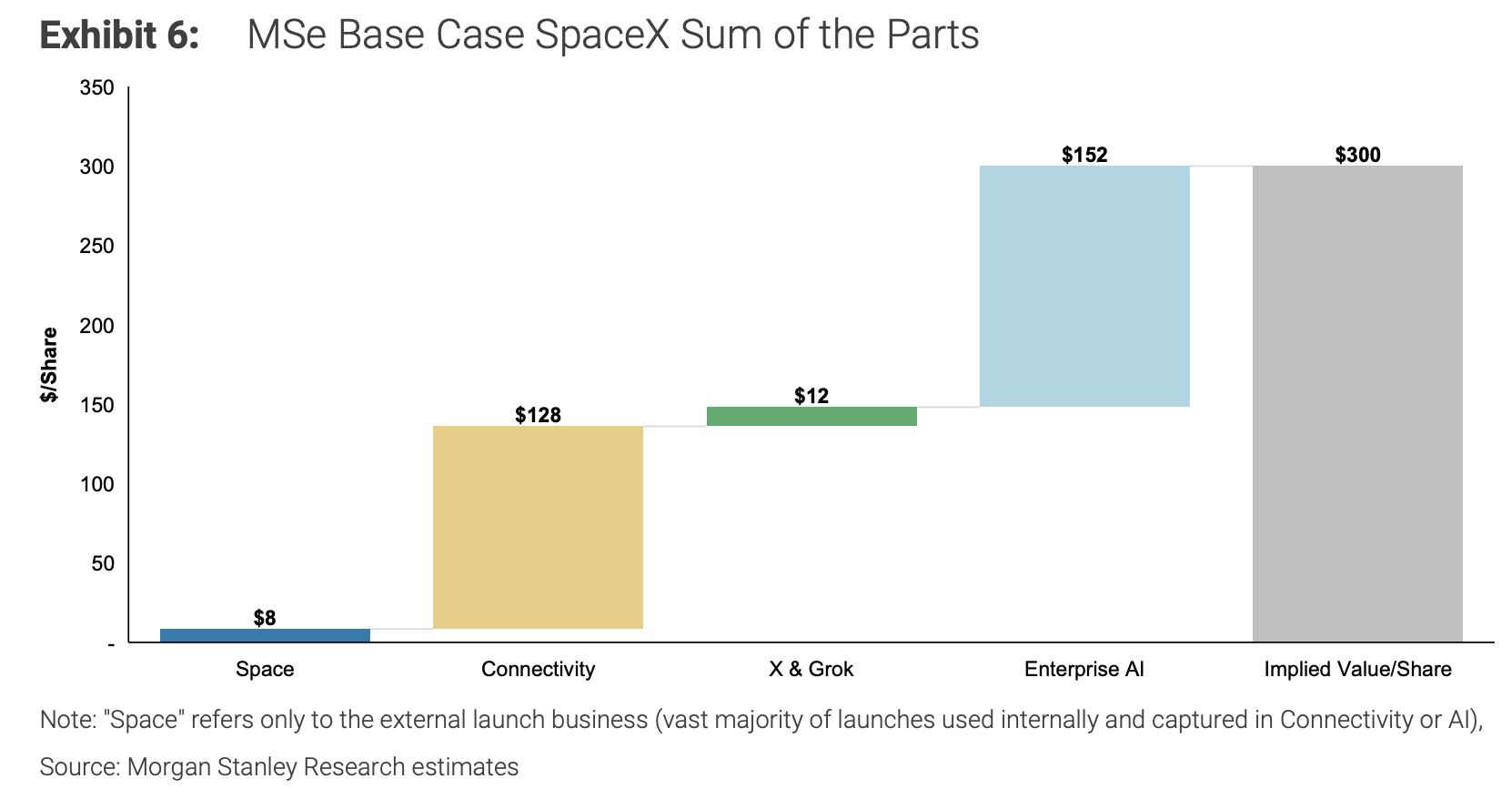
From a sum-of-the-parts valuation perspective, Morgan Stanley's base case target price of $300 is composed of: Space business at $8, Connectivity business at $128, X & Grok business at $12, and Enterprise AI business at $152.
Recent Positive Catalysts
At the launch level, Starship's 14th and 15th test flights are expected in September and October respectively. These may include the first catch of the V3 Starship booster, the first orbital flight (with deployment of operational V3 satellites), and the first catch of the Starship upper stage.
At the AI business level, Grok 4.6 (a 2 trillion parameter model) is expected to be released within the next month, and Grok 5.0 (a 6 trillion parameter model) is expected within the year. The Cursor acquisition is expected to close by the end of the third quarter, at which point a substantive update on Cursor's Annual Recurring Revenue (ARR) and Grok platform adoption rates will be disclosed.
At the computing power expansion level, SpaceX expects to double its computing capacity from current levels to 2 GW by the end of the year, which could lead to more large-scale neocloud contracts.
Given that the market currently assigns almost no value to AI, any of the above positive developments could serve as a trigger for upward price correction.
Key Risks Not to Be Ignored
In the short term, the stock faces dual pressures: first, the upcoming lock-up expiry will bring additional supply pressure; second, the upcoming earnings report may not answer the questions investors care about most.
The downside scenario (price target $75) assumes: Starship progress stalls, compressing the narrative; AI monetization is significantly slower than expected; the Rocket Launch & Starlink business accounts for over 90% of total valuation; and Starship operations are delayed to 2029.
Other major downside risks include: slowing Starlink user growth, persistently high cost per watt for AI infrastructure, extended AI business construction timelines, equity dilution from increased financing needs, and regulatory uncertainties.
The upside scenario (price target $600) assumes a full acceleration in Starship, orbital compute power, and Terafab deployment, with AI accounting for over 60% of total valuation and compute power deployment growing at a 46% CAGR.