






A-share market's new "stock king" is born: How to reasonably value ChangXin Memory Technologies?


- Core Thesis: As the only pure-play DRAM IDM leader on A-shares, CXMT is in a phase of explosive growth driven by a cyclical turnaround and market share gains. Brokerages have significant valuation divergence for its post-IPO valuation, centered on differing views on its long-term market share ceiling and growth premium: Northeast Securities estimates 3.2-5.7 trillion RMB, while Nomura provides an aggressive target of 7.76 trillion RMB.
- Key Factors:
- CXMT debuted on the STAR Market today with a market cap of approximately 579.1 billion RMB. However, the valuation gap between Northeast Securities and Nomura reaches up to 2 trillion RMB, primarily due to different assumptions on long-term market share (17% vs. 25%-30%) and PE multiples (10-15x vs. 20x).
- Northeast Securities uses three independent valuation methods — relative market share valuation, earnings-based PE valuation, and capacity-per-unit valuation. After accounting for minority interests, these methods converge on a reasonable valuation range of 3.2 trillion to 5.7 trillion RMB.
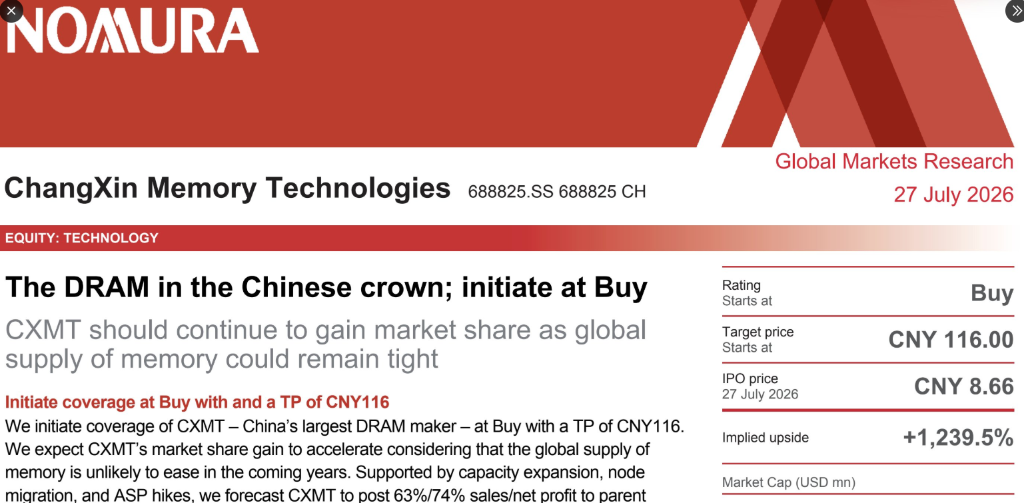
- Nomura sets a target price of 116 RMB (implying an upside of 1239%), based on three core logics: structural tightening of global memory supply, accelerated market share gains for CXMT, and a dual growth premium from the combined effects of domestic substitution and AI-driven demand.
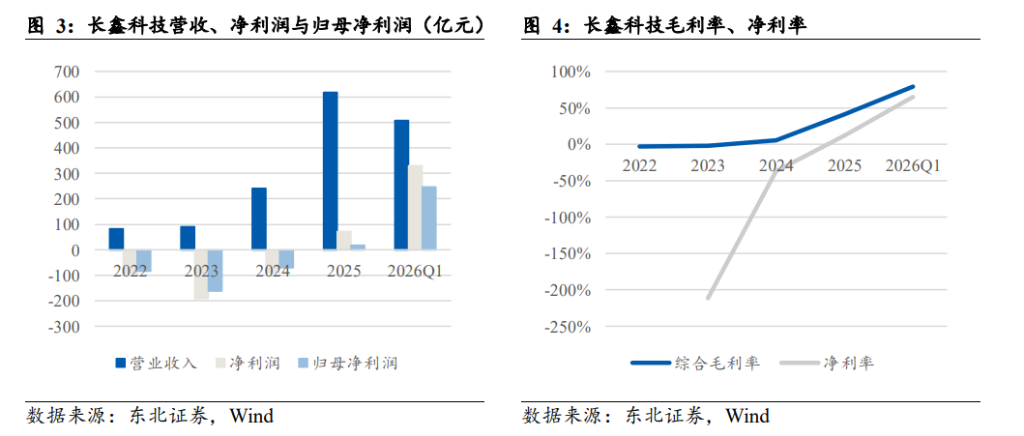
- The company's financial inflection point has arrived, driven by the DRAM price upcycle: Gross margin rose to 79.16% in Q1 2026, with a single-quarter net profit attributable to parent of 24.762 billion RMB. Management expects net profit attributable to parent for the first half of 2026 to range between 50 billion and 57 billion RMB.
- CXMT currently holds a 7.67% global DRAM market share (ranking first in China, fourth globally). Its capacity plan expands from 270,000 wafers per month in 2025 to 450,000 wafers per month by 2027. Its products have entered the supply chains of Alibaba, Tencent, ByteDance, and major smartphone OEMs.
Original Author: Long Yue
Original Source: Wall Street CN
CXMT (688825) will be listed today, becoming the largest IPO on the STAR Market. The IPO issue price is 8.66 yuan, with a total share capital of 66.881 billion shares (before the exercise of the over-allotment option) and a total market capitalization of 579.188 billion yuan at issuance. However, the market clearly does not intend to stay at this price.
In a research report, Li Jiu, an analyst at Northeast Securities, valued CXMT from three independent perspectives, with conclusions converging in the range of 3.2 to 5.7 trillion RMB. On the same day, Nomura Securities initiated coverage with a Buy rating and a target price of 116 yuan, implying an upside of 1,239% and a corresponding market cap of approximately 7.76 trillion RMB—1.4 times the upper limit of Northeast Securities' estimate. The core divergence between the two institutions lies in their judgment of CXMT's long-term market share ceiling—Northeast Securities assumes a base case of 17%, while Nomura bets on a larger share potential and higher growth premium.
The above valuations may not be exaggerated. CXMT is a unique entity in A-shares to date: a pure-play DRAM IDM leader, holding the entire chain of design and manufacturing capabilities, currently in a performance explosion phase driven by "cyclical reversal + market share growth." The company's products cover DDR4/5 and LPDDR4X/5/5X, and have entered the supply chains of Alibaba, Tencent, ByteDance, and major smartphone manufacturers. According to Omdia data, in Q4 2025, the company held a global market share of 7.67%, ranking first in China and fourth globally. Benefiting from DRAM price increases and the volume ramp-up of high-end products, the company's earnings elasticity is accelerating.
The DRAM supply-demand gap persists, and CXMT enjoys the dual dividends of "rising volume and price + domestic substitution." The real question is not whether it is valuable, but which yardstick to use for measurement.
Perspective 1: Relative Valuation by Market Share—Target Market Cap ~3.49 Trillion RMB
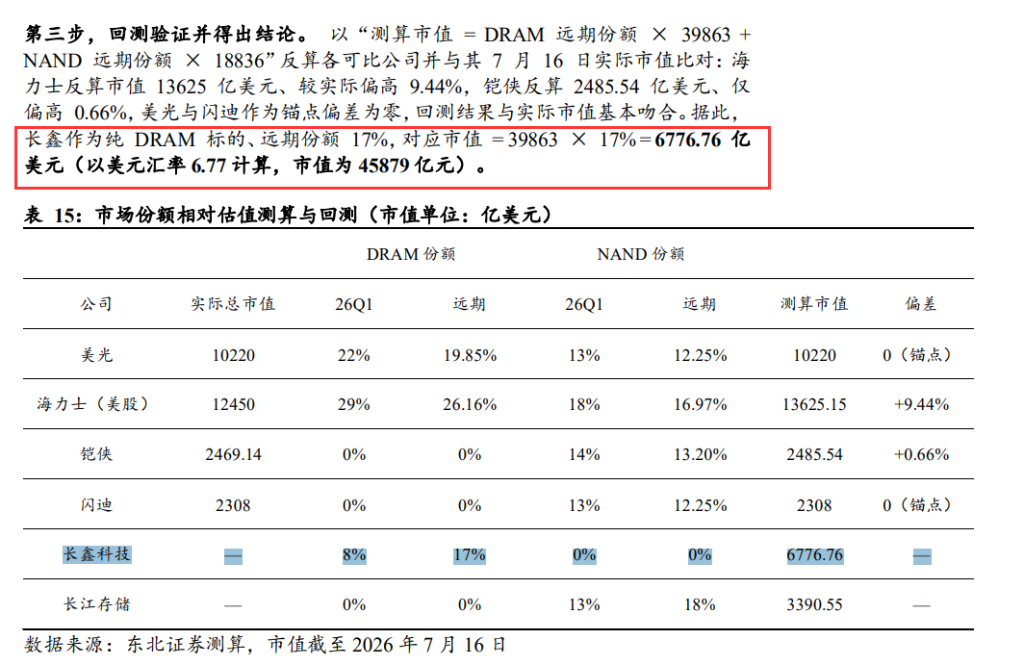
Logic: Since DRAM is a global market, the market caps of overseas listed memory companies already reflect the market's pricing for "each percentage point of share." By using the market caps of comparable US-listed companies, we can derive "the market cap corresponding to each 1% of global long-term share," and then multiply it by CXMT's long-term share.
Methodology: Micron and SanDisk have identical NAND market shares (both at 13%). Therefore, subtracting SanDisk's (pure NAND) market cap from Micron's (DRAM and NAND) market cap yields the market cap corresponding to Micron's DRAM business—$1,022 billion - $230.8 billion = $791.2 billion. Dividing this by Micron's 19.85% long-term DRAM share results in approximately $39.86 billion for each 1% of long-term DRAM share.
Conclusion: As a pure DRAM entity with a long-term share of 17% (currently ~8%), CXMT's corresponding market cap is approximately $677.676 billion, or about 4.58 trillion RMB (at an exchange rate of 6.77). After deducting approximately 24% for minority interests, the attributable market cap is approximately 3.49 trillion RMB.
Backtesting Verification: The back-calculated market cap for SK Hynix is 9.44% higher than the actual, while Kioxia is only 0.66% higher, indicating the results are largely consistent with actual market caps.
Perspective 2: Earnings Breakdown PE Valuation—Target Market Cap 2.85 Trillion to 4.27 Trillion RMB
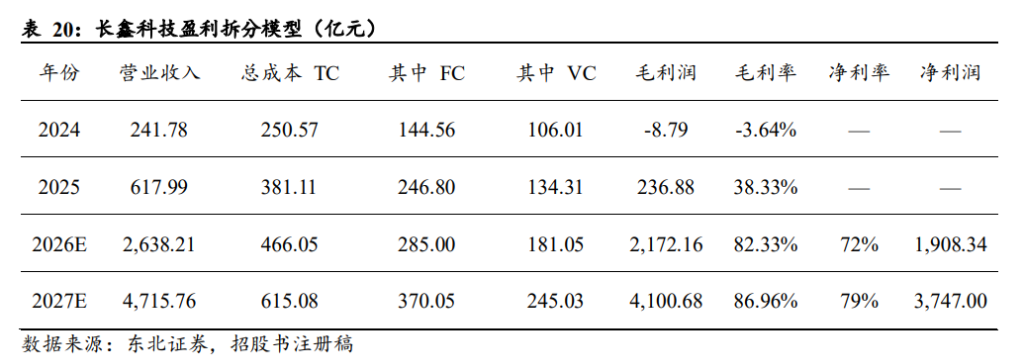
The second method is more fundamental: forecasting CXMT's own profits directly without external benchmarks. The cost structure of memory manufacturers is highly standardized. Fixed costs are predominantly depreciation, determined by the scale of capital expenditure; variable costs vary linearly with shipment volume. Since the prospectus did not disclose actual wafer capacity data, the estimation uses the original value of fixed assets as a proxy for capacity, multiplied by the utilization rate and sales rate to derive sales volume, which is then combined with ASP to calculate revenue.
Logic: Decompose revenue (capacity × utilization rate × sales rate × ASP) and costs (fixed cost depreciation + variable costs), forecast net profit, and then apply a PE multiple.
Key Forecasts:
- 2027 revenue: 471.6 billion RMB, gross margin 86.96%, net profit 374.7 billion RMB (consolidated basis)
- After deducting minority interests (assuming a constant 24%), attributable net profit is approximately 284.8 billion RMB
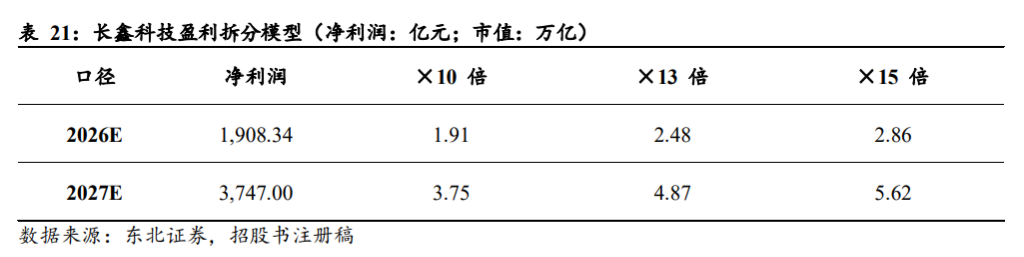
Valuation: Northeast Securities notes that Micron and SK Hynix trade at 2027 PEs of 7.51x and 7.94x respectively. However, CXMT is in a phase of rapid market share growth (with a long-term share estimated to reach ~30%), warranting a growth premium. Applying a PE of 10-15x and deducting minority interests, the attributable market cap is approximately 2.85 trillion to 4.27 trillion RMB.
Perspective 3: Relative Valuation by Unit Capacity—Target Market Cap 3.22 Trillion to 3.99 Trillion RMB
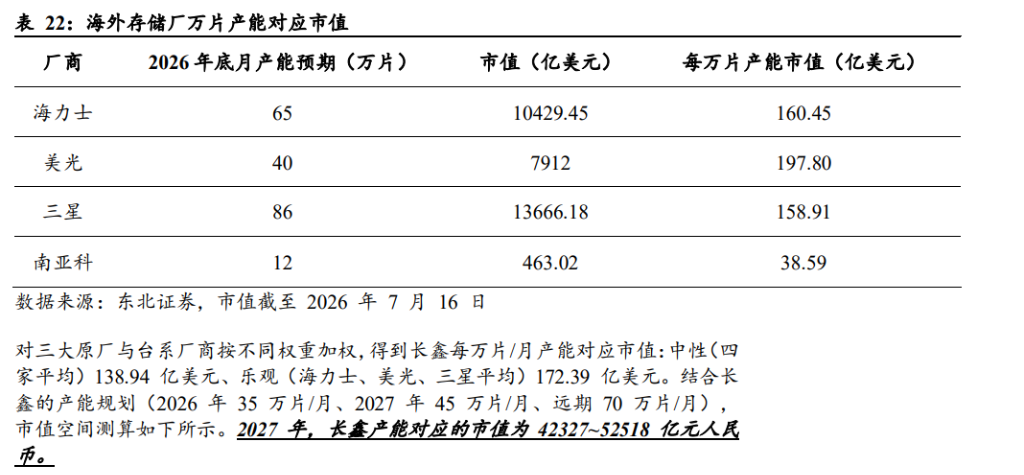
Logic: Divide the market cap of overseas memory manufacturers by their monthly capacity to derive the "market cap per 10,000 wafers/month capacity," then multiply by CXMT's planned capacity.
Benchmark: The market cap per 10,000 wafers/month for the three major manufacturers falls within the $158-198 billion range—SK Hynix $16.045 billion, Micron $19.780 billion, Samsung $15.891 billion.
Conclusion: With CXMT's capacity at 450,000 wafers/month in 2027, the corresponding market cap is:
- Optimistic scenario (average of three major manufacturers at $17.2 billion/10k wafers): 52,518 billion RMB
- Neutral scenario (including Taiwanese manufacturers' average of $13.9 billion/10k wafers): 42,327 billion RMB
After deducting minority interests, this corresponds to approximately 3.22 trillion to 3.99 trillion RMB.
Summary of Three Methods: Convergence at 3.2 Trillion to 5.7 Trillion RMB
Northeast Securities points out that CXMT's minority interest ratio was as high as 73.76% in 2025, far exceeding Samsung, SK Hynix, and Micron (all below 1%). Valuations must exclude this impact.
Assuming the minority interest ratio remains constant at 24% in 2026 and 2027, the conclusions from the three methods are as follows: After excluding the impact of minority interests, the reasonable valuation is 3.2 to 5.7 trillion RMB.
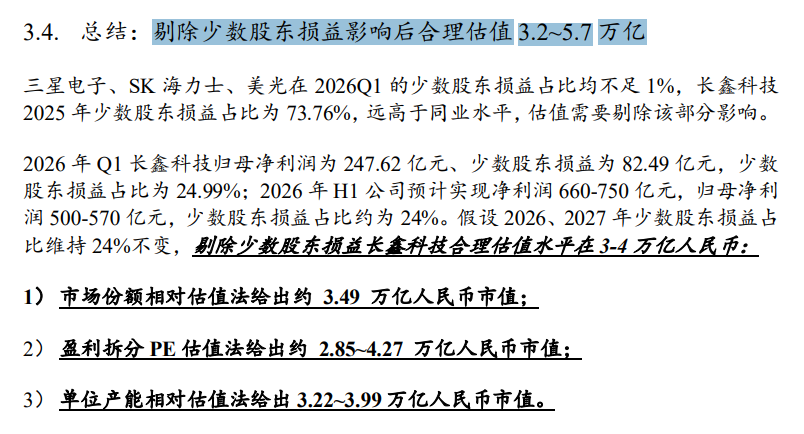
The three perspectives use different data and logical chains, but the final attributable ranges all converge around 3 to 4.3 trillion RMB. This convergence itself is a signal: under current share and capacity assumptions, pricing at this magnitude has strong internal consistency.
Nomura Securities: Target Price 116 Yuan, Implied Upside 1,239%
On July 27, Nomura Securities also initiated coverage on CXMT with a more aggressive view.
The bank started with a "Buy" rating and a target price of 116 RMB, corresponding to approximately 20x PE—exactly double Micron's current valuation (~10x) and more than double SK Hynix's current valuation.
Based on the IPO issue price of 8.66 yuan, the target price of 116 yuan implies an implied upside of 1,239.5%, corresponding to a market cap of approximately 7.76 trillion RMB.
This figure far exceeds Northeast Securities' upper valuation range of 5.7 trillion. The approximately 2 trillion gap between them essentially reflects different bets on two core variables: where CXMT's market share ceiling lies, and how much growth premium the market should assign to this company.
2026 is Just the Starting Point! Domestic Substitution Combined with AI Demand, Nomura Gives CXMT a Dual Growth Premium
The underlying logic for Nomura's 20x PE premium is built on three judgments.
First, structural supply tightening will persist for several years. The bank's core thesis is: "Global memory supply is unlikely to ease in the coming years." The capex of Samsung, SK Hynix, and Micron has shifted significantly towards HBM and advanced nodes, structurally constraining new supply additions for general-purpose DRAM. This means the general DRAM market where CXMT operates will maintain a supply-shortfall pattern for an extended period, unlike the traditional memory cycle of "two years up, two years down."
Second, CXMT's market share growth logic is "accelerating" rather than "linear." The bank judges that as CXMT's capacity continues to expand and its process technology migrates from the 4th to the 5th generation, its global market share growth in general DRAM will outpace market expectations. The current share of ~8%, in Nomura's model, corresponds to a long-term potential far exceeding Northeast Securities' assumed 17% ceiling. The forward share assumption implied by Nomura, back-calculated from the 7.76 trillion target market cap, likely falls within the 25% to 30% range, or even higher.
Third, domestic substitution combined with AI demand creates a dual growth premium. The bank believes CXMT is not just a memory cycle theme stock but also a "domestic substitution" theme stock. Chinese cloud vendors and smartphone manufacturers show a continuously increasing willingness to purchase domestic DRAM, providing CXMT with additional incremental growth independent of the global cycle. Simultaneously, AI servers drive exponential demand for DRAM, with server DRAM content per unit being nearly 80 times that of smartphones. This shift in demand structure will support a structural upward movement in the ASP center. With these dual logics combined, Nomura believes CXMT deserves a higher valuation premium than its overseas peers, not a discount.
In other words, Nomura does not view 2026 as the peak; it sees it merely as the starting point.
In specific financial forecasts, Nomura predicts CXMT's sales and attributable net profit will grow by 63% and 74%, respectively. Drivers include: capacity expansion from 270,000 wafers/month in 2025 to 450,000 wafers/month in 2027, increased value per wafer from process technology migration, and the continued upward trend in average DRAM prices against a backdrop of tightened supply. Nomura's absolute earnings forecasts are more aggressive than Northeast Securities', and the application of a 20x PE multiple further amplifies the final valuation outcome.
Supporting this more aggressive assumption are supply-demand data: global general DRAM capacity calculations show a persistent gap in 2027; Q1 2026 DRAM contract prices surged 93% to 98% QoQ, significantly exceeding previous expectations; CXMT's Q1 2026 gross margin rose to 79.16%, with a single-quarter attributable net profit of 24.762 billion RMB.
The height of the price upcycle is continuously revising the input assumptions of all models in real-time.
From Zero to Global Fourth, CXMT Took Seven Years
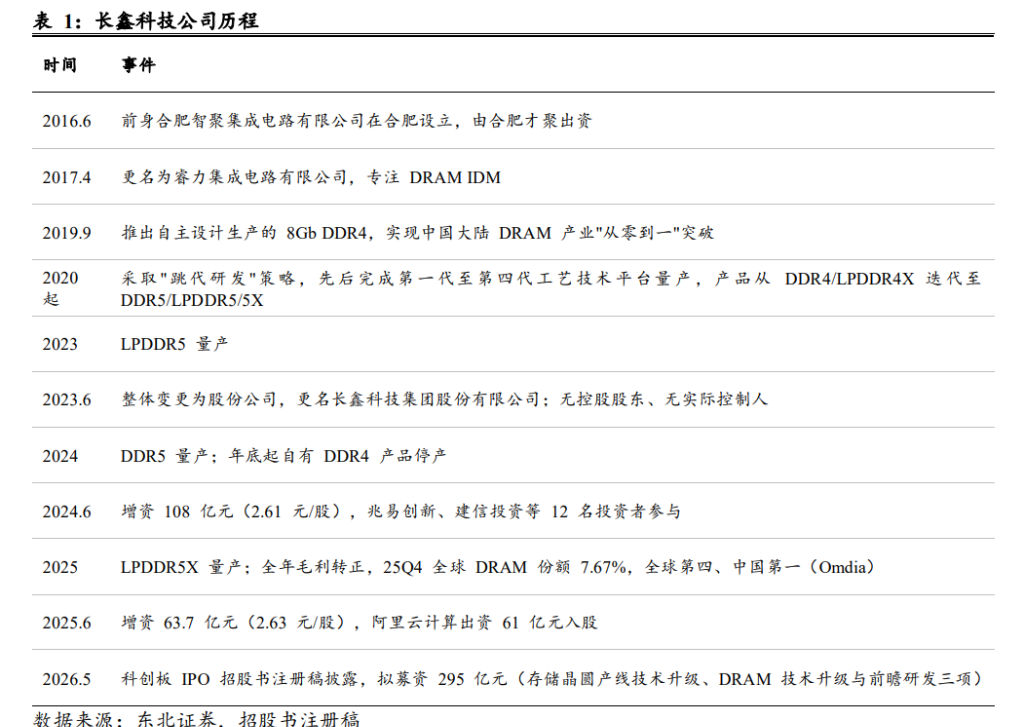
In 2019, CXMT (formerly known as Ryli Integration) launched Mainland China's first independently mass-produced 8Gb DDR4, achieving a breakthrough from zero to one for domestic DRAM.
Seven years later, the company is now China's largest and the world's fourth-largest DRAM manufacturer. According to Omdia data, CXMT held a 7.67% global market share in Q4 2025.
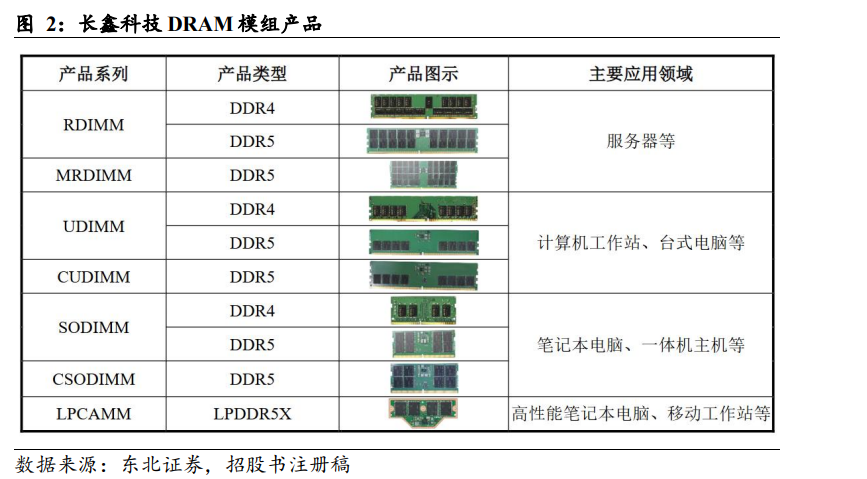
In terms of product lines, CXMT covers full generations including DDR4/5 and LPDDR4X/5/5X. It ceased production of its own DDR4 at the end of 2024, shifting capacity entirely towards high-value products like DDR5 and LPDDR5/5X. Customers include Alibaba, Tencent, ByteDance, and major smartphone supply chains.
Regarding capacity, the company operates three 12-inch wafer fabs—two in Hefei and one in Beijing. Northeast Securities expects capacity to expand from 270,000 wafers/month in 2025 to 450,000 wafers/month in 2027, increasing its global share from 14% to 17%.
Financial Inflection Point: Remarkable Profit Elasticity During Price Upcycle
CXMT's financial trajectory follows the classic script of an asset-heavy memory manufacturer—fixed costs front-loaded during a downturn cycle, leading to losses, and profits rapidly released during an upturn cycle.
Key milestones are as follows:
- 2025: Attributable net profit turned from a loss of 16.340 billion RMB to a profit of 1.875 billion RMB, with a consolidated gross margin rising to 40.99%, roughly in line with Samsung (39.38%)
- Q1 2026: Single-quarter revenue of 50.8 billion RMB (+719% YoY), gross margin of 79.16%, attributable net profit of 24.762 billion RMB
- First Half of 2026: Management expects revenue of 110-120 billion RMB, with attributable net profit of 50-57 billion RMB
The core driver of the profit explosion is price. According to TrendForce's latest June 2026 survey, general DRAM contract prices surged approximately 93% to 98% QoQ in Q1 2026, far exceeding the previous double-digit forecast range.
Northeast Securities also lists four main risks:
- Demand Shortfall: Slower-than-expected AI server buildout or weak consumer electronics recovery.
- Cyclical Price Downturns: The 2022-2023 period saw prices decline by up to 50% from pre-cycle peaks.
- Capacity and Technology Iteration Delays: Delays in the R&D of the fifth-generation process platform could affect volume and price realization.
- International Trade Friction and Supply Chain Constraints: Rising geopolitical tensions could increase industry chain instability.


