






The smarter AI gets, the more expensive real girlfriends become


- Core Thesis: Against the backdrop of AI's rapid proliferation and its tendency to lower prices for many services, the cost of high-end companionship services in San Francisco has paradoxically surged, reaching up to $6,000 per hour. The core driver is the "smart premium" sought by the new AI elite and the scarcity of deep, professional-level social interaction.
- Key Elements:
- Hourly rates for high-end companions have skyrocketed from under $1,000 five years ago to $3,000–$6,000, with schedules booked months in advance—growth far outpacing conventional industries.
- The primary clientele consists of the new AI rich, who possess significant liquid wealth (e.g., OpenAI employees cashing out an average of $11 million each) and are extremely time-poor, often prioritizing career over relationships ("stay single until Series B").
- The core offering isn't traditional companionship, but deep technical conversation. Clients are most willing to pay for a partner who can understand and discuss professional topics like AI and GPUs, eliminating the need to "translate themselves."
- Practitioners leverage platforms like X to post content related to the AI industry for precise client acquisition, creating a zero-cost, highly efficient "content marketing" loop that proactively filters and attracts technical clients.
- The "smart premium" in high-end companionship stems from extreme supply-side scarcity: while attractiveness is plentiful, the combination of beauty and the ability to engage in deep tech dialogue is nearly non-existent, forming the core pricing logic.
- AI is pushing genuine human connection toward luxury status. Because AI companion services (e.g., Replika, $20/month) are extremely cheap and continuously getting cheaper, the relative value of high-end human companionship is rising.
Original Author: Curry, TechFlow by Shenchao
Over the past two years, AI has drastically driven down the cost of many things. Writing code, doing design, editing videos—all have become tasks of just typing a few words into an input box.
However, in San Francisco, the epicenter of AI-generated wealth, the price of one service is moving in the opposite direction, rising quietly and unnoticed by any price statistics.
According to a Forbes cover story on June 7, a woman using the pseudonym Meida Marek was a low-level employee in the financial industry a few years ago. According to her account to Forbes, the starting point for her career change was one day when she began to ponder that AI would eventually threaten her job.
Thinking it over, she decided not to wait. She pivoted to making money from those working on AI. Now, she charges $3,500 per hour and is booked out for months.
Her business, in essence, is **high-end companionship.** A complete girlfriend experience: dating, chatting, accompanying to events... The price list is on her own website, clearly marked, with honest pricing.
This business itself is nothing new. What's new is the price.
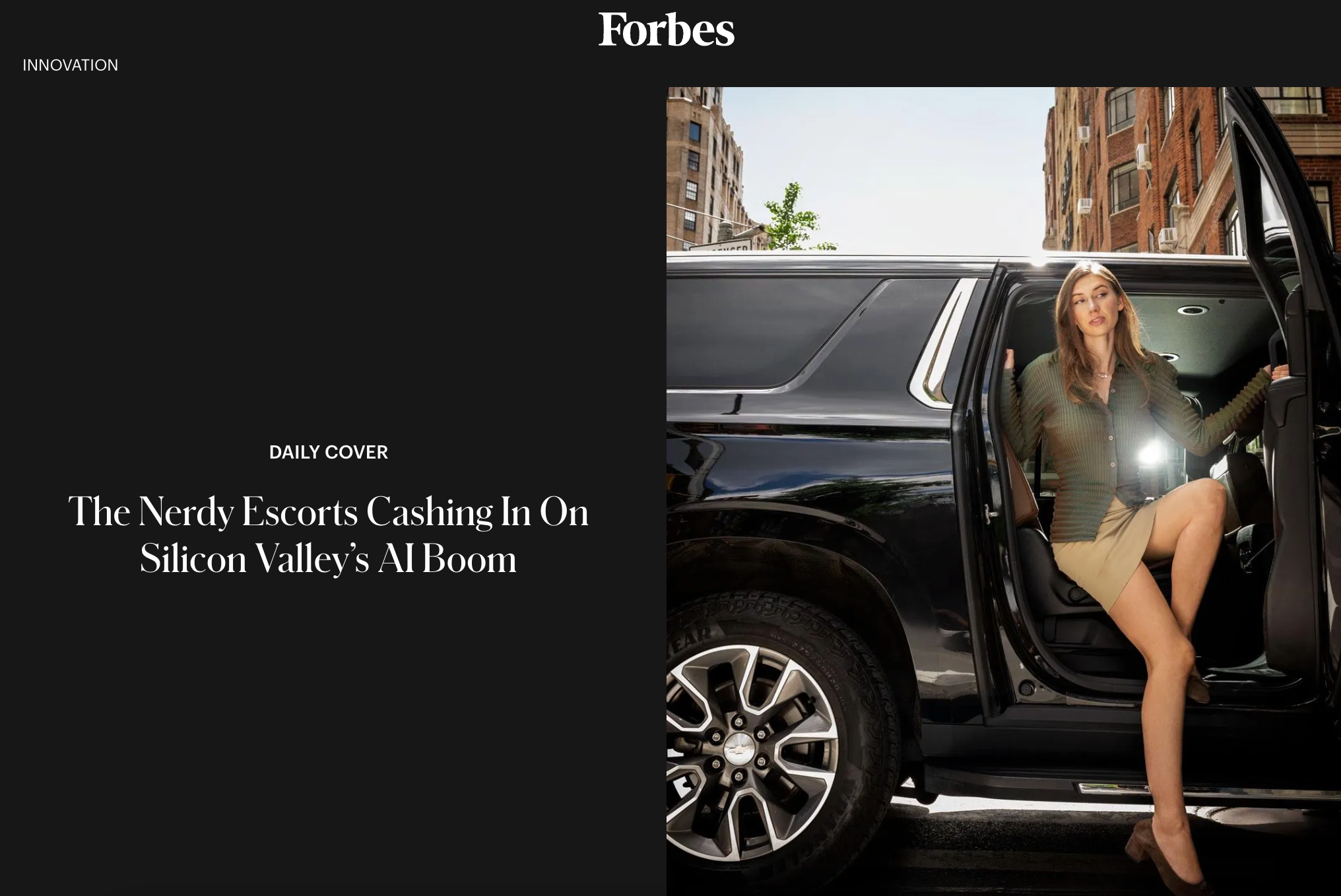
Practitioners interviewed by Forbes say that five years ago, earning over $1,000 an hour in this circle was rare. Now, $1,000 can't be found on the price lists of top players. $3,000 is just the starting point, and even at that price, people have to queue up.
This salary surge would be significant enough in any legitimate industry to warrant a discussion at the Federal Reserve.
We've been hearing stories for two years about Nvidia's stock creating millionaires en masse and AI company employees cashing out in amounts that take others a decade to earn. But where the money flows once it reaches these people has rarely been scrutinized closely.
This Forbes report essentially reveals one of these channels, and the people in this channel are earning more respectably than most startups just riding the AI hype wave.
Who exactly are the people who can book up months of a $3,500-an-hour schedule?
Single Until Series B
A popular self-deprecating saying has emerged in Silicon Valley in recent years: "Single until Series B," meaning staying single until the Series B funding round.
According to the Forbes report, this phrase started as a joke among founders. It has since spread widely and is now printed on T-shirts and caps.

Jokes become popular usually because they ring true. In this logic, romance is a deferrable item, prioritized after product, fundraising, and hiring, only to be considered once the company reaches a certain milestone.
Friends working at major domestic tech companies probably understand this state without needing a translation.
And this group of people who are deferring romance are seeing their wealth increase at an unprecedented rate. Last October, OpenAI conducted a secondary stock sale for employees. According to U.S. media reports like Business Insider, over 600 people participated, with an average cash-out of approximately $11 million per person. Similar wealth-creation stories have been happening regularly in the Bay Area over the past two years.
More money, less time. Social needs get squeezed into the cracks of a packed schedule.
For this group, dating apps represent another optimization problem with poor returns: matching, small talk, coordinating schedules, being stood up—each step has friction costs. More troublesome is that even if they do manage to get a date, the other party likely can't engage with their genuine interests.
So the market has provided a solution: just pay up to buy certainty.
On the price list of another practitioner in the Forbes report, it costs $23,000 for a whole day and $30,000 for a weekend. Even at these prices, you still have to wait in line.
For someone who just cashed out millions in stock, this math is simple. The hard part is getting a slot in the schedule.
Forbes also mentioned an unexpected yet logical detail: many clients purchase high-end companionship services primarily for...**chatting.**
Talking about technology, discussing the future, staying up late—certain unmentionable activities become more like embellishments. Among these clients are people who spend their days teaching AI to talk, and their evenings paying to listen to real humans speak.
This detail actually rewrites the pricing logic of the entire business.
If the main service is conversation, then a new variable enters the pricing equation: what can you talk about, and how deep can you go?
The market for beauty and physical appearance has been roughly understood for centuries, but no one had ever priced conversation.
So, in San Francisco, what kind of conversation is most valuable?
The Intelligence Premium
A practitioner interviewed by Forbes put it plainly: "The ones who charge the most are never the prettiest girls; they are the ones who are both beautiful and smart."
And as for how to monetize that intelligence, they've developed a complete playbook.
The main customer acquisition channel is X (formerly Twitter), where they regularly post AI-related content, industry trends, and technical opinions. One practitioner described the funnel's mechanism to Forbes:
"There's always a guy from Nvidia who chimes in, 'Wait, you actually know what a GPU is? Oh my god.'" Then, the business comes.
In other industries, this is called content marketing. Precise targeting, high conversion rates, customer acquisition cost nearly zero—many startup growth teams would dream of these metrics.
And what they discuss over dinner is genuinely technical, not just for show. Forbes wrote that gifts from clients include AI-generated artwork and hardware specifically configured for them to run open-source models at home...
Giving flowers and handbags is so last era. Today's Silicon Valley upstarts express their feelings by giving computing power.
These gifts reveal a very micro-level detail. A client giving you hardware to run open-source models shows that what he discusses in this paid relationship is **something he's genuinely fascinated by, with nowhere else to share it.**
This gets to the real core of this business.
For these newly wealthy AI clients, their wealth is an asset in the dating market, but their interests are a liability. Chatting with a regular date about models, graphics cards, and longevity research—the other person's eyes glaze over within three minutes... He has to translate himself into a 'normal person' just to get through a meal.
Over time, **"not having to translate yourself" becomes something money can't easily buy elsewhere.**
And the reason this demand can reach such astronomical prices lies on the supply side. In the dating market, there's never a shortage of beauty for sale at a marked price. What's scarce is beauty that can engage with topics like large language models and tech. The supply of this specific category is, in a way, close to zero.
Premium is never a reward for effort; it only rewards scarcity.
So, this companionship business has a paradoxical structure. In typical knowledge payment scenarios, the student pays the teacher. Here, it's the opposite: the person who knows the most about technology pays for a student who can understand his lecture.
Practitioners in the Forbes report have a name for this playbook: "**Nerd First**." First, being a kindred spirit; then it's a business.
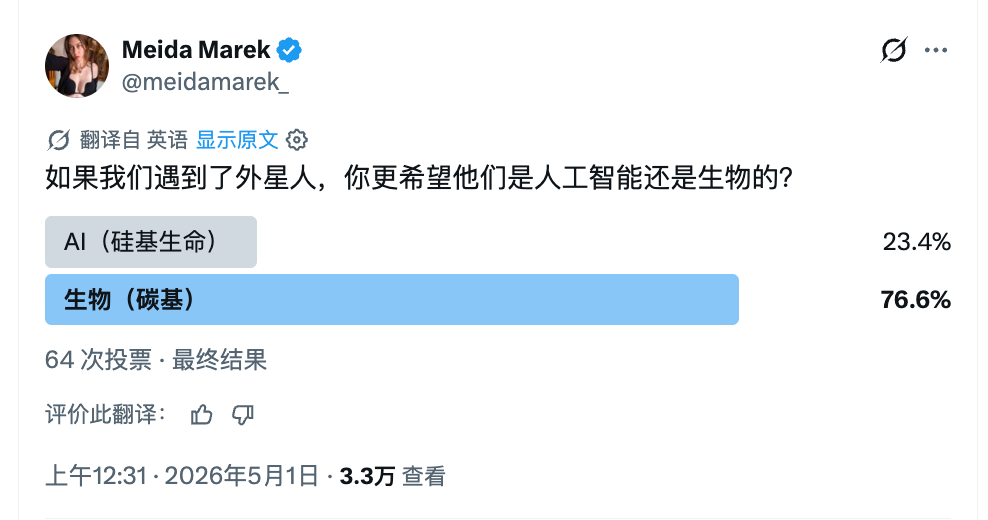
Meida, the woman who transitioned from finance mentioned at the beginning, provides a live tutorial on this approach via her social media accounts.
Click on her profile page. There aren't many selfies. Her timeline is filled with questions and polls. On May 1st this year, she asked her followers: If we encounter aliens, would you prefer they were AI or biological? She wrote the two options as "Silicon-based life" and "Carbon-based."
Her followers voted for carbon-based. Her techie clients might also be casting a vote with their wallets for shared interests.
Silicon Gets Cheaper, Carbon Gets Pricier
Companionship is a long-standing human-centric business.
And everyone knows the price on the silicon side. AI companion apps like Replika charge around $20 a month for unlimited use, always available, and always agreeable. Major AI models are even engaging in price wars, pushing this figure even lower.
On the carbon side, the high-end companionship mentioned in this article has a ceiling hourly rate of $6,000. By the U.S. Census Bureau's measurement, this one hour approaches the entire monthly income of an average American family. And you still have to wait in line.
In the original Forbes interview, one companion practitioner with a master's degree spelled it out: AI is turning real human connections into a luxury good.
This statement carries weight because her clients are precisely the people who understand AI best in the world. Insiders are the first to see shortages, and insiders are the first to stock up.
The capital market has already bought into this logic once this year.
In February, a term called HALO was popular in the U.S. stock market, referring to assets that are 'Hard to kill' and offer 'Low obsolescence risk'—companies immune to the evolution of AI. Money fled from software stocks and flowed into McDonald's and Walmart.
The companionship business is the "beautiful version" of the same logic, without the need to publish earnings reports.
San Francisco last saw a scene like this in 1849. Gold prospectors from all over the world flooded in. The gold mines were eventually exhausted, and people dispersed. The list of winners from that boom included few miners. One of them made pants for the miners: Levi Strauss.
Every wave of wealth re-prices the things around us. This time, it might be people themselves.
The AI story isn't over yet, and gold keeps emerging from the tech industry. But one thing is certain: for every cent silicon becomes cheaper, the price of carbon goes up another cent.


