






The largest IPO in history is coming. What are the retail channels for investing in SpaceX?


- Core Thesis: SpaceX's upcoming IPO (at $135 per share, with a valuation of approximately $1.75 trillion) is not only notable for being the largest in history but also for offering diversified participation channels for investors of different levels, marking a broader opening of top unicorn companies to retail investors.
- Key Elements:
- SpaceX plans to issue approximately 556 million shares at $135 per share, raising $75 billion and targeting a $1.75 trillion valuation, making it the largest IPO in history. However, Wall Street is divided on this high valuation.
- Traditional brokerage channels face issues such as high entry barriers and low allocation rates. Crypto exchanges (e.g., Kraken, Bybit) offer IPO subscriptions where users lock up funds at the IPO price plus a 5% fee, receiving 1:1 tokens (without voting rights) upon allocation.
- Pre-IPO contracts and stock tokens (e.g., on Binance, OKX) provide high flexibility and immediate exposure, but may come at a premium. Price inconsistencies arise across platforms due to different share data (125.2 billion shares in S-1 filing vs. 130.8 billion shares post-fundraising) and valuation conversion differences; investors need to understand the underlying logic.
- Post-IPO trading (after official listing) will offer more transparency and narrower spreads. By that time, most mainstream platforms will provide more mature stock tokens or derivatives, suitable for risk-averse investors.
Original: Odaily Planet Daily (@OdailyChina)
Author: Azuma (@Azuma_eth)
SpaceX, the commercial aerospace giant led by Elon Musk, is expected to officially conduct its IPO this Friday.
According to previous reports from multiple foreign media outlets, SpaceX plans to issue approximately 556 million new shares at a price of $135 per share, raising around $75 billion, corresponding to a company valuation of about $1.75 trillion. If the transaction is completed as planned, it will surpass the record set by Saudi Aramco in 2019, becoming the largest IPO in global history.
As the absolute focus of the current global capital markets, although some Wall Street research institutions remain divided on SpaceX's high valuation of $1.75 trillion, this has done nothing to dampen the frenzy among investors. Several Wall Street investment banks, including Goldman Sachs and Morgan Stanley, have even proactively engaged in a "price war" to win underwriter positions, pushing underwriting fees down to a rare level below 0.75% — traditional IPO underwriting fees typically range between 4% and 7%.
However, for most ordinary investors, the real question is not whether they should be bullish on SpaceX, but rather how they can actually buy into SpaceX.
Traditional brokerage channels often face issues such as high thresholds, limited quotas, and uncertain allocation rates. As the integration of the crypto industry with traditional finance accelerates, the investment channels surrounding SpaceX have also become increasingly diverse. From IPO subscription activities launched by CEXs to Pre-IPO equity tokens and various pre-market contract products, different types of investors are competing through different means for a "ticket" to SpaceX.
Overview of Participation Channels
Compliant Brokerages: A Mainstream Channel, but Not Accessible to Everyone
For eligible investors, participating in SpaceX's IPO through traditional brokerages remains the most mainstream channel. Investors can obtain real shares at a price closest to the offering price and are protected by mature securities regulatory systems. However, such channels often impose restrictions on regions and asset sizes, and star IPOs like SpaceX typically experience oversubscription, making the eventual allocation highly uncertain.
CEX IPO Subscriptions: The Channel Most Similar to Mainstream Brokerages
Beyond traditional brokerages, several crypto exchanges, including Kraken, Bybit, and Gate, have recently launched SpaceX IPO subscription activities.
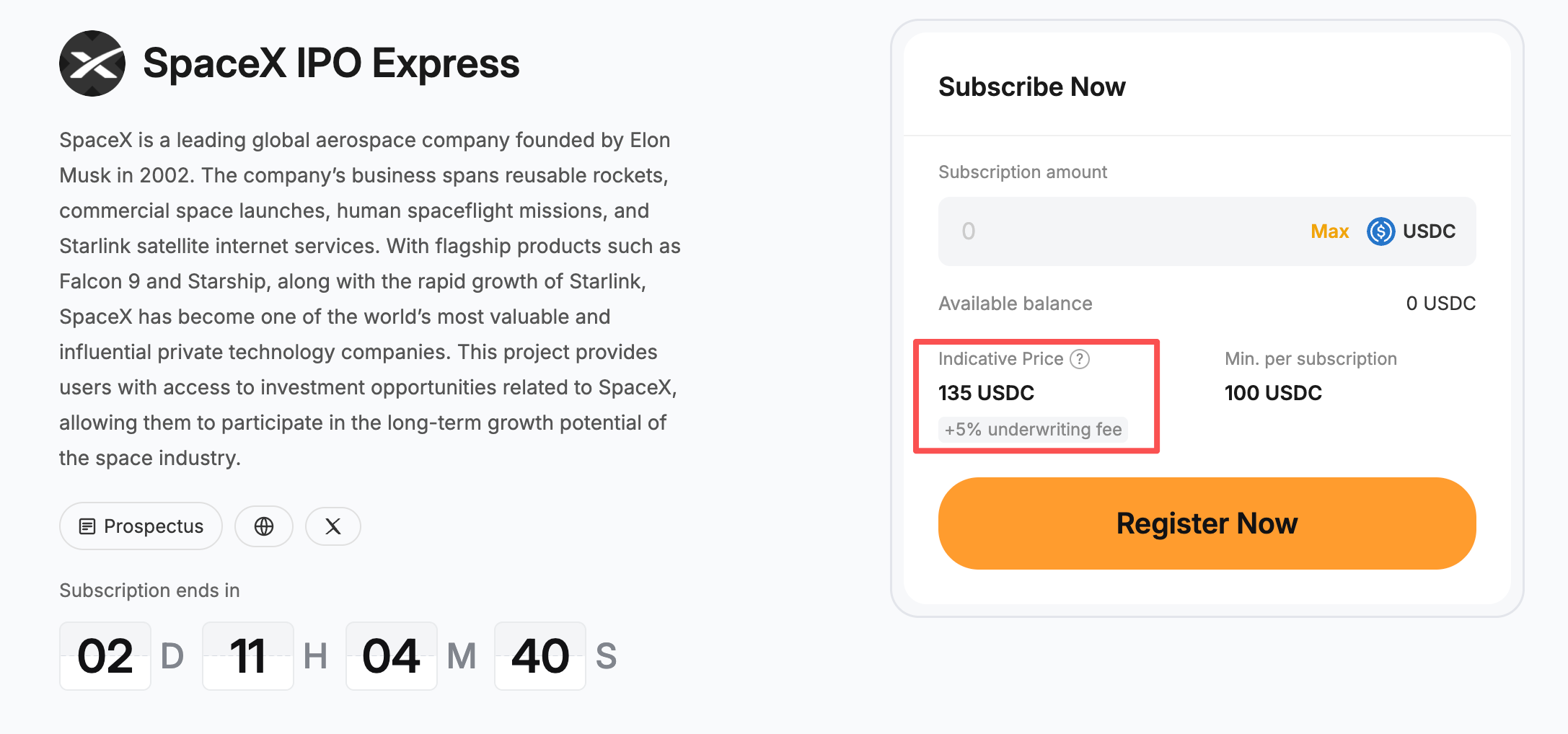
The models of the three platforms are broadly similar, with Kraken and Bybit's subscription partner being Kraken's stock token issuance platform, xStocks. In terms of subscription, users must first complete KYC verification, submit a subscription application during the subscription period, and lock in the corresponding funds — if the quota is ultimately secured, users will receive SpaceX-related rights at a price close to the IPO offering price; if the quota is not secured or only partially secured, the remaining funds will be returned to the account.
If the subscription on Kraken or Bybit is successful, users will receive SPCXx. SPCXx is a 1:1 tokenized representation of SpaceX equity, but it only provides price exposure and does not confer voting or dividend rights. In other words, users are not receiving the actual common stock.
Even so, compared to the Pre-IPO platforms or pre-market contract markets discussed below, subscribing through such channels still has a clear advantage — the price. According to the current rules of Kraken, Bybit, and Gate, users can participate in the subscription at the IPO offering price, plus an additional 5% underwriting fee (so the cost is still higher than compliant brokerages). If the IPO is ultimately priced at $135, the actual subscription cost would be approximately $141.75. This means investors have the opportunity to gain exposure to SpaceX at a cost close to the offering price, without bearing a high secondary market premium.
However, this channel still has certain thresholds and quota restrictions. Although not as stringent as compliant brokerages, Kraken, Bybit, and Gate have set KYC requirements and regional participation restrictions; Bybit also requires that only VIP users are eligible. In terms of quotas, allocations are determined by the final underwriter, not the CEX or xStocks, and subscribing does not guarantee "winning the lottery."
Pre-Market Crypto Stocks and Contracts: The Easiest Channel to Get In
If you prefer not to engage in the "luck-based, wait-for-allocation" subscription game, and instead want your funds to be "available anytime, ready to jump in immediately," then pre-market (Pre-IPO) crypto stocks and contracts are the most flexible participation channels currently available.
Compared to the brokerage and CEX subscription channels mentioned earlier, the biggest advantage of pre-market crypto stocks and contracts lies in their flexibility. Users do not need to wait for allocation results, nor are there quota limitations. As long as the market has sufficient liquidity, theoretically, one can open a SpaceX position of any size at any time. However, since pre-market trading essentially activates secondary market dynamics early, such products typically carry a certain premium over the proposed IPO price, meaning the entry cost is higher than $135.
Currently, pre-market related products on the market can be roughly divided into two categories. The first category is crypto stock products offered by platforms like PreStocks, Jarsy, and Tessera; the second is contract products offered by platforms such as Binance, OKX, Bitget, and Hyperliquid.
Crypto stock products typically adopt an SPV (Special Purpose Vehicle) shareholding model, where the platform or a third-party entity holds the corresponding stock and then issues tokenized rights to users. The advantage of crypto stocks lies in their relatively simple structure, without complex mechanisms like leverage, funding rates, or Rebase. However, such products often suffer from limited liquidity, and there has been some controversy regarding the compliance of the SPV shareholding model recently. Therefore, it is not highly recommended for users to choose this channel.
Compared to crypto stock products, pre-market contracts generally offer better liquidity, more flexible trading mechanisms, and a richer array of strategic choices. In addition to going long, investors can also engage in price speculation by shorting. Thus, for users accustomed to trading on CEXs or DEXs, this might be a more convenient channel.
However, please note that currently, the pre-market prices for SpaceX on platforms like Binance, OKX, Bitget, and Hyperliquid are not entirely consistent. One reason for this phenomenon is that different platforms have independent price discovery mechanisms, but a more critical reason is that the share capital data and valuation conversion methods used by each platform are not exactly the same — for instance, OKX is currently using the share capital data from the S-1 filing (12.52 billion shares), while Binance is about to adjust to the post-IPO fundraising share capital data (13.08 billion shares).
Recently, as details of the SpaceX IPO have gradually become clearer, various platforms have successively implemented Rebase adjustments to correct the previously used share capital base. However, due to differences in adjustment timing and standards, there are still some price discrepancies between different platforms, and some cross-platform arbitrage opportunities have emerged during this period.
Therefore, for investors looking to position themselves in SpaceX through pre-market contracts, it is essential not only to focus on the prices on different platforms but also to understand the corresponding share capital scale, valuation calculation logic, and historical Rebase status of the product. Otherwise, seemingly identical prices may actually represent different valuation levels.
Post-Market Positioning: Waiting and Observing Might Also Be Fine
Of course, if you still have concerns about various pre-market betting mechanisms, choosing to wait until SpaceX is officially listed before deciding whether to participate is also a reasonable option. After all, once SpaceX truly lands on the public market, investors will face a market with a more transparent price discovery mechanism and more unified trading rules.
For users, the range of available trading channels will further increase at that point. Referring to the current situation of already-listed US stocks, platforms like Binance, OKX, Bitget, Hyperliquid, Ondo, xStocks, and Backpack have all launched relatively mature crypto stock or related derivative products.
After SpaceX goes public, the market will form a unified understanding of core data such as share capital scale and valuation metrics, and the price differences between different platforms are likely to gradually converge. For investors who are not in a hurry, waiting for the market to complete price discovery before deciding whether to jump in might be a more prudent course of action.
Era-Defining Significance: A Top Unicorn Finally Opens Its Doors to Retail Investors
Looking back, the reason why SpaceX's IPO has garnered so much attention is not only because it could break global capital market fundraising records, but also because it carries the imagination of countless investors for "the next generation-defining company."
For a long time in the past, top unicorns like SpaceX were often exclusive to institutional investors, venture capital funds, and a select few high-net-worth individuals. The point at which ordinary investors could participate was often years after the company had gone public. This time, whether through traditional brokerages, CEX subscriptions, pre-market crypto stocks, or pre-market contracts, the increasingly diverse participation channels are allowing more people to join this capital feast earlier.
Of course, different channels come with different costs, risks, and uncertainties, but at the very least, retail investors finally have a hammer to break the capital blockade.


