Vitalik’s Vision for the Next Evolution of On-Chain Finance: How to Reconstruct DeFi with ‘Options Thinking’?


- Core Thesis: Vitalik Buterin proposes an options-based DeFi mechanism as an alternative to traditional CDP and forced liquidation models, aiming to build a more robust risk structure for Ethereum DeFi by eliminating instantaneous liquidations, reducing oracle dependency, and mitigating MEV attacks.
- Key Elements:
- Traditional CDP + forced liquidation can easily trigger cascading liquidations and liquidity crunches during extreme market conditions, as seen in the '312' and '519' events, with oracle delays and MEV arbitrage exacerbating the risks.
- Vitalik's new approach replaces the debt basis with an options structure, splitting the underlying asset into complementary yield contracts. This allows user exposure to smoothly deviate from the target without the need for real-time oracles or forced liquidations.
- The new mechanism can significantly reduce reliance on high-frequency oracles (to resist manipulation), eliminate gas wars triggered by instantaneous liquidations, and remove scenarios for MEV bots to profit from violent arbitrage.
- Facing competition from emerging ecosystems like Hyperliquid, Ethereum DeFi needs to win trust through more transparent risk design and user autonomy (e.g., preserving the right to choose during extreme market conditions).
- The core of the design lies in allowing users to hold positions within a set period. At expiry, users can independently decide to exercise or abandon based on the price, thus avoiding liquidation from flash crashes while sleeping and enhancing financial inclusivity.
If you've been in the industry for more than one market cycle, you've definitely seen this recurring scenario:
During extreme market conditions, prices flash crash, oracle feeds become distorted, liquidation robots swarm in, and a batch of positions gets cascadingly liquidated within minutes. The selling pressure compounds downwards, ultimately evolving into a liquidity crunch across the entire ecosystem. Starting with the "312" event in 2020, through successive crashes like "519" and "1011," forced liquidation has consistently been the most criticized trigger.
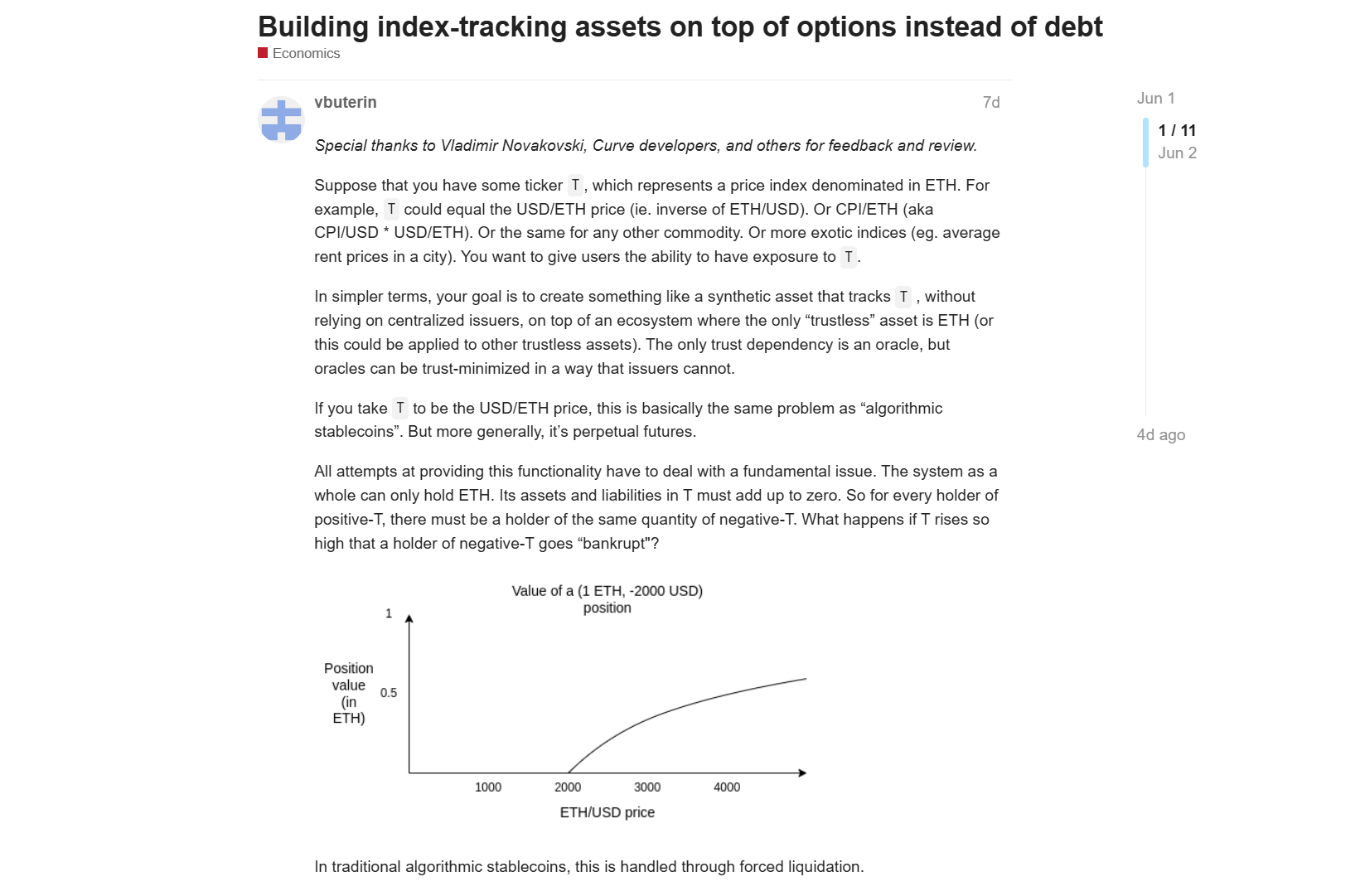
Faced with this dilemma, Vitalik Buterin published a research concept earlier this month titled "Building index-tracking assets on top of options instead of debt," proposing a rather disruptive question: Can DeFi completely replace the traditional CDP (Collateralized Debt Position) and forced liquidation model with an options-based mechanism?
According to Vitalik's vision, the core advantage of this design lies in replacing real-time oracles with "slow oracles," significantly reducing the risk of oracle manipulation. A user's exposure to the index would deviate from the target smoothly (in an approximately quadratic curve) rather than facing instantaneous forced liquidation.
1. The Achilles' Heel of Traditional DeFi
Before discussing Vitalik's new idea, it's necessary to revisit why "CDP + forced liquidation" became the core model of DeFi and why it also became its weakness.
As is well known, represented by classic lending protocols like MakerDAO/Sky, Aave, and Compound, one of the most important early financial innovations in DeFi was allowing users to collateralize on-chain assets to borrow another asset.
This mechanism can be simply understood as users depositing assets like ETH into the protocol to obtain a borrowing limit. As long as the collateral value is sufficiently high, the position is safe. However, once the collateral price drops below a certain threshold, the protocol triggers a liquidation, selling the collateral to repay the debt, thereby protecting the system's solvency.
It might seem unremarkable today, but this mechanism was crucial for early DeFi. It allowed on-chain assets like ETH to transform from being "passively held" into reusable financial base assets, enabling their use in more complex systems like lending, leverage, stablecoins, and yield strategies.
Arguably, CDPs and lending protocols laid the earliest and most critical foundation for composability in DeFi.
However, their problems are also evident:
- Forced liquidation depends on real-time and reliable oracles: Protocols must rely on external oracles for second-by-second price feeds. If the oracle experiences delay, manipulation, extreme network congestion, or if the asset itself lacks liquidity, the protocol might execute liquidations based on distorted prices within a short timeframe.
- Forced liquidation amplifies pressure during extreme market conditions: When collateral prices drop rapidly, liquidators and MEV bots compete intensely for liquidation opportunities. The concentrated selling of collateral further intensifies market pressure, potentially triggering a liquidity crunch across the entire ecosystem.
- Liquidity illusion: Traditional lending protocols assume that "there is always enough market liquidity to absorb liquidation sell pressure." However, in genuinely extreme market environments, liquidity can evaporate instantly. This leads to a downward spiral where the more prices fall, the fewer people are willing to take on risk, making successful liquidation harder. If the protocol cannot promptly handle bad positions, it may accumulate bad debt.
Therefore, objectively speaking, CDP + forced liquidation is not a flawed design. It was an incredibly important and effective foundational module for early DeFi. However, as DeFi enters a phase with larger capital scale and more complex structures, the costs of this model become increasingly apparent:
It concentrates risk heavily on a single liquidation threshold. Before the threshold is triggered, everything appears normal. Once the threshold is breached, users are often left to passively bear the consequences.
2. Vitalik's New Idea: Rebuilding Lending with "Options Thinking"
The essence of Vitalik's new idea is to change the underlying way DeFi handles risk.
We can summarize his thinking in one sentence: Can DeFi use "options" as its fundamental building block instead of "debt"?
The foundation of the traditional CDP model is debt. When a user borrows an asset, there must be a mechanism ensuring the debt is always sufficiently collateralized. Once collateral is insufficient, the protocol can only avoid systemic bad debt through forced liquidation.
The thinking behind an options-based design is completely different. Instead of having users create a debt position that needs real-time protection, it deconstructs the underlying asset into a set of contracts with complementary payoffs. Simply put, 1 ETH can be split into two types of assets: one with exposure closer to a stable asset or index tracker, and the other taking on the opposite risk and return. Regardless of price fluctuations, the combined returns of these two assets always correspond to the underlying 1 ETH.
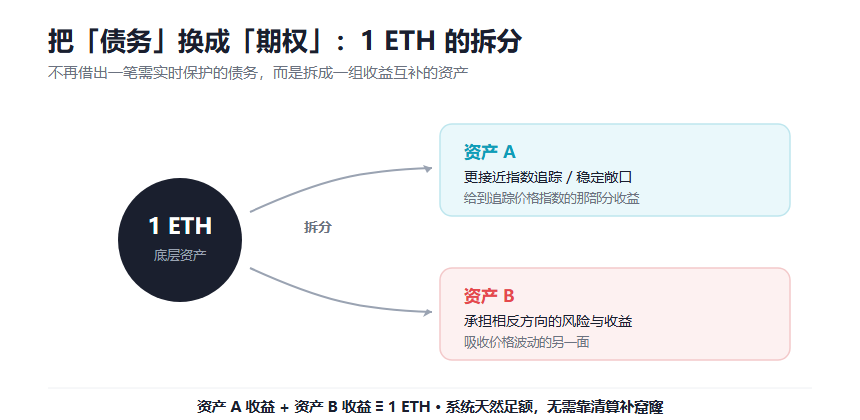
This means the system no longer needs to suddenly force-liquidate a user at a specific price point. In the traditional liquidation model, a user might be abruptly removed from their position when the price breaches a line. In the options-based model, the user faces a gradual deviation of their exposure from the target, requiring rebalancing at an appropriate time. A more relatable analogy can help understand this:
- Traditional Model (CDP): It's like you pledge $10,000 worth of ETH to a lending protocol to borrow $5,000. The protocol monitors the price via an oracle. If ETH drops to a critical point, it immediately sells your ETH without warning, charges you a hefty fee, and you have no recourse.
- New Options-based Model: You pledge your ETH and receive $5,000 in return. It's not called borrowing, but its form is more like a "right" with an expiration date. Before the agreed time, no matter how much ETH drops, your position won't be liquidated mid-course. You retain the initiative. At expiration, if the price recovers, you can redeem your collateral. If the price drops, you can choose not to exercise the option, letting the protocol keep the collateral. You already secured your $5,000, avoiding being "rug-pulled" by a sudden price wick while you sleep.
Of course, this is a simplified analogy for understanding. Vitalik's original design is closer to the combination strategy of "holding deep in-the-money options and gradually rolling down to lower strike prices as the market price approaches."
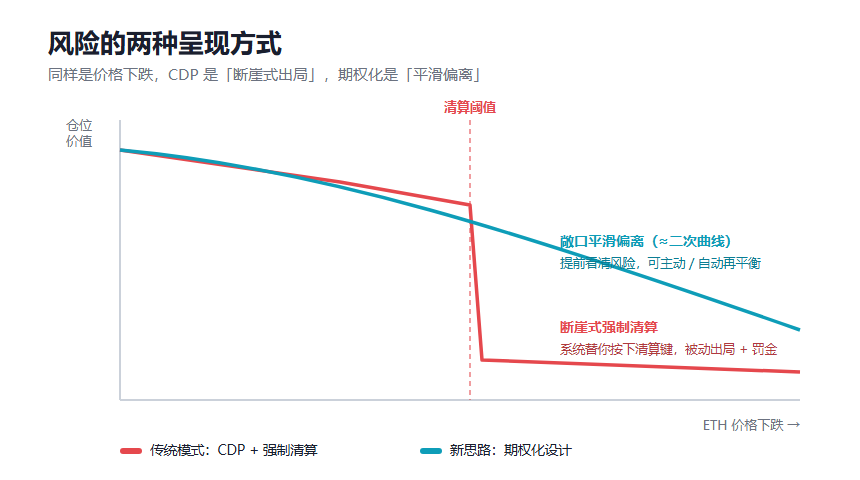
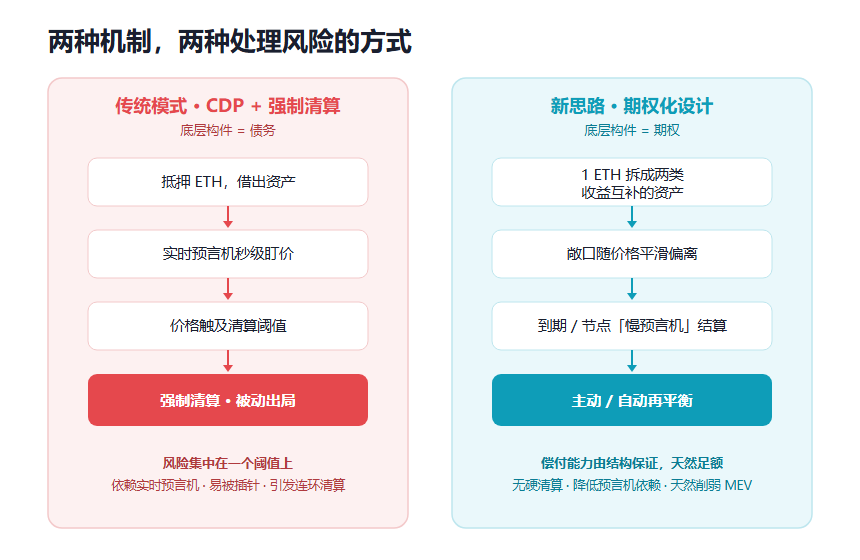
Overall, the former resembles "the system pressing the liquidation button for the user," while the latter is more like "the user clearly seeing the risk curve in advance and deciding when to adjust their position." This shift in mechanism will undoubtedly bring profound changes to DeFi on several levels:
- No more "hard liquidations": Since lending positions are converted into options with a time horizon, the protocol no longer needs a liquidation line that triggers immediately upon being touched. Users no longer need to obsessively watch the candlestick chart daily, nor will they be forcefully closed out by a malicious price wick while sleeping.
- Significantly reduced reliance on oracles: The new mechanism greatly decreases dependence on high-frequency, real-time oracle price feeds. The protocol only needs to settle at expiration or specific time points. This directly compresses the space for hackers to launch attacks using "flash loans + oracle manipulation."
- Inherent MEV resistance: Without instantaneous forced liquidation, the chain will no longer see gas bidding wars triggered by cascading liquidations. MEV bots lose their most profitable liquidation arbitrage scenario. The value generated by the protocol is more likely to genuinely flow back to users and LPs, rather than being extracted by arbitrageurs and sequencers.
The significance of this change goes far beyond just being "safer."
Because the future DeFi needs to serve not only high-risk traders but also more average users and real-world payment scenarios. For these groups, what truly matters is often not maximizing capital efficiency, but whether they can retain the option to choose during extreme market conditions, and whether they can avoid being forcibly ejected by the system due to a short-term fluctuation.
3. Do Users Still Need Ethereum DeFi?
This question is becoming increasingly relevant today.
With the rise of emerging ecosystems like Hyperliquid, users are seeing alternative DeFi product forms. These offer faster matching experiences, interactions closer to centralized exchanges, more concentrated liquidity, and a more direct fulfillment of trading needs.
This represents a real pressure point for Ethereum.
If we only compare transaction speed, fees, and front-end experience, Ethereum Mainnet and some traditional DeFi protocols may not always hold the advantage. Users won't automatically believe a protocol is better just because it's deployed on Ethereum. Nor will they ignore cheaper and more convenient alternatives simply because a product is more "orthodox."
Therefore, Ethereum DeFi needs to re-answer the question: why do users still need Ethereum DeFi?
The answer is definitely not just "because Ethereum is the most secure" or "because Ethereum has the largest TVL." A truly compelling answer should come from a more fundamental financial design capability.
In my opinion, if Ethereum DeFi wants to remain the core battleground for on-chain finance, it cannot stop at replicating traditional financial products to simply increase leverage efficiency. It must build advantages in more difficult areas, such as more transparent risk boundaries, more robust oracle mechanisms, fewer mandatory system actions, greater user autonomy, and protocol structures better tested by extreme scenarios.
In other words, the competitive focus for the next generation of Ethereum DeFi might shift. It may no longer be about who can help users earn the most, but rather who can help users get ejected less passively from complex financial environments and truly understand the risks they are assuming.
For ordinary users, Vitalik's proposed options-based DeFi design might still seem distant and may not mature into a tangible product soon. However, the direction it conveys is clear: DeFi should not only pursue higher yields but also pursue clearer, more explainable, and more manageable risk structures.
Final Thoughts
To be frank, after frequent security incidents, a common sentiment arises: since DeFi has so many risks, does it indicate that on-chain finance itself is unfeasible?
This judgment may be overly simplistic.
The problem with DeFi is not the direction of "decentralization" itself, but rather that many products have not yet truly completed the evolution from high-risk experiments to robust financial infrastructure. In the past, the industry was too accustomed to proving value through growth and TVL, while relatively underestimating the importance of risk design and resilience under extreme scenarios.
Vitalik's proposed new thinking precisely reminds the industry that the evolution of DeFi is not just about moving old finance onto the chain. It is about leveraging the programmable and composable nature of the blockchain to design novel risk structures that are not easily achievable in traditional finance.
If it's only a competition of speed and speculative efficiency, Ethereum will find it hard to win. Ethereum must return to its underlying narrative: security, decentralization, and fundamental innovation in financial paradigms.
This, perhaps, is where the true opportunity for Ethereum DeFi lies.