Farewell to traditional bull and bear cycles; the market enters an era of bubble rotation


- Core Thesis: Today's financial markets have shifted from the slow, sustained bull and bear cycles of the past to a "chain storm" market driven by a series of rapidly rotating, interconnected hot sectors. Investors must look beyond the obsession with any single trend and identify structural changes and cyclical logic from a higher dimension.
- Key Elements:
- Fundamental Shift in Market Structure: Compared to the past few decades, eight major transformations—including the universalization of speculative groups, the formation of permanent buy orders, the rise of passive investing, and the dominance of multi-strategy funds and high-frequency trading—have collectively shaped the current market environment, and this trend is irreversible.
- Market Pattern Formation: Market hotspots resemble summer thunderstorms, triggered by specific catalysts and progressing through stages such as "hibernation-ignition-narrative-differentiation-collapse." Capital flows out of fading hotspots, acting like a wedge of cold air, igniting a new wave of activity in adjacent sectors.
- Key Structural Factors: Low transaction costs, price-insensitive passive index investing, convergent risk management models among multi-strategy funds leading to concentrated market fragility, and zero-delay information dissemination that amplifies sentiment and trends.
- Investor Group Divergence: The market primarily favors two types of investors: industry experts who deeply understand technological barriers and profit logic, and trend observers who can discern the behavior patterns of mainstream capital and market sentiment.
- Abundant Future Themes: Upstream and downstream links in multiple fields—including AI infrastructure, robotics, cryptocurrencies, nuclear fusion, and quantum technology—will continue to serve as potential hotspots, providing ample fuel for rotation.
Original Author: Smac, Partner at Compound VC
Original Translation: Saoirse, Foresight News
Editor's Note: Amid the current market landscape, hot topics emerge in rapid succession, with the AI trend sweeping the board. Some question whether it will repeat the fate of the metaverse hype. In the midst of the noise, people are often swept away by immediate trends, losing sight of long-term trajectories. To make rational judgments, one must learn to gain a broader perspective. In this article, Compound VC partner Smac uses a meteorological analogy to deconstruct the market logic behind the wave of successive bubbles.
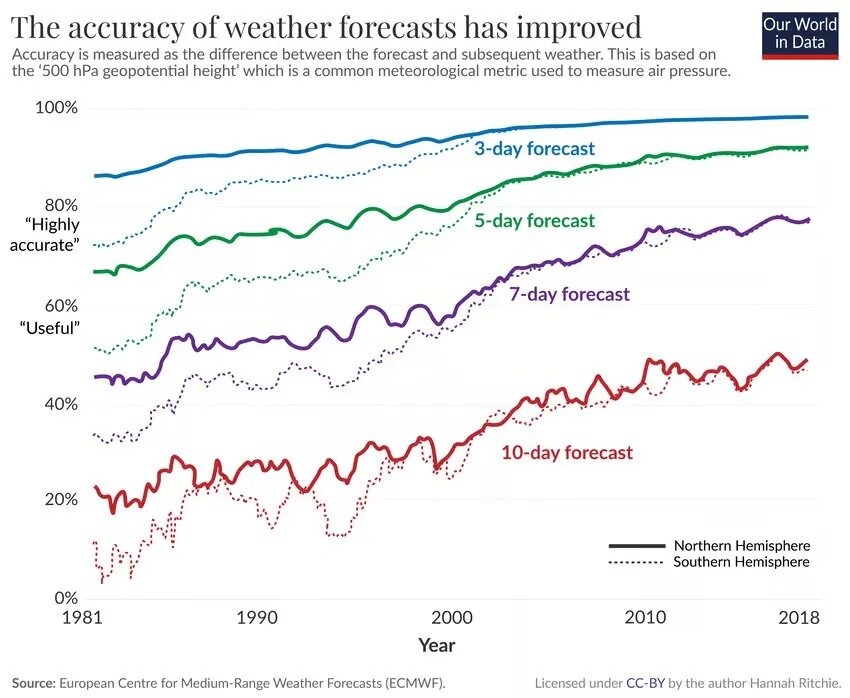
Meteorology is a fascinating field. Over the past fifty years, various weather forecasting tools have continuously evolved, improving the accuracy of weather predictions. A five-day forecast today is now as precise as a one-day forecast was thirty years ago.
Most people perceive weather as a single, coherent moving system: clouds roll in, rain falls, it stops, and the skies clear. Imagine a winter front approaching; the image that likely comes to mind is a vast expanse of gray clouds covering hundreds of miles, dumping heavy snow. Meteorologists call this type of weather stratiform cloudiness. Simply put, it’s like a layered cake; areas within the cloud cover experience the same sequence of weather changes.
But weather isn't monolithic. If you've ever witnessed a summer thunderstorm on the plains, you'd know it operates quite differently. First, individual convective clouds form: warm, moist air near the ground rises, meets colder air aloft, water vapor condenses, and towering, localized cumulonimbus clouds develop. Within an hour, hail, lightning, and torrential rain follow, reducing visibility to near zero.
Once the cloud reaches its peak, it releases its energy entirely and gradually dissipates. The downdraft from the dying storm spreads outward at speeds up to 40 miles per hour. When this cold air meets the surrounding warm, moist air that hasn't yet formed a storm, it acts like a wedge, pushing the warm air upward once again.
As long as the atmosphere remains sufficiently unstable, this "cold air wedge" will spawn new convective clouds dozens of miles away from the original storm.
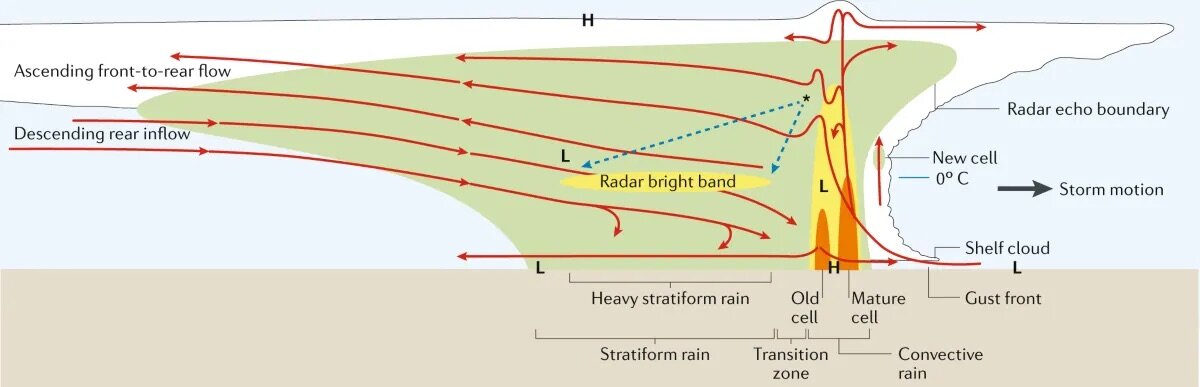
This new cloud cluster couldn't form on its own; the energy was stored in the atmosphere, but lacked a trigger. The dissipating storm provided that exact catalyst. The new cluster then repeats the development cycle of its predecessor.
When multiple convective clouds form in succession, they constitute a mesoscale convective system. For someone on the ground, they experience each storm individually, each one feeling like the entirety of the weather system. On one side, it's calm, with no hint of the approaching storm; on the other, the weather has already cleared. But from a satellite perspective, you see a line of independent cloud clusters, each at a different stage of development, moving forward until they exhaust the supply of warm, moist air along their path.

A supercell thunderstorm near sunset near Amistad, New Mexico.
This system of successive storms forms under conditions entirely different from a single frontal system. It relies on a specific atmospheric environment:
- Warm, moist air near the surface, serving as the storm's "fuel";
- Dry, cold air aloft, which encourages the upward movement of warm air and creates atmospheric instability;
- Varying wind directions at different altitudes, causing the storm to rotate and move laterally, known as wind shear.
When all three conditions are met, a chain of storms unfolds one after another.
Having discussed meteorology at length, let's return to the main point: the phenomenon described above is nearly identical to the state of financial markets today.
Markets used to be like a stratiform weather system: a bull market, then a bear market, alternating in a slow rotation of sector themes, with each cycle lasting years. The long bull market from 1982 to 2000 was followed by the dot-com bubble, and then the property and credit cycle from 2003 to 2007. These cycles were long and their contours clear. Even if an investor was off by a few years on timing, understanding the major trend allowed them to profit in the end.
But today's market is nothing like it was. We are in an era of convective storm-like chain reactions: one hot sector after another, each feeling like the dominant, all-encompassing trend to those caught within it.
Capital flows out of waning themes, only to seed the next wave in an adjacent area. The pace of market theme rotation has accelerated dramatically: AI infrastructure, GLP-1s (a class of diabetes drugs popular for weight loss effects, now a hot investment track), stablecoins, quantum technology, nuclear energy, distributed autonomous technology, robotics, space exploration... Each sector experiences a complete cycle of enthusiasm, gathers a loyal following, runs through a full narrative arc, and inevitably faces a downturn. The "cold air" dispersed by the previous wave ignites the next hot spot in a new domain.
Denying that today's market has fundamentally changed is self-deception. People love to joke "this time is different," but willfully ignoring the permanent shift in the financial market environment is either intellectual laziness or stubborn adherence to a fantasy of the old market.
A Fundamentally Changed Market Structure
For a long period after World War II, financial markets moved like those slow-moving weather systems. A bull market could last ten, fifteen, or even twenty years. Sector rotation always revolved around long-term megatrends.
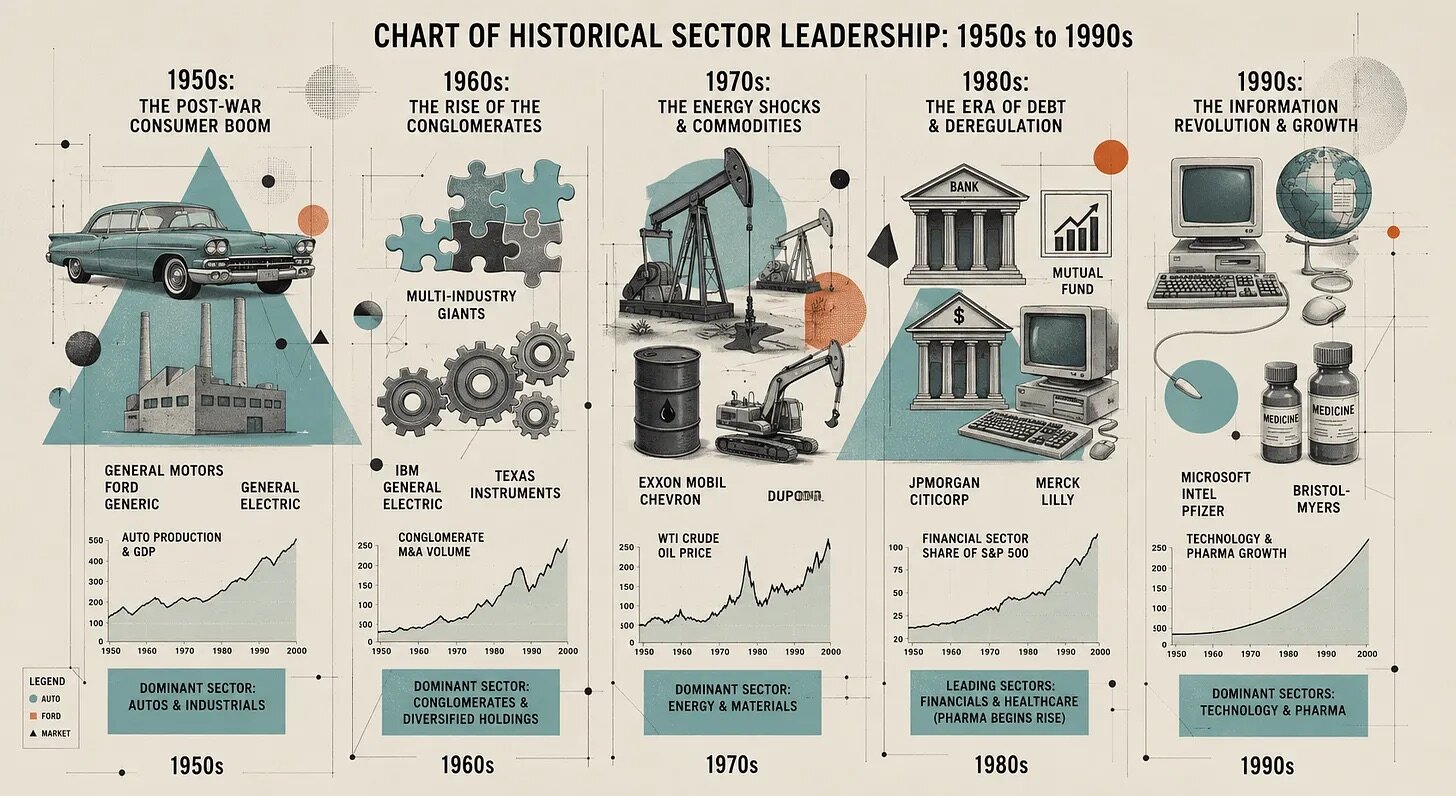
Approximate timeline of industry themes and leading sectors
Back then, sector shifts occurred within a unified macroeconomic environment. Only at landmark turning points – the collapse of Bretton Woods, Volcker's anti-inflation policies, the peak of the dot-com bubble, the Global Financial Crisis – did the market's overarching structure completely upend.
This market form was rooted in several structural factors: high transaction costs historically kept retail participation low, forcing long-term holding habits; pensions were the primary vehicle for retirement assets; the S&P 500 was dominated by manufacturing, energy, banking, and retail companies, whose earnings growth roughly tracked the economy's pace, offering stable and predictable performance. Meanwhile, information spread slowly; a company's annual report could take weeks to reach most investors.
Market volatility was also more balanced in the past. Bull markets were followed by deep corrections, leverage was gradually worked out, and adjustment periods were lengthy. Recoveries during bear markets were also gradual. The market lingered in different sentiment ranges for extended periods, and structural shifts took quarters or years to materialize.
In terms of the meteorological analogy, the old market had: moderate fuel, high atmospheric stability, and weak wind shear. Cycles were long and smooth, allowing investors to plan with a long horizon. Now, all environmental conditions have changed; some have completely reversed, leading to a fundamental transformation in market structure.
Where Did the Change Come From?
Numerous changes have intertwined and amplified each other. Any single one of these changes would have been enough to reshape the market. In summary, there are eight core transformations:
- Democratization of the speculative class
- Formation of perpetual buying pressure
- Passive investing creating inelastic counterparties
- Rise of multi-strategy funds and HFT, disappearance of market intermediaries
- Volatility artificially suppressed
- Complete change in index composition
- Complete disappearance of information delay
- Shift in fiscal and monetary environment
Democratization of the Speculative Class
The composition of market participants has visibly changed. In the 1990s, retail trading accounted for only about 10% of total US stock market volume. Due to high commissions, retail investors mostly held stocks long-term, with little active speculation.
Robinhood pioneered zero-commission trading and introduced Payment for Order Flow (PFOF). In the fall of 2019, Schwab followed suit by eliminating trading commissions, quickly imitated by Fidelity, TD Ameritrade, E*Trade, and others, completely rewriting the industry rulebook.
The COVID-19 pandemic accelerated this trend: fiscal stimulus checks, people stuck at home, and mobile trading apps gamifying trading saw retail volume share surge to 25% in 2020-2021. Many thought it was temporary, but high retail participation has persisted. On April 29, 2025, driven by tariff-related market volatility, JPMorgan data showed retail order flow hit a record high of 48%. On regular trading days, retail volume is more than double pre-pandemic levels; during major market swings, it can reach 35%.
A deeper change lies in what retail investors trade. Single-stock options have become a mainstream choice, with 0DTE (zero days to expiration) options experiencing explosive growth. New entrants are predominantly young, hold concentrated portfolios, and trade based on market narratives. Crucially, these investors often use special ways to lever up (leverage not reflected in standard margin data), make trading decisions more based on price action than fundamentals, and are highly susceptible to following others.
In meteorological terms: the "warm, moist air" near the surface in today's market is more abundant than ever, with latent energy reaching historic highs.
Formation of Perpetual Buying Pressure
I've written about this before. In short, the US retirement security system shifted from defined-benefit (DB) pensions to defined-contribution (DC) plans. Now, individuals must manage their own retirement savings. At a market level, this means a massive, price-insensitive stream of passive capital perpetually buying stocks every pay cycle, creating automated perpetual buying pressure.
The logic of traditional DB pensions was different: they needed to match liabilities and manage duration risk. Managers actively assessed market valuations; if stocks seemed expensive, they would adjust allocations towards bonds. Even if this rebalancing was slow, it was far more active than today's purely passive perpetual buying.
This is crucial: marginal trading capital in the market has a much greater influence on prices than ever before.
Passive Investing Creating Inelastic Counterparties
The essence of passive index investing is to buy and sell strictly according to index weights, regardless of price. The higher a stock's market cap, the more passive capital flows into it, and vice versa. This mechanism embeds momentum directly into the market's underlying logic: the stronger the trend, the more passive capital flows in, a dynamic that significantly contributes to the strong performance of the "Magnificent Seven" tech giants.
For years, many articles have analyzed the concentration of index weight in top companies. Of course, these top companies also possess strong profitability and growth, so the concentration isn't entirely unjustified. But the core issue is: passive capital has no natural "take-profit switch."
Rise of Multi-Strategy Funds and HFT, Disappearance of Market Intermediaries
While perpetual passive buying was forming, the active trading space also saw massive changes, notably the rise of multi-strategy portfolio trading firms. Institutions like Citadel, Millennium, Point72, and Balyasny aggregate hundreds of independent portfolio managers, each running a specific strategy under strict risk control. Their assets under management have exploded, concentrating capital at the top, mirroring the concentration trend in stock indices.
Simultaneously, high-frequency trading now accounts for 50-60% of US stock market volume and up to 75% in futures markets. This combination creates a fragile market environment: trading firms act as counterparties to each other, and the market's price discovery function is weakened. A significant portion of volume is just capital circulating within the market ecosystem.
Under normal conditions, bid-ask spreads are tiny, which is great. But when a narrative breaks, market positioning becomes extremely skewed, or multiple firms' risk limits are triggered simultaneously, the market's microstructure can instantly break down. All portfolio managers have highly correlated risk exposures and similar stop-loss rules. When one firm is forced to deleverage, the rest follow suit. The market crashes of February 2018, August 2019, March 2020, and August 2024 are prime examples. The market structure that breeds these events is now deeply entrenched and will continue to produce them.
Traditional fundamental long/short hedge funds are being squeezed out. These funds relied on deep research to select 20-40 stocks with holding periods of several quarters. Today, such institutions are either absorbed by larger asset management platforms or retreat to private markets, family offices, or single-strategy funds. In my view, significant alpha can still be found by understanding theme rotation logic and practicing patience amidst short-term capital flows.
Volatility Artificially Suppressed
Given the above four points, current volatility dynamics become understandable. Data shows that since 1990, the VIX closed below 20 on two-thirds of all trading days. The day-to-day correlation of volatility is as high as 85%, meaning today's level strongly predicts tomorrow's.
However, the pattern of market volatility regime shifts is extreme and imbalanced. Extensive research shows that prolonged suppressed volatility, once it breaks through a threshold, explodes violently within a few days. The reversion to lower volatility is slow, often taking weeks.
Multiple structural reasons exist: a massive "short volatility" industry has emerged. The proliferation of 0DTE options further suppresses intraday volatility through dealer hedging. The market lulls itself into a state of extended low volatility, where risks accumulate, and when tail risks materialize, all participants exit simultaneously.
In short, the distribution of market volatility is increasingly skewed: long periods of calm amplifying ultimately more violent releases.
Complete Change in Index Composition
The sixth change is the composition of the indices themselves. In 1980, the S&P 500 was dominated by manufacturing companies: industrials, materials, energy, financials, and consumer staples were the largest sectors. Their earnings growth roughly tracked GDP, offering smooth growth curves and valuation multiples that tended to mean-revert. Forecasting Procter & Gamble's earnings five years out wasn't subject to massive errors.
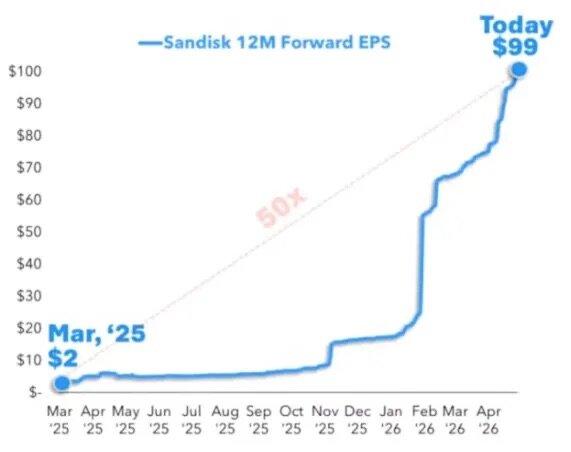
Today, it's a different story. Information Technology, Communication Services, plus the tech-heavy Amazon and Tesla from Consumer Discretionary, together account for over 40% of the S&P 500 weight. The business models of these companies are non-linear. The marginal cost of distributing software is near zero. The AI sector is particularly uncertain: opinions are polarised on whether AI labs will become the most critical infrastructure of the next half-century or a bottomless pit of cash-burning projects.
For such companies, forecasting short-term earnings is difficult, and long-term value is highly variable. Valuation multiples swing wildly. Corporate valuation is no longer solely a function of financial statements; narrative plays a central role. For investors who can anticipate technological frontiers, identify competitive moats, and map future emerging markets, there are ample alpha opportunities.
Traditional manufacturing companies expanded capacity gradually, their DCF valuations were relatively stable, and valuation multiples mean-reverted more reliably. Today, a company's valuation hinges significantly on the market's acceptance of its story. This doesn't mean traditional valuation frameworks are obsolete; it's simply the reality of modern business.
Today's major indices are filled with such long-duration, narrative-driven companies. The steeper the atmospheric temperature gradient, the more energy is stored. Similarly, the more of these companies in the market, the greater the latent kinetic energy, and the more violent the fluctuations once a trigger emerges.
Complete Disappearance of Information Delay
Everyone can intuitively feel this, but its impact is often underestimated. For most of financial history, the spread of market-related information was constrained by distribution channels. Today, information circulates with virtually zero latency.
Especially regarding positioning data, the speed of dissemination is unprecedented. Investors can see how well-known figures react to news in real-time, and more people are voluntarily disclosing their portfolios. A torrent of real-time information constantly stokes comparison. Profit screenshots are everywhere; stories of turning a small sum into millions go viral, continuously fueling FOMO.
Shift in Fiscal and Monetary Environment
This needs little elaboration. The key summary:
- US monetary policy has been structurally biased towards accommodation, with low real rates;
- Quantitative easing continuously expanded the Fed's balance sheet;
- Low discount rates inflated the prices of all long-duration assets;
- Fiscal policy was augmented with various subsidies and industrial legislation;
- Fiscal deficits reached wartime levels during peacetime, full employment;
- The economy exhibits K-shaped divergence, decoupling financial markets from the real economy.
How Do Storms Form?
Given all the changes above, the successive market bubbles become an inevitable outcome.
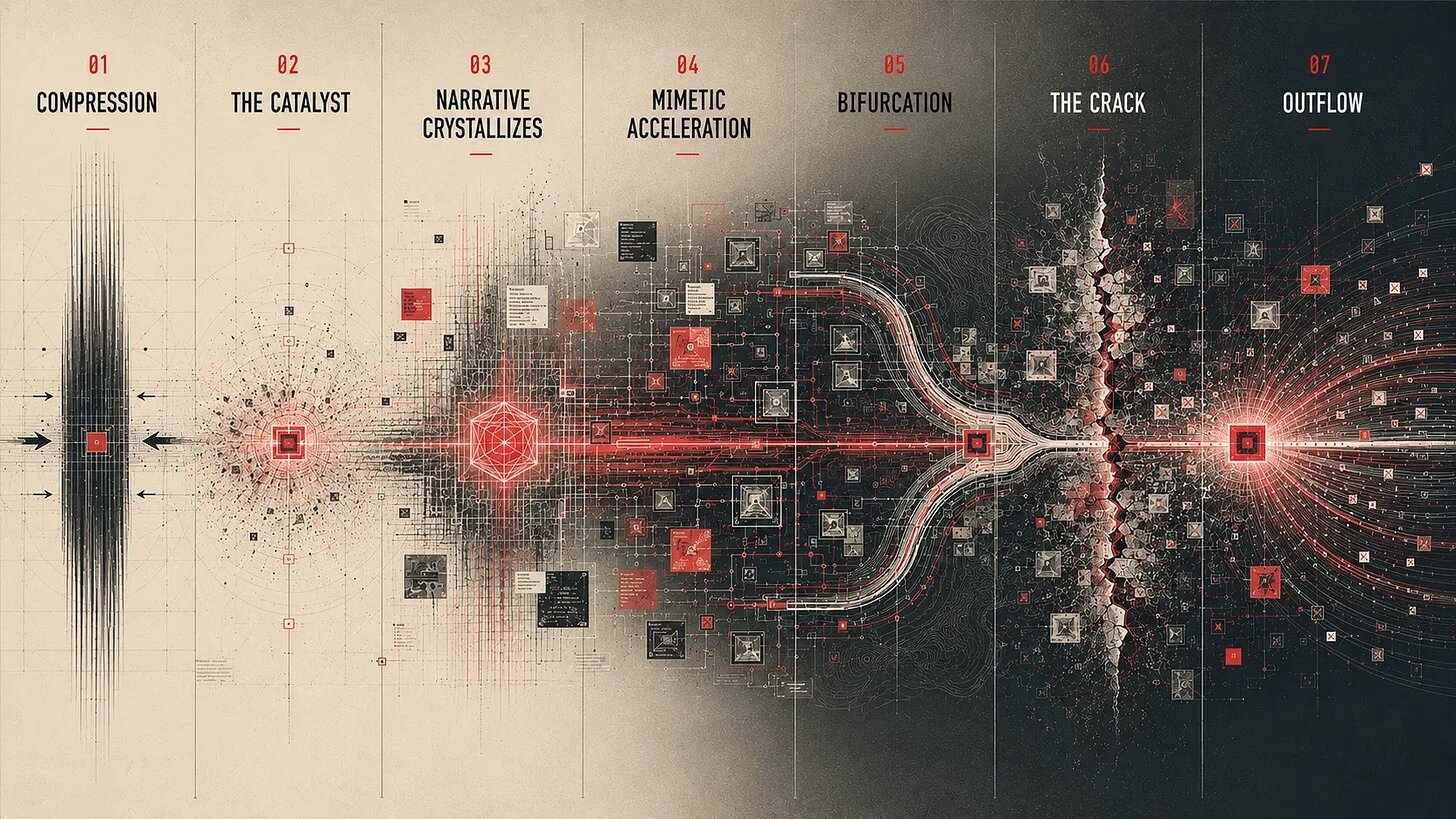
The evolution of a cycle proceeds through several logical stages:
- Dormancy Phase: Sectors take turns being out of favor, with low attention. Yet, even when unloved, dedicated industry participants continue their work.
- Initiating Spark: A substantive catalyst appears – a