






CoinP is Poised to Become a Pioneer in Stock Tokenization


- Core Thesis: Digital asset trading platforms are upgrading from a single trading gateway to a global asset digitalization gateway. By implementing modules such as stock tokenization, RWA, prediction markets, and AI Agents, CoinP is evolving into a "third-generation full-scenario financial trading platform," aiming to lower the barrier for users to access high-quality global assets.
- Key Elements:
- Stock tokenization is a key focus for the next cycle. Its core value lies in lowering the entry barrier for global assets like US stocks, ETFs, and gold, thereby attracting a large base of incremental users who have been underserved.
- The market scale is enormous. Institutions predict that the global tokenized asset market could reach between $2 trillion and $30 trillion by 2030, with stock tokenization being the most accessible entry point within the RWA sector.
- CoinP's upgrade roadmap from 2022 to 2026 is clear: moving from a basic trading system and diverse tools to comprehensive financial services. By 2025, it aims to build a foundational ecosystem including CPT, Wallet, and Insurance, subsequently transitioning into a global asset gateway.
- Core product differentiation spans six directions: the combination of stock tokens and contracts, contract insurance (2.0), prediction markets, the CoinP wallet, a discovery page (ecosystem navigation), and AI Agents.
- The team possesses composite capabilities, with technical members hailing from AAVE, top exchanges, and internet giants, providing fundamental support for stock tokenization, compliance, and high-concurrency systems.
- The security system encompasses six dimensions: technology, network, assets, compliance, operations, and transactions. This is a prerequisite for supporting multiple business scenarios (Wallet, RWA, Prediction Markets) and the upgrade to a full-scenario platform.
Author: Billion Dollar Think Tank Labs
In the past few years, the competitive focus of digital asset trading platforms has been shifting. Initially, platforms competed on the number of tokens, trading depth, and matching efficiency. Later, competition began to shift towards derivatives, wealth management, copy trading, wallets, and ecosystem capabilities. Now, the industry is entering a larger phase:
Trading platforms are evolving from digital asset trading gateways into global asset digitalization gateways.
Within this trend, stock tokenization is becoming one of the key directions.
Its significance goes far beyond merely allowing stocks to be traded in a different form; it's about enabling more users to access high-quality global assets like US stocks, ETFs, gold, and RWA through their digital asset accounts.
From a third-party observer's perspective, CoinP's upgrade path in recent years has perfectly aligned with this trend.
From the trading system and derivative products, to the CPT ecosystem, CoinP Wallet, contract insurance, the Discover page, and then to RWA, stock tokenization, prediction markets, and AI Agent, CoinP is moving from a single trading platform towards a "third-generation all-scenario financial trading platform."
1. What is a Third-Generation All-Scenario Financial Trading Platform?
Looking at the industry's evolution, trading platforms can generally be divided into three stages.
First Generation: Digital Asset Trading Platform. Primarily solved the issues of buying, selling, custody, matching, and liquidity for BTC, ETH, and early digital assets.
Second Generation: Platforms with Parallel CEX, DEX, and Web3 Wallets. Platforms began to integrate derivatives, wealth management, copy trading, wallets, DeFi, and on-chain applications.
Third Generation: All-Scenario Financial Trading Platform Integrating Web3 and Traditional Finance. The focus of this stage has shifted from "which digital assets can be traded" to "whether crypto assets, stocks, ETFs, gold, RWA, prediction markets, AI tools, and a unified account system can be combined within the same platform framework."
Based on CoinP's current product structure, it is moving closer to the goal of becoming a leading global third-generation all-scenario financial trading platform.
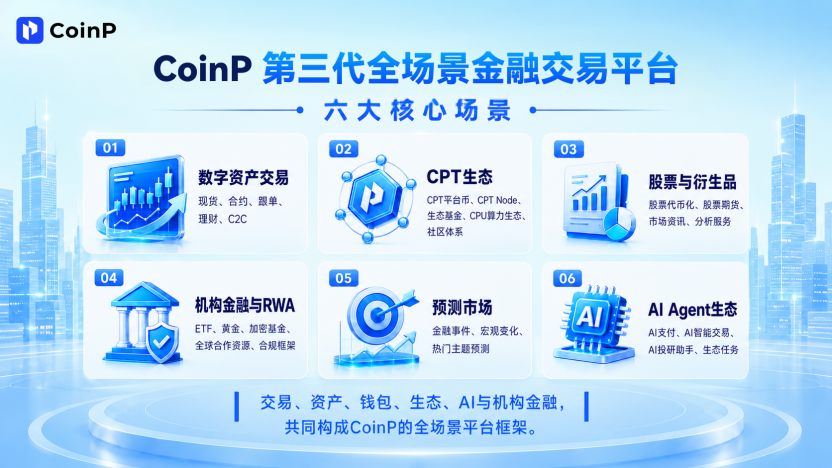
"All-scenario" here can be broken down into six core modules:
1. Digital Asset Trading Scenario: Spot, Derivatives, Copy Trading, Wealth Management, C2C
2. CPT Ecosystem Scenario: CPT Platform Token, CPT Node, Ecosystem Fund, CPU Computing Power Ecosystem, Community System
3. Stock & Derivative Scenario: Stock Tokenization, Stock Futures, Market News, Analysis Services
4. Institutional Finance & RWA Scenario: ETFs, Gold, Crypto Funds, Global Cooperation Resources, Compliance Framework
5. Prediction Market Scenario: Financial Events, Macro Changes, Industry Trends, Hot Topic Predictions
6. AI Agent Ecosystem Scenario: AI Payments, AI Smart Trading, AI Research, Ecosystem Tasks
This means CoinP's appeal extends beyond just adding more products. The key is its attempt to integrate trading, assets, wallets, ecosystems, AI, prediction markets, and institutional finance into a single platform system.
2. Why Will Stock Tokenization Be the Next Key Focus?
The core value of stock tokenization is lowering the barrier to entry for high-quality global assets.
In the past, users wanting to participate in US stocks, ETFs, gold, or high-quality Pre-IPO assets often faced issues like opening accounts, funding, regional restrictions, trading hours, and capital efficiency.
Stock tokenization offers a different path:
Allow high-quality global assets to be traded, held, and allocated in a way more suited to the digital finance world.
This is why more and more trading platforms are beginning to pay attention to this direction.
However, implementing stock tokenization isn't as simple as listing a new trading pair like a native crypto asset. It requires a trading system, market-making capabilities, risk control mechanisms, KYC systems, price synchronization, a unified account system, and market education capabilities.
Therefore, the barrier to entry in this track is quite high.
Platforms that truly have a chance to succeed typically need to possess all of the following simultaneously:
- Trading Depth
- User Base
- Market Making and Liquidity Capabilities
- Risk Control System
- Compliance Awareness
- Market Communication Capabilities
- Wallet and Ecosystem Gateway
CoinP's opportunity also stems from its ongoing gradual completion of these modules.
3. Market Size: A Trillion-Dollar Opportunity Behind Stock Tokenization
The importance of stock tokenization lies in the fact that it corresponds to a rapidly growing global asset digitalization market, not just a new product on a trading platform.
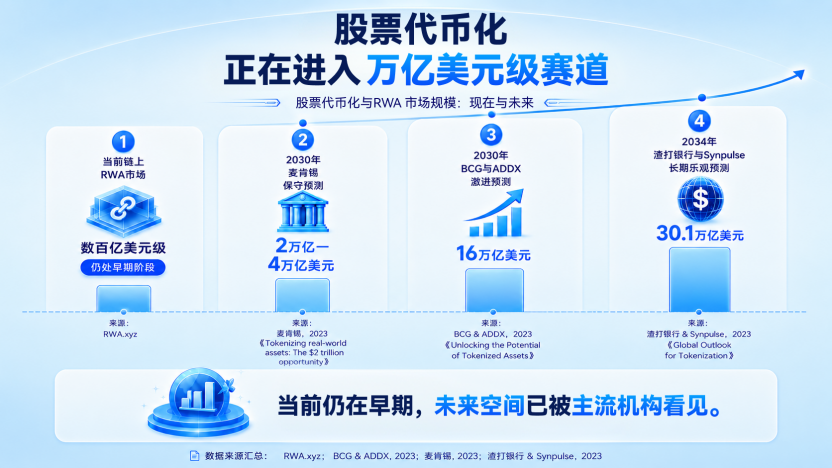
Looking at the current market, RWA is no longer just a concept. According to data from RWA.xyz, on-chain RWA has already formed an asset scale of hundreds of billions of dollars, and the stablecoin market has entered the hundreds of billions of dollars scale.
However, compared to future expectations, the market is still in its early stages.
Institutional predictions show:
- Boston Consulting Group (BCG) and ADDX predicted that by 2030, the global scale of tokenized illiquid assets could reach 16 trillion USD
- McKinsey & Company estimates that by 2030, the scale of tokenized financial assets could reach about 2 trillion USD, potentially reaching up to 4 trillion USD in an optimistic scenario
- Standard Chartered and Synpulse predicted that by 2034, the total demand for tokenized RWA could reach 30.1 trillion USD
This data indicates:
The current market is still early, but the future potential is already recognized by mainstream institutions.
Among the many RWA directions, stock tokenization is likely the easiest entry point for users to understand, accept, and propagate.
Compared to complex bonds, trade finance, or real estate equity, US stocks, tech stocks, AI companies, gold, and ETFs are easier for the public to grasp. Names like Nvidia, Apple, Tesla, Microsoft, OpenAI, and SpaceX have inherent appeal.
Therefore, stock tokenization can be seen as one of the core entry points within the larger RWA market with the highest potential for mainstream breakout.
4. Growth Effect: Driven by Long-Term Unmet Demand for High-Quality Assets
The truly attractive aspect of stock tokenization lies in its ability to unlock a long-underserved incremental market.
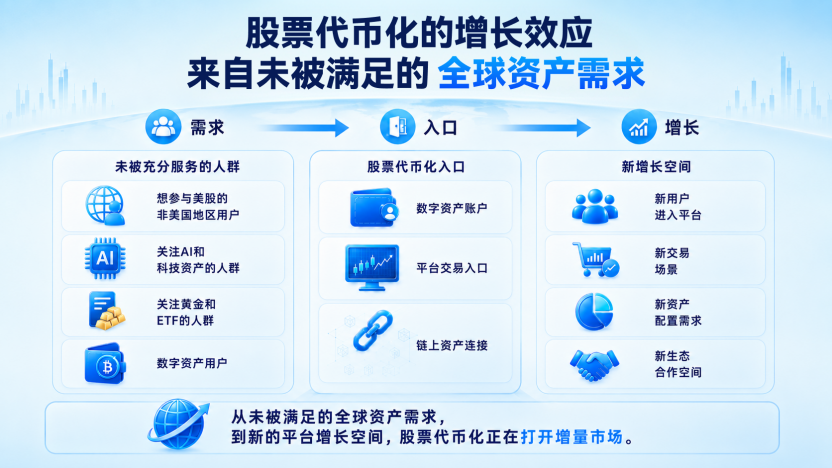
A vast number of users worldwide recognize the value of high-quality US stocks and see opportunities in AI, semiconductors, new energy, tech giants, and high-quality equities. However, due to factors like geography, account opening procedures, funding issues, trading habits, and capital requirements, many lack a smooth channel to participate in these assets.
Especially in non-US regions and areas with insufficient coverage by the US financial system, many users are not lacking in investment awareness or financial capacity. They simply lack a low-barrier, easy-to-understand, and operable entry point.
This represents the greatest market opportunity for stock tokenization.
It transforms high-quality global assets, previously accessible only to a select few, into a new asset class that more users can understand, access, and trade through their digital asset accounts.
The scale of the user base and capital behind this is substantial.
One group comprises regular users eager to participate in US stocks and global high-quality assets but lacking a smooth channel. Another group consists of digital asset users already accustomed to using stablecoins, trading platforms, and on-chain accounts.
When these two groups overlap, stock tokenization can become a new growth engine for trading platforms.
For community partners and channel collaborators, this also means the service scope is expanded. Previously focused mainly on digital asset users, they can now reach people interested in US stocks, gold, AI, tech assets, and global allocation opportunities.
Therefore, the growth effect of stock tokenization isn't just a one-off opportunity brought by short-term volatility of a particular asset; it stems more from the long-term potential of overall market growth:
l Users gain new asset access points
l Platforms acquire new trading scenarios
l Communities get new topics for propagation
l Channel partners find new service spaces
l Ecosystems discover new growth directions
This is precisely why CoinP's layout in stock tokenization is most noteworthy.
It targets a batch of global asset demands that have yet to be fully served.
5. CoinP's Iterative Upgrade Path: From Trading Platform to Global Asset Gateway
To observe CoinP, one shouldn't just look at a single product, but at its continuous upgrades over the past few years.
2022: Completing the Trading Foundation
In its early stages, CoinP focused on building the fundamental capabilities of an exchange.
Account systems, asset systems, order matching, market data display, deposits and withdrawals, security risk control, and user service are the most foundational layers of a trading platform.
This phase may seem basic, but it was critical.
Without a stable trading foundation, subsequent features like the wallet, contract insurance, CPT ecosystem, RWA, and stock tokenization would struggle to attract and retain users.
2023: From Basic Trading to Diverse Trading Tools
By 2023, CoinP began upgrading from "can trade" to "trades better."
The platform gradually improved spot trading, derivatives, copy trading, various margin modes, asset management, and the overall trading experience, allowing users at different stages to find their preferred participation method.
New users could enter the market through a simpler interface and copy trading features; experienced users could utilize derivatives, margin, and more complete trading tools; long-term users could perform more asset allocation and trading decisions within the platform.
This step allowed CoinP to gradually form a comprehensive trading product matrix.
2024: From Trading Tools to a Comprehensive Financial Services Platform
In 2024, CoinP's upgrade focus began to shift from trading functions towards comprehensive financial services.
That year, three changes emerged in the platform's product logic:
First, the trading matrix became more complete. Spot, derivatives, copy trading, asset management, risk warnings, and user service began to form a cohesive suite.
Second, user experience became more important. Factors like interface clarity, trading smoothness, asset display intuitiveness, timely customer support, and adequate risk warnings all influenced users' willingness to stay on the platform long-term.
Third, the ecosystem gateway started to take shape. CoinP gradually integrated functions like trading, wealth management, C2C, contract insurance, official ecosystem, third-party ecosystems, and event access within the platform, preparing for subsequent larger ecosystem expansion.
By 2024, CoinP was no longer just a simple trading tool; it was evolving into a comprehensive digital financial platform.
2025: CPT, Wallet, and Insurance Launch, Ecosystem Foundation Begins to Form
Entering 2025, CoinP's upgrade focus extended from trading products to the platform ecosystem.
That year, CoinP began building a more complete platform value cycle around CPT, the node system, CoinP Wallet, contract insurance, and official ecosystem projects.
CPT assumed multiple roles including ecosystem rights, nodes, mining, insurance, and incentives, deepening the relationship between users and the platform from pure trading to ecosystem participation.
The launch of the CoinP Wallet was a critical step in 2025. It endowed CoinP with on-chain asset management, DApp connectivity, and ecosystem interaction capabilities, laying the groundwork for subsequent RWA, stock tokenization, stablecoins, and more on-chain asset applications.
Simultaneously, the introduction of contract insurance added a risk management tool alongside CoinP's derivative trading.
Therefore, 2025 can be summarized as the year CoinP's ecosystem foundation was built.
Trading was responsible for user acquisition, CPT for the ecosystem cycle, nodes for community consensus, the wallet for the on-chain gateway, and contract insurance for risk buffering.
2026: From Platform Ecosystem to Global Asset Gateway
Entering 2026, CoinP's strategic direction became even clearer.
If the keyword for 2025 was "Ecosystem Foundation," then the keyword for 2026 is Global Asset Gateway.
In the past few months, several significant changes have occurred in CoinP's product structure: the Discover page ecosystem is taking shape, contract insurance has entered version 2.0, the official ecosystem and third-party ecosystems are being layered to serve different needs, and the directions of RWA, stock tokenization, and prediction markets are beginning to offer stronger strategic imagination.
Among these, the prediction market deserves special attention.
The core of a prediction market is to turn outcomes of real-world events, financial asset volatility, macroeconomic changes, sports events, and industry trends into tradable markets.
It is naturally related to RWA, stock tokenization, commodity assets, and on-chain trading. Stock price movements, gold prices, interest rate changes, AI company valuations, geopolitical events, and election results can all become trading themes for prediction markets.
For CoinP, the prediction market can create a new scenario connecting users, real-world events, and trading needs.
Stock tokenization provides the gateway to real assets, RWA provides the asset base, derivative trading provides the trading tools, the Discover page provides ecosystem distribution, and the prediction market can further enhance user engagement, topicality, and platform activity.


