






From HYPE to ZEC: Breaking Down the Four Main Threads of the Altcoin Localized Market Rally


- Core Thesis: The current crypto market is experiencing a localized rotation, with four distinct independent narratives (decentralized perpetuals, AI-focused L1s, privacy coins, and Meme coins) simultaneously driving capital flows. Among them, assets like HYPE, NEAR, and ZEC stand out due to high certainty around their respective catalysts, while WLD and GRASS are constrained by supply pressure.
- Key Factors:
- HYPE (Hyperliquid) commands approximately 70% of the Perp DEX market share, with a weekly revenue of $14 million, 97% of fees used for buybacks. Combined with institutional position increases and ETF listings, its price hit a new all-time high, entering the top ten by market cap.
- LIT (Lighter), ranked fourth in the Perp DEX sector, has a market cap only 1/40th of HYPE. Its catch-up rally is driven by public recognition from Vitalik and the launch of new products, though trading volume includes wash trading elements and it faces team unlock pressure at year-end.
- NEAR AI introduced a privacy feature that automatically strips sensitive information from prompts. Coinciding with OpenAI releasing a similar model around the same time, this sparked a privacy + AI narrative. It leads the AI track with a 30-day return of 50%.
- ZEC benefited from a triple catalyst: the conclusion of the SEC investigation, Robinhood listing, and spot ETF filing expectations. Its price doubled in 30 days and has surged 15x year-to-date, making it the leading privacy coin.
- USELESS (Meme coin) leveraged CEX on-ramps like Coinbase, community memory, and its highly memeable name, gaining nearly 70% in 30 days. However, it lacks fundamental support and carries extremely high volatility risk.
- Despite narrative upgrades such as Eightco institutional holdings and U.S. market expansion, WLD's price performance is the weakest (only +5%), due to large team deposits into exchanges and persistent unlock pressure lasting until July.
- Although GRASS has paying AI lab clients and a buyback mechanism, the combined supply from Season 2 airdrops and team unlocks totals approximately 170 million tokens, creating short-term supply pressure and suppressing the price amidst supply-demand dynamics.
Original author: David, TechFlow
The crypto market this week is clearly seeing localized movements.
Although BTC dominance is still hovering around 60%, and the altcoin season index is only 35, far from the 75 threshold needed to confirm an altcoin season; if you're scrolling through English CT, you'll notice that capital isn't waiting for macro signals anymore.
Over the past week, at least four independent narratives have been running simultaneously:
1. Perpetual DEXs are hitting new highs,
2. AI L1s are rotating,
3. Privacy coins are being repriced,
4. Meme coins are reigniting.
The seven coins frequently mentioned lately—HYPE, LIT, NEAR, GRASS, WLD, ZEC, and USELESS—are typical representatives, corresponding to four directions of market attention.
First, let's look at their performance trends:
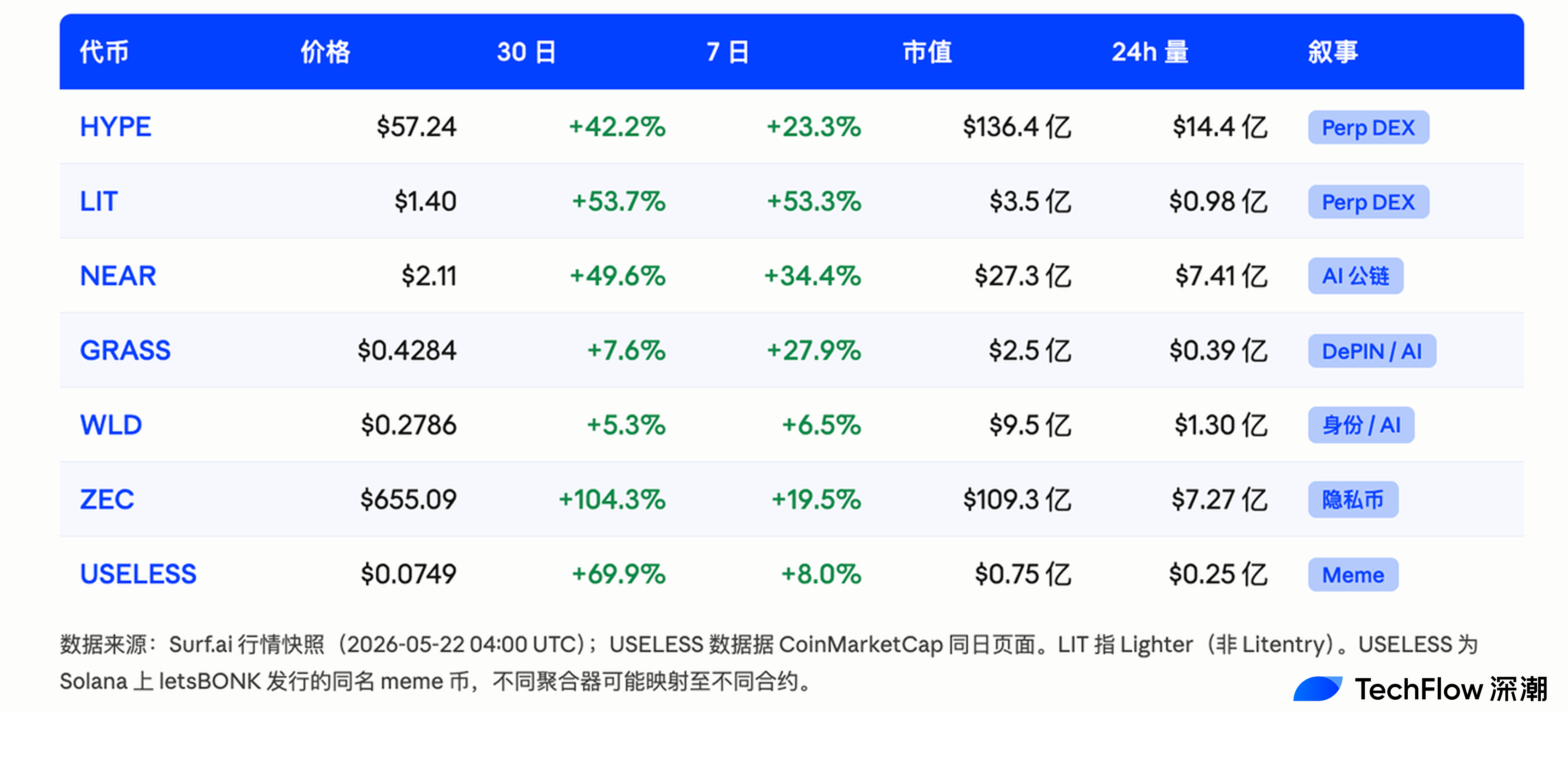
Several insights can be gleaned from the table.
First, ZEC and HYPE have the strongest 30-day gains and trading volume, indicating the most confirmed capital inflow within their respective narratives. LIT leads in 7-day gains, but its market cap is only 1/40th of HYPE, offering high upside but also significant downside risk.
USELESS quietly rose nearly 70% in 30 days, but with a market cap of only $75 million, it's in a completely different league from ZEC's multi-billion dollar valuation. WLD has barely moved, showing the weakest price confirmation in this group, yet it still generates substantial discussion on English CT.
Below, we break down the logic behind each narrative.
1. Perp DEX Narrative: HYPE Hits New Highs, LIT Plays Catch-Up
The Perp DEX narrative has the most complete capital flow chain in this altcoin cycle. Within the same month, HYPE has seen three catalysts materialize: protocol revenue, institutional holdings, and ETF wrappers.
HYPE's foundation is its revenue. Hyperliquid commands roughly 70% of the open interest share among perp DEXs, generating $14 million in weekly fee revenue, annualized to over $600 million. 97% of protocol fees are automatically used to buy back HYPE.
This flywheel has been spinning since the token launch in late 2024, resulting in the destruction of millions of tokens from circulation by May this year. Arthur Hayes's Maelstrom fund publicly stated it was selling holdings like ENA and PENDLE to accumulate HYPE, setting a $150 price target based on this revenue-buyback model.
Institutions are also joining in.
On-chain analyst @ai_9684xtpa flagged a wallet possibly linked to a16z that has been accumulating roughly 9.18 million HYPE (approximately $356 million) since mid-April (unconfirmed by a16z). On May 12 and 15, the HYPE spot ETFs from 21Shares and Bitwise were listed on Nasdaq and NYSE respectively, attracting over $5.6 million in net inflows in their first week.
BHYP's first-day trading volume set a record for altcoin ETF listings in 2026. Bitwise also allocates an additional 10% of its management fees for buybacks. On May 21, HYPE reached an all-time high of $62.14, entering the top 10 by market cap.
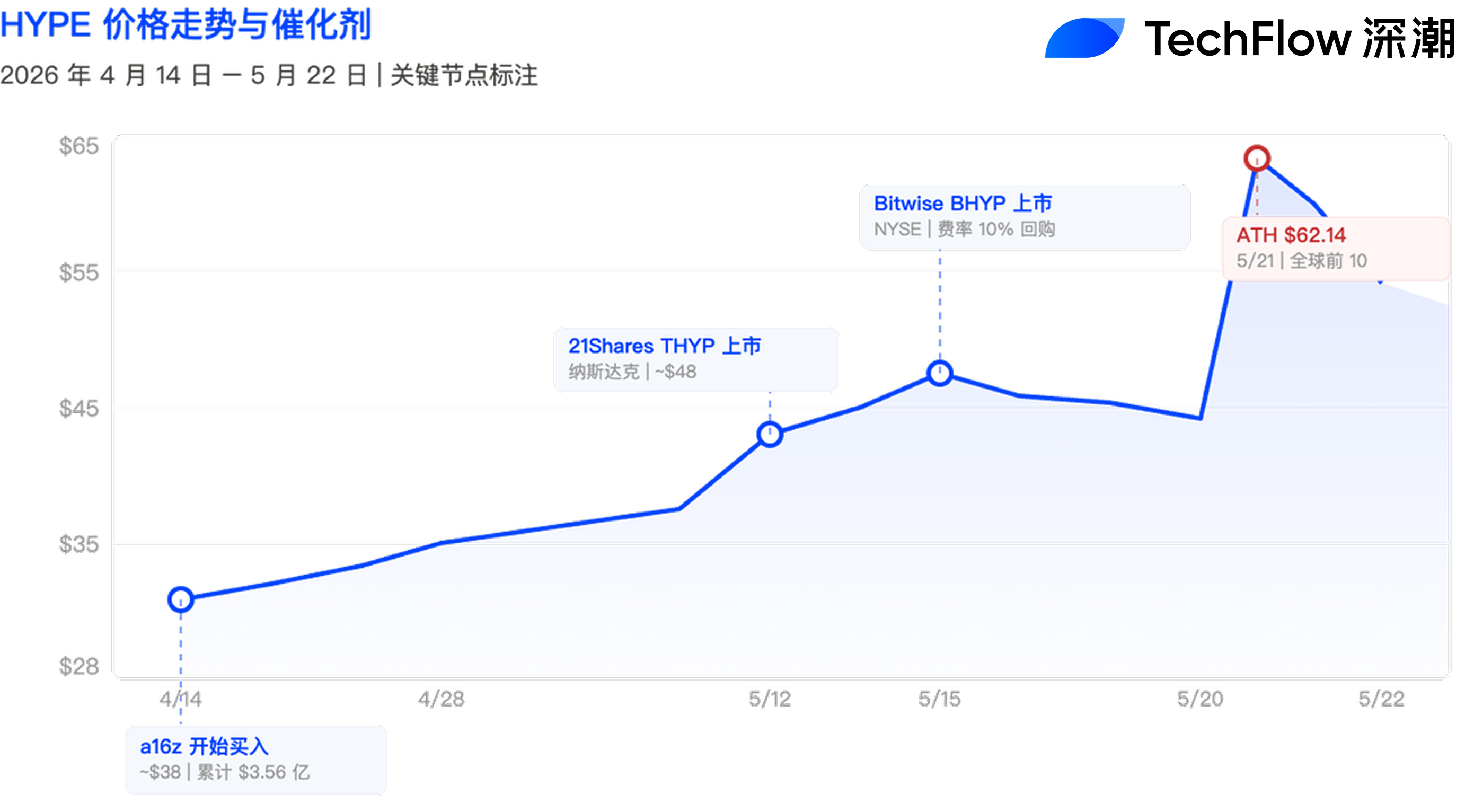
Revenue = Foundation, Institutions = Amplifier, ETF = On-ramp. Having all three layers align simultaneously is indeed rare among altcoins.
The rationale for spillover interest to the same sector is straightforward. Lighter is the fourth-largest player in the perp DEX sector, holding about 10% market share, but its market cap is only 1/40th of HYPE. With HYPE hitting an ATH and entering the top 10, traders naturally look for higher-beta bets along the same narrative.
On May 18, during a public dialogue, Vitalik mentioned Lighter is a "relatively successful new project" in the Ethereum ecosystem, effectively providing celebrity endorsement to this catch-up logic. LIT subsequently rose 30% over three days. Lighter also has its own developments: it launched a SpaceX pre-IPO perpetual contract, integrated with the Tealstreet trading terminal, has an annualized revenue of about $26.3 million, and also has an automatic buyback mechanism.
However, the risks associated with LIT are clearer compared to HYPE.
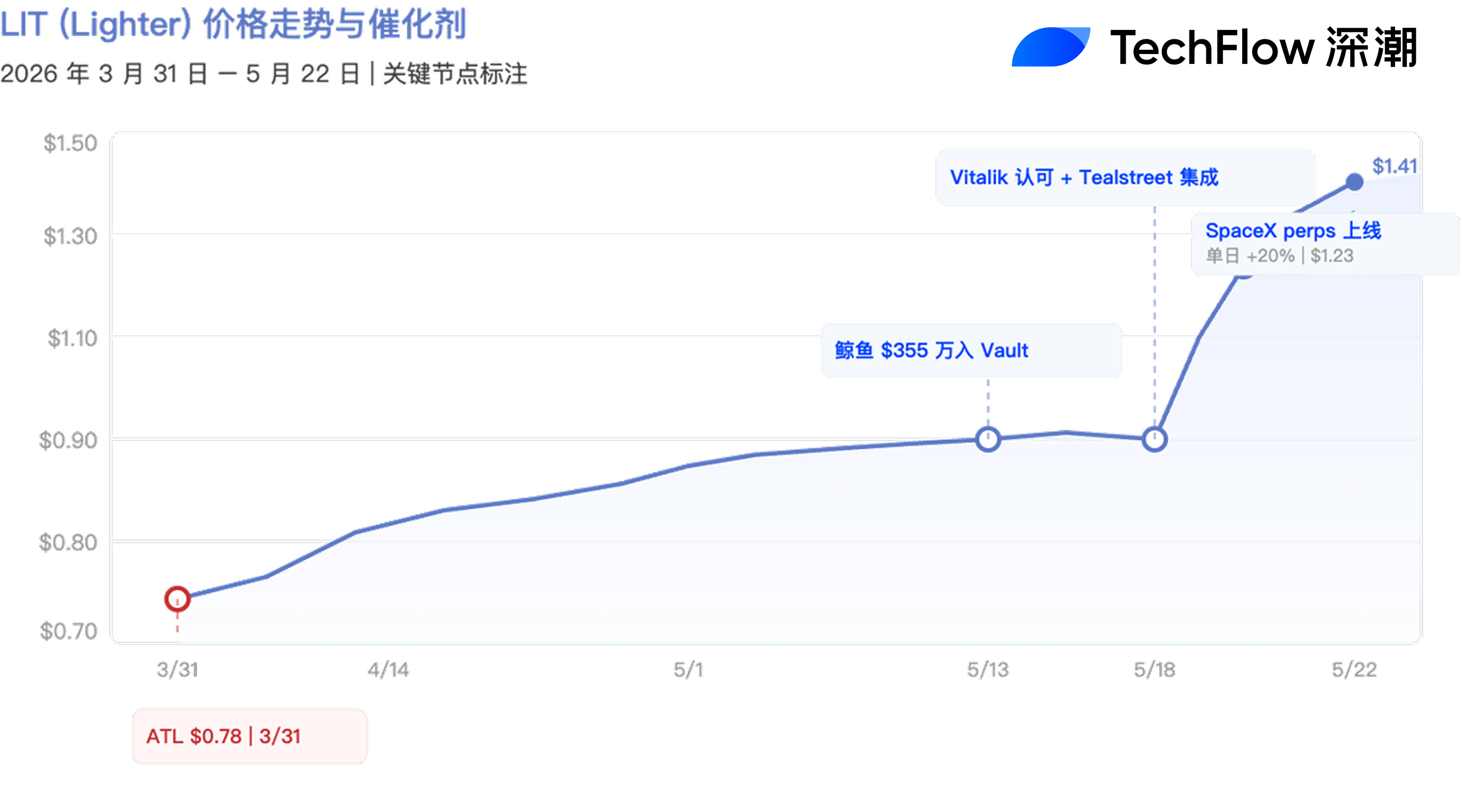
A portion of Lighter's high trading volume previously stemmed from incentive programs and zero-fee design. Some market analyses point to a high trading volume/open interest ratio, suggesting potential wash trading that needs monitoring. LIT's circulating supply is only 25% of its total supply. Team and investor tokens begin unlocking at the end of the year, approximately 13.5 million tokens per month.
The flip side of this catch-up potential is that if the main HYPE narrative cools down, LIT's retracement is likely to be faster and deeper.
This main narrative will likely continue to attract attention and capital in the short to medium term. Key points to watch:
1. Whether ETF inflows into HYPE can sustain or accelerate.
2. Whether Hyperliquid's protocol revenue can find new growth in synthetic trading of traditional assets (e.g., crude oil, stock perps like SPCX).
If both materialize, the perp DEX narrative has further room to run. If ETF inflows stall and revenue growth slows, the pressure from long-short position turnover around HYPE's ATH could quickly transmit to LIT.
2. AI Narrative: NEAR Leads, GRASS and WLD Face Distinct Hurdles
The AI narrative isn't new to the crypto market, but this cycle shows a shift in capital sentiment.
NEAR is up 50% in 30 days, GRASS 8%, and WLD 5%. All three wear the "AI" hat, yet their price performance varies tenfold. The market is no longer buying the whole basket; it's differentiating based on novel developments and catalysts.
$NEAR: Privacy + AI Narrative
NEAR's price leadership is directly linked to its intensive product activities over the past two months.
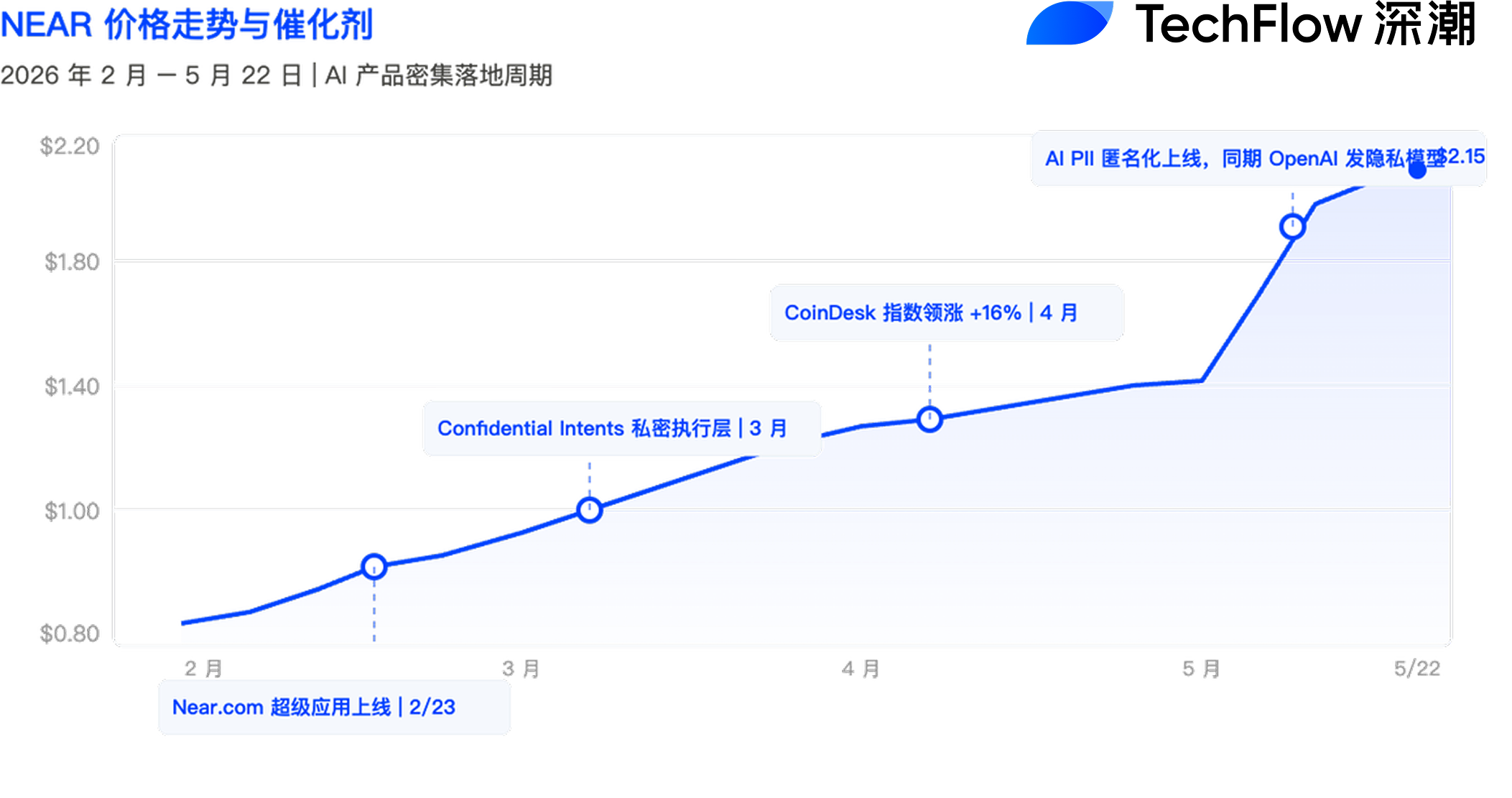
On May 19, NEAR AI launched a framework-level privacy feature:
When users send prompts to external models like ChatGPT or Claude, the system automatically strips out passwords, API keys, and personal information. Developers can enable it with a single header line.
This transforms into a compelling AI privacy identity narrative with practical utility. The overseas tech community values privacy and rights, so this taps into both AI excitement and privacy-centric sentiment.
Furthermore, the timing coincides with AI sector heat. OpenAI released its own Privacy Filter model in late April, and Microsoft launched PII Shield around the same time.
Essentially, NEAR is doing the same thing but on-chain, giving capital a reason to speculate.
Looking back, the Near.com super app launched in February integrated wallets, cross-chain swaps, and confidential transactions. March saw the launch of the Confidential Intents private execution layer. These products converge on a single narrative: enabling AI agents to trade and coordinate on-chain while preserving privacy.
$GRASS: Real Application, Burdened by Unlocks
The situation is different for GRASS.
On the product side, it's one of the few DePIN projects with real paying customers, reportedly including a "seven-figure" AI lab (per Blockworks). A portion of its revenue is used for GRASS buybacks.
On April 24, OKX listed GRASS trading pairs, improving liquidity access to some extent, leading to a 28% gain over 7 days.
However, price performance is hampered by supply-side unlock issues. Season 2 airdrop is releasing approximately 170 million GRASS tokens, combined with team and investor unlocks, keeping downward pressure on the price. Community discussions focus on this point. Grass's business is operational, but the token is currently in a state of supply-demand equilibrium, not yet forming a trend.
$WLD: Identity + AI Narrative
WLD is the most misunderstood among this group.
Many dismiss it as a "Sam Altman shadow trade," but its narrative foundation is actually evolving:
The more prevalent AI becomes, the more valuable it is to prove you are human. New variables supporting this logic have emerged intensively in recent months.
1. Nasdaq-listed Eightco Holdings (ticker: ORBS) holds 283 million WLD, representing 8.3% of the circulating supply, making it the largest publicly disclosed institutional holder globally.
2. Eightco also indirectly holds $90 million in OpenAI equity, with total assets around $337 million, positioning itself as a bundled exposure to "AI + Identity + Creator Economy."
3. On May 1, World officially entered the US market, planning to deploy 7,500 Orb scanning devices within 12 months, several times the current global deployment.
The problem also lies on the supply side. WLD has a total supply of 10 billion tokens, with currently about 3.4 billion in circulation. The team frequently deposits large amounts to Coinbase and Bybit. After July 24, the unlock rate will decrease by 43%, which could be a potential turning point, but supply pressure remains significant until then.
3. Privacy Narrative: English CT FOMO's on Privacy Coins Again, ZEC Doubles in 30 Days
ZEC needs little introduction; you can refer to our previous article: "Doubling in 30 Days, Up 15x This Year: Why is English CT FOMOing on $ZEC Again?"
Besides HYPE, English CT is filled with ZEC chatter.
Naval Ravikant called ZEC "insurance against Bitcoin." Arthur Hayes at Consensus set a long-term target of "10% of BTC's price." Multicoin Capital publicly disclosed a heavy position, reversing its 2019 stance that "privacy isn't worth paying for separately." Behind this wave of hype are several hard catalysts materializing simultaneously:
· The SEC confirmed the conclusion of its three-year investigation into the Zcash Foundation, recommending no enforcement action.
· Robinhood listed ZEC for nationwide trading on April 23, opening up a retail on-ramp. Grayscale's ZEC Trust is applying to convert into a spot ETF (ticker: ZCSH), which, if approved, would be the first privacy coin ETF in the US.
AI and privacy are almost overarching themes on English CT, with ZEC clearly leading the charge.
4. Meme Narrative: USELESS Needs No Fundamentals, But Needs Liquidity
USELESS is up nearly 70% in 30 days, second only to ZEC.
During last summer's Solana launchpad wars (pump.fun, letsBONK, BelieveApp competing for flow), USELESS emerged as one of the few survivors from letsBONK. The name itself is a meme: "I am completely useless, and I don't pretend to be useful."
The logic behind this resurgence has nothing to do with fundamentals (meme coins never do). The key variable is the CEX on-ramp: Coinbase, Bybit, and Crypto.com have all listed it. With 24-hour trading volume around $25 million, liquidity is sufficient for short-term trading. When meme capital rotates on Solana, an old meme with CEX listings, community history, and an inherently viral name is easily pulled back into the spotlight.
However, the risks of meme coins are well-known. Attention shifts faster than for any other type, making it an amplifier of market sentiment.
The all-time high of $0.43 is still far from the current price. The token distribution structure and significant past retracements warrant caution. Also, a quick reminder: meme names like USELESS are susceptible to name-squatting on different aggregators. Always verify the contract address before trading.
In summary, these seven coins correspond to four distinct narratives, with vastly different sources of hype and levels of confirmation.
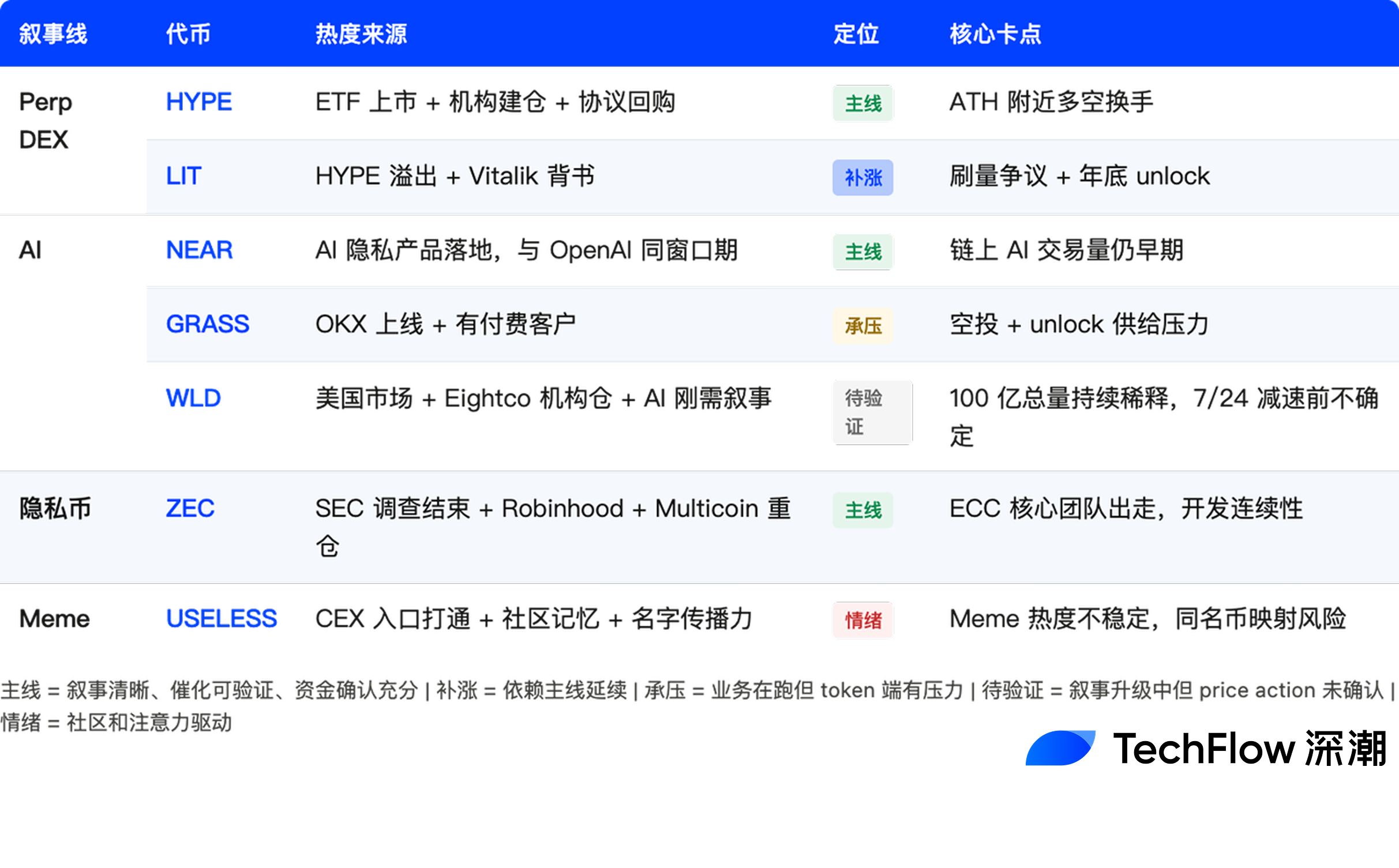
· HYPE, NEAR, and ZEC are the most confirmed assets on their respective narrative lines, with verifiable catalysts and traceable capital flows.
· LIT and GRASS are more dependent on the continuation of the main narrative and the digestion of supply pressure, offering high potential but lower certainty.
· WLD's demand narrative is upgrading, but token-side supply pressure looms until at least July, needing further direction. USELESS is pure attention and sentiment trading, not suitable for fundamental analysis.
For spot investors, understanding the general contours of these narratives is essential. There are only so many hotspots in the current crypto market; prices may correct, but the main themes are unlikely to change in the short to medium term.
For derivatives traders, timing becomes more critical, requiring a deeper look at shorter timeframes (e.g., 1-2 days) for changes in OI and funding rates.
Finally, structural opportunities still exist in the market. Research remains a good way to find returns when others are not paying attention.


