






Web3 Wallet at 10 Years: As the AI Inflection Point Accelerates, Charting a New Map for Crypto Users


- Core Thesis: In the age of AI, blockchain wallets are evolving from mere asset gateways into a user's "personal digital hub". Their core function is no longer to execute more automated operations on the user's behalf, but to provide a composable, co-creatable, and personalized trusted underlying capability, all while ensuring security and the user's ultimate control.
- Key Elements:
- Wallet narratives are shifting from an asset container (2016-2023) through a paradigm turning point (2024-2025) towards a personal digital hub (post-2026), with the core principle being "Tokens evolve, control remains".
- The pragmatic path for combining AI and wallets is not to let AI manage private keys, but to allow users to participate in wallet co-creation via natural language, and to open up underlying capabilities (such as Token Core) for safe AI invocation.
- The WebAssembly form of Token Core allows core wallet capabilities (private key management, signing, etc.) to run in a browser, providing developers and AI with a more open and composable infrastructure.
- Through tools like Token Core CLI, Token UI, and the Security Manual (SKILL.md), imToken is opening up wallet professionalism, security rules, and composability to the community, driving competition towards underlying capabilities and AI security boundaries.
- AI will drive the "personalization" of wallet forms, allowing users to customize interfaces (e.g., a DeFi panel or a micro-payment version), but the ultimate signing rights and asset control must remain with the user.
- In the future on-chain world led by AI Agents, the wallet's core role will be as the "console", responsible for risk warnings, permission constraints, and final signatures, ensuring user understanding and control over every interaction.
For a long time in the past, when we discussed wallets, we were essentially talking about assets.
For example, where BTC is stored, how to transfer ETH, how to manage NFTs, and how to access and use DeFi and RWA. For the vast majority of Crypto users, a wallet was, in a sense, synonymous with an asset gateway.
But AI is changing all of this.
When users can describe their needs in natural language, and when AI can help decompose the operational steps, the role of the wallet is also beginning to change. Especially in the past six months, it's increasingly acting like a console in the user's digital world. From this perspective, the real question for wallets in the AI era might not be "can it do more for the user," but rather, when more and more things can be automated, how can users continue to understand each of their interactions and retain ultimate control?
This is also the new question that imToken is continuing to answer a decade on.
1. The New Narrative for Wallets: From Asset Gateway to Personal Digital Hub
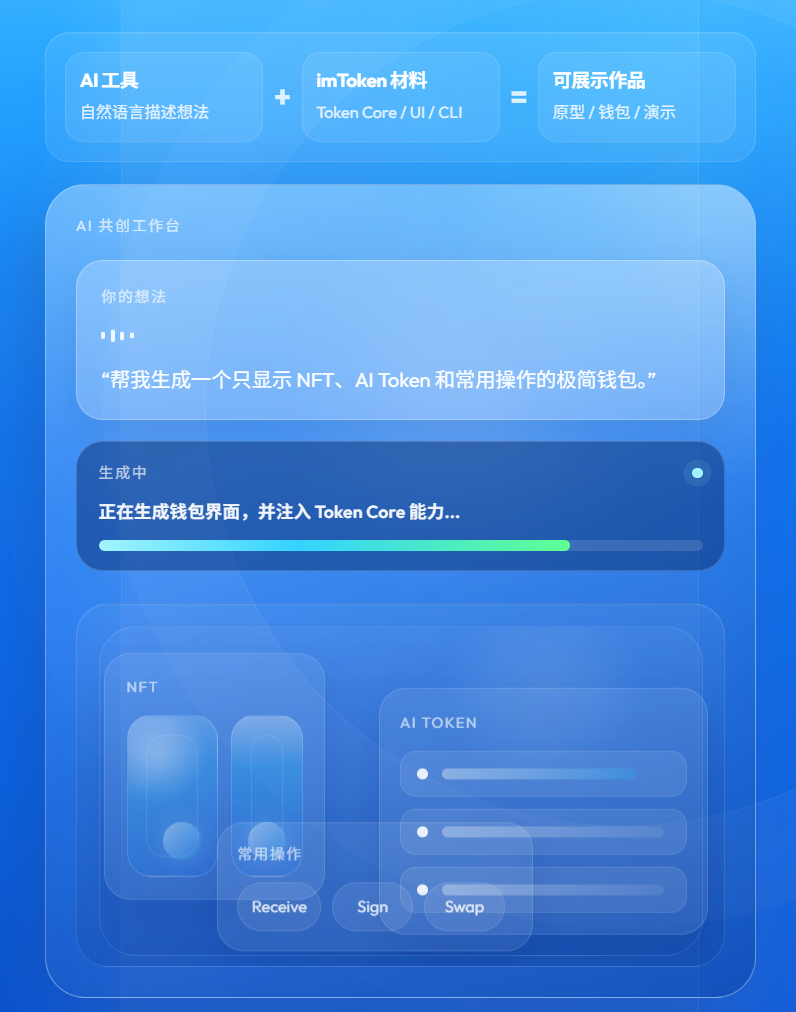
If you told an Ethereum user in 2016 that ten years later, they could type into a dialog box, "Generate a minimalist wallet that only shows NFTs, AI-category Tokens, and common operations," and get a working app for a testnet, they'd probably think you were a project team that couldn't write a proper whitepaper.
But by 2026, this no longer feels like a sci-fi scenario.
If you recently attended imToken's 10th-anniversary event, you would have seen a similar scenario is already achievable – users simply need to input this natural language request, and they can produce a preliminary wallet interface, complete with NFTs, AI Tokens, and common operations like Receive, Sign, and Swap.
"Your digital world, under your control." This phrase aptly summarizes imToken's new narrative for its 10th anniversary. It's not about packaging the wallet as a platform that does everything, but rather acknowledging that as the digital world users enter becomes increasingly complex, users need a long-term trusted, secure, clear, and self-controlled gateway.
This gateway was historically the wallet, and it will continue to evolve from it in the future. Because the more complex the digital world, the more a trusted starting point is needed.
In the past, wallets primarily helped users prove that "these assets belong to me." Whether it was ETH, ERC-20, NFTs, or later DeFi positions and RWA assets, the core role of the wallet was as an asset container and a signing gateway.
But wallets in the AI era also need to help users confirm more questions, such as: Do these identities belong to me? Are these authorizations managed by me? Are these operations something I understand? Are these automated processes still within my control boundaries?
This is the crux of the "Personal Digital Hub" narrative, also implying that the wallet's next destination is not just a wallet, but the foundational interface for users entering the digital world.
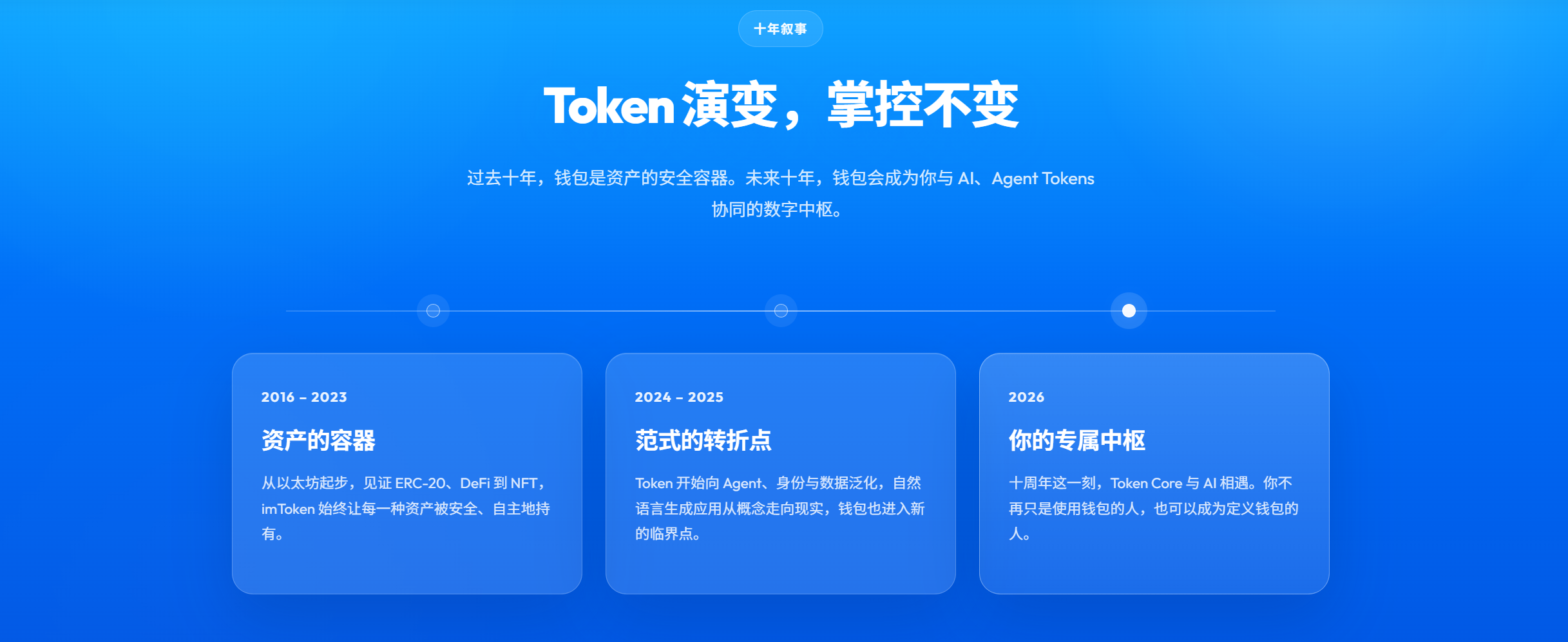
Again, using imToken as an example, if we divide its decade into three phases, we see a clear trajectory:
- 2016 - 2023: Wallet as a container for assets: Starting from the Ethereum ecosystem, expanding asset types like ERC-20, DeFi, and NFTs. The core proposition was simple: keep private keys as securely as possible on the user's own device, ensuring every new type of Token could be reliably housed in the same container. In this phase, the user's primary concern was "can assets be safely stored and easily withdrawn."
- 2024 - 2025: Wallets stand at a paradigm shift point: Tokens are no longer just assets but extend to identity/data/Agent/permission relationships. Ethereum's narrative is no longer just about scaling but moving closer to user experience aspects like account abstraction. Therefore, rewriting how users interact with chains is causing the relatively stable piece of the wallet puzzle to loosen significantly for the first time.
- Post-2026: Wallets are moving towards the "Personal Digital Hub": As AI begins to participate in application generation, transaction understanding, risk identification, and automated execution, wallets are no longer just tools to be used, but more like everyone's digital console, responsible for linking collaboration between users and AI Agents.
These three phases of change can be compressed into one sentence: Tokens evolve, control remains constant.
Asset forms will change, interaction methods will change, and AI capabilities will change, but what wallets truly need to protect remains unchanged: the user's ultimate control over their digital world.
2. Functionality is Not the End; Security is the Foundation
Take imToken's 10th-anniversary AI co-creation activity as an example. What's truly noteworthy is not just "using AI to generate a wallet interface," but placing the question of "how wallets and AI combine" at a more foundational level.
One point needs to be clarified: the AI direction currently shown by imToken is not the aggressive path of "handing private keys to AI for automated trading." Instead, it leans towards three more practical directions: first, enabling users to participate in wallet co-creation using natural language; second, making underlying wallet capabilities easier for developers and AI to call; third, embedding security rules into the generation and interaction process upfront.
We believe this path is more aligned with the logic of the wallet industry.
Because a wallet is not an ordinary app. A wrong button in an ordinary app might just be a poor user experience; a wrong signature, authorization, or private key handling process in a wallet can lead to real asset loss. Therefore, wallets in the AI era must emphasize not only "generated quickly" but also "generated securely," "understandable," and "verifiable."
One of the most specific actions is further opening up Token Core related capabilities into the co-creation scenario. For the average user, the name "Token Core" might sound technical, but it can be understood as the "heart" of the imToken wallet, responsible for the wallet's core capabilities like private key and keystore management, address generation, transaction signing, and multi-chain support.
Simply put, a wallet interface can take many forms, but what truly determines whether a wallet can securely manage assets, sign correctly, and run reliably across different chains is this underlying "heart."
As early as 2018, Token Core was open-sourced. Back then, it primarily served imToken's own mobile wallet, powering multi-chain asset management and signing capabilities on iOS and Android. Today, Token Core has evolved into a wallet core library covering multiple public chains and cross-platform calls.
Within the 10th-anniversary related branches, the emergence of the WebAssembly form is particularly noteworthy.
WebAssembly sounds technical, but in layman's terms, it allows core wallet capabilities, previously mostly running in App or local environments, to operate more conveniently in a browser environment. This makes it more direct for web-based wallet demos, AI-generated wallet applications, and developer-built wallet prototypes to call underlying wallet capabilities.
The significance is that the wallet is no longer just a collection of functions within a closed App but can become a set of more open, composable foundational capabilities. Accompanying this, several more intuitive tools have emerged:
- Token Core CLI demo can be understood as a 'command-line demonstration bench,' breaking down core wallet actions, such as creating wallets, deriving addresses, managing keystores, and signing transactions, allowing developers and AI to intuitively understand what the wallet's underlying layer is doing.
- Token UI can be understood as a 'wallet interface template library': Based on imToken's design system, it helps participants build wallet-like interfaces faster. Users can have AI generate a wallet interface prototype without designing every button, list, and asset card from scratch.
- security/SKILL.md acts more like a 'wallet security manual' specifically for AI coding assistants. When AI needs to generate code involving mnemonics/private keys, signatures/authorizations, it cannot just focus on making the functionality work; it must first understand the red lines, ensuring operations involving assets require user confirmation.
This set of open-source actions might differ significantly from how people previously understood wallet competition.
In the past, it was easy to view a wallet as an App – the one supporting more chains, having a better-looking page, or offering more comprehensive DApp entry points held the advantage. However, post-AI era, wallet competition may morph into a different form: Whoever can provide more trustworthy underlying capabilities, enable users and developers to combine wallet functions more securely, and maintain security boundaries even when AI generates user experiences, is more likely to become the foundation of the user's digital world.
This is why imToken's AI capabilities should not be simply understood as "running an AI wallet generation activity." It actually answers a more fundamental question – when AI can generate more and more wallet interfaces, interactions, and applications, what must remain stable? What can be opened for users and the community to recompose? What must be constrained by security rules?
And imToken's answer is: keep trust in the core, keep control with the user, and keep innovation for the community.
3. The New Map for Crypto Users: From Natural Language Interface to Agent Boundary Management
So, for the next decade, how can we envision the future of Web3 wallets?
Putting the two threads above together – on one side, imToken placing the wallet kernel, UI templates, and security rules into the hands of users and developers; on the other side, AI beginning to gain stronger comprehension and orchestration capabilities between users and chains – the position of an ordinary Crypto user is undergoing interesting changes.
In the past, users were more about adapting to the wallet.
For example, users use the wallet as its homepage is designed; they click on whatever functions the wallet supports; they follow whatever steps the transaction flow dictates. Even power users often switch back and forth between various fixed functions.
But with AI's involvement, wallets may increasingly adapt to the user. This means that Web3 wallets in the next decade may not just have more features, but likely become more personalized in form:
- You might no longer have to tolerate a one-size-fits-all wallet homepage. For instance, if you're a heavy DeFi user, you can have AI generate a minimalist interface focused only on yields, risks, and position changes, aggregating major positions, APYs, redemption times, and risk statuses across different chains.
- If you only care about stablecoin income and expenses, you can have your wallet homepage display only USDC/USDT balances, recent transactions, and frequently used receiving addresses, free from irrelevant assets and entry points.
- If you are deeply involved in LST / LRT, the wallet can integrate the actual ETH positions, yields, exit windows, and potential risks behind different staking credentials into an easy-to-understand panel.
- If you just want to prepare a small wallet for family, it can only retain receive, send, and balance display functions, hiding complex DApps, approvals, and cross-chain features.
The underlying signing, addresses, and transfer logic remain unchanged; what changes is the upper-layer experience. In short, the wallet is no longer a standard component but a digital tool assembled from the wallet kernel, UI Kit, and individual needs.
Looking further ahead, the next generation of Crypto users may face an on-chain world populated with numerous AI Agents.
Your AI assistant scans stablecoin pool arbitrage opportunities daily; your research Agent performs small test transactions when a new protocol launches; your payment Agent handles subscriptions, refunds, and settlements; your asset management Agent reminds you to rebalance according to your set rules.
These scenarios sound radical, but they do not mean users should hand over their private keys to AI. Quite the opposite: the stronger the Agent, the more important the wallet becomes. A healthy AI-wallet relationship is not about letting Agent infinitely take over user assets, but about letting the Agent only make requests, while the wallet translates those requests into transaction content the user understands and presents it to the user for final confirmation.
In other words, AI Agents can be responsible for discovering opportunities, making suggestions, and generating paths; the wallet must be responsible for risk warnings, permission constraints, and final signatures.
Overall, AI will make wallets smarter and on-chain operations smoother. This is a grand development, and it has only just begun.
In Conclusion
The underlying logic of the Crypto world is always built upon user control. The private key issue will not disappear with the advent of AI; it will become even more critical.
This is also where imToken's new narrative and the truly noteworthy aspects of the wallet track lie.
Especially as the digital world expands from assets to identity and AI agents, users still need a trusted entry point to help them understand, confirm, and control each digital action. Therefore, transitioning from a trusted master wallet to a personal digital hub is not just a conceptual rebranding; it's a natural extension of the wallet's role in a new technological environment.
Perhaps when we look back at 2026 from 2036, we will see a somewhat counterintuitive fact: the next decade for wallets is not just about becoming more powerful in functionality, but about users transforming from being served to being the definers of services.
Your digital world, under your control.





