






茅台时刻:当流动性枯竭,所有人都在抱团HYPE和ZEC


- 核心观点: 2026年5月,加密市场在流动性收缩下出现极端“核心资产抱团”现象,资金从ETH和SOL等主流资产集中流向HYPE和ZEC,导致市场分化严重,信仰崩塌。
- 关键要素:
- Bankless联合创始人David Hoffman清仓所有ETH,标志以太坊信仰彻底瓦解。ETH价格较2025年高点4946美元腰斩至2100美元附近。
- 市场呈“两种天气”:HYPE距离历史新高仅一步之遥,ZEC年初至今涨幅超1400%,而ETH与SOL陷入困境。
- Hyperliquid(HYPE)因“现金流故事”逆势崛起,其去中心化永续合约交易所年收入超12亿美元,且与Circle达成USDC收益分成协议,提供稳定回购现金流。
- ZEC(Zcash)成为“恐惧故事”核心资产:Arthur Hayes和Multicoin资本重仓支持,隐私需求因AI去匿名化和量子计算威胁激增,SEC调查关闭及Robinhood上线强化其正名。
- 机构观点看空ETH:Citi和JPMorgan下调目标价,Culper Research发布做空报告,指出Fusaka升级削弱通缩机制。
- Solana“高β”属性成负债,其早期金主Multicoin资本已转移信仰至ZEC,标志着资金从生态基础设施流向隐私声明和现金流项目。
- 抱团风险积累:ZEC合约未平仓量飙升40%至13亿美元,HYPE资金费率持续翻正,融资成本上升,暗示多杀多踩踏风险。
Original Author: TechFlow (Shenchao)
David Hoffman posted a tweet in the early hours of May 21, 2026.
Just one sentence: "Has the vibe on crypto Twitter genuinely changed in the last two weeks, or did I just sell my last ETH?"
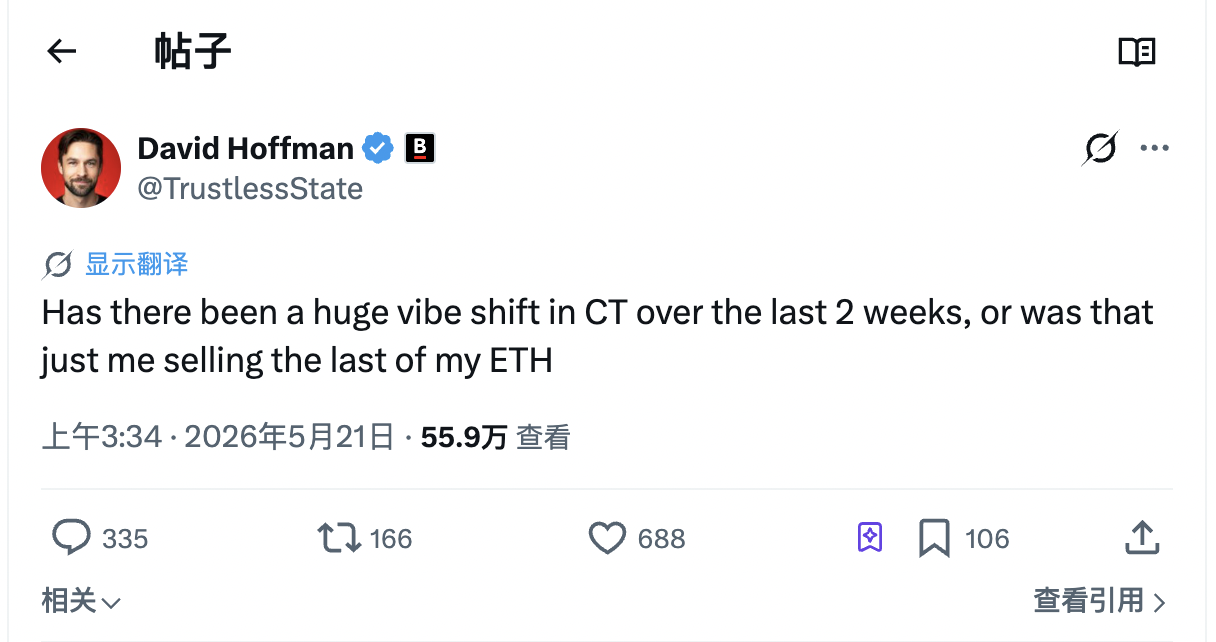
David Hoffman is the co-founder of Bankless and one of the most prominent public evangelists for Ethereum over the past six years. He once wrote on his personal page, "99% of wealth is not in banks, but on Ethereum." He authored *Ether: The Triple Point Asset* and was a core missionary of the narrative defining ETH as "ultrasound money."
Now he's liquidated.
If last year some still viewed ETH as "the bond of the future world" and SOL as "a high-speed Nasdaq," then by May 2026, the market has decisively voted with price action to complete a thorough de-credibilization. ETH is currently struggling around $2100, having been halved from its peak of $4946 in August 2025.
Yet in the same market, HYPE is just a step away from its all-time high of $59.39, up 15% over the past seven days; ZEC has more than doubled in the past month, surging over 1400% year-to-date, and its market cap has cracked the top 20.
One market, two climates.
The Baijiu of Yesteryear
This isn't the first time the crypto world has seen such fragmentation. But you need to momentarily glance away from the screen and return to China's A-share market in 2020.
From the second half of 2020 to early 2021, liquidity in A-shares peaked and began to decline. Mutual funds faced a choice: either spread positions evenly across over 3,000 stocks to accept mediocre beta returns, or concentrate ammunition on a handful of core assets with clear future cash flow narratives. Everyone chose the latter. The result was that Kweichow Moutai and Wuliangye were driven sky-high, while the remaining stocks were thrown by the market into "garbage time."
That year, a very precise term emerged: "core asset clustering." Its essence wasn't fund managers colluding, but an inevitable reaction under a liquidity contraction environment. When the water in the pool decreases, all fish swim towards the deepest corner.
The crypto market is now swimming towards that deepest corner.
What happened over the past year? Bitcoin ETFs absorbed approximately $70 billion in funds during 2024-2025, turning Bitcoin into an "asset priced by Wall Street." However, this also meant Bitcoin's marginal buying power became constrained by macro interest rates and equity market risk appetite. Q1 2026 inflation data exceeded expectations, coupled with $1 billion in weekly net outflows from ETFs, causing the entire market to shudder.
More damaging was the narrative collapse. Citi cut its 12-month target for ETH from $4,304 to $3,175 in early 2026, citing "stalled market structure legislation and weakening on-chain activity." JPMorgan was more blunt in its May 19 report: "ETH needs stronger network growth and DeFi adoption to reverse its weakness relative to Bitcoin." Short-side research firm Culper Research even publicly shorted ETH, releasing a report arguing that the Fusaka upgrade weakened EIP-1559's burn mechanism, stripping ETH of its previous deflationary properties.
Solana, meanwhile, fell into a different predicament. It remains the best chain for DePIN, meme coins, and on-chain trading experience. But when the market enters a risk-off period, its greatest past asset – "high beta" – becomes a liability. Tushar Jain of Multicoin, the man who once carried Solana back from the brink, publicly announced at Consensus Miami in May that Multicoin has taken a heavy position in Zcash.
This was a landmark moment: Solana's earliest and biggest backer began shifting its faith to another chain.
Clustering Around HYPE and ZEC
So where did the capital go?
The answer is strikingly consistent: HYPE and ZEC.
Hyperliquid's story was seeded way back in November 2024 with its near-perfect airdrop. The team, led by Harvard alumni Jeff and Iliensinc, with a background from Caltech/MIT/Citadel/Hudson River Trading, accomplished something few in crypto had achieved in the past decade: distributing 76% of tokens to users with zero VC allocation.
If you only see this, you see its "moral story." What truly drove HYPE's counter-trend rally during the 2026 liquidity drought is its "cash flow story."
Hyperliquid is not a traditional "narrative token." It's a full-fledged chain, more accurately a high-speed on-chain cash machine: As the largest decentralized perpetual exchange, it generates over $1.2 billion in annual protocol revenue; it struck a deal with Circle for a 90% share of USDC reserve yield, contributing $135 million to $160 million annually in cash flow for token buybacks alone; this week (May 19), Bitwise announced adding HYPE to its balance sheet while launching an ETF product based on HYPE.
HYPE's open interest currently stands at $2.1 billion, with funding rates turning positive. This signals fresh long capital is consistently entering, not a false boom from short squeezes.
ZEC's story belongs to a completely different dimension. It's not a "cash flow story"; it's a "fear story."
Arthur Hayes wrote directly in his latest January essay: "The dominant narrative this year is privacy. ZEC will be the privacy beta. To outperform Bitcoin and Ethereum, I will sell BTC to fund my privacy positions." His fund, Maelstrom, began building positions in Q3 2025.
Then, in early May, Multicoin Capital's Tushar Jain publicly added to positions at Consensus. CoinDesk, in its March research, tagged ZEC with a label: "encryption supremacy," meaning privacy networks have become a dominant infrastructure. The underlying logic chain is a simultaneous convergence of three things: AI gaining the ability to mass-de-anonymize user identities on transparent chains; quantum computing threats creating long-term uncertainty for existing wallet encryption systems; and on-chain quarterly transaction volume surpassing $100 billion for the first time, turning "wealth visible to the entire network" into a genuine fear.
The proportion of ZEC supply locked in shielded addresses has reached 30%, an all-time high. This quantifies real privacy demand on-chain, moving beyond literary narrative. On May 20, the SEC officially closed its over-two-year-long investigation into the Zcash Foundation without recommending any enforcement action. Robinhood has listed ZEC, and expectations for Grayscale's ZEC ETF are coming to the forefront.
Hayes predicts ZEC's market cap will eventually reach 10% of Bitcoin's, implying a token price 15-20 times its current level.
Clustering Disintegration?
When will this clustering break?
The A-share baijiu cluster broke after the 2021 Chinese New Year. The catalyst wasn't fundamental deterioration, but a shift in central bank policy, turning the market from a zero-sum game back into an expansionary one. When the water in the pool starts increasing, fish no longer need to crowd into the deepest corner.
When will the crypto pool grow? It depends on when the Fed cuts rates, when ETF capital returns, when stablecoin market caps hit new highs, and when traditional finance brings more money on-chain.
But another possibility warrants caution: the cluster might self-destruct due to being "too tightly packed." ZEC's open interest surged 40% in the past 24 hours to $1.3 billion. This concentration itself is a risk signal. Hayes, Multicoin, retail traders, Robinhood users – everyone squeezed into the same trade means any marginal exit could trigger a cascading long squeeze. HYPE's funding rates have turned positive and are climbing, accumulating financing costs.
The endpoint of clustering is either a rising tide lifts all boats, with everyone taking profits; or a stampede out, where the last one in catches all the falling knives.
Where are we now? No one can give a definitive answer. But there's one question worth asking yourself if you've read this far:
If even David Hoffman has sold, that ETH still sitting in your wallet – do you hold it because you believe in it, or because you forgot it was there?
The next question is more pragmatic: When a market only has two names left to cluster around, what will be the third name? Will it be Aave? Maker? Some undiscovered privacy L2? A high-performance chain yet to issue a token?
Those who figure this out will be the first to enter the next cluster.
Those who don't will be the last to hold the bag when it breaks.


