






Trade.xyz 220 days after its launch, Hyperliquid is becoming the "New Nasdaq"


- Core Thesis: Hyperliquid is transforming from an on-chain perpetual contract exchange into an "On-Chain Nasdaq." Through its product Trade.xyz, it facilitates 24/7 price discovery for RWA assets such as U.S. stocks and commodities, attracting traditional financial institutions and signaling a restructuring of global financial infrastructure.
- Key Elements:
- Hyperliquid's RWA open interest has reached $2.6 billion, with total trading volume for tokenized stocks hitting $3.57 billion, both setting new all-time highs.
- Of its top 30 markets, only 7 are cryptocurrency trading pairs; the remaining dominant assets come from Trade.xyz's commodities and stocks (e.g., S&P 500, Crude Oil, Gold).
- Bloomberg cited Hyperliquid's crude oil contract pricing as the "most authoritative on-chain price reference," marking mainstream media recognition of its on-chain pricing authority.
- Trade.xyz utilizes a pure perpetual synthetic asset structure, bypassing the compliance constraints of traditional SPV shareholding, and supports 3-50x leverage, attracting global whales to participate in price discovery.
- Institutional adoption is accelerating: Goldman Sachs has purchased HYPE tokens, and Bitwise will allocate 10% of its ETF management fee income to hold and stake HYPE.
- With CME markets closed over weekends, traders use Hyperliquid to speculate on crude oil; during Cerebras' IPO, its pre-market price on Hyperliquid was used as a key stock price reference.
Original: Odaily Planet Daily (@OdailyChina)
Author: Wenser (@wenser 2010)
Several years ago, when CZ was asked by the media to compare Binance with other exchanges, he boldly declared, "Binance's only real competitor is Nasdaq."
Today, the entity closest to that goal is Hyperliquid, which has seen a sustained surge in trading volume for US stocks, gold, silver, and commodities.
With its token HYPE surging over 100% (Recommended reading: "Why is HYPE still rallying hard? Has it peaked?"), both the crypto market and even traditional finance are re-evaluating and pricing this "former Perp DEX."
After the pre-market Cerebras (CBRS) event, Hyperliquid has begun to play the role of "US stock price discovery machine" and is emerging as the new Nasdaq.
Answering 2026: Describe Hyperliquid in One Sentence?
Last May, Trade.xyz founder Shoku (@sershokunin) mentioned in a tweet: "Very interestingly, people still just view/evaluate Hyperliquid as an on-chain contract exchange after all this time. But if you take the time to dig deeper, you'll realize this team's true ambition goes far beyond that. The next product Units is about to launch will make everyone see just how big this opportunity really is."
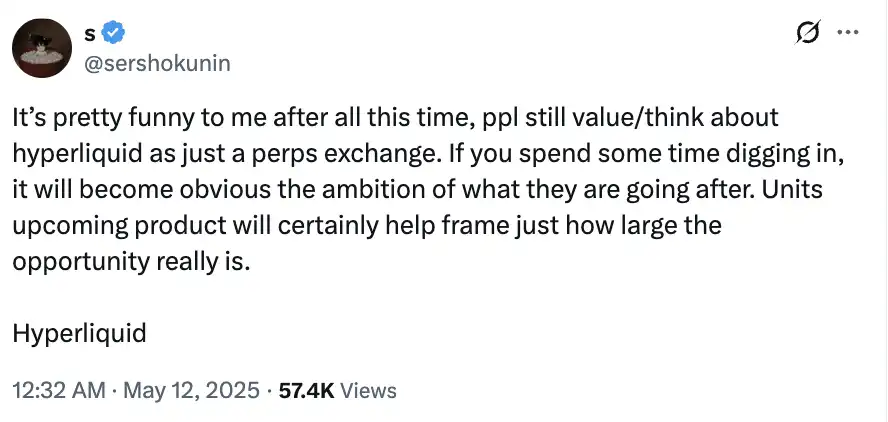
A year later, people realized the foresight of that tweet, and that heavyweight product became today's "nascent on-chain Nasdaq" — Trade.xyz.
In October last year, HIP-3 was officially opened, and Trade.xyz, the largest third-party perpetual market application on HIP-3, was subsequently launched. In just under half a year, Trade.xyz achieved a milestone breakthrough of "cumulative trading volume exceeding $110 billion." Leveraging the trading liquidity for on-chain US stocks, pre-market US stocks, commodities, and other assets introduced by HIP-3 and Trade.xyz, Hyperliquid has vaulted to become the current "new king of RWA trading."
On May 18, Hyperliquid released official data stating that the platform's open interest in RWA trading had risen to $2.6 billion, a new all-time high, doubling from two months ago. The latest data shows that the total trading volume of tokenized stocks reached a record high of $3.57 billion, with Hyperliquid being a standout in this track.
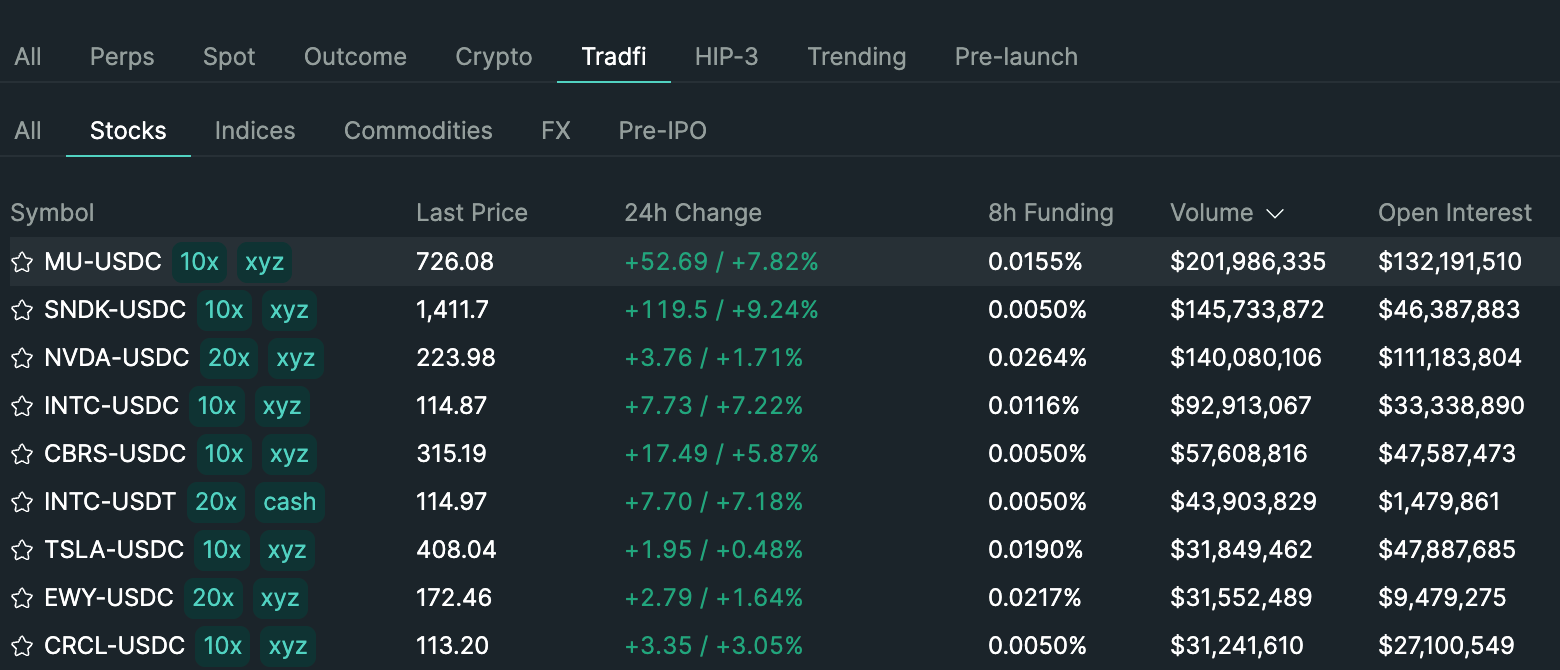
On today's Hyperliquid, crypto assets are no longer the "main theme"; tokenized stocks and commodities are increasingly becoming the liquidity focus of the platform. These include assets like the Nasdaq index, S&P 500, crude oil, gold, and silver.
A recent weekly report from asset management firm Arca pointed out that among the top 30 markets on Hyperliquid, only 7 are cryptocurrency trading pairs, while the vast majority are commodity and stock trading pairs from Trade.xyz.
During CME weekend closures, traders are betting on crude oil price movements on Hyperliquid; before the Cerebras IPO, US stock traders and investment bank fund managers used Hyperliquid's pre-market prices for more accurate share price references; as soon as SpaceX pre-market stocks were listed, the entire market subsequently pushed its market cap above $2 trillion.
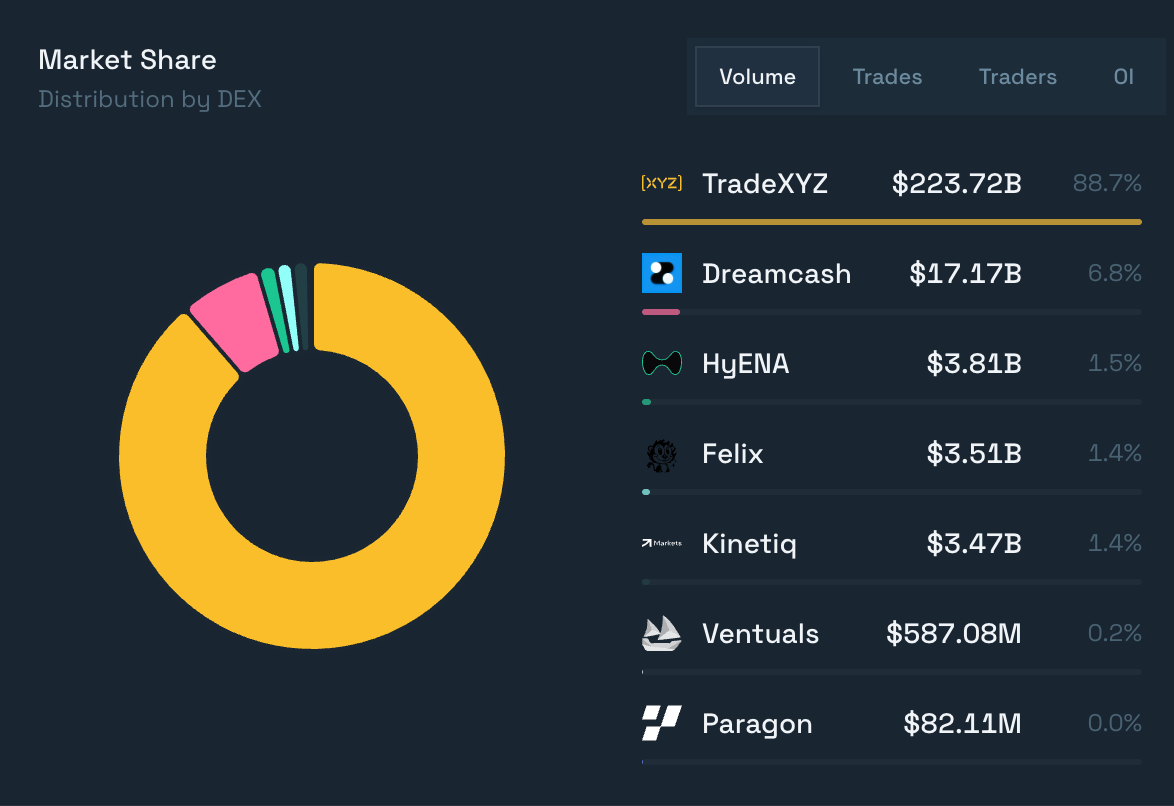
HIP-3 Trading Volume Share, Trade.xyz at nearly 90%
In terms of trading scale, the on-chain US stock contracts dominated by Trade.xyz are no longer "speculative play money" but a financial market infrastructure with substantive price discovery functions. In the past, only a handful of investment banking giants, brokerages, market makers, and exchanges in the capital market held this power.
Compared to traditional pre-market markets, the close alignment of Trade.xyz and Hyperliquid with final real prices forces recognition: For the first time, the "price discovery power" of US stocks has shifted from traditional trading hours to the 24/7 on-chain environment.
How Hyperliquid Prices Stocks: The Never-Ending Game of Capital
The ability to achieve such accurate pricing stems not only from the advantage of continuous trading hours but also from multiple factors including product structure, global capital, and whale leverage.
First, the trading time advantage. Limited by historical development, traditional financial markets have a fundamental flaw: For US stocks, the official Nasdaq trading session is only from 9:30 AM to 4:00 PM ET. Yet, major events impacting global financial markets increasingly occur during "non-stock trading hours." This trend has become more pronounced in recent months — the US-Iran conflict, tariff negotiations, policy advancements... unexpected events often erupt after Friday's close, precisely when traditional financial markets are shut. Traders, needing to hedge risks most acutely, have nowhere to go, so they flock to Hyperliquid. Now, Bloomberg has cited Hyperliquid's crude oil contract prices as "the most valuable reference price," marking the growing authority of on-chain prices recognized by mainstream media.
Second, the product structure advantage. Unlike stock pre-market trading platforms like PreStocks that use an SPV shareholding structure, Trade.xyz's pre-market contracts are purely perpetual synthetic assets — they involve no real equity but are cash-settled derivatives. Legally, this perpetual asset is entirely different from traditional tokenized equities, offering greater flexibility in terms of regulatory compliance. Earlier, S&P Dow Jones Indices licensed the S&P 500 index for Hyperliquid perpetual contract trading, a significant example.
Furthermore, the global capital flow advantage. After the US stock market closes, global liquidity, including Asian capital, requires channels. The US stock market, with its largest capital capacity, highest capital flow efficiency, and largest number of participants, becomes the "best vehicle," and Hyperliquid's RWA trading platform provides them with a sufficiently broad stage.
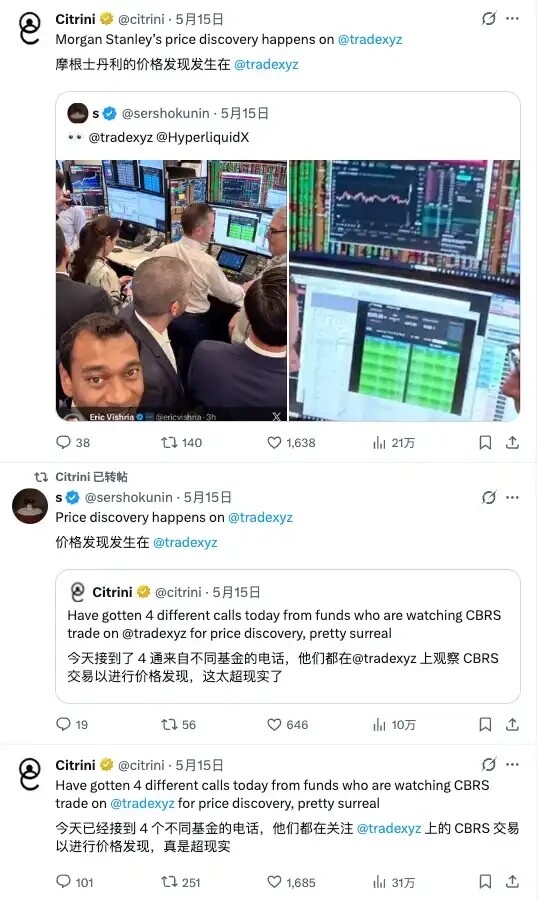
Macroeconomic and stock analyst Citrini's affirmation of Trade.xyz's price discovery
Finally, the leveraged whale pricing advantage. Compared to exchanges with strict KYC requirements or other pre-market trading platforms, Hyperliquid is undoubtedly more friendly to whales needing high-leverage trading. The rapid on-chain competition and 3-50x leverage greatly enhance convenience for these large players.
A Two-Way Convergence of Crypto and Traditional Finance
Have you noticed that the US stock market, once strictly adhering to "business performance and earnings reports," is increasingly displaying a "crypto market temperament"? It is heavily driven by macro data, swayed by a single Trump tweet, spurred by calls from institutional influencers, amplified by narrative logic, pushed to highs by retail FOMO — and then abruptly slammed to the floor by a piece of breaking news.
On the other hand, since the approval of crypto ETFs, mainstream coins have been somewhat "co-opted" by traditional finance: volatility has decreased, falling into range-bound stagnation lacking narratives.
This style switch between the two asset classes has opened genuine upside potential for Hyperliquid: As US stock assets and crypto assets gradually converge, using on-chain tools to facilitate US stock price discovery becomes increasingly feasible, and an active adaptation to this new market structure is already quietly underway. In the near future, the transmission chain of "on-chain pricing first → pre-market market follows → regular stock opening confirms" will reshape financial markets. Hyperliquid, this foundational piece of crypto infrastructure, is transforming into a "globalized Nasdaq" in a new way.
Institutions that recognize this are scrambling to take positions in the Hyperliquid ecosystem.
On May 19, Bitwise announced it would allocate 10% of the management fee income from its BHYP Hyperliquid ETF to hold Hyperliquid's native token HYPE on its corporate balance sheet, and the relevant HYPE holdings would also be staked. On May 20, renowned investment bank Goldman Sachs sold $152 million worth of XRP, $500 million worth of ETH, and $450 million worth of BTC, while simultaneously buying HYPE tokens.
Bitwise CIO Matt Hougan publicly stated that HYPE's value is still being underestimated by the market; Hyperliquid's true potential lies in becoming a global transactional super-app covering stocks, pre-IPO assets, commodities, prediction markets, and crypto assets.
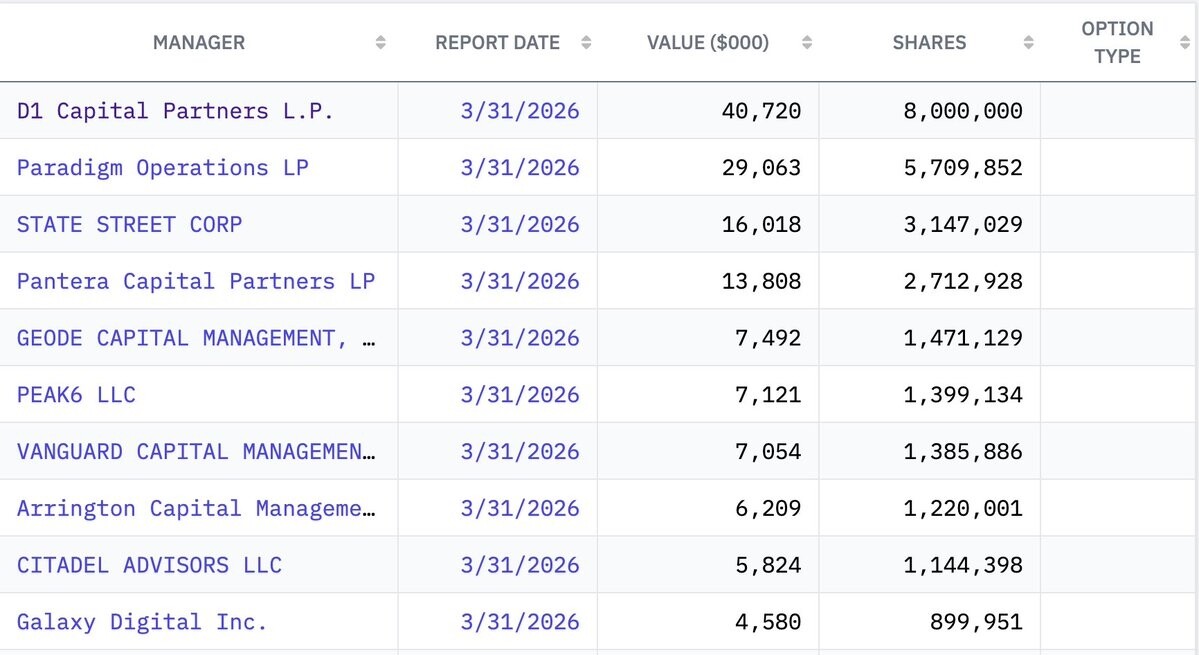
Furthermore, according to recently disclosed 13F filings, fund institutions including Paradigm, Pentera, Vanguard Group, Citadel, and Galaxy are rushing to add positions in HYPE DAT treasury company PURR to their investment asset lists.
A Global, Non-Stop Nasdaq, Starting On-Chain
CZ once said the crypto market's ultimate rival should be traditional stock exchanges like Nasdaq. Now, this statement is being redefined by Hyperliquid.
The market has realized that this competition isn't about "who can build a bigger crypto exchange," but about the reconstruction of global financial infrastructure. Hyperliquid isn't just half-heartedly moving Wall Street on-chain; it's attempting to redefine what a "market" itself is.
US stock trading is limited by fixed time zones, private companies lack public pricing, and global users find it difficult to participate equally in primary and secondary markets. These long-accepted financial boundaries are gradually being broken down by on-chain trading systems.
"Tokenizing assets" is too cliché; this is already an experiment in a paradigm shift concerning the "right to price discovery."
On Hyperliquid, global users are, for the first time, approaching a true market prototype — 24/7, borderless, with free flow across all asset classes.
Traditional platforms, including Nasdaq itself, are also being forced to rethink the boundaries of future financial markets.


