Developer Numbers Cut in Half: Crypto Isn’t Dead; It’s Just Surrendering Talent to AI


- Core Thesis: The apparent halving of developer numbers in the cryptocurrency industry (from 45K to 23K) does not signal a contraction, but rather a "talent deleveraging." The mass exodus is primarily comprised of newcomers who flooded in during the bull run. Meanwhile, the number of experienced developers (over two years) and their share of code commits have reached all-time highs. Development is shifting away from narrative-driven hype towards ecosystems with real users and revenue, with core competencies being transferred to the AI era.
- Key Factors:
- Churn rate for newcomers (less than one year in the industry) is as high as 52%. Their code contributions have never exceeded 25% of the total. These roles are highly dependent on market hype, disappearing when projects fail.
- The number of experienced developers (over two years) has reached an all-time high, contributing approximately 70% of the codebase. They focus on complex infrastructure work like protocol development and security auditing, creating a professional barrier to entry.
- Ecosystem distribution shows developers "voting with their feet": Bitcoin developers grew by 64.3% over two years, Solana by 11.1%, while Cosmos and Polkadot saw declines of 51.1% and 46.9%, respectively.
- Changes in job structure confirm the industry is moving from a construction phase to an execution phase: In 2025, project management roles accounted for over 27% of new Web3 positions, emphasizing compliance, security, and multi-stakeholder coordination.
- Core industry capabilities are migrating to AI scenarios: compute aggregation (Hyperbolic utilizing PoSP consensus), multi-agent collaborative governance (EigenLayer's economic staking), and autonomous payments (Coinbase's x402 protocol processing over 165 million transactions).
- Top venture capital firms and institutions have clearly stated their positions: Paradigm, Haun Ventures, a16z crypto, and others have established large funds focusing on the convergence of crypto and AI, targeting financial infrastructure and verifiable computation.
Original Authors: Xinyang, Ethan, IOSG Ventures
In 2026, the GitHub activity curve of the Crypto open-source community completed a remarkable "bottoming out." The monthly active developers fell from a peak of 45K in 2022 to approximately 23K. This apparent halving on paper sparked discussions about "narrative exhaustion" on social media. However, when we dissect the cross-section of this curve, what we see is not an industry contraction, but a profound "de-leveraging of talent."
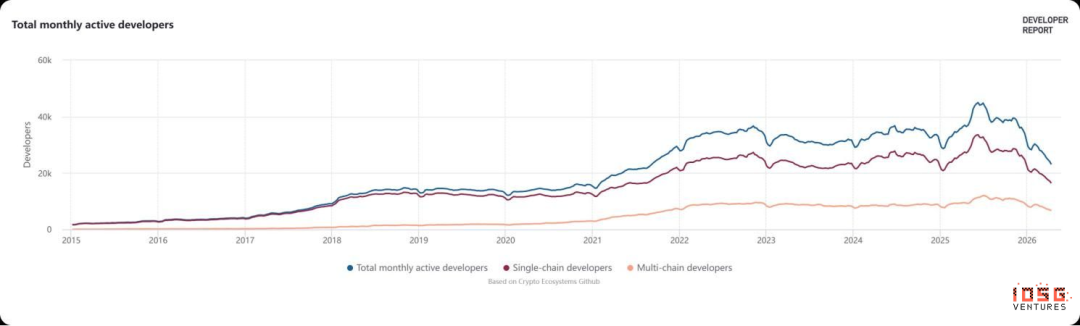
▲ Data Source: Electric Capital Developer Report, based on Crypto Ecosystems Github
Who Left? Who Stayed?
Those who left were primarily newcomers. In February 2024, the number of new developers added in a single month reached 5,462, followed by a significant decline, with a churn rate of 52% for those with less than a year in the industry. Most of these people flooded in during the bull market, working on NFT minting contracts, forking DeFi protocols, and building frontends for new L2s.
These roles are highly dependent on market sentiment. Once the heat fades, projects cease operations, and the roles disappear. Data shows that the code contributions of newcomers never exceeded 25% of the total. These individuals were never in the core circle of the industry from the beginning.
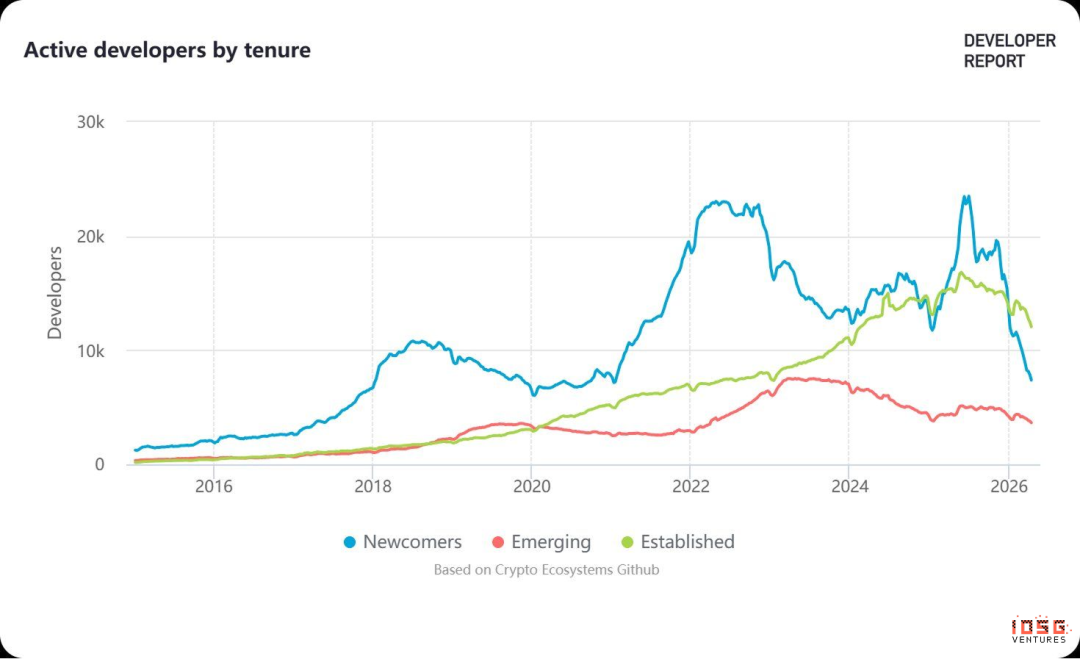
▲ Newcomers surged in during the bull market and left during the bear; Established devs (2+ years of experience) hit an all-time high in the same period.
Data Source: Electric Capital Developer Report
On the other hand, the number of developers with over two years of experience increased during the same period, reaching an all-time high and contributing approximately 70% of the code volume. Maria Shen, GP at Electric Capital, put it directly: "When we look at the established developers group, it's growing, and it looks very healthy."
They aren't staying because they have no other options.
Technologically, the core work in crypto now revolves around infrastructure development that typically requires years of accumulated knowledge to understand: protocol-level development, security audits, cross-chain architecture. This work requires years of experience to master effectively and cannot be simply phased out by market sentiment.
Economically, many veterans hold unvested tokens, governance power within protocols, and equity relationships. Their accumulation in this industry has formed real barriers and returns.
Looking at ecosystem distribution, they are voting with their feet: Bitcoin developers grew 64.3% over two years, Solana +11.1%, while Cosmos dropped 51.1% and Polkadot dropped 46.9%. Veterans are consolidating towards ecosystems with real users and revenue, leaving projects that still rely on narratives to sustain themselves.
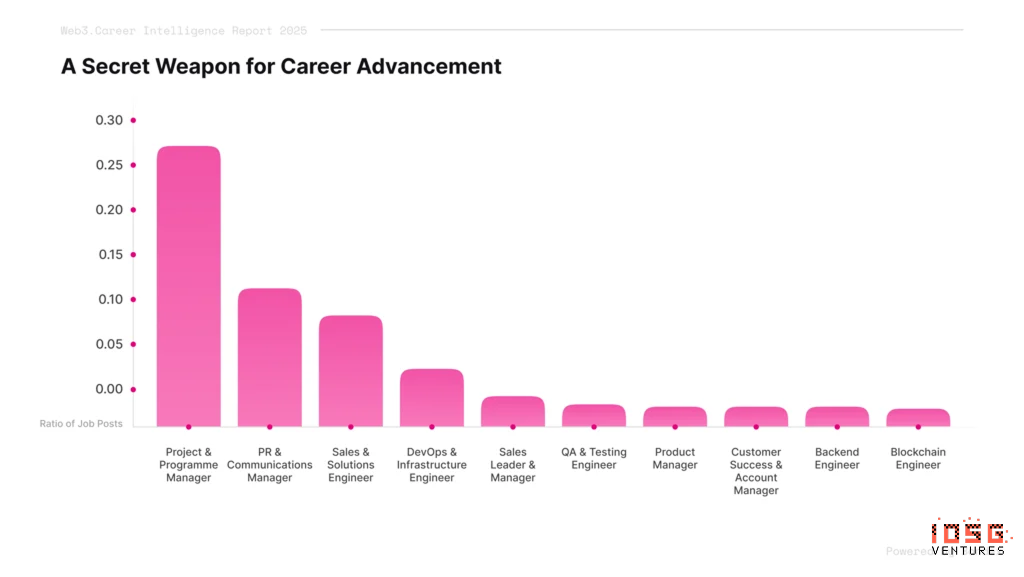
▲ Source: Coincub Web3 Jobs Report 2025
Data Source: Web3.Career
The changing structure of job roles confirms the same story. Among new Web3 positions added in 2025, the largest share was not for developers, but for Project & Programme Management, accounting for over 27%.
This is counterintuitive for an industry known for being technology-driven, but the underlying logic is straightforward: the industry is moving from a construction phase to an execution phase. Over 100 chains need integration. The entry of institutional clients brings vastly different requirements for compliance and security. DAO governance requires finding balance among stakeholders with diverse interests.
This isn't traditional project management; it's about coordinating and making judgments in an environment where rules are still being formed.
The industry appears to be shrinking on the surface, but its core density is actually increasing. The bear market of 2018-2019 also saw significant developer attrition, yet it was followed by the emergence of phenomenal projects like Uniswap, Aave, and OpenSea, which defined the bull market of 2020-2021. The builders who stayed this time have more mature infrastructure, and the AI era provides them with a bigger stage than the last cycle.
What Capabilities Do Those Who Stay Possess?
What specific capabilities has the crypto industry forged in its builders? To answer this, we need to return to the underlying principles of blockchain. Through the rotation of bull and bear cycles, the industry has always operated on the same fundamental rule: Code is Law, Execution is Finality.
In the 2016 DAO incident, an attacker exploited a recursive call vulnerability to siphon $36 million. The code had no bugs; the logic executed exactly as intended, but the boundaries were unforeseen by the designers. In 2021, the Poly Network cross-chain bridge was attacked, with $610 million transferred within hours.
No platform could halt it, no institution could reverse it, no legal clause could seek recourse. This is the structural feature distinguishing crypto from almost all other industries: zero margin for error, and post-hoc intervention is virtually non-existent.
This environment forces out a set of capabilities rarely needed in other industries: the ability to build a functioning system from scratch, without established rules or trust, that strangers are willing to participate in.
This capability has two layers. First, building trust from zero, relying not on any external authority, but only on code and mechanisms to make strangers willing to deposit real assets. Second, making judgments under both technological and economic uncertainty—designing systems that can function without a regulatory framework, historical data, or industry standards to refer to.
Both layers have concrete validation within crypto. Uniswap, with no company guarantee, no KYC, and no customer support, relies solely on trust in a few hundred lines of code and an economic mechanism to facilitate hundreds of billions of dollars in daily trading volume. MakerDAO, without a central bank backstop or deposit insurance, maintains DAI's stability purely through on-chain governance and collateral mechanisms.
The DeFi Summer was even more extreme: no regulatory framework, no auditing standards, no historical data to reference. Builders designed AMMs, lending protocols, and liquidity mining, going from concept to billions in TVL in just a few months. The manifestation of this capability differs across protocol, application, and governance layer builders, but the underlying principle remains the same.
The AI era is creating a structurally similar problem. Model decision-making processes are opaque, and output results cannot be independently verified. AI agents are beginning to autonomously execute transactions and allocate funds, but the supporting rule systems and constraint mechanisms are still nonexistent.
Large model companies control both the models and the evaluation criteria, leaving users without effective verification means. Computing power is highly concentrated among a few top tech giants, creating monopolistic pricing when demand surges. These issues point to the same core: the trust problem for autonomous systems, replayed at the larger scale of AI.
Crypto builders have been handling such problems for years in environments without external authoritative rules. The previous context was on-chain protocols; now it's AI. And a group of people have already directly brought their accumulated crypto capabilities into AI, achieving results.
How Are These Capabilities Being Repriced in the AI Era?
Cases of pivoting from crypto to AI are not uncommon in recent years, but upon closer inspection, what they bring with them differs.
The most straightforward path is the direct transfer of hardware and experience. The three co-founders of CoreWeave, Michael Intrator, Brian Venturo, and Brannin McBee, started mining Ethereum with GPUs in 2017, expanding from a single unit to thousands. They shut down their mining operation in 2022. Two months later, ChatGPT launched, and their GPUs were directly converted into AI compute supply. In March 2025, they went public on Nasdaq with an IPO valuation of approximately $23 billion, with the market cap peaking near $70 billion afterward.
Alex Atallah, co-founder of OpenSea, dealt with the aggregation and routing of highly heterogeneous assets in the NFT marketplace. He applied the same expertise to AI model routing, founding OpenRouter, which served over 5 million developers within two years and reached a valuation of $500 million.
Another type of migration is more noteworthy. NEAR founder Illia Polosukhin is a co-author of the Transformer paper. After leaving Google, he initially wanted to build AI applications using natural language but encountered a practical problem: needing to make cross-border payments to data labelers worldwide, many of whom lacked bank accounts. Blockchain technology became the optimal solution for this payment challenge.
Now, NEAR is transitioning into an AI infrastructure platform, with a core focus on user-owned AI and Decentralized Confidential Machine Learning (DCML), enabling users to utilize AI services without exposing their data. The experience in decentralized architecture accumulated at NEAR has become the most difficult-to-replicate starting point for this direction.
Sean Neville, co-founder of Circle, left to start Catena Labs, positioning it as an AI-native bank. He directly transferred his understanding of stablecoin infrastructure to the financial scenario for AI agents, with a16z crypto leading an $18 million seed round.
Nader Dabit, a senior developer at Aave and Lens Protocol, moved to Cognition, bringing his experience in building developer ecosystems across multiple crypto protocols into the field of AI agent tools.
What this group brings is not just GPU hardware or user networks, but an intuition for mechanism design, experience in building developer ecosystems, and the judgment to construct trusted systems from scratch in the absence of rules. These capabilities precisely correspond to three structural gaps encountered in AI scaling.
Aggregation and Optimization of Compute Power
Compute power is the most immediate bottleneck for AI scaling. Training and inference require massive amounts of GPUs, demand is volatile, cloud providers are expensive with queues, and enterprises are reluctant to stockpile hardware themselves. This problem has two aspects: how to aggregate and allocate compute, and how to use the aggregated compute more efficiently. Crypto builders have directly transferable expertise in both areas.
Hyperbolic addresses the distribution and trust problem. Founder Jasper Zhang brought decentralized mechanism design into the AI compute track: tokens incentivize scattered GPU holders to contribute idle compute. However, the more critical issue is trust.
Why should you trust the computational result provided by an unknown node? Their core innovation, PoSP, uses random sampling combined with game theory to make honesty the dominant strategy for nodes. It requires no full verification, has low overhead, is scalable, and produces reliable results. This mechanism is directly migrated from crypto's logic for verifying the behavior of unknown nodes.
MoonMath addresses the efficiency problem. Its predecessor, Ingonyama, focused on ZK hardware acceleration, increasing ZK proof generation speed several times under extreme computational constraints.
Its direction has now shifted to the Physical AI performance layer, working on sparse attention acceleration for video diffusion models (LiteAttention), low-rank decomposition for FFN layers (LiteLinear), and training backpropagation acceleration (BackLite). From ZK acceleration to AI inference acceleration, the underlying capability is the same: making math run faster under extreme computational constraints. The track has changed, but the accumulated expertise is not wasted.
AI Governance and Incentive Mechanism Design
When multiple AI agents collaborate to execute tasks, how do we ensure they don't undermine the overall system while pursuing their individual goals? Each participant is optimizing its own objective function, with no guarantee that the sum of their actions keeps the system functional, and the execution speed of agents far exceeds the window for human intervention.
This is a problem type crypto builders have repeatedly addressed in DAO governance and tokenomics design: getting participants with completely different vested interests to operate according to the system's intended direction without a central authority. Crypto's answer is economic mechanisms. Violating rules carries a real economic cost, and the rules are written in code and executed automatically.
EigenLayer has directly migrated this mechanism to the AI scenario. Through its restaking mechanism, nodes must stake assets before participating in collaboration. Failure to perform or violating rules triggers automatic slashing. The rules are not suggestions; they are rigid boundaries with real economic consequences.
EigenCloud extends this logic to verifiable computation and collaborative governance for AI agents, ensuring that agents must operate within predefined boundaries while pursuing their goals. Using economic mechanisms to constrain agents is far more reliable than using ethical guidelines.
Autonomous Payment for AI Agents
There is also a more fundamental issue: how do agents pay? Traditional payment systems are designed for humans. Credit cards require opening an account, bank transfers require authorization. Every step assumes the operator is human, has an identity, and can wait. Agents don't wait. They might initiate a massive number of requests per second, each potentially involving micropayments. Traditional payment pipelines are directly ineffective in this scenario.
Stablecoins and on-chain rules are infrastructure already built by crypto builders. They are natively programmable, permissionless, and operate 24/7. These three characteristics are exactly the hard requirements for agent payment scenarios. What was missing was a protocol layer to connect stablecoins to agent workflows.
x402, launched by Coinbase in May 2025, activates the HTTP 402 status code. It embeds stablecoin payments directly into HTTP requests, allowing an agent to complete payment simultaneously with initiating a request. No account is needed, and settlement takes about two seconds.
As of April 2026, the x402 protocol has processed over 165 million transactions, with a cumulative volume of approximately $50 million and 69,000 active agents (source: x402 Foundation). Cloudflare, AWS, Stripe, and Anthropic MCP have all integrated. Agent payment is already a track with real traffic.
These three directions correspond to three structural gaps encountered in AI scaling: the aggregation and efficiency of compute power, incentive alignment for multi-agent collaboration, and infrastructure for autonomous payments. There are no ready-made answers to these three problems within traditional software architecture, but the crypto industry has corresponding experience in handling them. The capabilities haven't disappeared; they've just found new application scenarios.
The Builder's New Role: From Writing Contracts to Setting Rules for AI
The scaling of AI is creating a functional gap that didn't exist before. It's not a gap in technical talent, but a gap in people who can design trust mechanisms within autonomous systems. As the served entity shifts from humans to AI, the role of the crypto builder is also being redefined.
The table below compares the dimensional changes in specific functional paradigms:
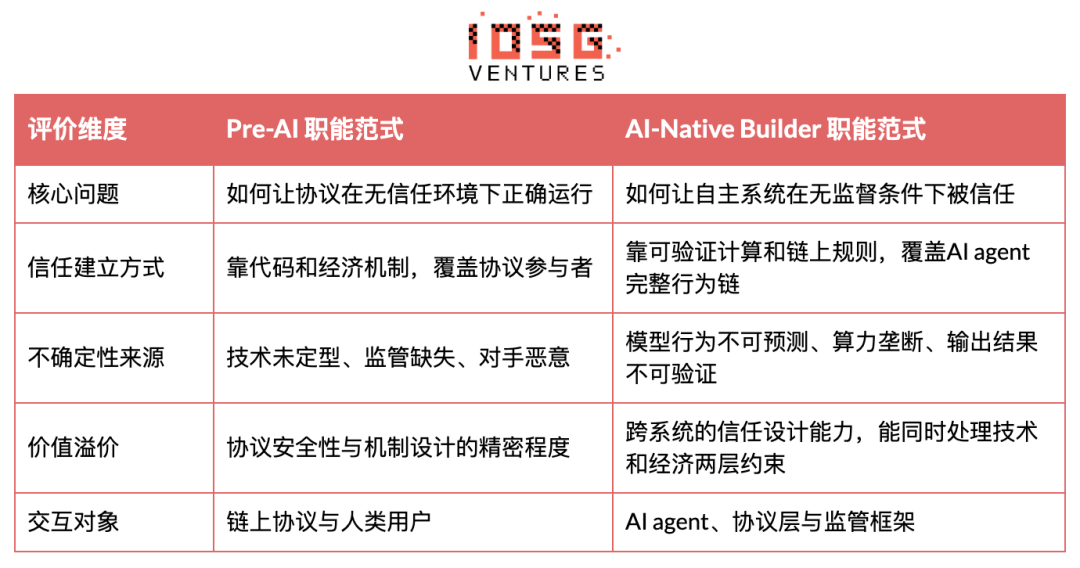
The core difference between the two paradigms is not the tech stack, but the method of building trust and the logic of rule execution. In the Pre-AI era, crypto builders faced human participants. Rules were written into contracts, the margin for error was zero, but the boundaries of the system were relatively clear.
In the AI-Native era, when the interaction object becomes autonomously running AI agents, the problem to be solved is different: agent behavior is unpredictable, execution speed far exceeds the window for human intervention, and the boundaries of the system itself need to be redefined under greater uncertainty.
The functional positioning of the crypto builder is shifting from "writing secure contracts" to "designing trusted mechanisms for autonomous AI systems."
Headlines and recruitment from leading institutions already reflect this change:
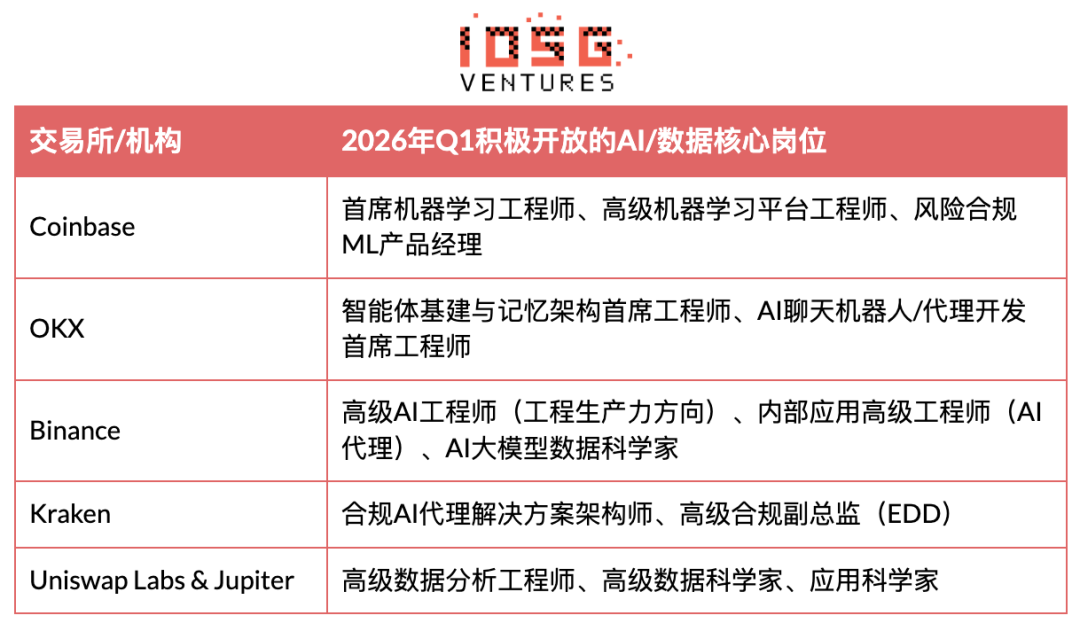
▲ Active AI/Data core positions opened by leading trading platforms in Q1 2026
Source: Gate Research Institute
The hiring from leading trading platforms and institutions in 2026 clearly reflects this trend: They are no longer simply hiring AI engineers or crypto developers. They are looking for people who can bridge the two sides—those who understand on-chain incentive distortions and governance games, can deeply embed AI tools into crypto workflows, and can design mechanisms that ensure long-term alignment between agents, regulators, and users.
Capital allocation already reflects this judgment. Paradigm is raising a new fund of up to $1.5 billion, expanding its investment scope from crypto to AI and robotics. Haun Ventures completed a $1 billion Fund II, with a key focus on the financial infrastructure for the convergence of crypto and AI, particularly supporting payments, stablecoins, and agent-to-agent economic systems for autonomous AI agent transactions and coordination. a16z crypto closed its fifth fund, Crypto Fund V, at $2.2 billion, stating clearly that the fund will be 100% allocated to the crypto space. In response to the complexity and opaqueness of the AI era, they will focus on applications of crypto's transparency, verifiability, and decentralization characteristics.
Furthermore, according to PitchBook data, in 2025, approximately 40% of VC investment in the US crypto space flowed into companies also involved in AI businesses, a significant increase from 2024.
Regarding crypto builders pivoting to AI, the chosen paths show clear differences depending on the market environment. In the US, as the regulatory environment has become relatively clearer, protocol-level innovation has gained real space to exist. The capital network density is high, the path from idea to funding is short, and the margin for error is relatively large.
The common characteristic of projects like Hyperbolic, EigenCloud, Gensyn, and Ritual is designing new mechanisms from scratch, rather than simply applying integrations on existing systems. Top VCs have