






Korea’s Financial Turmoil: Samsung Strike, ‘AI Universal Basic Income’, and Crypto Market Bloodbath


- Core Thesis: Driven by the AI dividend, South Korea’s financial market is witnessing a mix of prosperity and chaos. A strike at Samsung Electronics and policy discussions around an “AI Citizen Dividend” have triggered sharp stock market volatility, while the cryptocurrency market continues to languish due to liquidity drain and regulatory tightening, forming a stark divergence.
- Key Factors:
- The Samsung Electronics strike could inflict massive economic losses, with a single day of work stoppage potentially costing 1 trillion won (approximately $668 million). Courts have partially approved an injunction against the strike, but the union still plans to proceed as scheduled.
- An official from the presidential office proposed the concept of an “AI Citizen Dividend,” sparking market concerns over excessive taxation and causing the KOSPI index to plummet by up to 5%. The government later clarified that the funding source would be “excess tax revenue,” not corporate profits.
- Last week, foreign capital outflows from the South Korean stock market reached $13.2 billion, marking the second-largest single-week outflow on record, impacted by the Samsung strike and profit-taking.
- South Korea's crypto market continues to shrink. Upbit parent company Dunamu saw its first-quarter net profit plunge by 78.3%, while Bithumb swung from profitability to a loss of 86.9 billion won.
- South Korean regulators are tightening the crypto market through anti-money laundering rules, a 22% tax on crypto gains (effective 2027), and a review of Hana Bank’s acquisition of a stake in Dunamu.
- As of May 4, 15 virtual asset service providers that have ceased operations in South Korea are tied to approximately 1.949 million users, with frozen assets totaling 22.1 billion won ($14.87 million).
- South Korean financial authorities plan to tighten liquidity supervision standards for securities firms, including optimizing liquidity ratio calculations and increasing risk weights for real estate, to enhance crisis response capabilities.
Original|Odaily (@OdailyChina)
Author|Wenser (@wenser 2010)
Hot on the heels of SK Hynix's "record 6.1 million won bonuses," South Korea's financial sector has taken a sharp downturn:
On May 18, South Korea's stock market triggered a circuit breaker as KOSPI 200 futures fell 5%, halting program trading for five minutes. Samsung Electronics, meanwhile, found itself in a bind due to a "massive union strike." Compounding this, a previous proposal by Kim Yong-beom, head of policy at the presidential office, for an "AI tax-funded universal dividend" had already sent stocks tumbling. On the other side, the crypto market, once a key focus of South Korea's financial sector, continues to bleed, with Dunamu, the parent company of Upbit, seeing its first-quarter net profit plummet by 78%.
Coexisting with both bubbles and dividends, speculation and hype, South Korea's financial market is reaping the rewards of the AI era while also entering a new phase of chaos.
Samsung Strike Turmoil: From a Court Injunction to Ongoing Talks, the Strike May Still Proceed
Let's start with Samsung Electronics, often referred to as the "barometer of the South Korean stock market."
Previously, Odaily mentioned in an article, "The AI Bull Market is Repricing Everything, Including the 'Male Valuation System' in the Marriage Market", the root of this massive strike: the union wants the company to increase bonus ratios and remove the bonus cap. At that time, JPMorgan estimated that the planned 18-day strike could cause 4 trillion won in losses and reduce production of DRAM and NAND chips.
But the negative impact of this strike extends far beyond that.
According to South Korean Prime Minister Kim Min-seok: "A single day's shutdown at Samsung Electronics' semiconductor fab is expected to cause direct losses of up to 1 trillion won (approximately $668 million). More worryingly, a brief halt in semiconductor production lines could take months to resume. If materials must be scrapped due to the strike, market concerns suggest economic losses could expand to as much as 100 trillion won." In other words, this is a strike with losses too significant for Samsung Electronics, and indeed the entire South Korean financial market, to accept.
In light of this, Prime Minister Kim Min-seok first stated he would explore all options to avoid the strike at Samsung Electronics. Subsequently, this morning, a South Korean court partially granted Samsung Electronics' injunction request against the union's planned strike. Following this news, the KOSPI index turned positive. After Samsung Electronics resumed high-stakes wage negotiations with its largest union, Samsung's stock price also rose by 6.7% at one point.
Just as the market thought the "Samsung mega-strike" incident was taking a positive turn, news from the union side sent Korean retail investors' hearts racing again. Around 12 p.m., the Samsung Electronics union declared that, despite the district court partially granting the company's injunction, they would proceed with the strike as planned on May 21. Paraphrasing their statement: "They respect the court's injunction, which requires the union to ensure any strike action does not disrupt production."
Last Sunday, the South Korean government announced it would invest 170 billion won (approximately $113.3 million) to support small and medium-sized enterprises involved in cutting-edge semiconductors and related industries. This also reveals the government's new plans and developmental intentions for the financial market and economic industries. While Samsung Electronics is certainly experiencing growth opportunities thanks to the AI dividend, it also signifies a restructuring of profit distribution, accompanied by increased volatility and risk in financial markets like the KOSPI index.
Behind the "AI Communism" Discussion: South Korea's Government Aims to "Maximize the AI Dividend"
Last Friday, May 15, the KOSPI index touched the 8,000-point mark for the first time, hitting an all-time high.
Simultaneously, last week also saw a historic "foreign capital exodus" from the South Korean stock market.
On May 15, driven by factors like the Samsung strike and profit-taking, foreign investors sold 1.6 trillion won worth of KOSPI stocks during morning trading. According to Goldman Sachs data, overseas investors withdrew approximately $17 billion from Asian emerging markets excluding China last week, marking the second-largest single-week outflow on record. The South Korean market accounted for the vast majority, with outflows reaching $13.2 billion.
Kim Yong-beom's earlier proposal for an "AI citizen dividend" was a major contributing factor.
On May 11, Kim Yong-beom posted on Facebook: "Excess profits generated in the AI infrastructure era should be structurally returned to all citizens through institutional design" – a concept he tentatively named "Citizen (National) Dividend."
He also emphasized that excess profits in the AI era naturally concentrate among a minority. Without institutional intervention, domestic wealth inequality will worsen. Shareholders of memory chip companies, core engineers, and various asset holders are highly likely to reap substantial rewards, while the broad middle class may only feel the indirect effects.
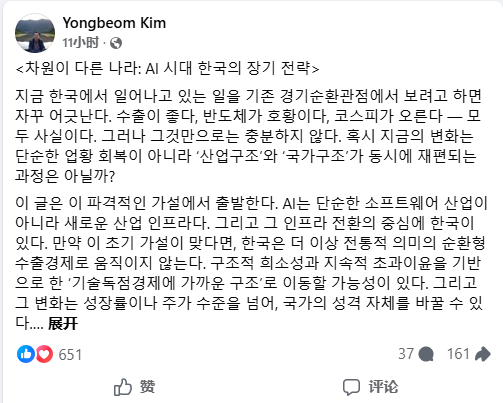
Although I don't understand why a government department spokesperson's opinion needed to be posted on Facebook?
This sparked an uproar. Many interpreted his remarks as the government planning to impose additional taxes on high-profit AI companies like Samsung Electronics and SK Hynix. The KOSPI index subsequently plunged over 5% at one point.
Kim Yong-beom later clarified to the media, stating: "The 'citizen dividend' from the AI industry would come from excess tax revenue, not directly from the profits of AI companies." South Korean President Lee Jae-myung also posted on X, stating that Kim's remarks were about exploring "the possibility of distributing excess national tax revenue generated from AI sector excess profits in the form of a citizen dividend," and did not imply directly using corporate profits for subsidies. Lee Jae-myung used strong language, labeling related external interpretations as "fake news manipulating public opinion."
As one of the world's major economies, South Korea's industrial and social structures are highly distinctive. Limited by domestic market size and historical technological advantages, its economic industries are characterized by high reliance on exports, heavy dependence on the chip industry, and concentration among a few conglomerates (chaebols). Socially, South Korea possesses a strong labor union culture and high social sensitivity. Consequently, when the AI industry became a "profit machine," South Korea became the financial market with the most intense "excess profit distribution conflict."
Only a few companies, including Samsung Electronics, SK Hynix, and Micron, have the mass production capability for HBM (High Bandwidth Memory), holding the key to "AI memory." This is the primary reason why countless securities firms and institutions are flocking to stocks like SK Hynix and Samsung. Today, Nomura published a report indicating that AI-driven demand is growing exponentially while memory supply is limited, predicting a re-rating of memory stocks. The firm significantly raised its target prices for Samsung Electronics and SK Hynix. Samsung's target price was raised from 340,000 won to 590,000 won, and SK Hynix's target price was raised from 2.34 million won to 4 million won, with a "Buy" rating for both.
"The Crypto Market Abandoned by South Korean Finance": Plummeting Exchange Revenues, Regulatory Scrutiny, and Asset Freezes
According to estimates from renowned investment bank Goldman Sachs, South Korean retail investors bought $14.1 billion worth of stocks last week. In contrast, the South Korean crypto market began its sustained bleed much earlier, starting last year.
Statistics show that the total value held by South Korean crypto investors nearly halved within a year. In January 2025, the South Korean crypto market was sized at approximately 121.8 trillion won ($83.3 billion). By the end of February 2026, this figure had plummeted to 60.6 trillion won ($41.4 billion). The average daily trading volume of South Korea's top five crypto exchanges (Upbit, Bithumb, etc.) also crashed from $11.6 billion in December 2024 to $3 billion in February 2026, a staggering drop of 74%.
The primary reasons for this continuous liquidity drain are the persistent downtrend in the overall crypto market and the simultaneous suction of capital into the stock market. In a nutshell, while external stock markets were hitting new highs, the crypto market itself failed to hold its ground.
Revenue Plummets at Top Two Exchanges: Upbit Parent Net Profit Down 78%, Bithumb Revenue/Profit Down 95%
According to a report from The Asia Daily, Dunamu, the parent company of Upbit, reported first-quarter revenue of 234.6 billion won, down 54.6% year-over-year from 516.2 billion won. Operating profit was 88 billion won, down 77.8% from 396.3 billion won. Net profit also fell to 69.5 billion won, down 78.3% from 320.5 billion won.
Bithumb reported first-quarter revenue of 82.5 billion won, down 57.6% year-over-year from 194.7 billion won. Operating profit was 2.9 billion won, plunging 95.8% from 67.8 billion won. Net profit swung from a profit of 33 billion won in the same period last year to a loss of 86.9 billion won.
AML Rules, Crypto Taxation, and Acquisition Review
In August last year, South Korea's Financial Supervisory Service implemented revised anti-money laundering rules, designating transactions over 10 million won to/from foreign exchanges or private wallets as suspicious addresses.
Additionally, the Ministry of Economy and Finance has confirmed that the 22% tax on crypto gains will take effect as scheduled on January 1, 2027.
Furthermore, the recent acquisition involving Dunamu, Upbit's parent company, has also come under review by the Financial Services Commission. Previously, Hana Bank announced plans to acquire approximately 6.55% of Dunamu's shares but did not consult with regulators. This transaction is suspected of violating regulatory rules requiring the "separation of finance and virtual assets."
A representative from the virtual asset division of the Financial Services Commission stated that Hana Bank's indirect acquisition of Dunamu equity through purchasing Kakao Investment shares is essentially an investment in a virtual asset trading platform and will therefore be reviewed under the same regulatory standards. Notably, since 2017, the South Korean government has used administrative guidance to restrict financial institutions from holding, purchasing virtual assets, or making equity investments in related companies. If ultimately deemed a violation, Hana Bank's related transaction may not be completed.
Over 22.1 Billion Won in Assets Frozen for Korean Crypto Investors
As early as 2024, a joint study by the Financial Supervisory Service (FSS) and the Financial Intelligence Unit (FIU) found that up to 70% of closed cryptocurrency exchanges failed to return customer investment funds.
Now, more detailed data has emerged. According to Yonhap News Agency, data obtained by Kang Min-guk, a lawmaker from the People Power Party, from the Financial Supervisory Service shows that as of May 4, there were 15 virtual asset service providers that had ceased operations in South Korea, involving approximately 1.949 million users and frozen assets totaling 22.1 billion won ($14.87 million).
It's fair to say that such a polarized regulatory environment doesn't encourage new retail investors to enter the crypto space.
The "Leverage Nation" Drinking from the Bubbles
Today, South Korean finance seems to have found a "second wind" through the "AI bubble." Although institutions like Goldman Sachs and Citigroup have stated that they have taken profits at this stage, they still maintain a highly optimistic outlook for the future trajectory of the Korean stock market.
Drawing lessons from past experiences, including the Asian Financial Crisis and the Lotte debt crisis of 2022, South Korea's financial regulatory authorities have their own plan for risk management.
Recently, the Financial Services Commission and the Financial Supervisory Service announced plans to tighten liquidity regulations for domestic securities firms. They intend to apply liquidity ratio rules comprehensively to all local brokerages, optimize the calculation method by applying discount coefficients to assets and including contingent liabilities like debt guarantees, to enhance crisis response capabilities. Additionally, they plan to raise risk weights for real estate-related exposures in the net capital ratio and set overall investment limits. Special capital regulations will be introduced for systemically important brokerages.
On one side, you have aggressive investors with a penchant for "leveraged trading." On the other, a heavy-handed government trying to clamp down. A new era of chaos in South Korean finance has begun.





