The "CLARITY Act" Emerges: Is Ethereum the Biggest Winner?


- Core Thesis: By establishing a rigorous decentralization test, the U.S. CLARITY Act will make Ethereum the only programmable digital commodity with regulatory clarity under U.S. law. This would finally eliminate the two major bearish theses that have long suppressed ETH (regulatory risk and competitive threats), propelling it into a valuation framework based on monetary premium rather than cash flow, and unlocking a potential multi-trillion-dollar revaluation.
- Key Elements:
- Among the bill's five tests for "coordinated control" (such as decentralization, open source, permissions, etc.), the 49% threshold for token or voting power concentration is the critical dividing line. Bitcoin and Ethereum pass easily, while major smart contract platforms like Solana, BNB Chain, and Sui structurally fail and are classified as "affiliated assets."
- The "affiliated asset" classification triggers semi-annual disclosure obligations and a cash-flow-based valuation framework, causing tokens to lose their monetary premium. Conversely, assets that pass the tests (like ETH and BTC) can be priced based on non-fundamental factors such as scarcity and network effects, with their valuation ceiling completely removed.
- By passing all five tests, ETH directly eliminates its regulatory risk of being classified as a "security." Furthermore, direct competitors that fail the tests (such as Solana) are forced into a cash-flow valuation system and cannot compete with ETH on a monetary premium valuation framework, ending the "Ethereum killer" narrative.
- Compared to Bitcoin, Ethereum's native staking yield provides a positive net carrying cost and avoids the structural sell pressure and long-term security subsidy risks of Proof-of-Work. This makes it a Tier 1 monetary asset with superior economic advantages.
- The global monetary premium capital pool (approximately $50 trillion in assets) is migrating from traditional vehicles like real estate and gold towards digital assets in response to declining institutional trust and geopolitical risks. ETH becomes the first candidate asset that combines a negative carrying cost, global liquidity, cryptographic security, and institutional independence.
- Even if networks like Solana or Aptos pass the tests within the four-year transition period, merely obtaining legal certification is insufficient for an automatic Tier 1 valuation. They would also need the network itself, its ecosystem, and the market to reach a consensus on its "monetary premium" property—a significant challenge for networks currently oriented towards performance and applications.
Original Author: Adriano Feria
Translation by: Jiahuan, ChainCatcher
On May 12, the Senate Banking Committee released the full 309-page revised text of the Digital Asset Market Clarity Act.
Most coverage will focus on which tokens fail the new decentralization test, which issuers face new disclosure burdens, and which projects need to restructure during the four-year transitional certification window. This reporting isn't wrong, but it's incomplete.
The more significant story is the Act's impact on the one asset that passes every criterion of the test and happens to be the only programmable smart contract platform.
Once the framework becomes law, Ethereum will occupy a regulatory category in the U.S. legal system with only itself as a member. The two major bearish theses on ETH that have dominated the market for the past five years will collapse simultaneously, and the market has yet to price this in.
Two Bills, One Framework
Before delving into the substance, it's necessary to briefly review the broader regulatory architecture, as public discourse often conflates two distinct pieces of legislation.
The GENIUS Act (Guiding and Establishing National Innovation for U.S. Stablecoins Act) was signed into law by the President on July 18, 2025.
It establishes the first federal regulatory framework for payment stablecoins: requiring 1:1 reserves with liquid assets, monthly reserve disclosures, federal or state licensing for issuers, a ban on algorithmic stablecoins, and a key restriction preventing stablecoin issuers from paying interest or yield directly to holders.
The GENIUS Act covers USDC, USDT, and bank-issued stablecoins. It does not cover anything else.
The CLARITY Act covers everything else. It addresses SEC and CFTC jurisdictional divisions, decentralization tests for non-stablecoin tokens, exchange registration, DeFi rules, custody rules, and the ancillary asset framework.
These two acts are complementary parts of a broader regulatory architecture.
Most financial media coverage of the CLARITY Act focuses on the stablecoin yield issue, as Title IV's section on "Preserving Stablecoin Holder Rewards" was the political flashpoint nearly derailing the bill.
Banks pushed to prohibit indirect yield through exchanges and DeFi protocols, fearing yield-bearing stablecoins would compete with bank deposits. Crypto exchanges vehemently argued for its retention. The bipartisan compromise reached on May 1, 2026, cleared the bill's path, but it remains on thin ice after several procedural delays.
This debate is important, but it is only one piece of a nine-title bill. For anyone actually holding and trading non-stablecoin tokens, the more consequential provisions are hidden in Section 104, and almost no one is discussing their second-order effects on asset valuation.
The Five Tests
Section 104(b)(2) of the Act instructs the SEC to weigh five criteria when determining whether a network and its token are under coordinated control:
Open digital system. Is the protocol publicly available open-source code?
Permissionless and credibly neutral. Can any coordinating group censor users or grant itself hardcoded priority access?
Distributed digital network. Does any coordinating group beneficially own 49% or more of the circulating tokens or voting power?
Autonomous distributed ledger system. Has the network reached an autonomous state, or does someone retain unilateral upgrade authority?
Economic independence. Is the primary value capture mechanism actually functioning?
Networks failing this test will produce a "network token" presumed to be an "ancillary asset," meaning the token's value depends on the entrepreneurial or managerial efforts of a specific promoter.
This classification triggers semi-annual disclosure obligations, insider resale restrictions mimicking Rule 144, and initial issuance registration requirements. Secondary market trading on exchanges can continue unimpeded.
The 49% threshold is the key data point, significantly more lenient than the House version of the CLARITY Act's 20% line. Networks failing under the 49% threshold do so for genuinely structural reasons, not technicalities.
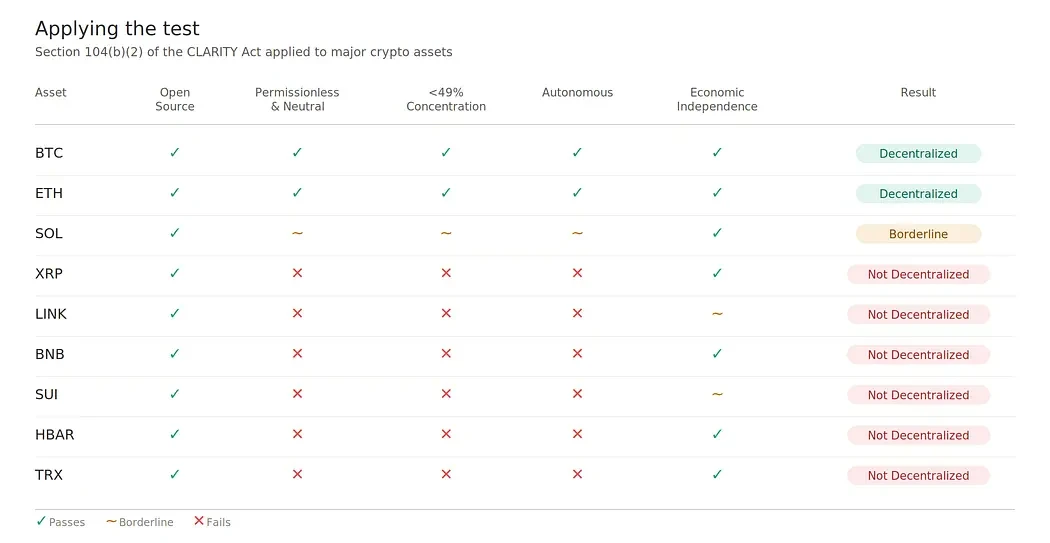
Bitcoin and Ethereum pass all criteria without controversy. Solana hovers on the edge, with the Foundation's influence on upgrades, heavy early insider allocations, and a historical record of coordinated network pauses conflicting with autonomy and credible neutrality standards.
Every other major smart contract platform fails for structural reasons not easily remedied. This list includes XRP, BNB Chain, Sui, Hedera, and Tron, extending to most L1 competitors.
Among the assets passing the test, precisely one has a functioning native smart contract economy.
The Shift in Valuation Regime
Token trading operates on two fundamentally different valuation frameworks.
The first is the commodity/monetary premium regime, where value derives from scarcity, network effects, store-of-value properties, and reflexive demand, with no fundamental valuation cap.
The second is the cash flow/equity regime, where value derives from revenue capitalized through standard multiples and is subject to strict upper limits imposed by realistic income projections.
Most non-Bitcoin tokens have existed in strategic ambiguity between these two regimes, marketing themselves under whichever framework yields higher valuations. The CLARITY Act ends this ambiguity through three mechanisms.
First, disclosure requirements impose a cognitive framework. Section 4B(d) requires semi-annual disclosures including audited financial statements (above $25 million), CFO going-concern statements, related-party transaction summaries, and forward-looking development costs.
Once a token has SEC filings resembling a 10-Q, institutional analysts will evaluate it like they evaluate entities filing 10-Qs. The format dictates the valuation framework.
Second, the statutory definition itself is a qualifier. An ancillary asset is defined as a token "whose value depends on the entrepreneurial or managerial efforts of the ancillary asset promoter." This definition is conceptually incompatible with a monetary premium, which requires value independent of any issuer's efforts.
A token cannot plausibly claim monetary premium pricing while simultaneously satisfying the legal definition of an ancillary asset.
Third, visible scarcity is fragile scarcity. Monetary premium is reflexive, and reflexivity requires a credible scarcity narrative the market can collectively believe.
When a token discloses treasury information, named insider unlock schedules, and quarterly reports on related-party transactions to the SEC, its scarcity story becomes visible; once visible, reflexivity disappears. Investors can see exactly how much supply insiders hold and when those tokens will be sold. This visibility kills the bid.
The result is a two-tier market. Tier 1 assets trade on monetary premium with no fundamental valuation cap. Tier 2 assets trade on revenue multiples with rational valuation caps.
Tokens currently priced on Tier 1 logic but categorized into Tier 2 will face structural re-ratings. For tokens with weak fundamentals but narrative-driven valuations, typified by LINK and SUI, this re-rating could be severe.
The End of Two Major ETH Bear Theses
For five years, the bear case for ETH rested on two pillars.
The first thesis argued that ETH would ultimately be classified not as a commodity but as a security. The pre-mine, the Foundation's ongoing influence, Vitalik's public role, and post-merge validator economics all gave the SEC ample grounds to act against it if desired.
Every bullish argument for ETH had to discount the tail risk of restricted institutional access.
The second thesis argued that ETH would be superseded by faster, cheaper smart contract platforms. Each cycle births new "Ethereum killers" like Solana, Sui, Aptos, Avalanche, Sei, and BNB Chain, all selling better user experience and lower fees.
This argument posits that ETH's technical limitations will force economic activity to migrate, diluting its value capture.
The CLARITY Act does not merely weaken these bear theses; it structurally overturns them entirely.
The first thesis collapses because ETH cleanly passes all five criteria in Section 104. No coordinated control, ownership concentration well below 49%, no unilateral upgrade authority post-merge, fully open source, and a functioning value capture mechanism.
The regulatory tail risk that long justified a discount for ETH vanishes.
The second thesis collapses in a more interesting way. "Ethereum killers" only compete with ETH if they share the same valuation framework.
If SOL is certified as a decentralized asset, the competition continues. If it fails (which currently all other major smart contract competitors also do), they are forced into the Tier 2 valuation system, while ETH remains in Tier 1.
The competitive landscape thus changes. A Tier 2 asset cannot compete with a Tier 1 asset on monetary premium, because the entire point of Tier 1 is its exemption from fundamental valuation caps.
Faster, cheaper chains can still win in specific verticals on throughput and developer attention. They cannot win on the asset valuation framework that determines the bulk of L1 market capitalization.
The Only Ticket
Among assets passing Section 104's test, Ethereum is the only one with a functioning native smart contract economy. Bitcoin passes the test, but its base layer does not support programmable finance.
Every smart contract platform with significant TVL has one or more material failures on the test. This includes Solana, BNB Chain, Sui, Tron, Avalanche, Near, Aptos, and Cardano.
Thus, the Act creates a new regulatory category: decentralized digital commodities with native smart contract economies, and currently only one member in that category.
Every traditional financial institution exploring tokenization, settlement, custody, or on-chain finance needs two things: programmability and regulatory clarity.
Before CLARITY, these attributes were strictly separated. Bitcoin had clarity but no programmability. Smart contract platforms had programmability but legal ambiguity. After CLARITY, Ethereum becomes the only asset offering both within a single statutory category.
Once the framework is in effect, anyone building tokenized treasuries, tokenized funds, on-chain settlement infrastructure, or institutional-grade DeFi entry points will have a clear first-choice underlying vehicle.
This preference is not aesthetic or technical. It is compliance-driven. Asset managers, custodians, and bank-affiliated funds operate within legal frameworks that favor commodity-class assets and disfavor securities-like assets.
Institutional money follows asset classification, and the classification has narrowed to a single programmable asset.
The Sound Money Question
Once BTC and ETH share Tier 1 classification, a close examination of their monetary properties is necessary, as conventional wisdom gets the causation backwards.
Bitcoin's appeal has always rested on its nominally fixed supply schedule of 21 million and its predictable halving every four years. This is genuinely valuable as a scarcity narrative, and the simplicity of the story is why BTC achieved monetary premium first.
But BTC's supply model also carries three structural burdens rarely mentioned in scarcity discussions.
First, mining creates continuous structural sell pressure. Network security depends on miners bearing real-world operating costs: electricity, hardware, hosting, and financing.
These costs are denominated in fiat, meaning miners must continuously sell a significant portion of newly issued BTC into the market regardless of price.
This selling is permanent, price-insensitive, and embedded in the consensus mechanism itself. It is the price of maintaining Proof-of-Work security.
Second, BTC offers no native yield. Holders seeking yield must either lend BTC to counterparties (introducing credit risk) or move it onto non-BTC platforms (introducing custody and bridge risk).
The opportunity cost of holding non-yielding BTC compounds over time relative to assets that produce native yield. For institutional holders measured against yield-inclusive benchmarks, this is a real and persistent drag.
Third, the mining subsidy cliff is a long-tail risk to the decentralization that qualifies BTC for Tier 1 treatment.
Block rewards halve every four years and approach zero by 2140, but the practical pressure comes much earlier. By the 2030s, subsidy revenue will be a fraction of today's, and the network must rely on fee revenue to bridge the security gap.
If fee markets fail to develop sufficiently, the lowest-cost mining firms will consolidate, miner concentration will rise, and the credible neutrality and decentralization valued in Section 104 will begin to erode. This is not an imminent risk, but a structural risk BTC's model has not yet solved.
Ethereum reverses each of these properties.
ETH has variable issuance and no fixed supply cap, the core argument sound money purists use against it. This argument is superficial.
What matters to a holder is the rate of change in their share of total supply, not whether the supply schedule has a fixed terminal value.
Under Ethereum's post-merge design, all issued tokens are distributed as staking rewards to validators. Validators have historically earned yields higher than the inflation rate, meaning anyone participating in staking maintains or increases their share of total supply over time.
For anyone running a validator or holding a liquid staking derivative, the "infinite supply" argument is rhetorically loud but mathematically unsound.
The structural sell pressure burdening BTC does not exist for ETH at the same scale. Validator operating costs are negligible relative to their rewards. Solo staking requires a one-time hardware purchase and minimal ongoing electricity. Liquid and pooled staking abstract away even these costs.
Newly issued tokens accrue to validators and are largely retained rather than sold into markets to cover costs. The same security model that distributes rewards to holders also avoids the price-insensitive selling required by Proof-of-Work.
The subsidy cliff problem also does not exist. Ethereum's security budget scales with the value of staked ETH and is funded through ongoing issuance and fee revenue. There is no predetermined date when security funding drops off a cliff.
This model is self-sustaining, whereas BTC's model increasingly depends on fee market development that may or may not materialize.
None of this argues that ETH will replace BTC. They serve different roles in institutional portfolios.
BTC is a simpler, cleaner, politically safer scarcity asset. ETH is productive monetary collateral that pays its holders for participating in its security.
The key point is that the conventional view holding BTC as "harder money" than ETH because of its fixed supply cap collapses under scrutiny.
ETH's variable issuance combined with native yield provides holders better actual economic properties than BTC's fixed supply combined with zero yield, and it does so without structural sell pressure or long-term security funding risk.
For institutional allocators building Tier 1 crypto exposure, this matters significantly. The case for ETH alongside BTC is not just "the programmable one," but "the one that pays you to hold it without forcing structural selling to maintain its security."
The Treasury Companies Tell the Same Story
The structural differences between BTC and ETH are not abstract. They manifest concretely in