






专访Bitget CEO Gracy:把“误解”印在文创袋上,用幽默回应世界


Author: TechFlow
Playfully dubbed "a show-off," she turned the joke into a printed slogan on a canvas bag, carrying it with her into an industry conference.
As the head of Bitget, a leading global crypto exchange, Gracy has steered this 2,000-strong ship from a "pursuit of quantity" to a "pursuit of quality" in her two years as CEO.
From deepening roots in the Chinese-language market to expanding globally, from pioneering the UEX strategy to embrace traditional assets to going all-in on AI to welcome the era of silicon-based life, Bitget is reshaping the trading ecosystem at a rapid evolutionary pace.
During the Web3 Carnival, we had an in-depth conversation with Gracy, covering personal public perception, company strategy, and family. Gracy shared, for the first time comprehensively, Bitget's strategic evolution and business logic. She also discussed her own journey from Managing Director to CEO. In this cycle full of uncertainty, see how this female leader uses "the quietude of a secluded corner" to command "an even bigger stage." And beyond the CEO halo, her softness and resilience as a single mother.
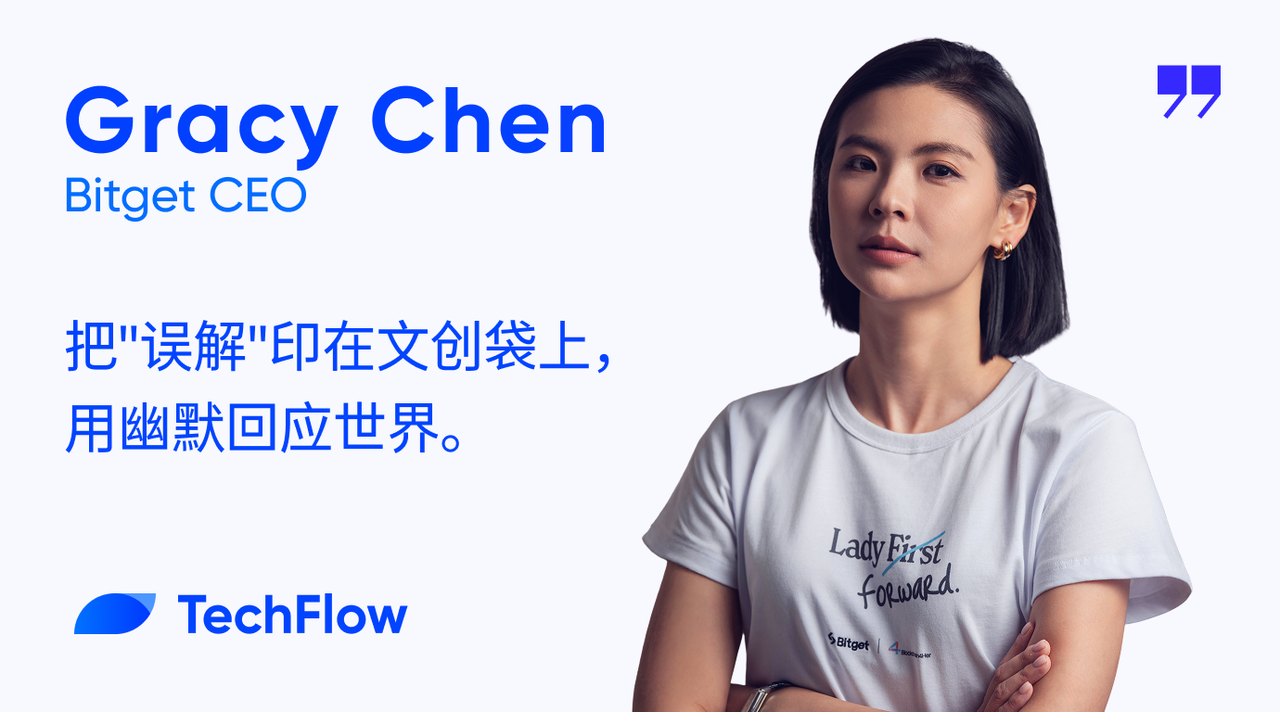
Facing Criticism Head-On: Printing "Misunderstandings" on a Canvas Bag
Q1: You often appear publicly in the Chinese-speaking market. In your view, which regions are Bitget's current primary focus? And how does the Chinese-speaking market differ from other regional markets?
Gracy: The regions Bitget focuses on are precisely the most active areas in the entire crypto industry.
The Chinese-language region accounts for about 25% to 1/3 of global market share in terms of user base and trading volume, comparable to the US market. The European English-language (EUEN) region has a large market size but is geographically fragmented, with diverse languages and cultures; the characteristics of Eastern and Western European markets are also completely different. In the derivatives trading sector, some East Asian countries stand out. However, looking at the spot market, the core regions mentioned earlier are the primary markets, while Latin America, Southeast Asia, and emerging European regions represent new business growth points.
Bitget has been deeply involved in the industry for over seven years, serving users across more than 100 countries and possessing a global operational perspective. Most core team members are of Chinese descent, and I myself grew up in a Chinese-speaking environment, with Chinese as my native language. Many team members come from traditional finance and Web2 tech industries, so our commitment to the Chinese-speaking market is unquestionable. It is the business region we know best and is also one of the world's major markets.
Q2: On Xiaohongshu, I see many posts about your travels and personal growth. How do you balance travel with your CEO responsibilities? And what's your favorite travel destination and why?
Gracy: It's refreshing to talk about something other than work all the time.
New Zealand was my travel destination during last year's National Day holiday. Christmas, National Day, May Day, and Spring Festival are major core holidays, and many team members take time off. Last National Day, I was invited to participate in and give a speech at a local New Zealand innovation and entrepreneurship competition. I also interacted with several local friends, including a fellow alum from my MIT days who is now a female member of the New Zealand Parliament, who even accompanied me on a tour of the New Zealand Parliament. I'm used to deep cross-border travel, typically staying five to six days per trip. In New Zealand, I stayed maybe seven or eight days, and it felt very immersive and delightful.
Regarding travel, for me personally and for our company, despite the intense work culture, we're even notoriously known for it, sometimes jokingly called the "Huawei of crypto." I want to clarify something: I accept that title, but it doesn't necessarily mean excessively long working hours. It's more about embodying a "work hard and play hard" spirit. For example, we don't require clocking in or coming to the office every day, even though we have offices worldwide. What we value more is the outcome. As long as results are delivered, you have a lot of flexibility.
Our team also needs time off, but you can't just disappear and neglect your work during holidays – we would mind that. So, my travels usually coincide with these kinds of holidays. This May Day, for instance, I'm going to Miami for Consensus, as we have some business matters in the US to handle this year.
For pure leisure travel, among the places I've visited so far, I might prefer exotic locations like Morocco and Turkey. If it's more about relaxing, I really like Italy. But there are still some places on my bucket list I haven't been to, like Tanzania to see the Great Migration, and more adventurous trips like the Arctic and Antarctic – I'm also looking forward to those.
Q3: On Xiaohongshu, you have content directly addressing negative comments. Which evaluations do you feel are the most misunderstood about you? And what is the truth?
Gracy: Haven't those bags of ours been quite popular these past couple of days? At this year's conference, since we didn't have a booth, our marketing team thought, "Let's create a mobile booth instead." They asked if I'd mind if they used my photo for a bag that could go viral. I agreed without a second thought. I recall one slogan was, "I'm very socially anxious, but this bag is very socially confident." So, one misunderstanding is that everyone thinks I'm super outgoing. I'm not antisocial, but recently, I've started to really enjoy being alone.

I think I'm an extrovert at heart, but this job has made me more introverted. I think the second misunderstanding is also reflected on that bag – "a show-off." So, we honestly printed these misunderstandings right on it. It's a way for me to respond. Plus, in such a competitive industry, I think capturing people's attention is a good thing. As they say, any publicity is good publicity.
On the other hand, society is quite tolerant nowadays. For example, people are quite accepting of female CEOs or female leaders who can be assertive, hold sharp opinions, be a bit dramatic, and also have a personal life. I think people also tolerate brands that try unconventional ways of doing marketing and communication.
But there was a controversial incident before: Bitget Wallet used a photo of a famous kissing scene in Dubai for a card. Our Wallet team had gotten permission from the two people involved, but it wasn't cleared by me at the time and was released directly. When I saw it, I also thought it was a bit over the line. Many netizens criticized it, so it was taken down.
My point is, from a company perspective, we encourage innovative thinking. And I think in this process of innovation, things like this are bound to happen; you need to find the right balance. I believe we must first encourage innovation. If we can't even tolerate small mistakes, then people will be afraid to innovate. And a brand's core communicative power and creativity often manifest in these very aspects.
Breaking Ground and Reshaping: UEX Strategy, the RWA Wave, and a New Trading Paradigm in the Age of Silicon-Based Life
Q4: Bitget has proactively listed assets like stocks, IPOs, and precious metals. I've heard that stock trading volume accounts for a significant portion for some exchanges. Could you share how user behavior and portfolio structure changed after Bitget launched traditional assets? From a data perspective, what percentage of Bitget's UEX plan would you say has been achieved?
Gracy: UEX is our long-term strategy, and aggregating various assets is just the first step. We've already seen shifts in the data. For instance, in Q1 of this year, non-crypto trading volume on our platform approached 40%. We've also noticed that user adoption of non-crypto assets in the UEX sector shows significant regional characteristics.
Taking US stock tokens as an example, users in regions with asset controls, foreign exchange restrictions, and difficulties opening US stock brokerage accounts show higher acceptance of our products. First, we do not operate in sanctioned countries like Iran; regardless of the offer, we won't profit from it. But conversely, it's true that in many regions where opening a US brokerage account is difficult, we become a natural choice for users wanting global asset allocation because they previously had no other channel. We aren't a nice-to-have; we are a necessity. So, these regions show this characteristic and demonstrate higher adoption rates.
Secondly, over half of Bitget's users are from Asia. The geopolitical conflicts in January-February this year caused significant volatility in precious metals and oil prices. Trading volumes would spike suddenly; on the highest day, gold trading volume on our platform nearly approached that of Bitcoin.
Since launching the UEX strategy last September, we completed listing a large number of US stock assets in Q4. In January this year, we laid out commodities like gold and oil, as well as forex assets, via CFDs. But users need an adaptation period for new products. Geopolitical conflicts and other unexpected events served as catalysts for improving user acceptance. Including when gold prices corrected significantly, user trading activity also increased. Coupled with leverage factors, we saw a certain scale of liquidations in the market, which is a normal phenomenon in highly volatile markets.
Looking at the UEX strategy now, I think we've only completed the first phase. In my definition, phase one is about achieving relatively comprehensive coverage of these assets. The next phase involves continuously optimizing the products we've already listed.
Let me give you an example. US stock tokenization is quite mainstream in the RWA world now. But projects like Ondo or xStocks have been doing this for almost a year. Although we launched around September-October last year, we still see many issues. For example, a major user question is whether dividends are paid or not. The mechanism design for dividends is not very transparent. Actually, dividends are given, but they aren't directly credited to your account. Instead, the underlying SPV uses them to buy back the asset, which is then reflected in the price. So you receive the economic benefit of the dividend, but you don't directly see the dividend payment. Because of this mechanism, the price of the underlying SPV (e.g., this tokenized product) might increase. If we hypothetically say Meta is at $500, after a dividend, it might become $510, but the underlying Meta is still $500. So users feel the price gap widening, which can be confusing. These issues are very subtle.
If you haven't done this yourself, or aren't a trader, you might not think of this problem. And it's exactly the kind of thing we need to continuously optimize in the second phase. For example, can we figure out a better dividend distribution method or make it more perceptible to users? And 24/7 or 24/5 trading sounds appealing, but how do you optimize liquidity on weekends when the US stock market is closed? There are many such problems we encounter when dealing with traditional assets.
Q5: I noticed Bitget recently launched IPO Prime. I understand it's a key step in the UEX strategy, extending from the secondary market to the primary market. What was the logic behind choosing Republic as a partner and launching preSPAX first? Compared to other exchanges' on-chain models, reservation models, or derivative models, what do you see as the advantages of Bitget's "compliant SPV + structured subscription" design?
Gracy: I wrote an article sharing some stories behind our collaboration with Republic. I've known the two co-CEOs of Republic Crypto for many years. A little anecdote: I was in a group with their co-CEO, Andrew, for a Dragonfly closed-door event because both our companies were invested by Dragonfly. We teamed up for various tasks and even won first place. It was a very fun experience that strengthened my ties with Republic and Andrew personally.
We planned to launch the Pre-IPO product last year. Knowing their deep involvement in this area, I asked our team to talk to Republic. But we didn't make a decision just because Gracy and Andrew have a good relationship. Objectively speaking, the team conducted thorough market research, and ultimately, the choice fell on Republic. They have extensive licenses, including in the US and many parts of Europe. They've also successfully listed Pre-IPO tokens for US stocks with other exchanges and encountered some pitfalls along the way. Those experiences helped us refine our product design, for example, avoiding risks in word choice. For instance, in our promotions, we emphasize it's a debt instrument, not equity, although a third-party SPV does hold the equity. For external communication, we have certain compliance-related risk controls in our messaging.
Our core reasons for choosing Republic were: first, their licenses; second, their existing experience; and third, their transparent mechanisms. Republic's Pre-IPO product is trickier than standard US stock products because a company's IPO timeline and price are uncertain. Take our current offering, SpaceX. When will it go public? Only Elon Musk can decide that. We've been designing this product since last year. But in February-March this year, SpaceX merged with xAI, acquiring Grok. This caused the SPV's potential partners selling secondary shares to suddenly halt or change prices entirely, requiring renegotiation. Many such details only become apparent when you actually build the product. And we offered it to users close to our cost price; we're not looking to profit on this product. It's more about providing a benefit to our users.
Many users ask: our valuation here is $1.5 trillion, while Reuters estimates a post-IPO valuation of $2 trillion, and some on-chain platforms already have trading valuations exceeding $2 trillion. So they wonder why Bitget is so cheap. Could there be risks related to 1:1 mapping? I want to explain that this is because our third-party SPV acquired and confirmed the valuation in the market six months ago. Essentially, users are getting this lower valuation due to a time lag—it's the valuation we secured six months ago, now offered at a current price point. So users are getting a bargain here; it doesn't mean the underlying asset isn't mapped. For us, 1:1 mapping is the most critical aspect of designing any RWA product. Regarding the Pre-IPO product mechanism design, we also ensure that once the IPO eventually occurs, the price of the "pre-sale" token will align 1:1 with the asset's stock token.
Q6: You mentioned in a previous interview that "the four-year cycle pattern still exists, but it has been 'smoothed out' by Wall Street capital represented by ETFs and DATs." The global market is reassessing macro risks faster. In this context, what impact does this have on exchanges, and what strategic shifts are you making?
Gracy: Yes, we've made significant strategic adjustments. Why did we conceptualize UEX? Because we found that pure Crypto was no longer satisfying our users' needs or our own development cycle. We see certain definite trends in the market that we need to capture.
The first is the growth of stablecoins. Stablecoins are attracting more and more traditional capital at a super-fast pace, including family offices and endowments, especially for cross-border payments. I was talking to a friend the other day, completely outside our industry, whose family runs many shops in Yiwu. He told me he was holding a lot of USDT. When I asked why, he said everyone in Yiwu uses USDT because it's the most convenient asset for cross-border transfers.
There are many similar scenarios. I'm confident people will hold more and more stablecoins, and the ratio of stablecoins to fiat will increase. We want to capture this incremental stablecoin trading volume. Since Bitget's core business is trading, while Bitget Wallet or our sister companies handle more payment scenarios, we believe that as stablecoins become more used for payments, they will also be used more for trading. So, this is the first opportunity we want to capture: trading with stablecoins.
The second opportunity is RWA. US stock tokens compared to actual US stocks are currently at 0.1%. For products like money market funds or private credit, RWA adoption might be at 0.5% - 1%. I believe the tokenization of US stocks will accelerate rapidly with the involvement


