a16z partner refutes AI doomsday theories: Don’t panic, technological change will grow the pie


- Core Thesis: The "doomsday" theories about AI causing mass unemployment stem from the "lump of labor fallacy," ignoring the historical pattern of infinite human demand and the new economic ecosystems catalyzed by technological progress. AI will boost productivity, expand the economic pie, and create more, higher-value jobs.
- Key Elements:
- Historical Paradox: Transformations like agricultural mechanization and electrification drastically reduced old jobs but ultimately unleashed productivity, giving rise to larger, more diverse new industries and employment opportunities.
- Data Support: Studies show that AI adoption currently has a limited net impact on total firm employment and is more often characterized as "augmentation" than "substitution"; Goldman Sachs estimates the augmentation effect far outweighs the substitution effect.
- Real-World Cases: After technological disruption in industries like travel agencies and bookkeeping, displaced workers moved into new fields, while those remaining saw higher pay due to increased productivity; AI is creating entirely new roles, like cloud migration specialists.
- Market Signals: In earnings calls, mentions of "AI as an enhancement" outnumber "AI as a replacement" by 8 to 1; hiring demand for roles like software engineers and product managers continues to grow, boosted by AI-driven efficiency.
- Trend Assessment: The surge in new company formation, exponential growth in application development, and a sharp increase in data concentration in robotics indicate that AI is ushering in a new era for knowledge work, not an end to it.
Original Author: David George
Compiled by: Felix, PANews
Editor’s Note: The current AI "doomsday" narrative seems to dominate public discourse, with fears of "AI taking our jobs" and "unemployment" spreading globally. People from all walks of life are also offering suggestions on how to deal with the disruptive changes AI is about to bring. However, a16z General Partner David George argues that the "doomsday" view is pure nonsense, lacking both evidence and imagination, and failing to understand human nature. The following is the full text.
The "permanent underclass" argument put forward by AI alarmists is unconvincing. This is nothing new; it's just the "lump of labor fallacy" in a new package.
The "lump of labor fallacy" claims that the total amount of work needing to be done in the world is fixed. It assumes a zero-sum game between existing workers and any person or thing that might do the same work (whether other workers, machines, or now AI). If the total amount of useful work to be done is fixed, then if AI does more, humans must necessarily do less.
The problem with this premise is that it contradicts everything we know about people, markets, and economics. Human needs and desires are far from fixed. Keynes, nearly a century ago, predicted automation would lead to a 15-hour work week, but history proved him wrong. He was correct about automation creating a "surplus of labor," but instead of resting on our laurels, we found new and different productive activities to fill our time.
Of course, AI will absolutely eliminate some jobs and compress certain roles (and there is evidence this may already be happening). The landscape of the labor market will change, as it inevitably does with every transformative technology. However, the notion that AI will lead to economy-wide, permanent unemployment is bad marketing hype, poor economics, and a gross ignorance of history. On the contrary, productivity gains should increase the demand for labor, as labor becomes more valuable.
Here are our reasons why.
"Humanity is Doomed?" Don't Be Ridiculous
We agree with the "doomsayers" on one point: the cost of cognition is plummeting. AI is becoming increasingly proficient at tasks once considered the exclusive domain of the human brain.
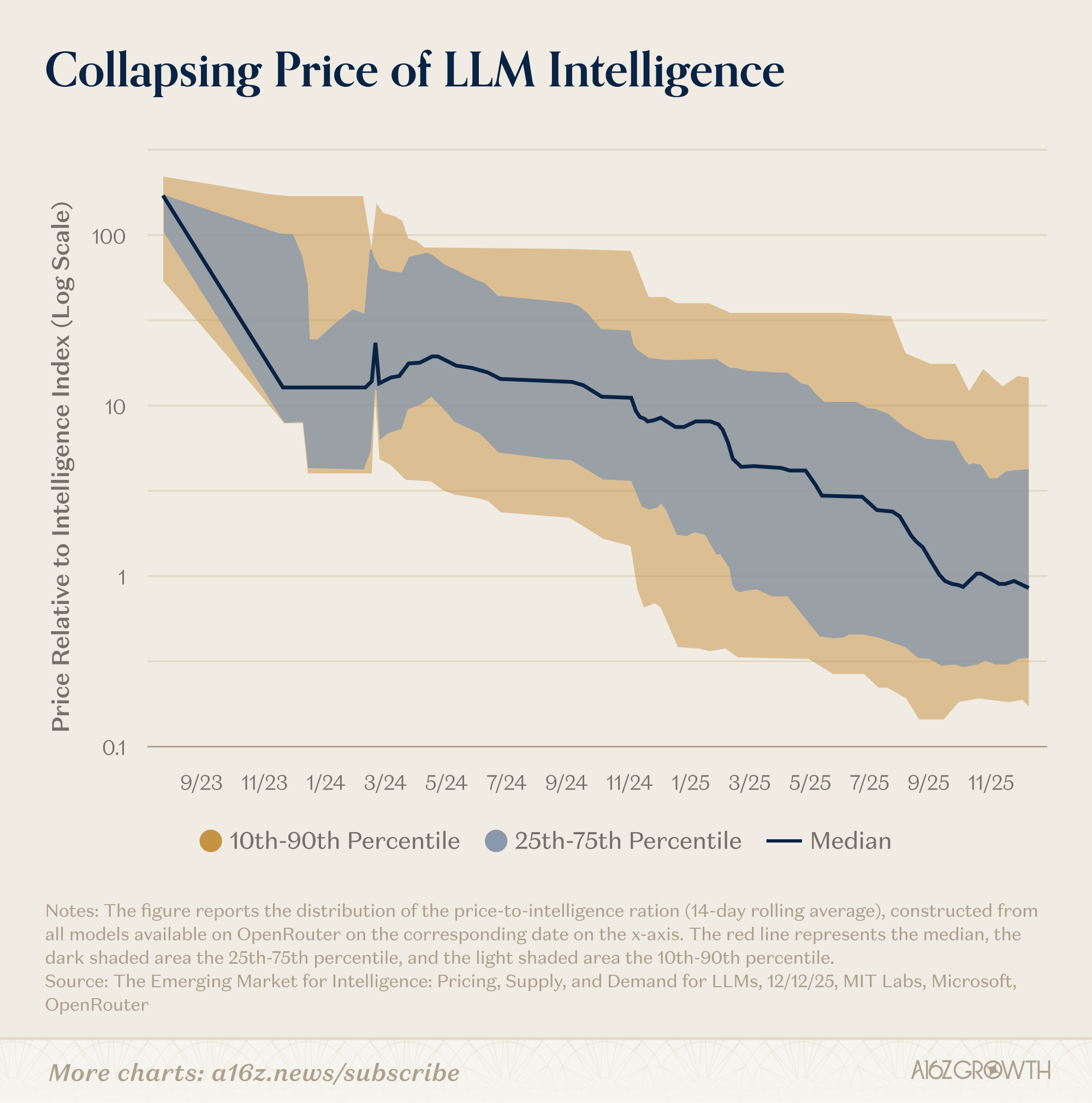
Doomsayers argue: "If AI can think for us, humanity's 'moat' disappears, and our ultimate value drops to zero." Humanity is finished. Apparently, we have already completed all the thinking we need or want, and now as AI takes on an increasing cognitive load, humans will gradually be phased out.
However, the reality is: precedent (and intuition) show that when the cost of a powerful input falls, the economy does not stagnate. Costs fall, quality improves, speed increases, new products become viable, and demand expands outward. Jevons paradox strikes again. When fossil fuels first made energy cheap and abundant, we didn't just put whalers and woodcutters out of work; we invented plastics.
Contrary to the doomsayers' view, we have every reason to expect a similar impact from AI. Since AI will shoulder an increasing cognitive load, humans will be freed up to explore new, larger frontiers than ever before.
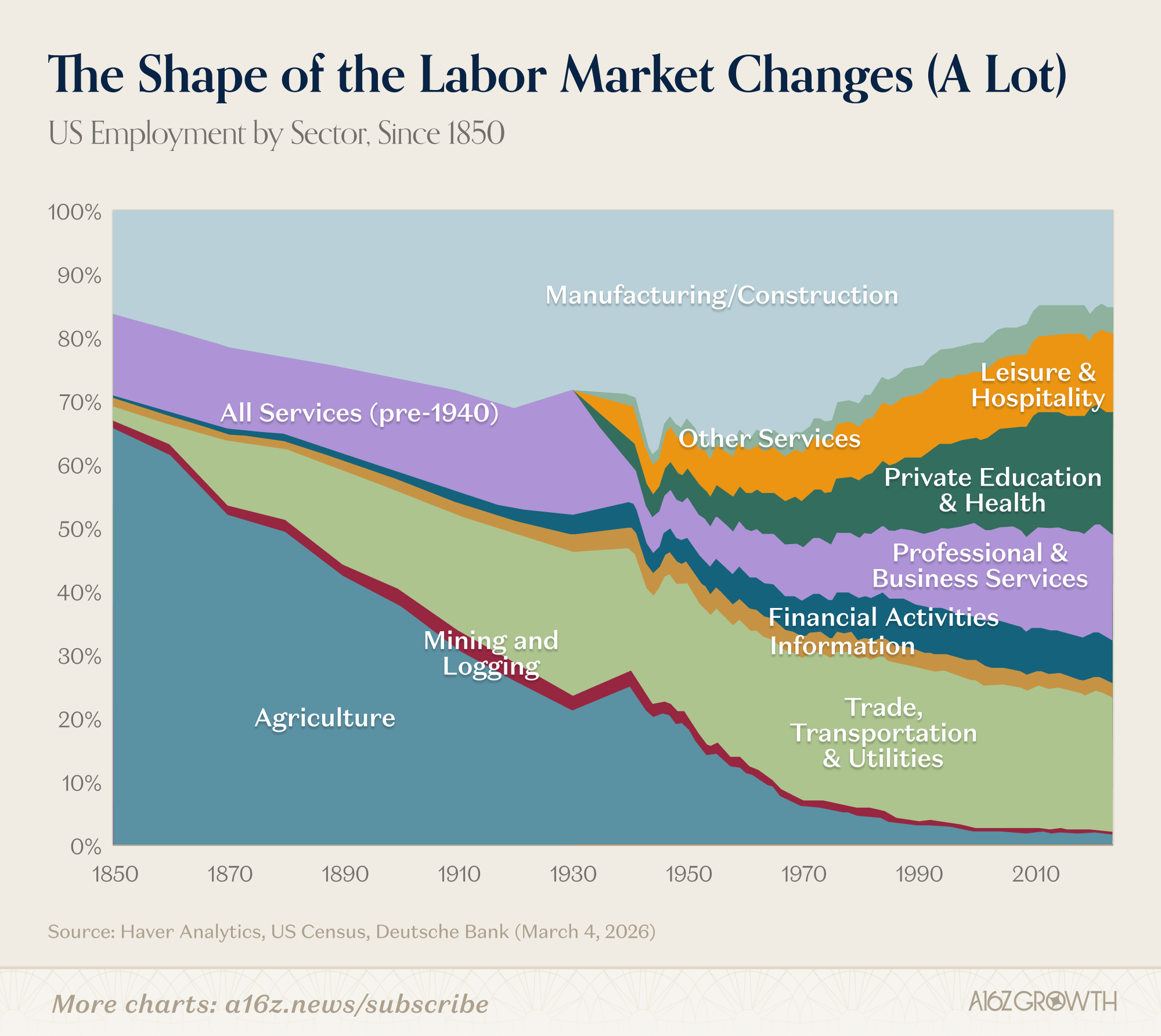
History has proven that technological change inevitably makes the economic pie larger.
Each "dominant economic sector" has been replaced by a larger successor... which, in turn, further expanded the scale of the economy.
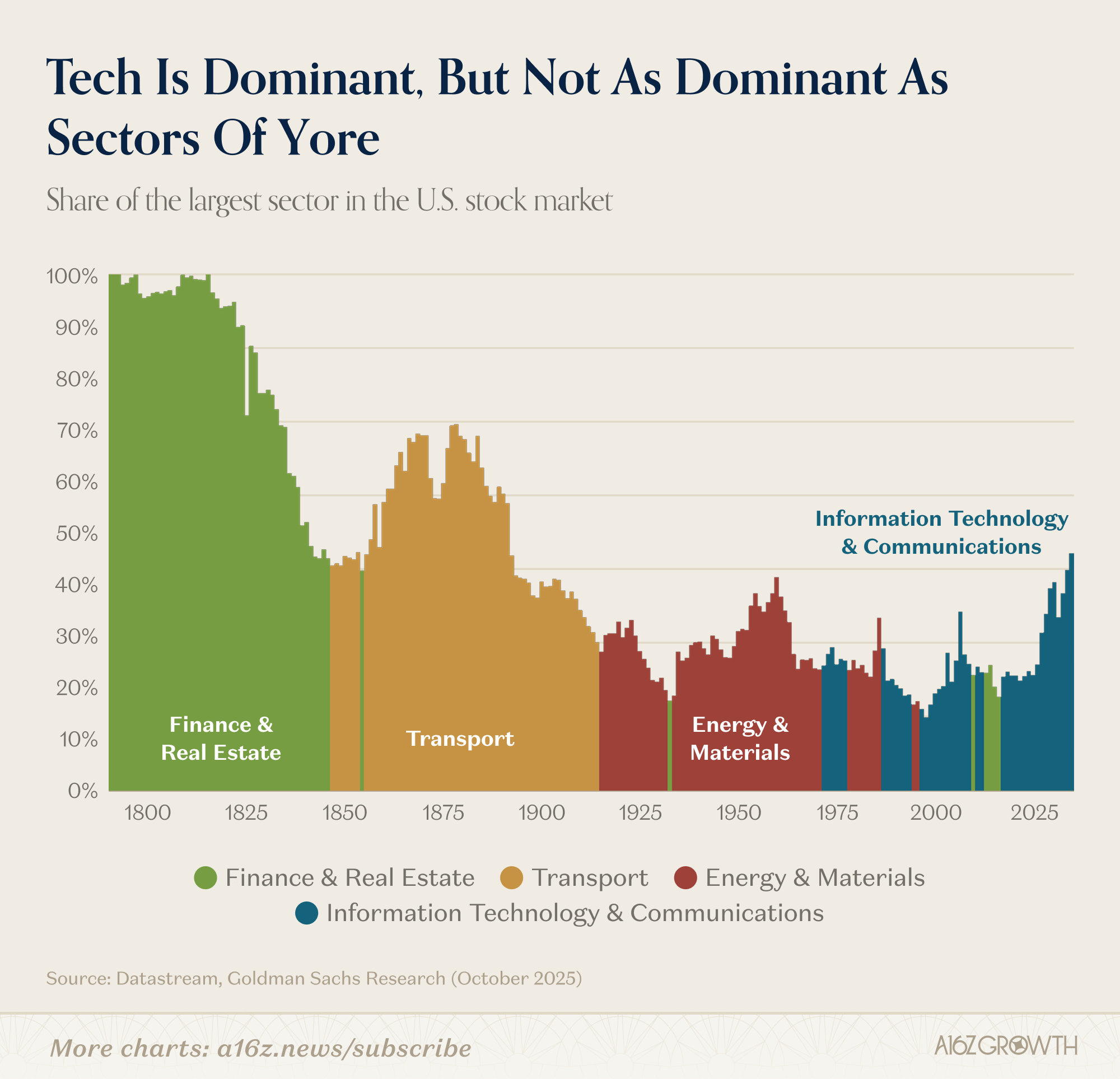
Today's tech sector is far larger than finance, railroads, or industry were in their prime, yet it still represents a relatively small portion of the overall economy or market. Productivity gains are far from a negative-sum game; they are a powerful force for positive-sum outcomes. Delegating so much work to machines ultimately results in a larger, more diverse, and more complex economy and labor market.
Doomsayers want you to ignore the history of innovation, focus solely on the sharp decline in cognitive costs, and accept that as the whole truth. They see task substitution and stop thinking.
"We'll increase cognitive output tenfold, but instead of doing more thinking, we'll just pat our bellies, eat an early lunch, and everyone else will do the same." This statement not only reflects a profound lack of imagination but also a failure to observe basic facts. Doomsayers call it "realism," but it is simply not going to happen.
The Failure of Luddism
(PANews Note: Luddism refers to a social movement in early 19th century Britain where working-class people destroyed industrial machinery to protest worsening working conditions and unemployment during the Industrial Revolution.)
Let's look at what actually happens when a massive leap in productivity sweeps through an economy.
Agriculture
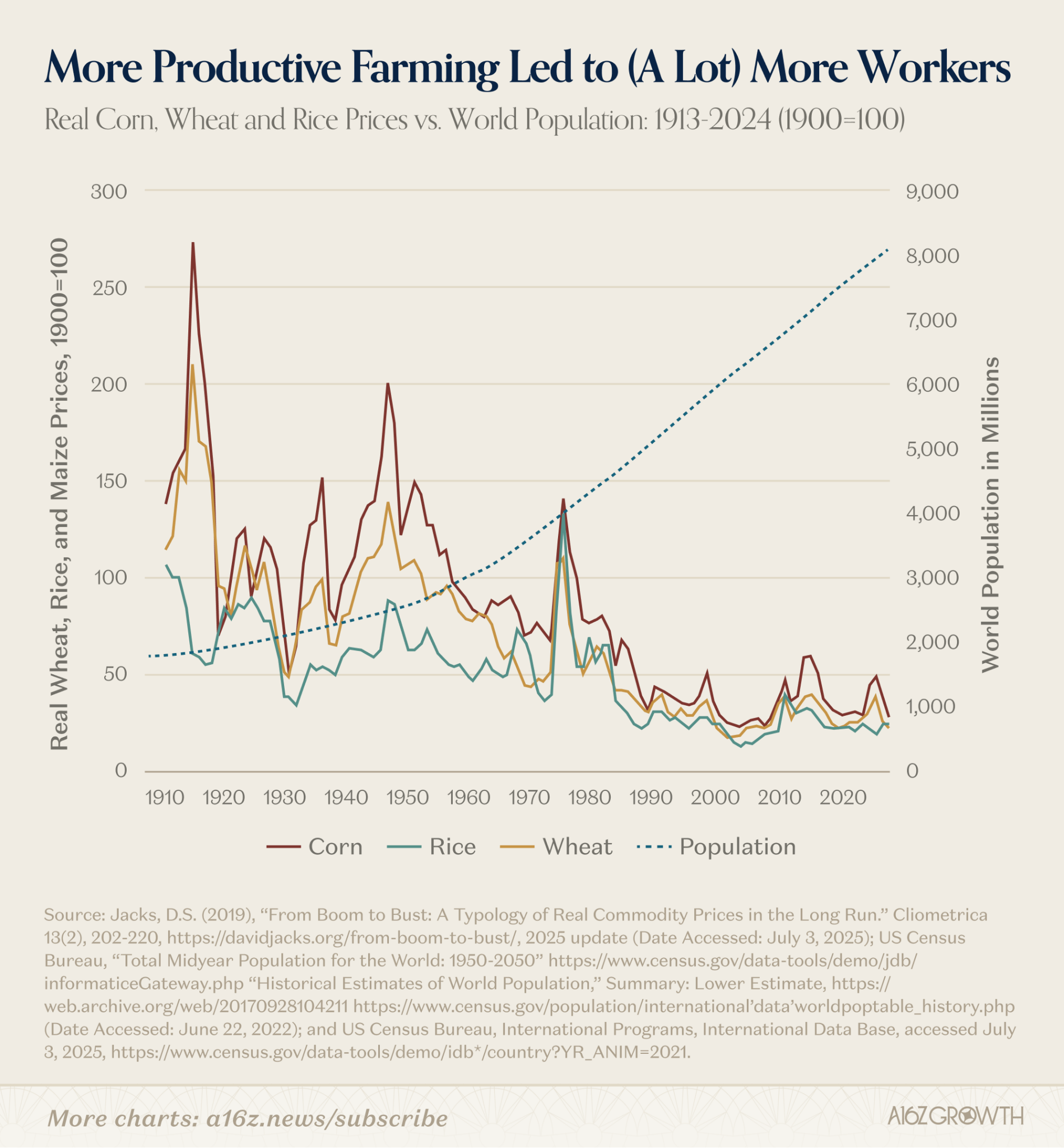
At the beginning of the 20th century, before the widespread adoption of agricultural mechanization, about one-third of the employed population in the United States worked in agriculture. By 2017, this figure had dropped to approximately 2%.
If automation caused permanent unemployment, the tractor should have completely destroyed the labor market. Yet it didn't. Agricultural output nearly tripled, supporting significant population growth. Instead of remaining permanently unemployed, these workers flowed into previously unimaginable industries, factories, shops, offices, hospitals, laboratories, and eventually into the service and software sectors.
So, yes, you can say technology disrupted the career prospects of the average farmworker, but in doing so, it also freed up a surplus of global labor (and resources) and spawned an entirely new economic system.
Electrification
The story of electricity is similar.
Electrification wasn't just swapping one energy source for another. It replaced driveshafts and belts with individual electric motors, forcing factories to reorganize around entirely new workflows, and spawned entirely new categories of consumer and industrial goods.
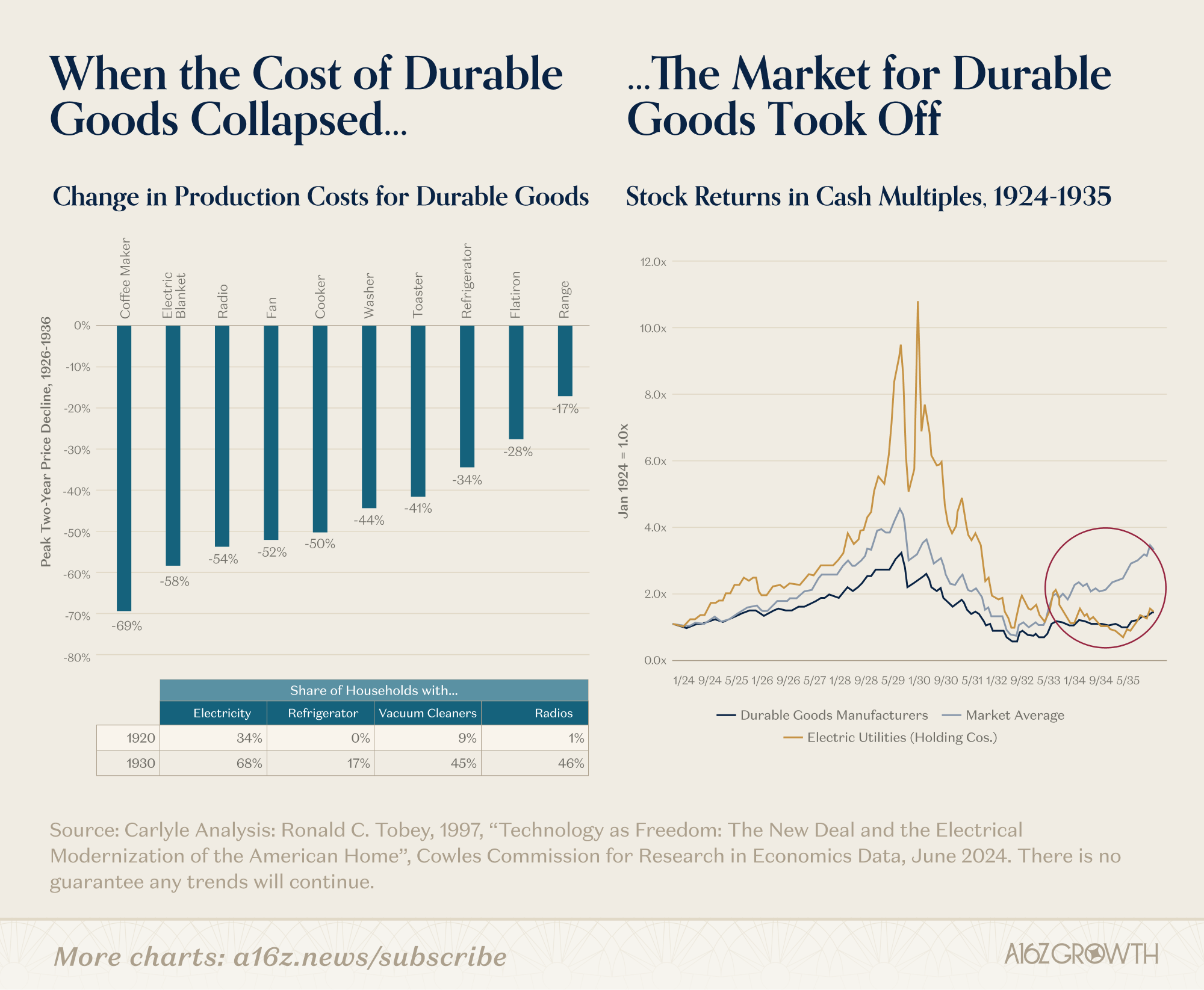
This is precisely what we expect during different phases of a technological revolution, as documented by Carlota Perez in "Technological Revolutions and Financial Capital": massive upfront investment and financial interests, a sharp drop in the cost of durable goods, followed by generational prosperity for their manufacturers.
It also wasn't an overnight process for electricity to realize its productivity advantages. In the early 20th century, only 5% of U.S. factories used electric power to drive machinery, and fewer than 10% of homes were electrified.
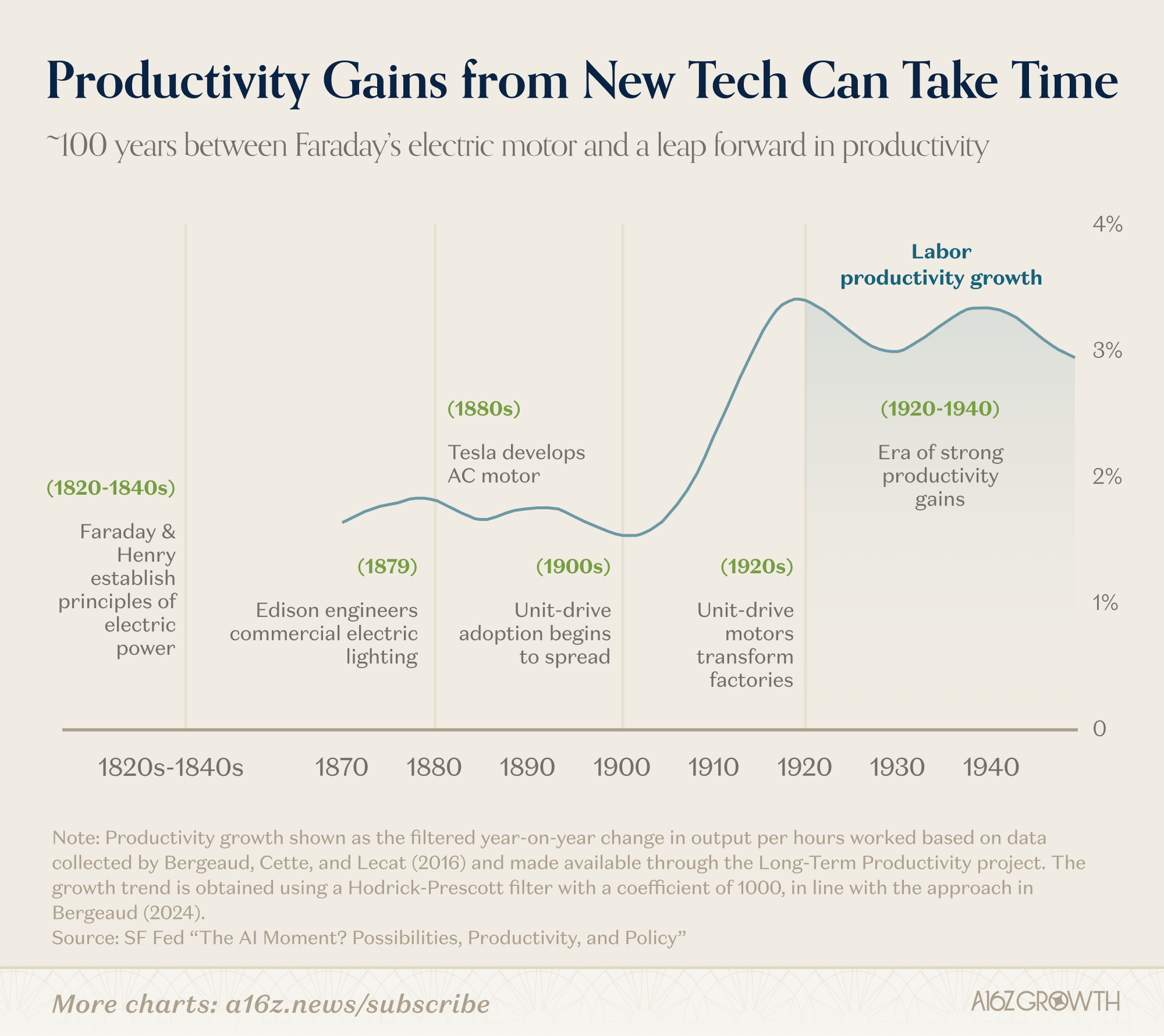
By 1930, electricity powered nearly 80% of manufacturing power, and labor productivity doubled over the next few decades.
Far from diminishing the demand for labor, these productivity gains led to more manufacturing, more salespeople, more credit, and more commercial activity, not to mention the ripple effects from labor-saving devices like washing machines and automobiles, which enabled more people to engage in higher-value work previously out of reach.
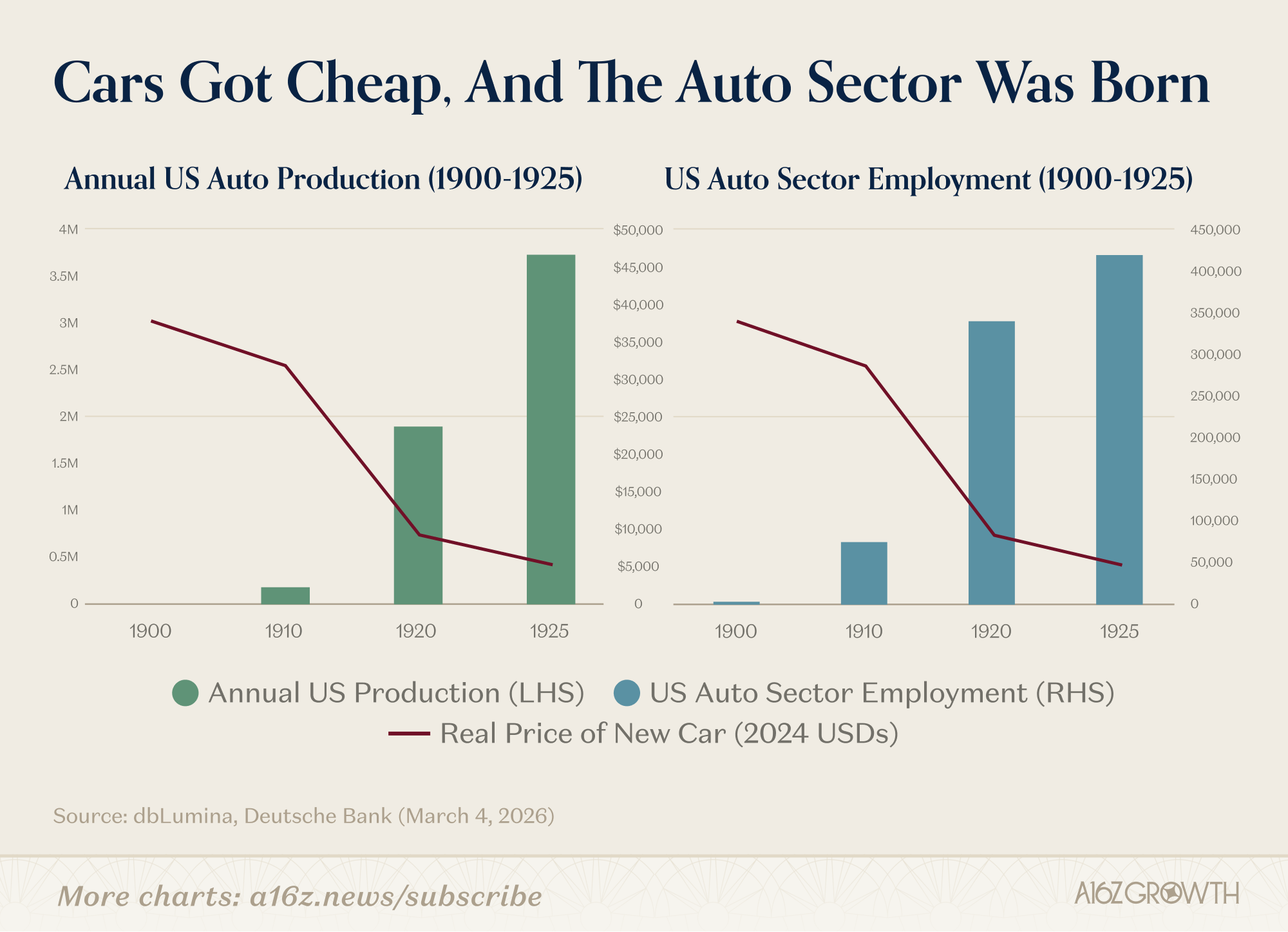
As car prices fell, both vehicle production and employment exploded.
This is the effect of a true general-purpose technology: it restructures the economy and expands the frontier of useful work.
We see this time and again. Did VisiCalc and Excel spell the end for bookkeepers? Absolutely not. If anything, vastly more efficient computing technology led to a surge in the number of bookkeepers and spawned the entire industry of Financial Planning & Analysis (FP&A).
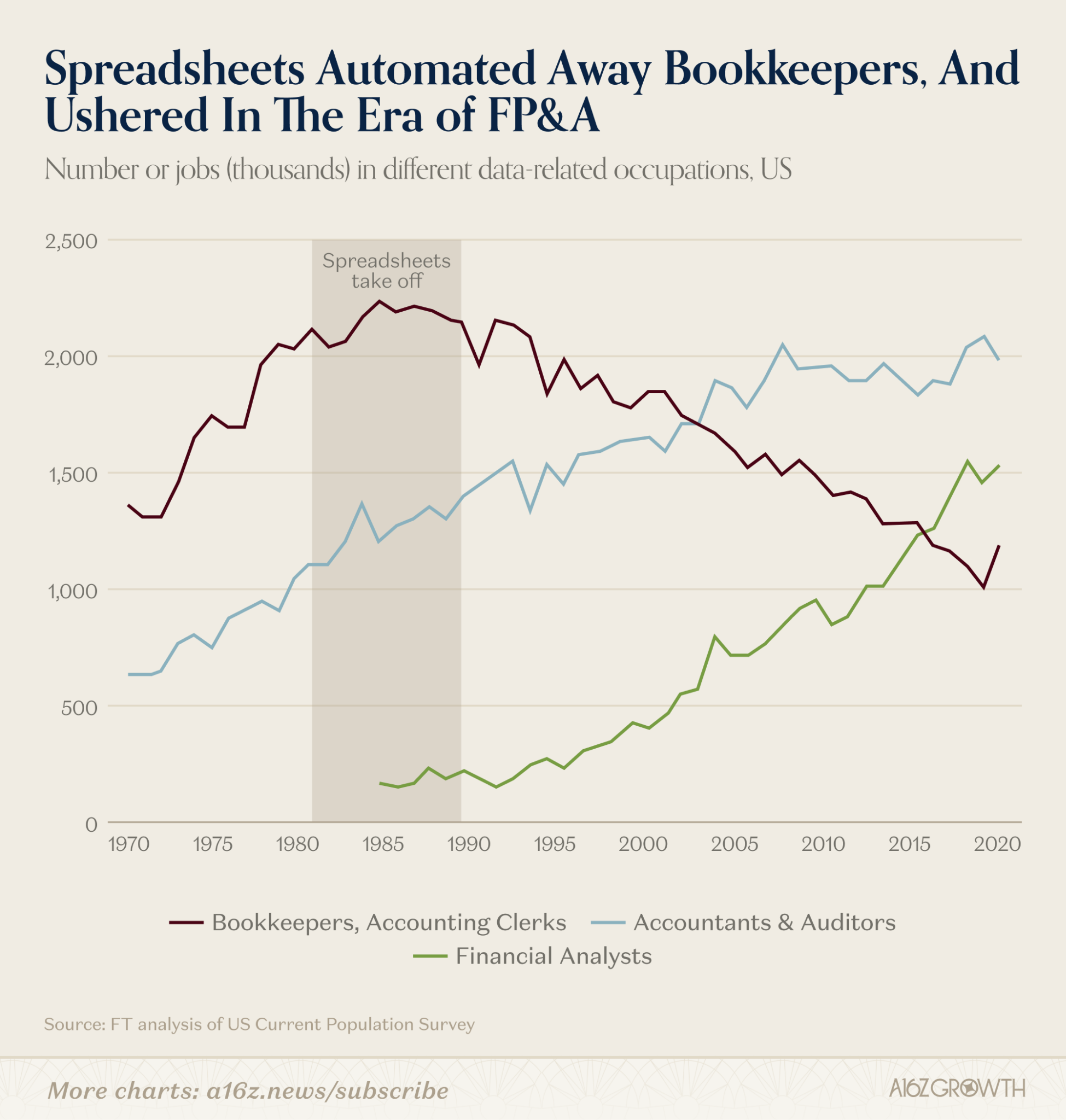
We lost about 1 million "bookkeepers," but gained about 1.5 million "financial analysts."
New Service Sector Jobs Created
Of course, job displacement doesn't always lead to job growth in related economic sectors. Sometimes, productivity gains translate into new jobs in completely unrelated industries.
But what if AI means some people become extremely wealthy while others are left far behind?
At the very least, the super-rich will have to spend their money somewhere, just as they did before, creating entirely new service industries from scratch:
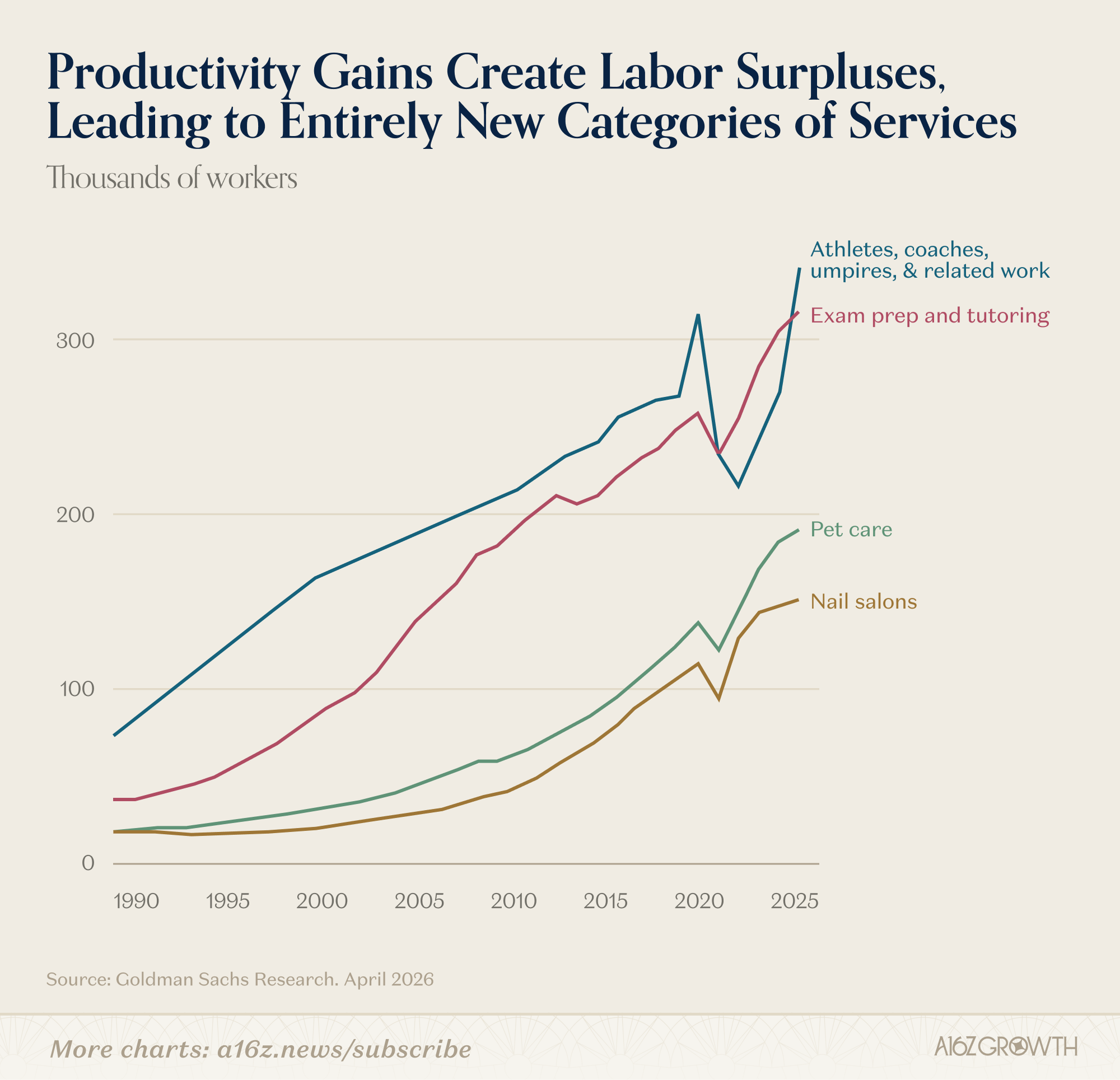
Massive productivity gains and the resulting wealth creation spawned entirely new areas of work that might never have existed without income growth and increased labor supply (even though these areas were technically feasible long before the 90s). Whatever one thinks of service industries catering to the wealthy, the ultimate outcome benefits everyone because increased demand leads to significant rises in median wages (thereby creating more "wealthy" people).
Stripe's internal economist Ernie Tedeschi provides a comprehensive case study of how technology disrupted, transformed, and reshaped the travel agency profession.
Did technology reduce the demand for travel agents? Yes.
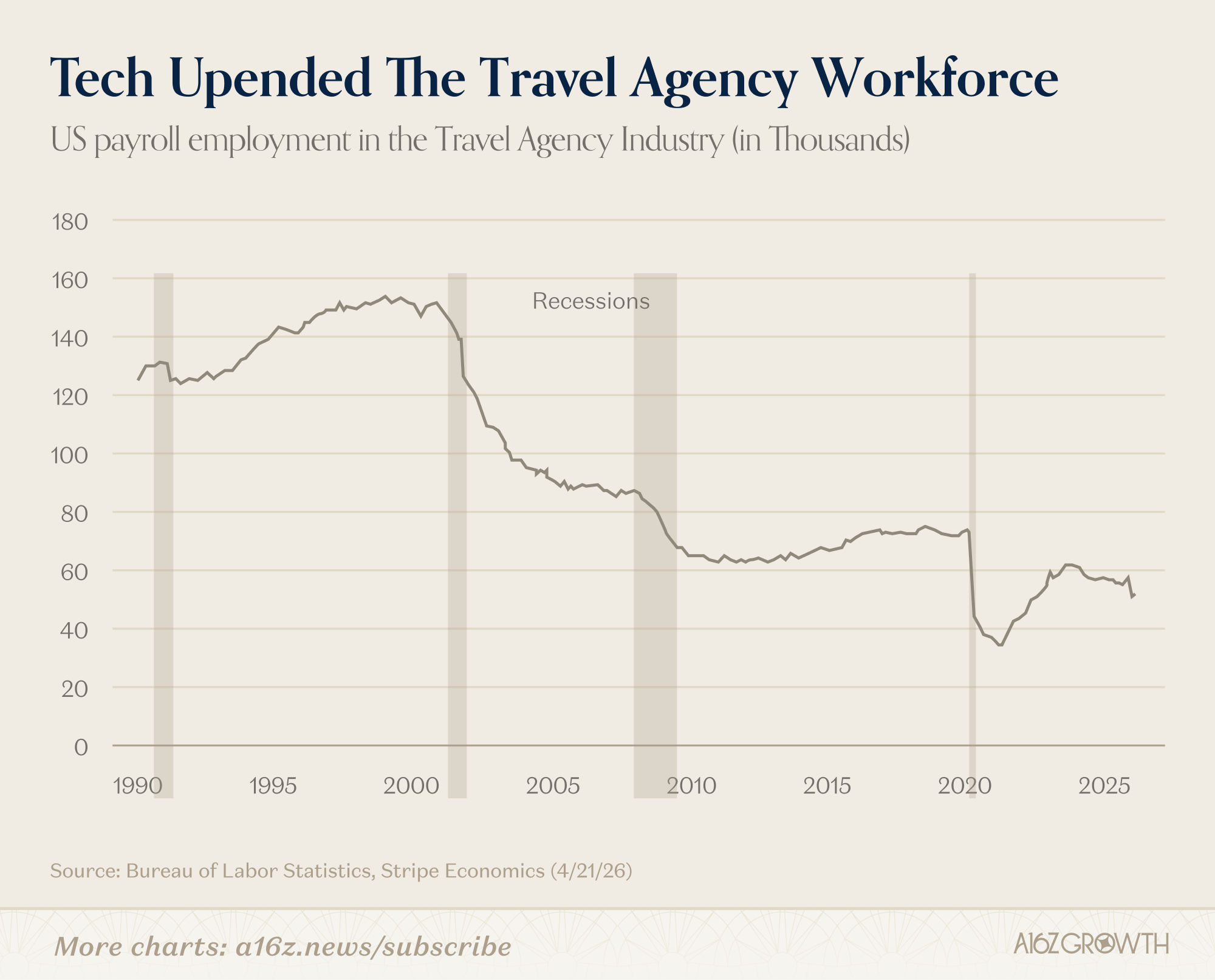
Today, the number of travel agent employees is about half of what it was around 2000, almost certainly due to technological advancements.
So, does this mean technology killed jobs? No, because travel agents didn't remain permanently unemployed. They found jobs in other areas of the economy, and the overall employment-to-population ratio for the working-age population is roughly the same as in 2000 (adjusted for population aging).
Meanwhile, for those who remained in the now tech-enabled travel agency industry, productivity gains translated into higher wages than ever before:
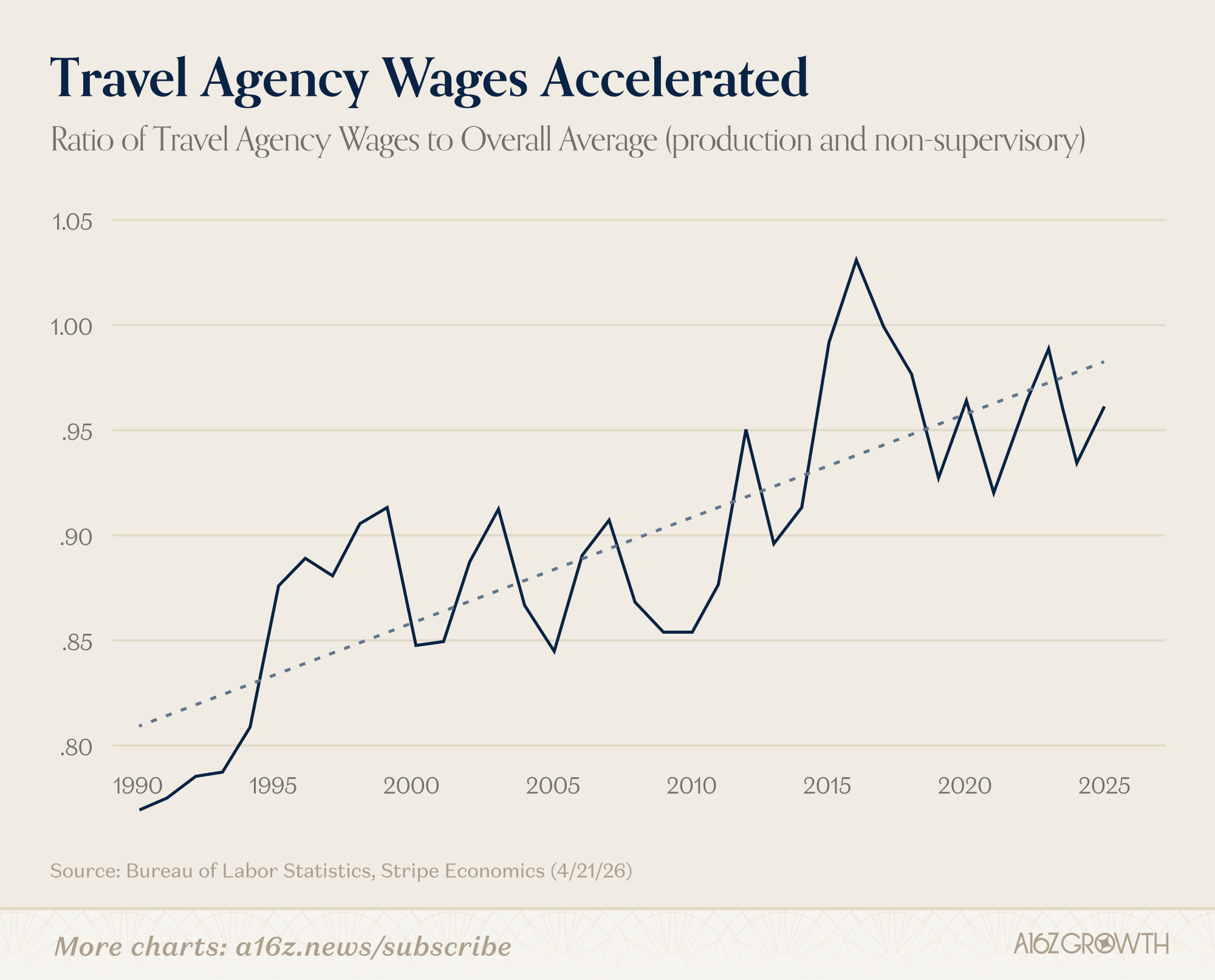
"At their peak in 2000, travel agents' average weekly wages were 87% of the overall average weekly wage. By 2025, this figure reached 99%, meaning travel agent wages grew faster than the rest of the private sector during this period."
Therefore, even though technology did impact travel agency employment, the overall employment rate for the working-age population remained stable, and the remaining travel agents are better off than ever.
Augmentation > Replacement (And Jobs Yet to Come)
This last point is crucial and again shows that doomsayers only tell a small part of the story.
For some jobs, AI poses an existential threat. This is true. But for others, AI acts as a multiplier: making those jobs more valuable. For every job at risk of AI replacement, there are other jobs poised to benefit:
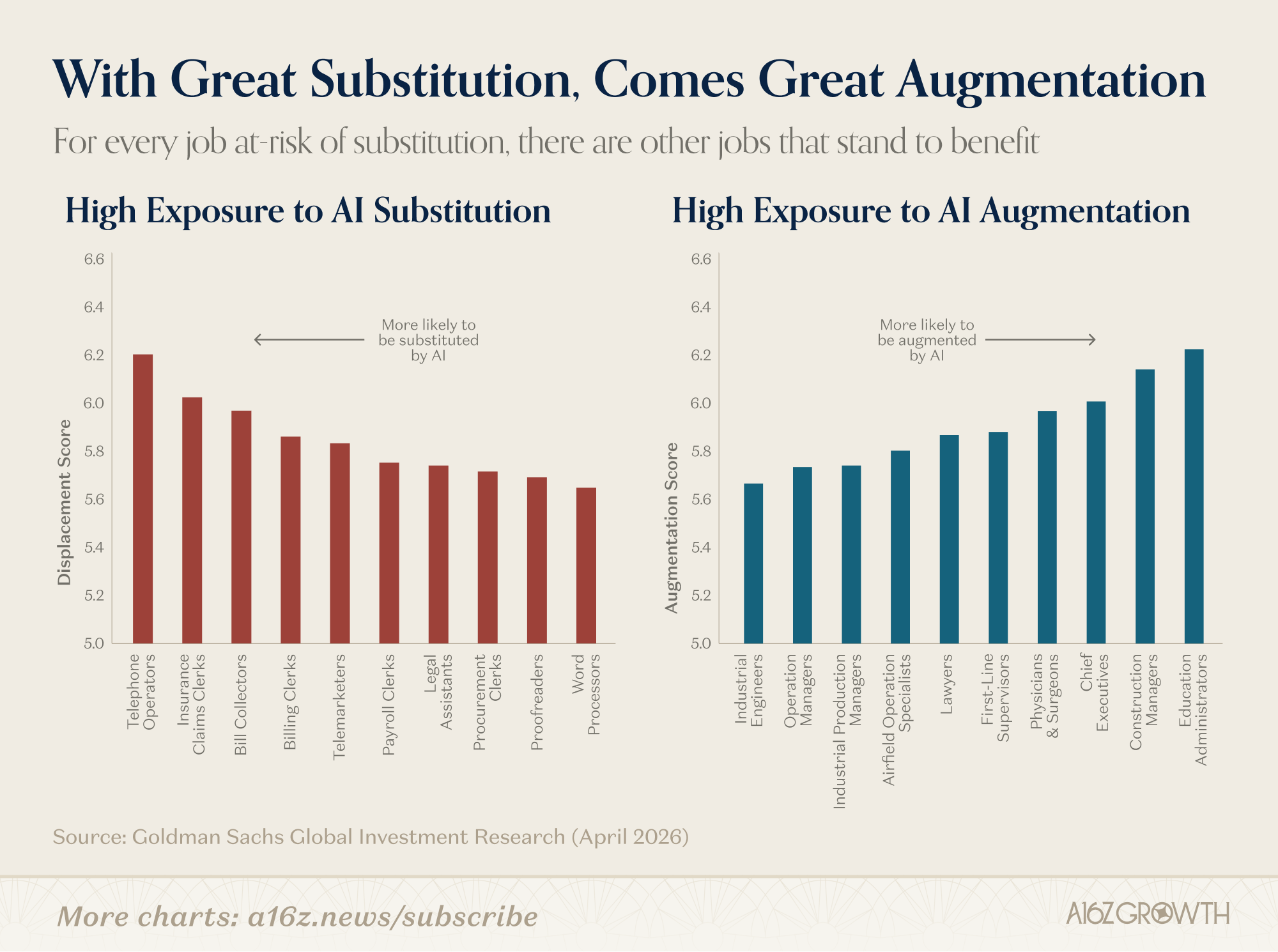
Goldman Sachs estimates the "AI replacement" effect to be far less significant than the "AI augmentation" effect.
It's also worth noting that management teams seem to focus more on augmentation than replacement:
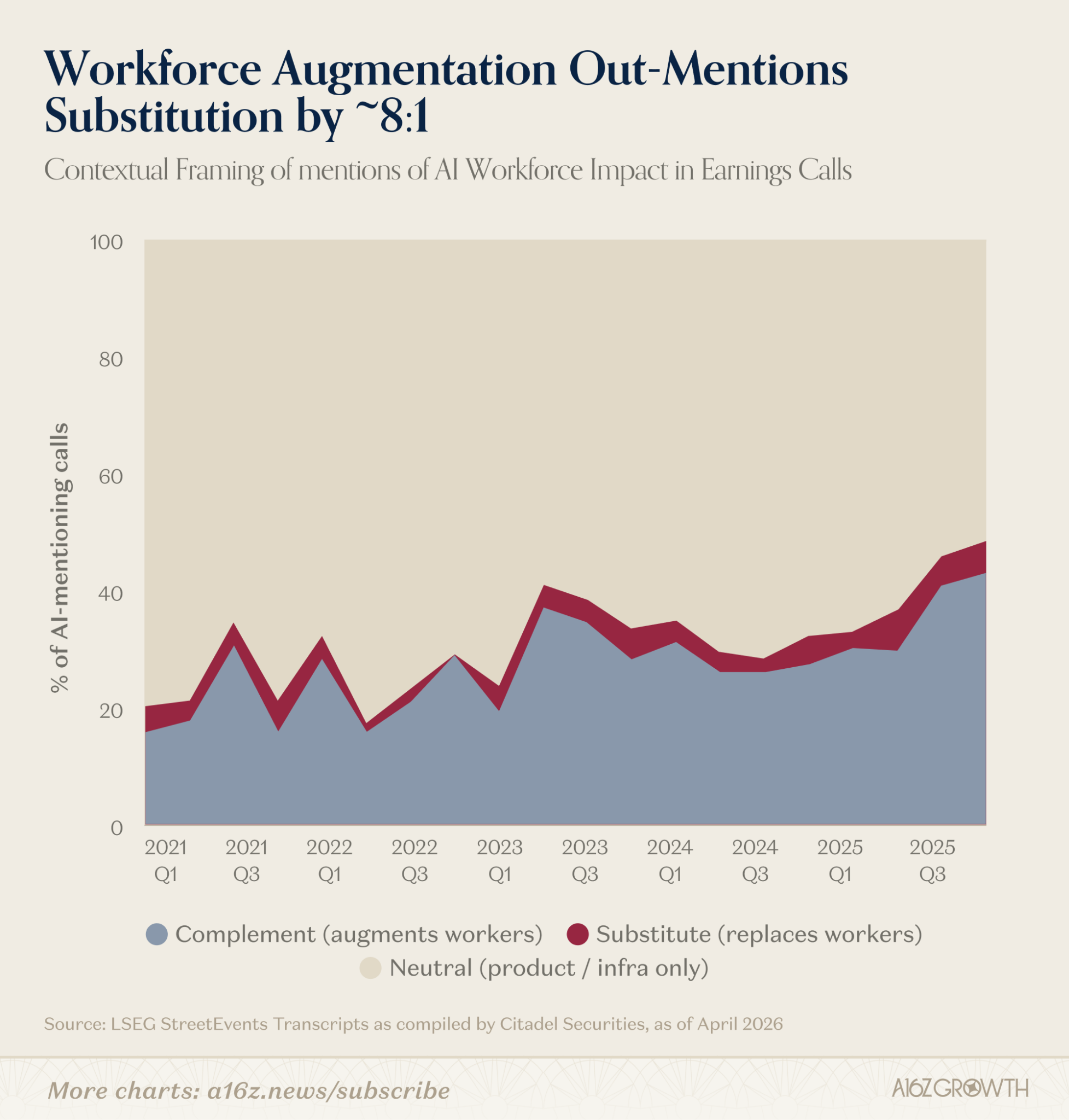
So far, mentions of "AI as augmentation" outnumber mentions of "AI as replacement" on earnings calls by about 8 to 1.
Although Goldman Sachs doesn't even include software engineers on its "augmented" talent list, they are perhaps the best example of AI-augmented professionals.
AI is a multiplier for coding. Not only have git push counts surged (as has the creation of new apps and businesses), but the demand for software engineers also appears to be rising:
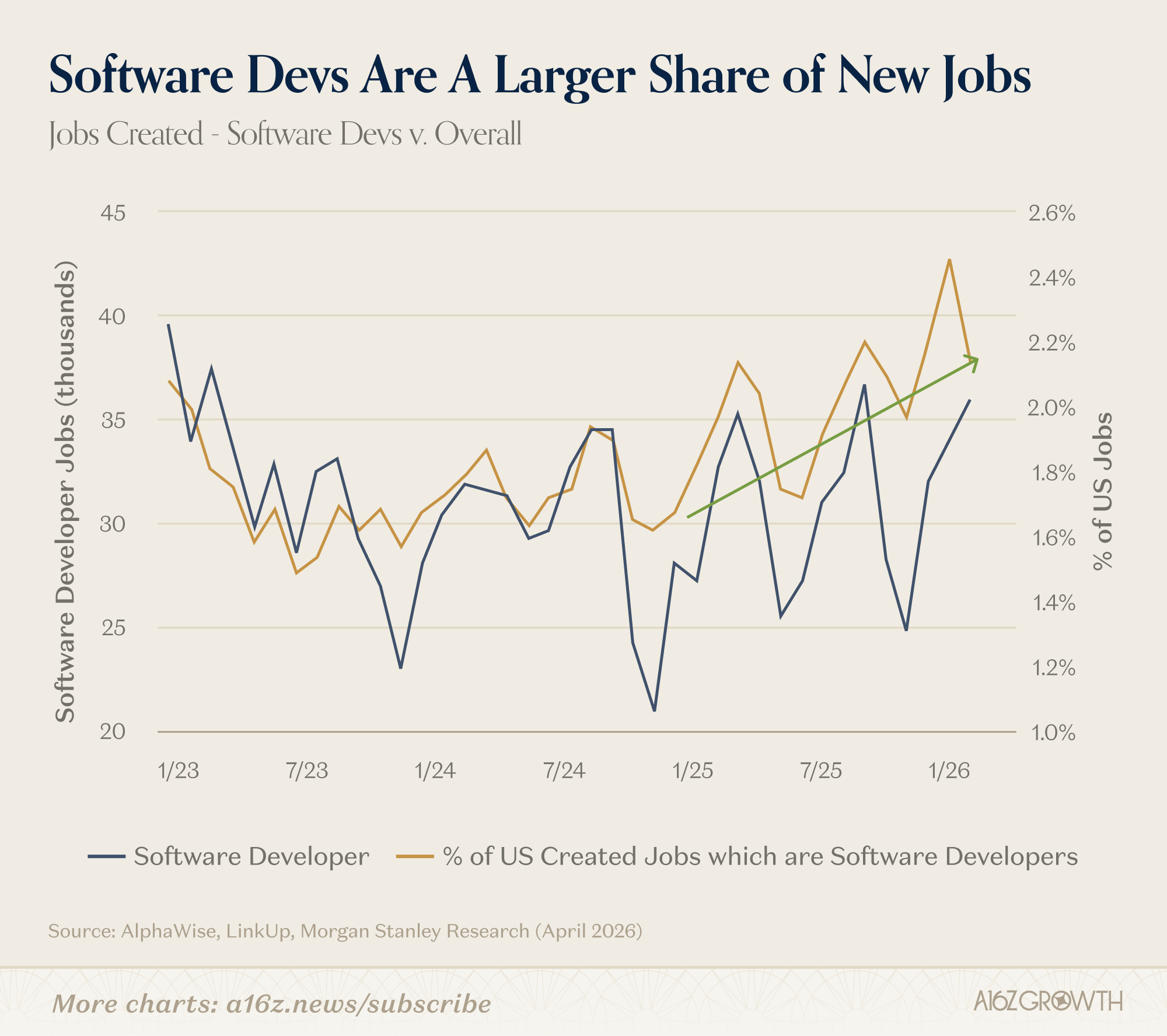
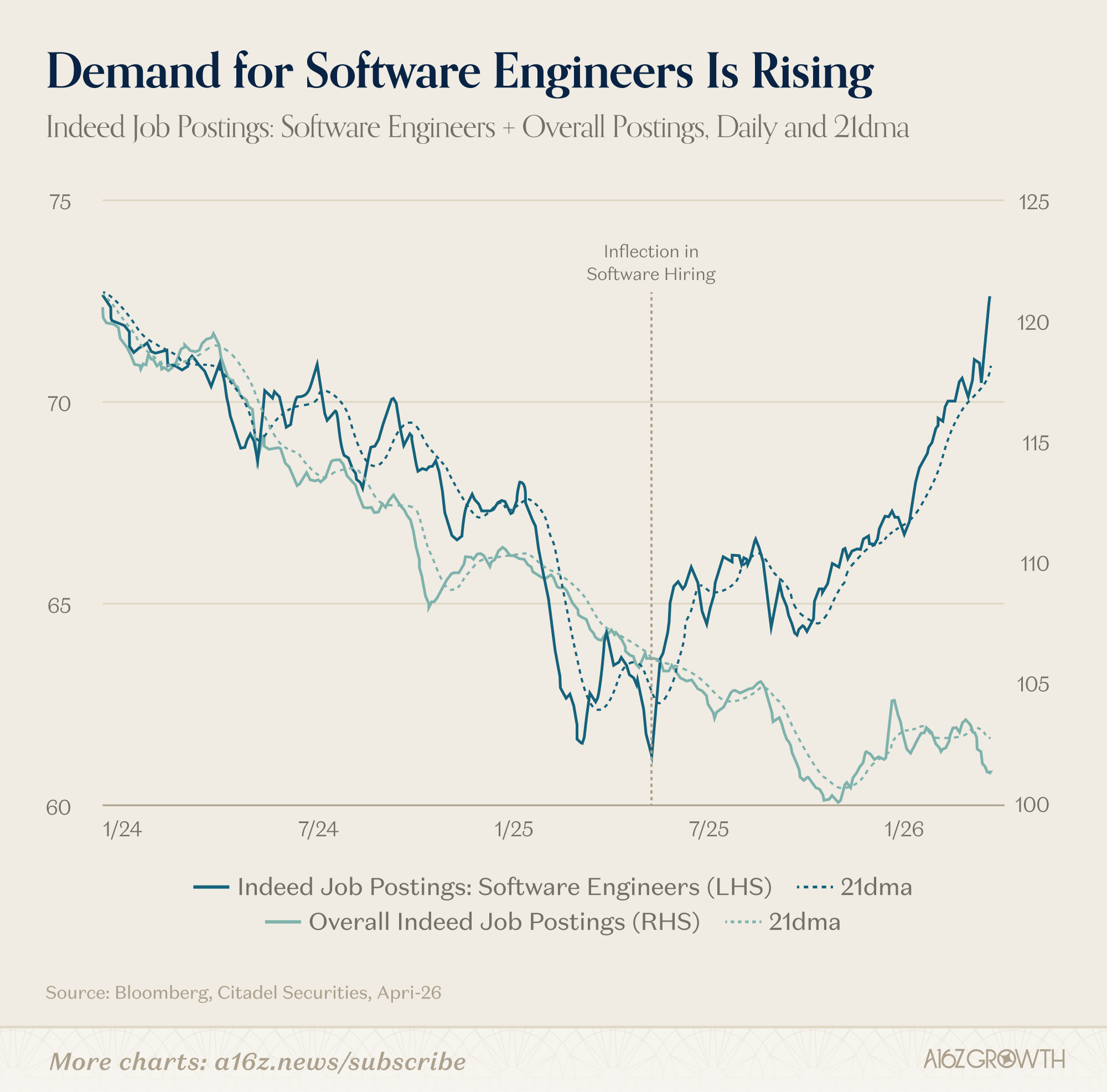
Since early 2025, software development roles (both in absolute numbers and as a percentage of the overall job market) have been steadily increasing.
Is this related to AI? Frankly, it may be too early to tell, but AI undoubtedly enhances software engineering productivity, not to mention that AI has become a top focus for executives at every company.
Given everyone is trying to figure out how to integrate AI into their businesses, it's unsurprising that companies are hiring aggressively, which inevitably elevates the value of some employees rather than diminishing it.
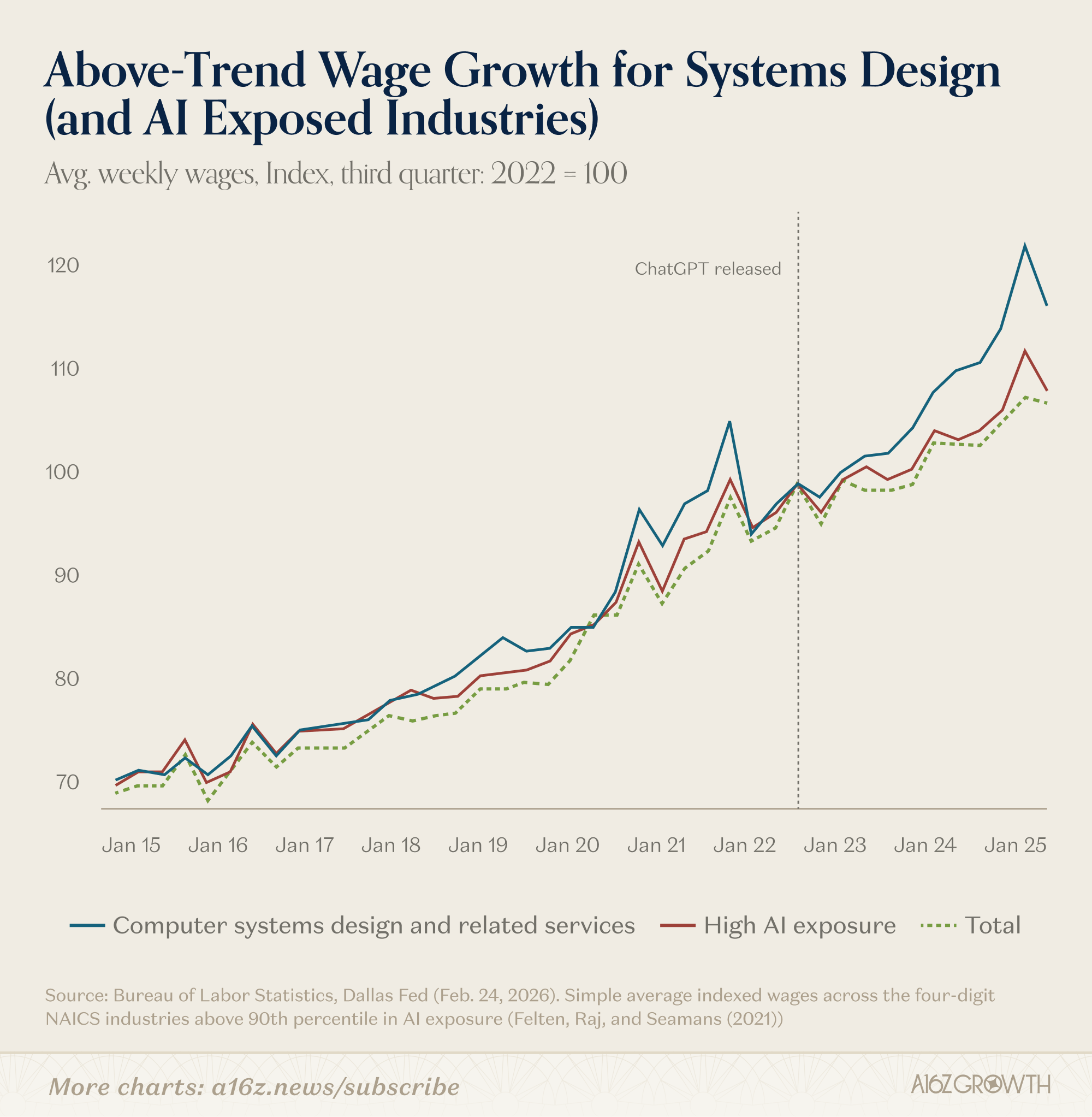
The proliferation of AI seems to be driving above-average wage growth (particularly in systems design).
These gains might be limited for now, but it's still early days. Opportunities will grow as expertise expands. Regardless, these are not the data points doomsayers want you to see.
Meanwhile, according to Lenny Rachitsky (founder of Lenny's Newsletter, a platform for tech insiders), the number of open project manager positions continues to climb (after a significant drop due to interest rate fluctuations), now higher than at any point since 2022:
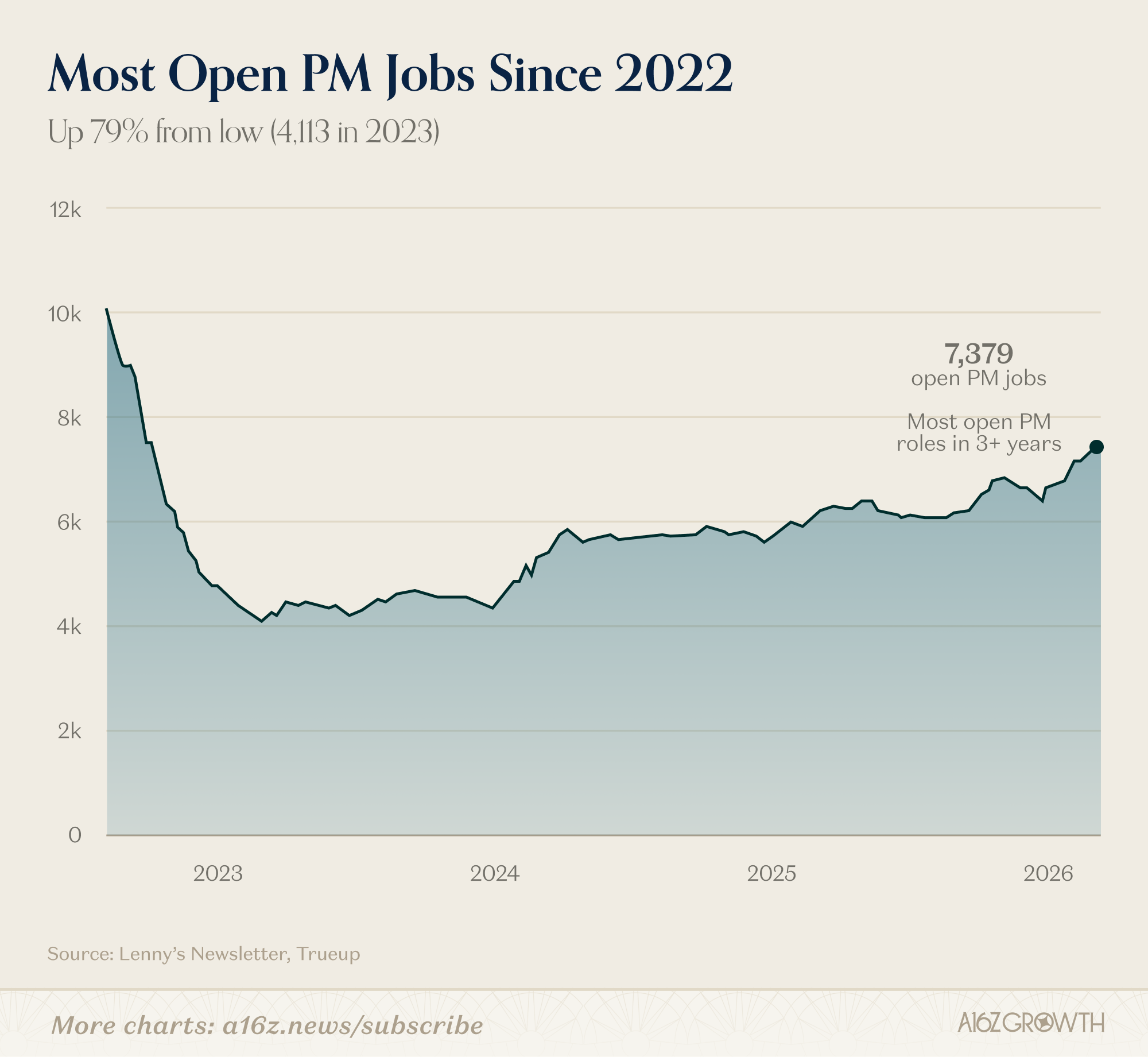
The concurrent growth in hiring for both software engineers and product managers is powerful evidence validating the 'lump of work' fallacy. If AI fully replaced human thinking, you might expect 'engineers need fewer product managers,' or vice versa. But we see demand rebounding for both, precisely because people are becoming more productive.
This is why the doomsayers' rhetoric fundamentally represents a failure of imagination. They only focus on the jobs that will be automated away, ignoring the demand for entirely new roles we haven't even conceived yet:
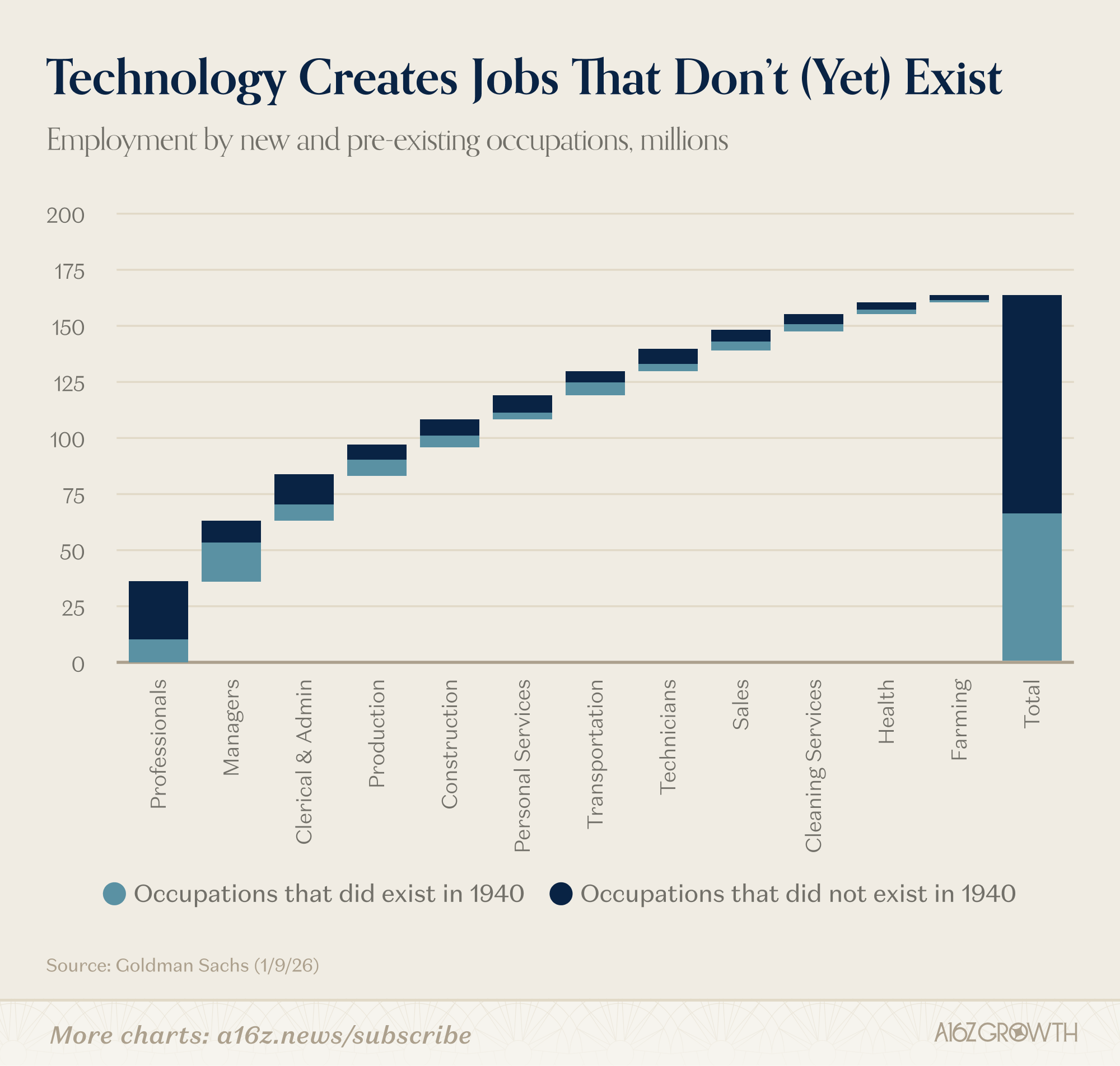
Most jobs created since 1940 didn't even exist in 1940. By the year 2000, it was easy to imagine travel agents becoming obsolete, but much harder to envision a mid-market tech services industry built around "cloud migration," as cloud adoption was at least a decade away.
What Does the Current Situation Look Like?
So far, we've mainly discussed theory and precedent, both of which support the optimists:

Exactly. Every productivity boost leads to increased demand or the reallocation of surplus resources to other parts of the economy. This means more jobs, many of which become significantly more valuable, and even jobs we've never heard of. If this time is different, the doomsayers need to provide stronger arguments, not just empty rhetoric.
It makes perfect sense that "job displacement" is not the end of civilization (quite the opposite). Human nature is to be restless. We finish one job and look for another.
But setting aside theory and precedent, what do the actual data say about AI and employment? While it's still early days (for better or worse), existing data does not support the doomsayers' view. If anything, it shows 'no significant change,' but there is also emerging data pointing in the opposite direction: AI creates more jobs than it displaces.
First, let's look at some academic research. This is not an exhaustive literature review, but a few examples of recent papers:
- "AI, Productivity, and Labor: Evidence from Firm Executives" (NBER Working Paper 34984): "Taken together, these results suggest that while the adoption of AI has not yet led to significant changes in aggregate employment, it has begun to reshape the distribution of tasks and occupations within firms. Specifically, routine clerical and administrative activities appear more susceptible to replacement, while analytical, technical, and managerial tasks are more often described as being complemented or augmented by AI."
- "Firm-Level Data on AI" (Atlanta Fed Working Paper 2026