






When AI Coding Starts Taking Over Everything, Why Is Ethereum Still Emphasizing Security and Decentralization?


- Core Thesis: Ethereum's core value lies not in pursuing极致 performance, but in serving as a "public bulletin board" and "computation layer," providing verifiable, decentralized, and self-sovereign trust infrastructure. In the AI era, this value will be amplified, serving as a defense against the dilution of user sovereignty in exchange for efficiency.
- Key Elements:
- Ethereum is positioned as a "public bulletin board" and "computation layer." The former ensures public verifiability of information publication and ordering, while the latter supports the creation of decentralized digital objects, distinguishing it from traditional, efficient but centrally trusted servers.
- The focus of scaling has shifted from increasing TPS to preserving verifiability and decentralization in complex scenarios; the historical mission of L2 is no longer simply to divert transactions but to serve as a functional extension and forward outpost for Ethereum's public base layer.
- Security and decentralization are Ethereum's raison d'être. If it sacrifices the ability of ordinary users to run nodes and verify state for speed, it will degrade into a less efficient centralized service.
- AI will lower the barrier to entry, but natural language interaction may shift user trust from "trusting the platform" to "trusting the model." Ethereum's value lies in providing a verifiable trust infrastructure for the AI era, rather than a more efficient yet uncontrollable black box.
- The role of the wallet will evolve from a signing tool to a permission management layer, where users set boundaries for AI Agent's automated execution, asset call permissions, and security reviews, retaining the ability to revoke and self-protect.
- The Ethereum Foundation's EF Mandate proposes the CROPS principles (Censorship Resistance, Open Source, Privacy, Security), emphasizing that decentralization is about protecting user sovereignty from implicit dilution in the AI era, not merely the number of nodes or consensus mechanisms.
- In the future roadmap, AI is incorporated into the technical context for generating code proofs and assisting formal verification, addressing the risk of code vulnerabilities as on-chain assets increase, becoming part of protocol security engineering.
At the Hong Kong Web3 Carnival, Vitalik Buterin predictably brought up that perennial question: What exactly does Ethereum want to become?
In reality, over the past few years, the crypto industry has grown accustomed to discussing public chain competition through performance metrics. For instance, whoever has a higher TPS, faster confirmation speed, or lower gas fees is more readily perceived as the "next-generation infrastructure," and so on...
But by 2026, whether it's Ethereum or new public chains, the challenges they face are no longer limited to internal topics like DeFi, NFTs, L2 scaling, and on-chain finance — AI Coding is rapidly absorbing everything, and progress in formal verification and zero-knowledge proofs has also been significant.
This signifies that the world confronting public chains is undergoing new changes. So, do we still need a public infrastructure that anyone can verify, exit, self-custody, and that cannot be controlled by a single point?
And how exactly is Ethereum thinking about and preparing for this?
1. What is Ethereum for: Bulletin Board and Computation
"Ethereum is not built to compete with high-frequency trading platforms. Ethereum is not meant to be the fastest chain. Ethereum aims to be the secure chain, the decentralized chain, the chain that stays online, the chain you can always rely on." In this talk, Vitalik reinterpreted Ethereum's value using two very fundamental concepts: First, Ethereum acts like a "public bulletin board"; second, Ethereum provides "computation" capabilities.
These two simple concepts not only encapsulate the new direction for Ethereum that we've been articulating recently but also almost entirely summarize the fundamental reason Ethereum differs from ordinary internet services.
The so-called public bulletin board is not an abstract metaphor. It means applications can post messages on Ethereum, and everyone can see the content and order of the messages posted. These messages can be transactions, hash values, encrypted data, or any other information requiring public commitment, ordering, and verification (read more: From 'World Computer / Settlement Layer' to 'Bulletin Board': What Do Ethereum and Vitalik Want to Do?).
This is also the most fundamental difference between Ethereum and ordinary servers. Servers can be faster, cheaper, and more efficient, but they typically require users to trust that the operator won't tamper with records, refuse service, or shut down the system at a critical moment. Ethereum aims to provide precisely this capability.
Computation, on the other hand, refers to Ethereum allowing people to create shared digital objects controlled by code. These objects can be ERC-20 tokens, NFTs, ENS names, or DAOs, on-chain organizations, financial protocols, and other more complex applications.
Therefore, by 2026, if one still only understands Ethereum through the lens of "performance," or merely compares TPS, gas costs, and confirmation speeds with new public chains, it's easy to miss the real problems Ethereum is about to solve.
The focus of public chain scaling in the coming years is no longer just about "making the chain faster," but about how to maintain verifiability, decentralization, and user self-sovereignty within more complex application scenarios. In other words, scaling isn't about transforming Ethereum into another centralized high-performance system, but about enabling more applications to run without compromising the underlying trust assumptions.
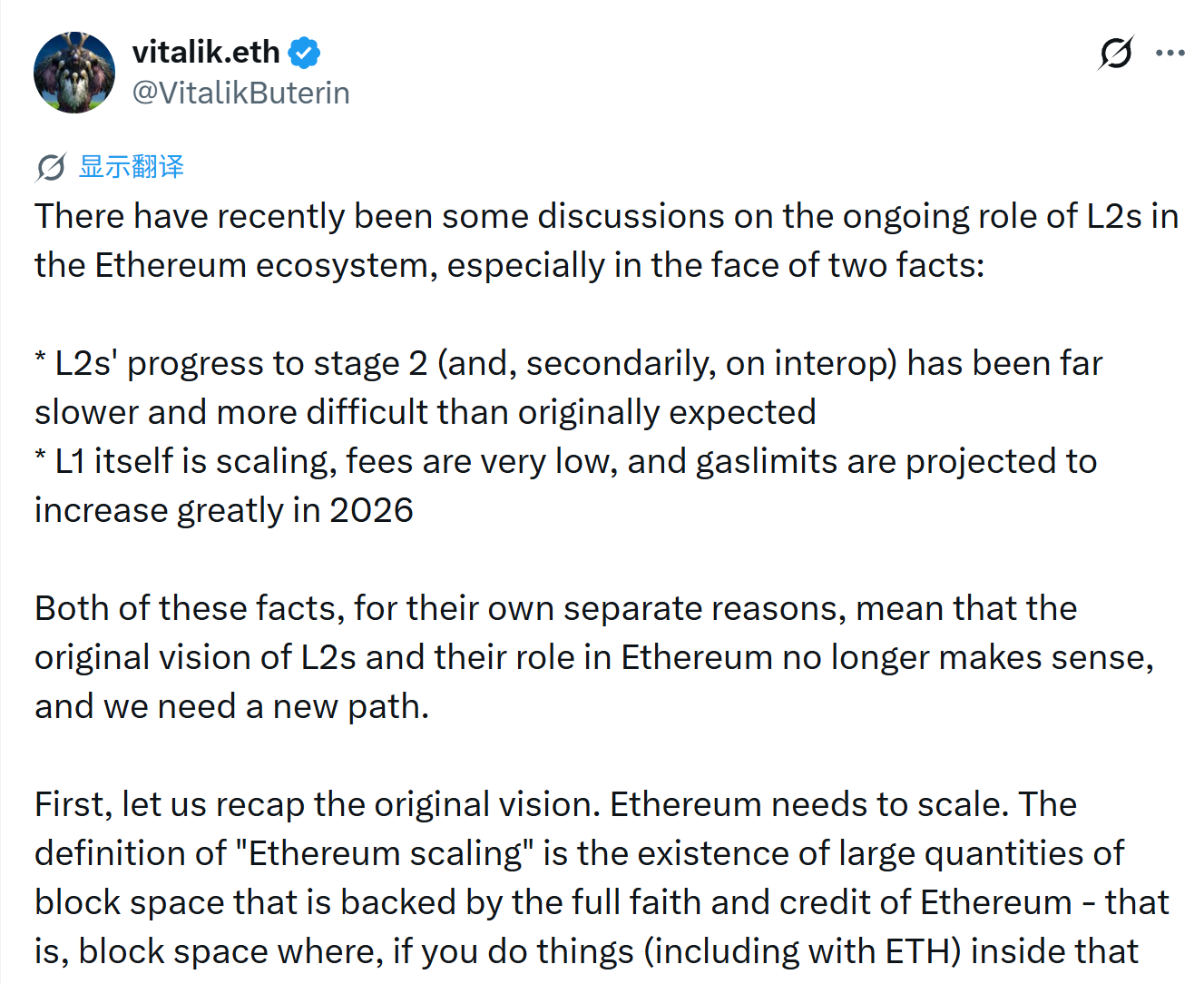
This is also the key reason Vitalik has been re-evaluating L2s since the beginning of this year.
Simply put, he feels the market has been more accustomed to viewing L2s as Ethereum's scaling tools—like when the mainnet is expensive or congested, users migrate more transactions to L2s. But now that L2s have essentially fulfilled their historical mission for a phase, they shouldn't just remain at the "transaction offloading" level. Instead, they should become the front line for extending Ethereum into more diverse application scenarios.
This judgment is particularly important for the Ethereum ecosystem today.
Over the past few years, the market has often simplified L2s as "cheaper Ethereum." But in Vitalik's framework, L2s are not simple cheaper substitutes. They are functional extensions built around Ethereum's public base layer. L1 assumes the most critical roles of commitment, settlement, data publication, and verification, while L2s and off-chain systems provide higher-frequency, more flexible, and more privacy-friendly execution capabilities for specific application scenarios.
This is also why Vitalik is unwilling to make "fastest" Ethereum's primary goal.
Speed is certainly important. But if the cost of speed is that ordinary users cannot run nodes, cannot verify the state, or cannot protect themselves when the system has problems, then that chain will gradually become a less efficient centralized service.
For Ethereum, speed is merely a matter of user experience; security and decentralization are its raison d'être.
2. In the AI Era, Ethereum's Value Could Be Re-amplified
The most noteworthy aspect of this talk is that Vitalik didn't just treat AI as an external trend. He integrated it into the technical context of Ethereum's future roadmap.
For example, the Ethereum community has already started experimenting with using AI to generate code proofs, proving that the software version running Ethereum possesses the characteristics it should have. Two years ago, this was very difficult to achieve, but the rapid advancement of AI is making software security verification easier.
This addresses a very real problem: as blockchains carry more assets, identities, organizations, and rules, the cost of code vulnerabilities also increases. If AI can help developers find vulnerabilities, generate proofs, and assist with formal verification, it won't just be an efficiency tool for the application layer, but will become part of protocol security engineering (read more: As Hackers 'More Efficiently' Use AI, How Will the Web3 'Spear and Shield' Arms Race Escalate?).
But AI's deeper impact on Ethereum isn't limited to the development side; it's also on the user side, especially in changing how ordinary users interact with digital systems.
As is well known, human-computer interaction has undergone several major shifts in the past few decades. Early on, users conversed with computers via command lines, and only a few technically proficient people could truly use complex systems. Later, with the prevalence of graphical interfaces and mobile apps, ordinary users could perform operations through buttons, pages, and menus.
Now, AI is pushing interaction towards natural language. Users no longer need to understand each step of an operation; they only need to state the goal, and the system can autonomously break down the path, call tools, and complete the execution.
This shift will have an even more significant impact in Web3.
Today, for a user to complete a cross-chain DeFi operation, they often need to choose the network themselves, confirm gas, authorize contracts, execute swaps, bridge assets, and then deposit into a protocol. Each step requires a signature, and each step is prone to error. In the future, if AI Agents become the primary entry point for wallets and on-chain applications, users might only need to say: "Convert some of my ETH into stablecoins and deposit them into a yield protocol following a low-risk strategy." The remaining path planning, protocol selection, transaction simulation, and execution could all be handled by the intelligent agent.
This sounds like it will significantly lower the barrier to entry. Of course, problems also arise. After all, when users no longer click through each step themselves, and when an AI Agent interprets intent, calls contracts, and initiates transactions on behalf of the user, how can the user confirm it hasn't overstepped its authority? How can they know the chosen path isn't malicious? How can they retain the ability to revoke, verify, and self-protect without sacrificing experience?
This is precisely where Ethereum's value gets re-amplified.
AI can make operations more natural, but natural language itself doesn't bring trust. A smarter interface, if it still relies on an unverifiable black box system, means users are just swapping "trusting the platform" for "trusting the model." What Ethereum offers is more like a trust infrastructure for the AI era.
Expanding on this point, it also makes the wallet's role much more important. The future wallet might no longer be just a "signing tool" or "asset list." It could gradually become the permission management layer between users and AI Agents, on-chain applications, identity systems, and payment networks. Users will need to set boundaries through their wallets—which operations can be executed automatically, which require secondary confirmation, which assets cannot be accessed, and which authorizations need periodic checks and cleanups.
3. CROPS: From Foundation Charter to Community Covenant
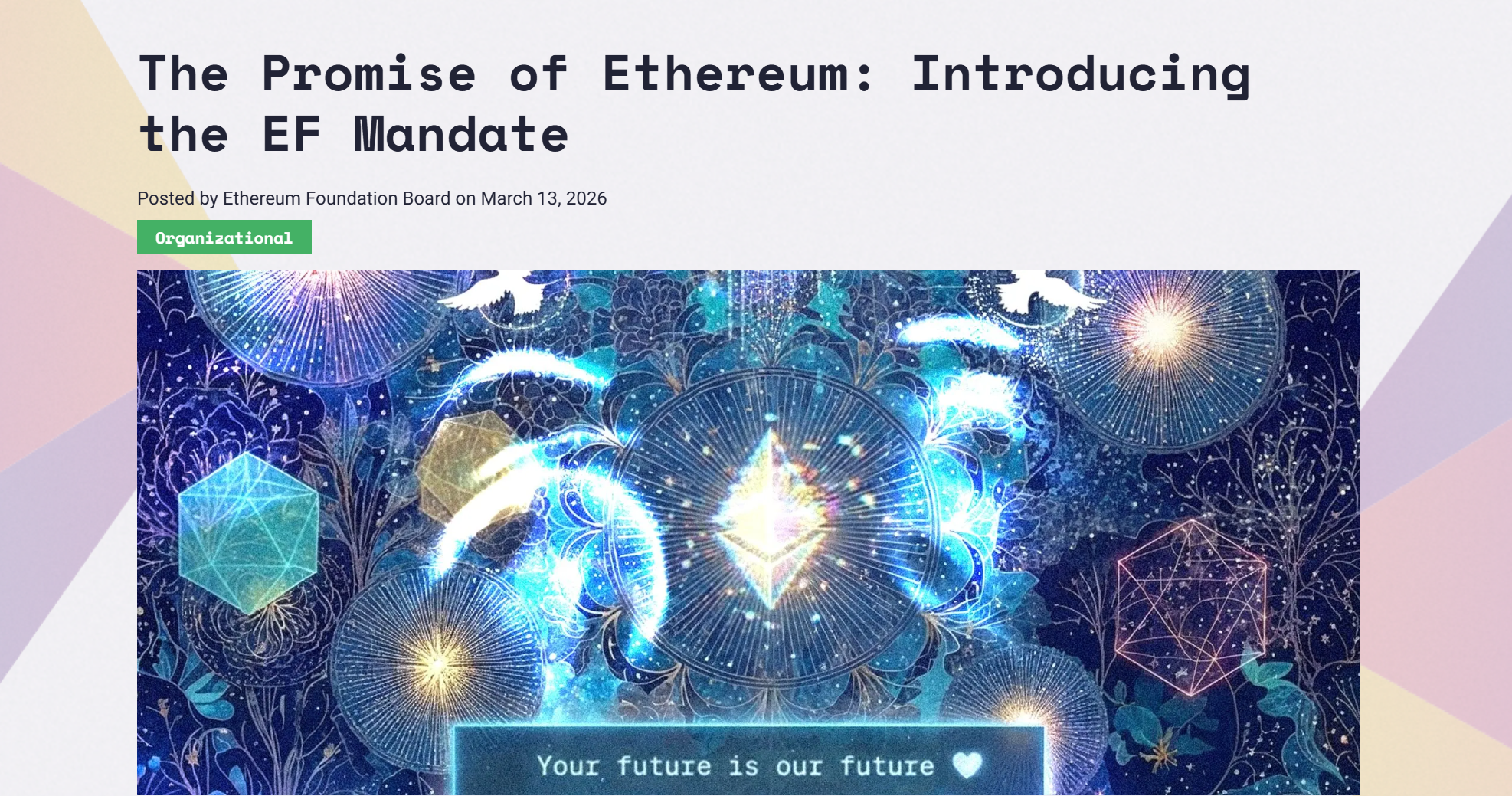
Interestingly, just before Vitalik reinterpreted Ethereum from a protocol roadmap perspective, the Ethereum Foundation also released the EF Mandate, which serves as a formal confirmation of this path at the value level.
This Mandate document proposes that Ethereum's ultimate reason for existing is to protect user self-sovereignty—the ability of users to independently control their assets, identity, actions, and choices without relying on any centralized intermediary.
Around this point, the EF Mandate introduces the acronym "CROPS," which stands for Censorship Resistance, Open Source, Privacy, and Security. In the Foundation's framing, Ethereum must first and foremost maintain these four attributes. Without them, Ethereum loses its reason for being worth using, building upon, and safeguarding.
Objectively speaking, terms like censorship resistance, open source, privacy, and security aren't new in the Web3 context. They've been discussed repeatedly since the early days of the crypto industry. But re-emphasizing them today carries a significantly different meaning.
In the early days of crypto, these values were discussed primarily to oppose centralized platforms and financial intermediaries. Today, however, these values must also confront new problems in the AI era. The EF Mandate states that future centralization might not manifest as a platform forcefully controlling you, but rather as you being completely unaware of how the system (especially AI) makes decisions on your behalf.
For example, when recommendation algorithms decide what content you see, when AI assistants filter information for you, when intelligent agents execute transactions on your behalf, and when identities, assets, and data are all encapsulated behind interfaces, user sovereignty can be subtly diluted through a series of "more convenient" experiences.
Therefore, Ethereum's decentralization shouldn't only be understood in terms of node count, client diversity, or consensus mechanisms. It should be understood as a decentralized system where no single entity can easily change the rules. Within this system, users can verify the state, developers can build freely, applications can be publicly audited, and assets and identities don't have to be fully entrusted to a platform.
Vitalik also emphasized that decentralization isn't a feature of Ethereum; it is the reason for Ethereum's existence. Because if it loses decentralization, Ethereum would merely be a less efficient centralized service. This statement also explains why the Ethereum community always emphasizes that "Everyone is a Builder."
- In the Web2 era, most users were just consumers of products. Platforms defined the rules, and users accepted them; platforms changed interfaces, and users adapted; platforms shut down services, and users had to migrate or abandon them.
- But in the Ethereum ecosystem, builders aren't just a small group of core developers. They also include wallet developers, DApp developers, node operators, researchers, educators, auditors, community contributors, and even every ordinary user who diligently manages their private keys, learns about on-chain security, and participates in governance discussions.
This implies that CROPS shouldn't remain a slogan. It needs to be realized through specific products and actions. Taking a wallet like imToken as an example, security isn't just a warning message; it's a complete experience encompassing seed phrase management, risk alerts, DApp permission management, transaction parsing, and phishing identification.
Final Thoughts
Returning to Vitalik's speech at the Hong Kong Web3 Carnival, on the surface it discussed the technical roadmap for the next five years: scaling, zkEVM, post-quantum security, formal verification, privacy, block building, account abstraction, zkVM, and so on.
But on a deeper level, it was actually answering a value question: When the entire industry is chasing faster and cheaper, what exactly should Ethereum be optimizing for?
The answer isn't to reject performance or user experience. It's to make on-chain applications easier for ordinary users to access, and to do so while serving self-sovereignty, security, verifiability, and fair participation, rather than trading these things for short-term efficiency.
The AI era will make this question even more acute.
From this perspective, what truly matters for Ethereum's next phase might not be whether it can become the fastest chain, but whether it can continue to be the most trustworthy, easiest to verify, and least dependent on single points of authority as a public infrastructure.


