






Space Dog Fork Sparks Another Round of Heated Debate: Who Really Defines a Meme Coin’s "Legitimacy"?


- Core Thesis: "Forking" or "splitting" is a common phenomenon in the meme coin market, fundamentally stemming from the lack of a widely recognized standard of "legitimacy." The key to solving this issue lies in establishing a comprehensive meme coin valuation framework. Centralized exchanges (CEXs) should take the lead by incorporating multi-dimensional indicators such as IP ownership and community activity into their listing criteria, thereby guiding the market towards standardization.
- Key Elements:
- "Forking" occurs when capital and influential users, driven by conflicting interests (such as reluctance to buy at high prices), create similar new tokens while simultaneously disparaging the original target, leading to market chaos and retail investor losses.
- In the "Space Dog" case, a dispute over the "legitimacy" of $ASTEROID on both the ETH and SOL chains emerged. The stance and authorization of the IP owner, Rebecca Perrotto, became a critical factor determining the project's ceiling.
- Historical precedents (such as the Neiro case with upper/lower case tickers) demonstrate that tokens with official IP licenses can use legal means to force other similar tokens off exchanges, highlighting the tangible commercial value of "legitimacy."
- For IPs without clear ownership (e.g., Wojak), market mechanisms (like market cap and community consensus) can naturally determine "legitimacy," but a recognized standard for success is required to end the forking process.
- Platforms like Pump.fun have lowered the cost of token creation and accelerated liquidity turnover in the meme coin space. However, they have simultaneously undermined previously established informal rules of valuation, such as "OG" status and "community activity."
- By establishing a strict listing mechanism that includes IP ownership verification, observation periods, and multi-dimensional data evaluation, CEXs have the capacity to build a market-recognized value assessment system. This is a crucial pathway to fundamentally solving the "forking" problem.
"Splitting" has always been a contentious topic within the meme coin space, and indeed the entire cryptocurrency market.
The vast majority of traders deeply despise this phenomenon, primarily for the following reasons:
- It is not easy to establish a sufficiently large narrative, especially in a market with poor liquidity where no meme coin has reached a market cap of over $1 billion for a long time. Splitting makes the market more chaotic and trading more difficult.
- In the vast majority of cases, splitting is triggered by influential figures leading the call. In the eyes of retail investors, these influential individuals already have advantages in terms of capital and trading. They should participate collectively, focusing their efforts on pushing an already rising asset to even greater heights, rather than refusing to "support the price" just because the position is already high.
- During the splitting process, statements from influential figures almost inevitably involve "praising one and disparaging another." While draining liquidity, this causes even greater harm to the original target asset.
Men die for riches, birds die for food. For a long time, the debate surrounding "splitting" has had its logic, but the final output often becomes an "emotional output with a logical facade." Retail investors, already at a disadvantage, experience profit pullbacks or even losses due to splitting. It is completely understandable and reasonable for them to vent their anger. But when we calm down and think, is there a way to overcome the phenomenon of "splitting"? Can this never-ending debate within the crypto circle ever draw to a close?
How to Determine "Legitimacy"?
If we hope to one day eliminate "splitting," we first need to solve one problem: How exactly is a token's "legitimacy" determined?
Let's start with the recent "Space Dog split." This theme was considered the biggest meme coin opportunity recently because Elon Musk agreed to make the "Space Dog" Asteroid the mascot for SpaceX. The split revolves around two corresponding $ASTEROID meme coins on ETH and SOL:
- $ASTEROID ETH: $ASTEROID on the Ethereum mainnet has been operating since September 2024, but after March 2025, its official Twitter account became less active, with posts every few months. The official website linked in the account's bio is now inaccessible. They previously donated 0.5% of the token supply to St. Jude Children's Research Hospital, the same beneficiary as all proceeds from the sale of Asteroid Shiba plush toys by creator Liv Perrotto, used to fund childhood cancer treatment. However, this occurred back in 2024. Nevertheless, their past charitable acts cannot be erased, and the market recognized the community's past efforts. Before Musk tweeted about making Asteroid SpaceX's new mascot, its market cap had already surpassed $160 million.
- $ASTEROID SOL: Liv Perrotto's mother, Rebecca Perrotto, claimed approximately 2013 SOL in fee revenue from $ASTEROID on SOL. This coin was launched via the Bags platform, and total fee revenue has now reached 2291 SOL. Rebecca Perrotto has explicitly stated that all income from the Bags platform will be used to establish a foundation in memory of Liv Perrotto.
From a trading perspective, both sides have their points, especially $ASTEROID on ETH, which more closely aligns with the unwritten rule the crypto community has long used to determine "legitimacy" — acknowledge the OG, acknowledge the community.
But analyzing it calmly, the root of the "split" lies in the actions of Liv Perrotto's mother, Rebecca Perrotto. By claiming the fee income from SOL $ASTEROID and declaring its use for a foundation in Liv's memory, she provided the angle for the split.
After Liv Perrotto's passing, Rebecca Perrotto, as the current owner of the IP, her stance is the ceiling for this angle. She had previously expressed her attitude towards ETH $ASTEROID in a comment thread on Aster's tweet listing ETH $ASTEROID:
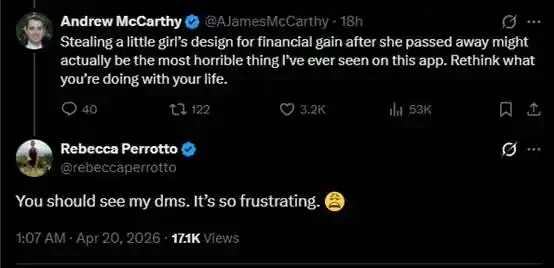
@AJamesMcCarthy stated that profiting from a deceased little girl's creative design is despicable. Rebecca Perrotto replied, "This is just so disheartening."
I will not make any subjective or emotional judgment on this stance itself. I can only assume that, given Rebecca Perrotto's unfamiliarity with cryptocurrency, she might not be fully aware of the charitable acts previously undertaken by $ASTEROID on ETH.
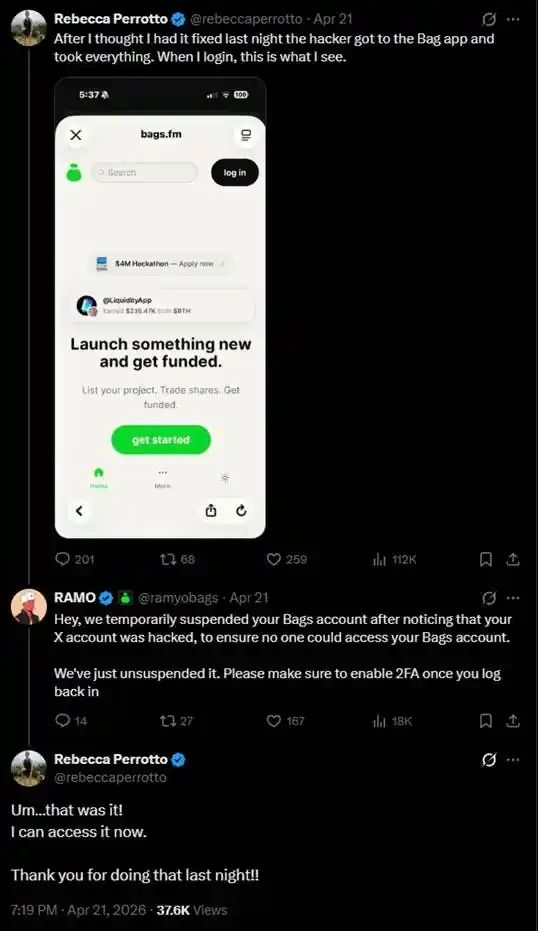
Regarding $ASTEROID on SOL, she can directly obtain fee income from it, and there may have been some communication involved. When her Bags account was hacked, Bags team members responded quickly:
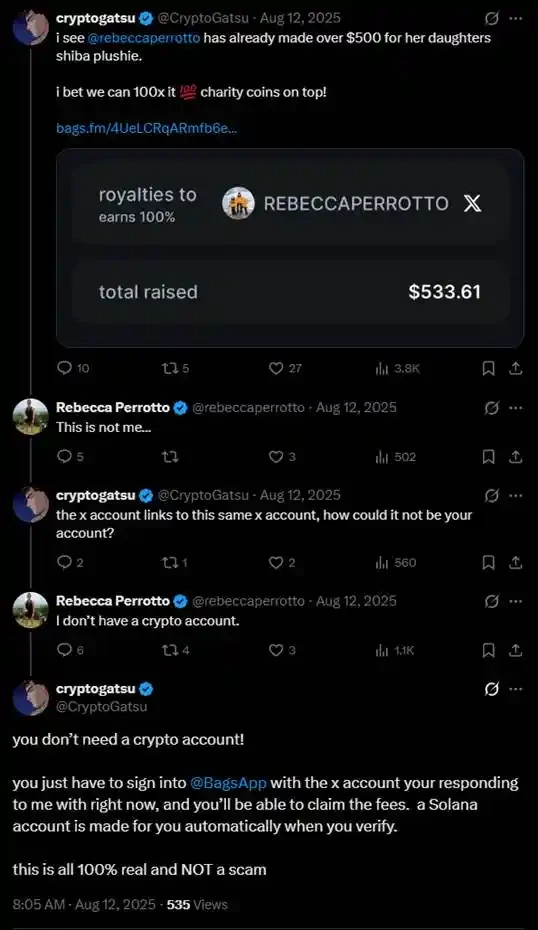
In fact, $ASTEROID on SOL had already caught Rebecca Perrotto's attention when it launched last August. At that time, her stance was to clarify its relationship with her, and she did not make any further response regarding the fees:
You might say, why does Rebecca Perrotto's stance matter? Our on-chain capital has already chosen $ASTEROID on ETH. She can say whatever she wants. Why can't we unite and avoid splitting?
For short-term price movements, it indeed doesn't matter much. If SpaceX doesn't officially announce Asteroid as its new mascot on social media, neither $ASTEROID on ETH nor SOL will likely be able to break through to higher ceilings.
But if it does get officially announced, and the coin gets listed on exchanges, who Rebecca Perrotto, as the IP owner, authorizes becomes very important.
Let's review the final outcome of the Neiro (capitalization) dispute (citing @0xVeil):
"In April 2025, the Neiro CTO project reached the most milestone event in its development history: it passed a partnership with OwnTheDoge's decentralized autonomous organization (DAO), formally obtaining the global exclusive intellectual property (IP) license for the Neiro name and image from kabosu mama herself, becoming the sole legitimate inheritor of the legendary Doge meme.
The most direct impact of this was that the legal team for the Neiro CTO project sent copyright infringement notices to major trading platforms, demanding the delisting of all unauthorized 'Neiro' token contracts. The real target was just one: NEIRO ETH, even though it wasn't listed on Binance spot, it was on various other secondary exchanges, including Binance Futures.
The major trading platforms responded quickly, successively announcing the delisting of infringing Neiro perpetual contracts or spot trading pairs. With that, NEIRO ETH was completely finished."
Whoever holds the copyright can not only legitimately get listed on exchanges but also legitimately prevent other tokens with the same name and concept from being listed. Therefore, when we discuss "how to determine legitimacy" here, we are not trying to rank $ASTEROID on ETH versus SOL. This kind of legitimacy dispute for an IP with an owner is not actually the current intra-circle shouting match vying for existing capital. It's a "realistic problem that must be faced if the ceiling is actually broken."
Whether it's $ASTEROID on ETH or SOL, both should now establish good communication with Rebecca Perrotto as quickly as possible, explaining their operational ideas and philosophies. It doesn't necessarily mean buying the license; at least establishing a "tacit approval" like $PEPE did — yes, $PEPE still hasn't obtained the license from Pepe IP creator Matt Furie, but Matt earned approximately $600,000 by selling the $PEPE tokens gifted to him by the community. He has never publicly endorsed $PEPE, but he has also never taken any legal action. Notably, for other Pepe-related crypto assets, he successfully used DMCA takedowns to force OpenSea to delist several unauthorized Pepe NFT projects (e.g., the Sad Frogs District in 2021, which had a trading volume of $4 million).
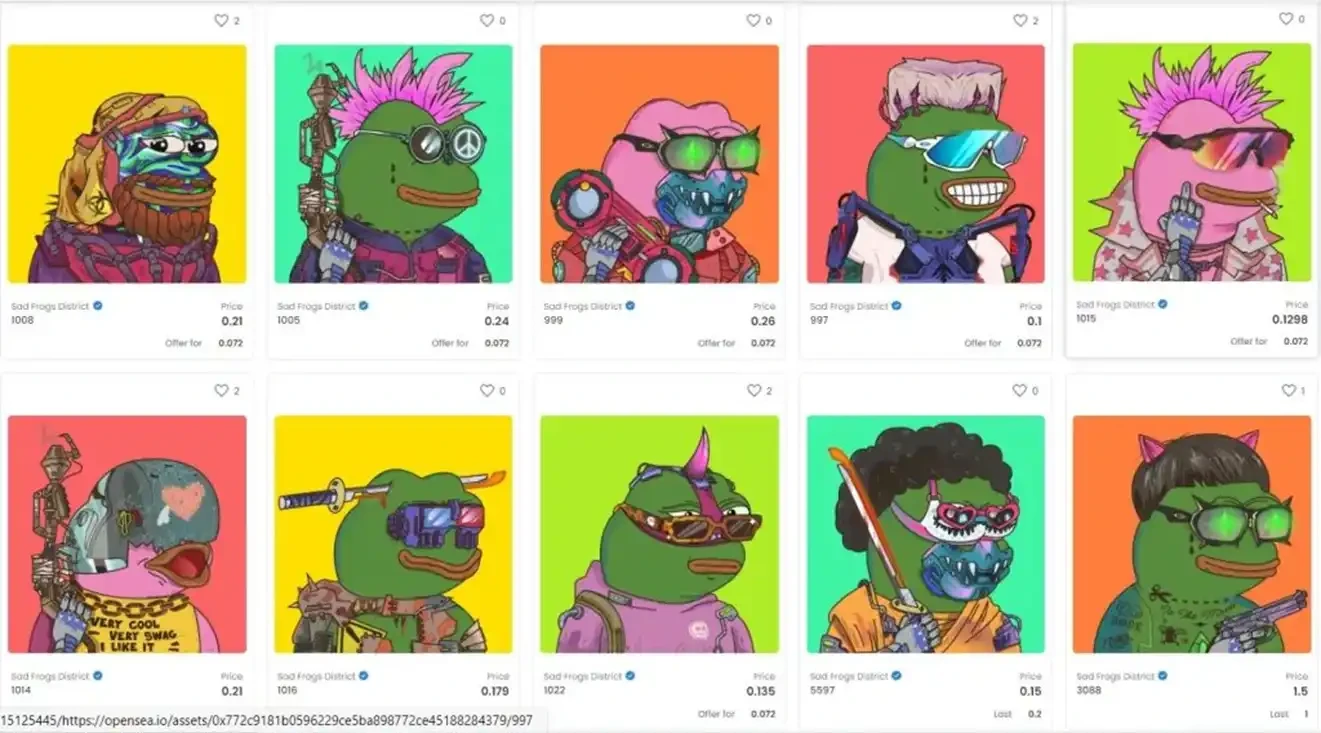
The former Sad Frogs District
Returning to the title of this section, how to determine "legitimacy"? Here, the first answer I offer is not really a definition, but rather a suggestion — For a meme coin with a clearly defined IP owner, if you are truly determined to build it into a Binance-listed, multi-billion dollar market cap meme coin, please advocate for and assist the token community you support in negotiating IP-related matters.
How to Determine "Legitimacy" for Ownerless IP?
Many memes are, in fact, "ownerless."
For example, Wojak is a typical anonymous internet meme with no single verifiable creator or legal copyright owner. Its origins can be traced back to the Polish imageboard Vichan around 2009, first appearing with the filename "ciepłatwarz.jpg" (warm face.jpg). It only became popular on platforms like 4chan after being promoted by an anonymous user with the handle "Wojak" on Krautchan (a now-defunct German imageboard) in 2010.
Because it was born from anonymous/pseudonymous imageboard culture, the image itself is a product of community rapid sharing and modification, lacking formal author attribution, copyright registration, or public claim. Wikipedia, KnowYourMeme, and related analytical articles all clearly state: The original creator is unknown, the copyright owner is difficult to trace, and it is essentially in the public domain, belonging to the internet's collective cultural heritage.
Another example is NEET, a typical descriptive term from public policy/sociology. This abbreviation was first proposed in 1996 by a senior British Home Office civil servant to replace previously controversial terms. Copyright laws in various countries explicitly exclude "idea/fact/short phrase," meaning no individual, company, or institution can claim exclusive intellectual property rights (copyright, trademark, etc.). It also falls essentially into the public domain.
In such cases, let the market decide who is the "legitimate" one. In fact, if we look beyond meme coins, truly powerful crypto assets have never feared "splitting":
- In the blocksize war, the "OG" Bitcoin had the last laugh.
- In the Ethereum rollback and PoS transition, the "OG" Ethereum had the last laugh.
- Milady not only doesn't restrict derivative series on various chains but encourages this creativity to "plant flags" on chains outside the ETH mainnet.
This brings us to another question: How do we establish a victory standard that convinces the market and gains widespread recognition?
Only by solving this problem can we fundamentally cure "splitting."
Exploring a Cure for "Splitting"
Meme coins are not without value. We won't delve into the specific value of meme coins here, but rather consider another question: Why has it always been said that meme coins have no value?
Because all these years, we haven't established a value evaluation system for meme coins.
Although retail traders have some unwritten rules, like recognizing OG coins, watching community activity, and assessing cultural influence, these rules are fragmented in themselves. Since pump.fun drastically lowered the cost of launching meme coins, everyone has become accustomed to quick flips, and these unwritten rules are on the verge of failing.
Murad proposed a good "Meme Coin Supercycle" theory, but unfortunately, from the current perspective, it has only become a short-term "angle" rather than a consensus on trading logic like the price-to-earnings ratio or industry outlook for stocks.
Some launchpads have taken corresponding measures to solve the "splitting" problem, such as prohibiting the deployment of new coins with the same ticker within a certain period. However, this is difficult to popularize as it doesn't suit the needs of bundlers looking to launch and dump controlled supplies, nor is it conducive to the platform's own profitability.
CEXs, as the largest liquidity hubs in the crypto space, are best positioned to lead the market in establishing a value evaluation system for meme coins. We have seen attempts at voting-based listings, but such measures encounter too much interference from various factors.
By establishing strict listing mechanisms for meme coins, CEXs have the capability to guide the development of meme coins towards a more serious market, leveraging cultural influence to demonstrate their positive externalities from a consensus perspective.
Some measures I can think of include:
- For meme coins with clearly defined IP ownership, CEXs should use the resolution of IP ownership as a crucial basis for listing, especially when a split occurs.
- For meme coins without IP ownership, set a sufficiently long observation period before listing, employing multi-dimensional criteria such as theme culture, social media metrics, and community activity for long-term tracking and observation.
- For all listed meme coins, publish a complete listing research report.
Cultivating a convincing value evaluation system for meme coins is the beginning of their development into a serious track within the crypto space and even a cultural industry.


