As TGE Approaches, a Guide to Navigating the MegaETH Ecosystem DeFi


- Core Viewpoint: The MegaETH (MEGA) token is scheduled to launch on April 30th, adopting a low-circulation, high-FDV issuance model. Its core value drivers stem from ecosystem capital rotation, mainnet airdrop incentives, and a unique commercialization model (stablecoin yield buyback). However, it faces risks such as unlock sell pressure, weak macro market conditions, and an imbalanced ecosystem structure.
- Key Elements:
- MEGA's pre-market FDV is approximately $17.9 billion, but its initial circulating market cap is only about $180 million (or potentially as low as $66.92 million). With a highly scarce circulating supply, volatility will be significant.
- Core Driver One: Post-TGE, funds from early investor sell-offs are expected to rotate within the ecosystem into Meme coins, DeFi protocols, etc., bringing activity to the entire public chain.
- Core Driver Two: The mainnet airdrop, accounting for 2.5% of the total supply, will precisely incentivize new liquidity. The plan is to leverage the Aave + Ethena USDe combination to form a positive flywheel of "TVL growth → USDM expansion → Treasury yield buyback of MEGA."
- Historically, most L2 tokens have dropped below their issuance price within 12-18 months (e.g., ZKsync down 75%, Starknet down 90%). There is a divergence between the market consensus valuation (approximately $10 billion) and the optimistic pre-market pricing.
- MEGA's Three Core Value Supports: 10-millisecond block confirmations, sequencer priority fee auctions (inelastic demand), and a secondary market buyback loop based on USDM stablecoin yield.
- Major Risks: Macro bear market, large unlocks (Fluffle and team shares), single sequencer centralization, high KPI thresholds, declining L2 narrative hype, and excessive dominance by the leading application, Kumbaya.
- Regarding ecosystem applications, it is recommended to focus on leading or high-potential projects such as Cap (staking stcUSD), Kumbaya (USDe/USDm liquidity), World Markets (funding rate arbitrage), and Euphoria (clicker game).
Original Author: Ignas | DeFi Research
Original Translation: Saoirse, Foresight News
Over ten MegaMafia ecosystem applications have officially launched on the MegaETH mainnet, with the MEGA TGE set for April 30th. The pre-market price for MEGA is $0.179, translating to a fully diluted valuation (FDV) of approximately $17.9 billion based on a total supply of 10 billion tokens.
However, it’s important to note: the pre-market price reflects the FDV, not the actual circulating market cap. At launch, only about 10% of tokens will be in circulation, with some industry sources suggesting the circulating supply could be even lower. Therefore, MEGA’s first-day real circulating market cap is around $180 million, potentially less.
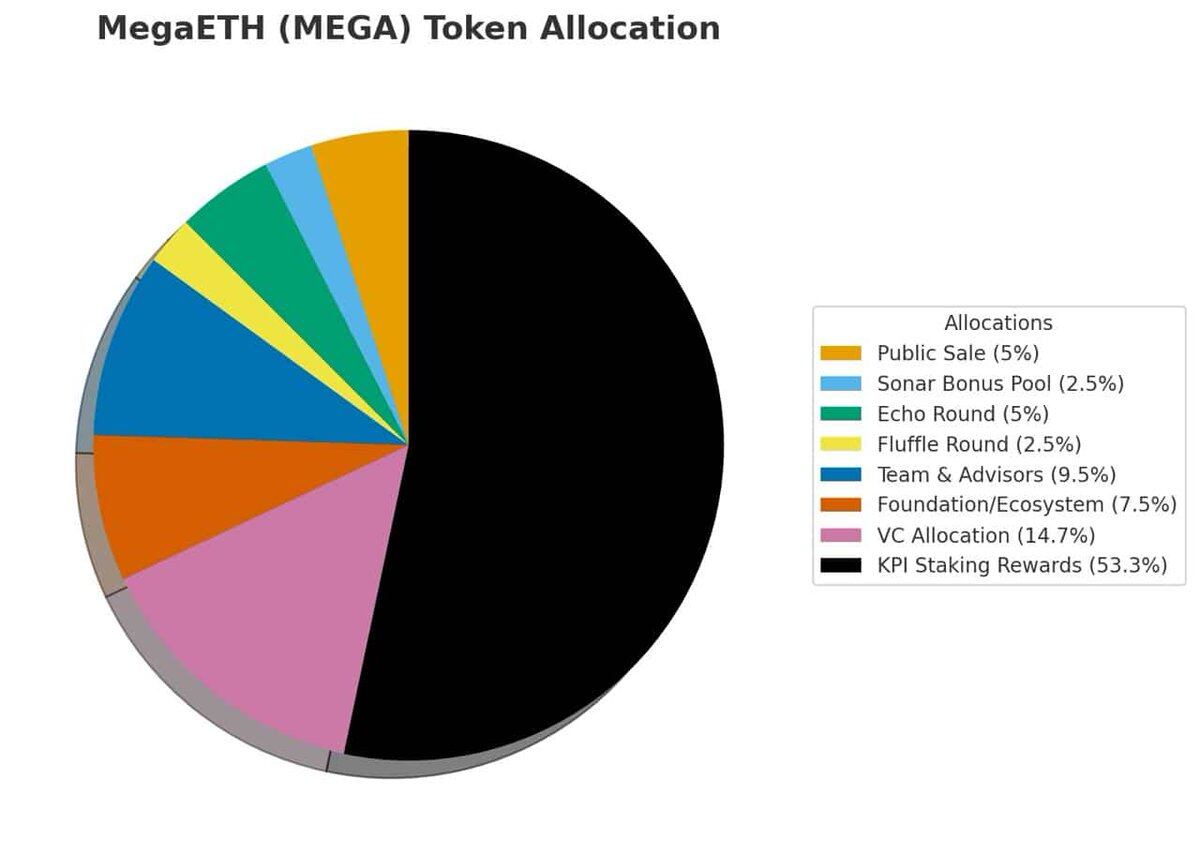
Pie chart of MegaETH (MEGA) token distribution
This MEGA launch exemplifies a typical low-circulation, high-FDV issuance model, mirroring the characteristics of early on-chain projects. However, the project includes major unlocking cliffs at 6 and 12 months. The selling pressure from these large unlocks will continuously test the token price, significantly amplifying short-term market volatility.
Two Core Forces Driving MegaETH’s Development
Core Driver 1: MEGA Token Launch Injects Fresh Capital into the Ecosystem
Early MegaETH ecosystem participants will see token unlocks: Echo holders unlock 20% of their allocation, and Fluffle holders unlock 50%. Non-US Sonar A plan holders, who had no lock-up period, will receive a large token airdrop, which includes the author of this article.
The market anticipates a concentrated wave of selling, particularly from early Sonar investors. These participants, expecting a quick token listing and exit, were forced into long-term holdings, creating a strong desire to sell post-TGE.
Even with concentrated profit-taking, most selling capital is unlikely to leave the public chain entirely. Instead, it will likely rotate within the ecosystem: allocating to Meme coins, providing liquidity for protocols, trading cultural tokens on Kumbaya, purchasing Fluffle series NFTs, or chasing currently popular narrative assets.
The higher MEGA’s price on its first day, the stronger the wealth effect, and the more significant the ecosystem’s empowerment and catalytic impact. Conversely, a substantial price drop immediately after launch would directly dampen speculative confidence, hindering the ecosystem’s long-term development.
The author plans to sell a small portion of their holdings to diversify into launched ecosystem applications, trending narrative tracks, and Meme coins. Most Fluffle and Echo holders are expected to adopt a similar asset rotation strategy. Simultaneous portfolio adjustments by thousands of on-chain speculators will bring immense on-chain activity and capital flow to the entire MegaETH network.
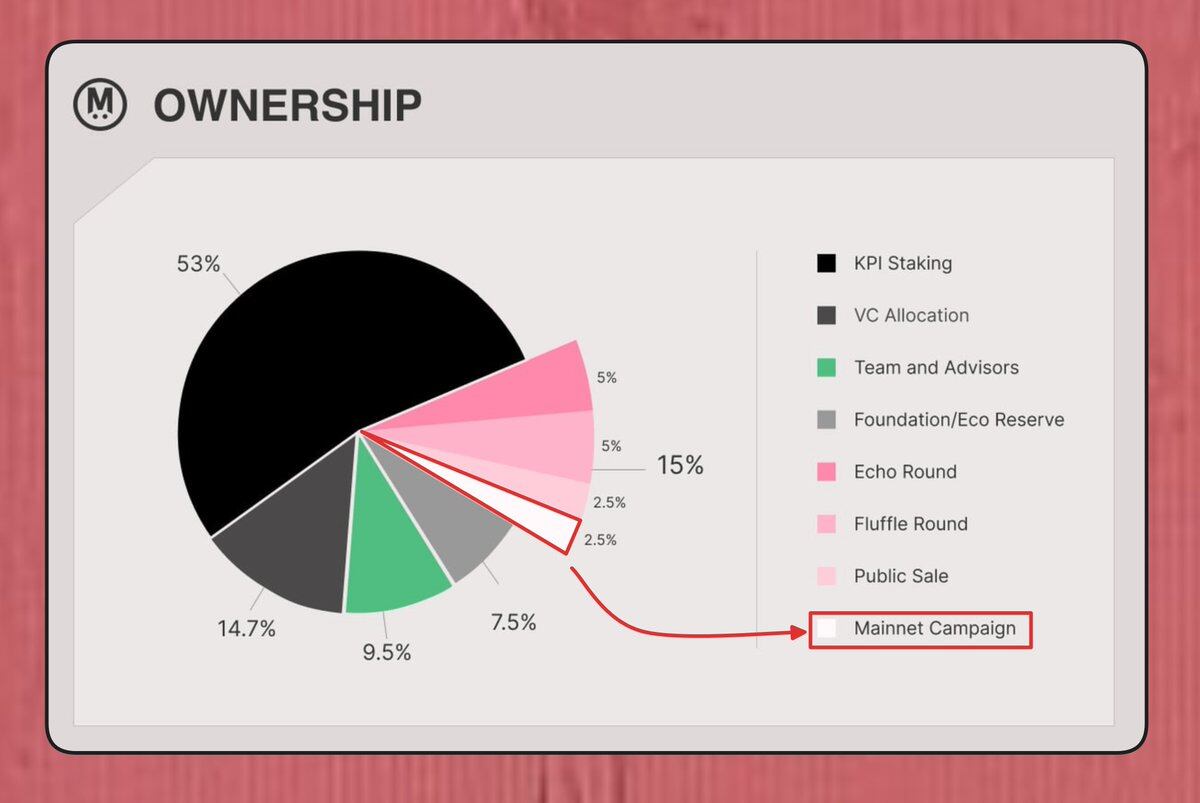
Core Driver 2: 2.5% Mainnet Airdrop Campaign Amplifies Ecosystem Growth Momentum
The team has confirmed a mainnet incentive airdrop plan totaling 2.5% of the token supply. They state it will be carefully planned for optimal timing, rejecting inefficient subsidies. The incentive mechanism is designed with multi-tiered interactive gameplay, allowing users to combine strategies and compound returns, avoiding a simple yield-farming-and-dumping model.
MegaETH is one of the few crypto projects in the industry that operates with mature business logic, precisely calculating User Lifetime Value (LTV) and Customer Acquisition Cost (CAC), thus avoiding the pitfalls of the extensive operational methods seen in most on-chain projects.
Incentive resources will be precisely targeted towards *new* liquidity, not universal distributions. The existing $50 million in stable liquidity already generates natural yield-farming returns, requiring no duplicate subsidies, thereby improving capital efficiency.
The team's core member additions have further enhanced MegaETH's long-term value proposition. The previously planned on-chain composable "Lego" functionalities are now realized with core applications like Aave (paired with Ethena's USDe) and Brix fully launched. With the ecosystem infrastructure maturing, details of the airdrop campaign are likely to be announced shortly after the TGE (mid-to-late May), attracting a wave of yield farmers.
Ecosystem Positive Flywheel Logic:
Yield farmers boost TVL on the chain → Leveraging the Aave+Ethena combination to expand the USDM supply → The treasury yield generated by USDM supports the Foundation in continuously buying back MEGA → Regular buybacks create a support bid, stabilizing the token price.
Whether this entire growth loop succeeds depends entirely on MEGA's launch performance. If the FDV falls below $10 billion and continues to weaken, ecosystem hype and participant enthusiasm will cool down rapidly.
Divergent Market Valuations and Expectations
Institutional analysts and bloggers have offered varying forecasts for MEGA's valuation at launch:
- Eli5defi, using five valuation models, projects a weighted FDV of $12 billion.
- The optimistic pre-market price suggests an FDV of around $16.4 billion.
- The prediction market Polymarket generally expects a valuation of only $10 billion.
From a fundamental perspective, a reasonable valuation should fall in the middle range, leaning towards the lower end. Looking at historical L2 trends: all major Layer 2 tokens saw their valuations drop below listing price within 12–18 months post-launch. ZKsync fell by 75%, and Starknet plummeted by 90%.
There is a clear contradiction in expectations: either the current pre-market rally is overheated due to KPI narrative hype, requiring a future valuation correction, or the prediction market has underestimated MegaETH’s real market demand.
Other data suggests MEGA's actual initial circulating supply is only 3.86%, corresponding to a market cap of approximately $66.92 million, indicating highly scarce circulating tokens:
- VC, Team, Advisor Allocations (24.2%): Fully locked, with a 1-year cliff followed by a 3-year linear vesting.
- KPI Staking Allocation (53%): Permanently locked if KPI targets are not met.
- Ecosystem Reserve (7.5%): Technically unlocked but controlled by the team, not subject to malicious dumping.
- Mainnet Airdrop Allocation (2.5%): Locked and gradually released over 6–8 months.
If this data is accurate, MEGA's initial market cap is under $70 million, far below the general expectation of $180 million. This extreme scarcity in the circulating supply will amplify price volatility, making movements upward and downward more intense, similar to the market dynamics of HYPE, which features high consensus and low circulation.
Different from traditional Layer 2 networks, MegaETH has a unique profit model. It doesn't rely on sequencer fees extracted from users but commercializes through the yield generated by its USDM stablecoin. Backed by compliant BlackRock Treasury products, the USDM generates stable returns, which are entirely used for secondary market buybacks of MEGA.
Market Price Expectations
- Optimistic Scenario: Driven by stablecoin yields, ecosystem incentives, and new application launches, MEGA's short-term price could reach $0.5–$1, representing a potential 3-6x increase.
- Institutional View: A partner at 6th Man Ventures believes MegaETH will evolve into a super-app ecosystem, distinct from neutral chains like Ethereum or Solana. Its core driver will be application revenue, following a vertical integration development path.
MegaETH's Core Differentiating Advantages
Most Layer 2 tokens have uni-dimensional value, used only for gas fees and on-chain governance, lacking real fundamental demand. In contrast, MEGA has three core value pillars forming a solid demand base:
- Extreme Transaction Speed: Block confirmation latency is as low as 10 milliseconds, far outperforming Arbitrum (250ms), Base/Optimism (2 seconds), and Ethereum (12 seconds). It is perfectly suited for order book exchanges and high-frequency trading, being the only EVM ecosystem chain offering low-latency advantages.
- Proximity Sequencer Auction Mechanism: An auction for priority access to the sequencer, priced in MEGA, enables millisecond-level transaction order insertion. HFT teams and market makers must continuously bid MEGA to secure priority block inclusion, creating persistent structural demand.
- Stablecoin Yield Buyback Loop: Leveraging the USDM loop-lending mechanism to rapidly scale towards the $500 million KPI target. Combined with revenue from transaction fees, premium speed services, and treasury yield products, these multiple narratives collectively empower the token's value.
Existing Ecosystem Risks and Concerns
- Macro Market Pressure: The overall crypto market is in a bearish sentiment, and a weak broader market can drag down even fundamentally strong ecosystems.
- Unlock Selling Pressure: Fluffle allocations unlock 50% at TGE + phased release over 6 months; Team and VC shares face a concentrated unlock at 1 year.
- Centralization Risk: Single sequencer architecture poses potential centralization risks.
- High KPI Hurdle: Phase 3 KPI requires 3 applications to maintain an average daily fee of $50,000 for 30 consecutive days. Any interruption resets the timer.
- Narrative Fatigue: The L2 narrative has lost momentum, with declining user and capital attention.
- Unbalanced Ecosystem Structure: Top DEX Kumbaya holds 57% of the chain's total TVL, making the entire chain vulnerable to fluctuations from a single project.
- Ecosystem Project Attrition: Innovative application Avon has announced its departure from MegaETH; leading lending protocol Aave is facing a trust crisis.
Historically, many once-hyped narrative projects ended up going to zero. Even with solid infrastructure, the risk of market downturns and narrative collapse cannot be fully avoided.
However, current on-chain farming costs are low, stablecoin swaps and loop-lending operations are simple. Combined with the expectation of ecosystem application airdrops, participants generally hope for a smooth MEGA launch to maintain ecosystem vitality.
Practical Guide to the Top 10 Ecosystem Applications
Key Points:
- Stake stcUSD to earn yields.
- Provide USDe/USDm liquidity on Kumbaya + small allocation to cultural tokens.
- Use World Markets for ETH funding rate arbitrage or leveraged high-risk trading; or use hit.one, waiting for synchronized rewards.
- Allocate a small position in iTRY on Brix for non-correlated hedging.
- Use Euphoria for trading/gaming.
Cap (@CapApp)
- An adaptive yield stablecoin. You can mint cUSD 1:1 with USDC/USDT and stake it as stcUSD to earn yield from authorized strategies.
- The largest fee generator on the chain, averaging ~$21,000 daily. It is a core project for the team's publicly announced KPI-3.
- Raised a total of $12.9 million across three rounds. Seed round led by Franklin Templeton, with participation from Nomura's Laser Digital and Kraken Ventures.
- High probability of being the first Mafia application to issue a token after MEGA (expedited by traditional finance investors).
- Action: Stake stcUSD to earn yield, use cUSD as the settlement stablecoin on MegaETH.
Kumbaya (@kumbaya_xyz)
- The top DEX on MegaETH, with a TVL of ~$59 million.
- The cultural token launchpad is integrated within the DEX, avoiding the "graduation and disconnect" problem seen with Solana's pump.fun moving to Raydium.
- The USDe/USDm pool (~$6 million) is a key routing node for the Aavethena loop.
- Daily fees are ~$2,000; no public funding information. Although most DEX airdrops have been underwhelming lately.
- Action: Provide liquidity to the USDe/USDm pool to earn fees, riding the expansion of Aavethena. For high risk, trade meme coins.
World Markets (@worldmarketsinc)
- A unified margin order book system covering spot, perpetuals, and lending – one collateral type serves all three.
- TVL is $11.6 million, daily fees ~$4,000 (second highest on-chain). No public funding.
- The team claims capital efficiency can be up to 100x compared to fragmented DeFi.
- Cross-margin trading requires margin updates and liquidations within the same block, which only MegaETH's speed can support.
- Action: ETH funding rate arbitrage (long spot + short perpetual using the same collateral); or hold ETH to earn lending yields while opening a perpetual hedge.
Honestly, I find its interface not very user-friendly.
Brix (@brix_money)
- Tokenized emerging market yield products. iTRY is a tokenized Turkish Lira money market product (~20% local annualized yield), custodied by licensed entities.
- Raised $5.5 million in April 2026, led by FRWRD and Is Asset Management, with participation from Circle Ventures, ConsenSys, and Borderless Capital.
- The only non-crypto-native yield product in the Mafia ecosystem, offering non-correlated hedging during macro downturns.
- Future plans include listing more emerging market currencies (Brazilian Real BRL, Indian Rupee INR are priorities).
- Action: Small allocation to iTRY for non-correlated hedging. I believe a USD delta-neutral strategy could be very attractive.
Euphoria (@Euphoria_fi)
- A click-based trading game: predict short-term price movements by clicking on grid squares.
- Raised $7.5 million ($2.5M pre-seed + $5M seed) led by Karatage, with over 100 investors participating.
- The most anticipated consumer-grade application in the Tier-2 cohort.
- Currently mainnet is whitelist-only (AMA participants + early testers), fully opening mid-May.
- Notcoin on TON brought over 30 million wallets to an unknown chain. Euphoria is the closest product to that model within the Mafia ecosystem.
- Action: Join the waitlist; monitor closely for the mid-May launch.
Show