






OpenAI making a phone: Lifeline or digging its own grave?


- Core Thesis: OpenAI plans to mass-produce its self-developed phone by 2028. The core driving force is not technological innovation, but to address the revenue bottleneck of approximately $9 billion in annual cash burn and a mere 5% paid conversion rate. By bundling subscriptions with hardware, it aims to open a new monetization channel to meet the narrative demands of a trillion-dollar IPO.
- Key Factors:
- Financial Pressure: OpenAI's 2025 cash burn is approximately $9 billion, with a paid conversion rate of only 5% (roughly $20 billion ARR), indicating a ceiling for its subscription-driven growth model.
- Strategic Pivot: Hardware is seen as a vehicle to shift computing costs and lock in user subscriptions; the CFO states that hardware represents the next layer of value increment, aimed at driving user upgrades and subscription growth.
- Market Risk: Previous AI hardware projects like Humane AI Pin and Rabbit R1 failed due to technical misjudgments and ecosystem deficiencies, serving as cautionary tales for the industry.
- Competitive Landscape: By 2028, companies like Apple and Samsung will have deeply integrated AI capabilities, and model capabilities may be supplied via API, raising questions about the differentiation of OpenAI's self-developed phone.
- Profit Outlook: OpenAI's cumulative cash burn could reach $115 billion, and surveys show a lack of interest from institutional investors in its secondary market trading, casting doubt on the financial sustainability of its hardware plans.
Original Author: Ada, TechFlow
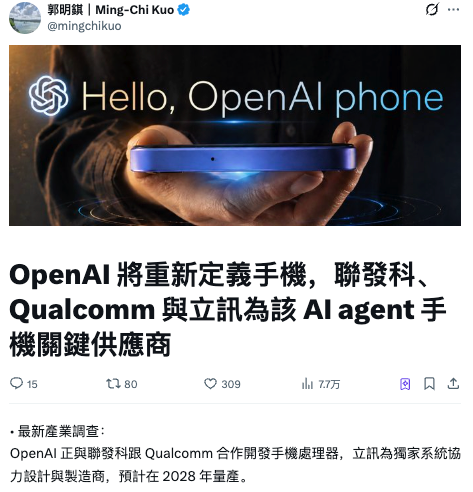
TF International Securities analyst Ming-Chi Kuo posted a message stating that OpenAI is collaborating with MediaTek and Qualcomm to develop mobile phone processors, with Luxshare Precision serving as the exclusive manufacturing partner, and mass production is expected to begin in 2028. This news has also been confirmed and reported by multiple media outlets.
As the news spread, supply chain stocks rallied first. Analysts began calculating MediaTek's incremental orders, Luxshare Precision's optimized customer structure, and Qualcomm's licensing revenue from its baseband solutions.
But the question is, why would a company that isn't expected to turn a profit until 2030, with cumulative cash burn potentially reaching approximately $115 billion, want to make phones?
The Subscription Model Trap
OpenAI achieved $20 billion in ARR in 2025, with revenue growing 3,628 times since 2020. ChatGPT has 500 million weekly active users, making it a top-tier consumer internet product globally.
However, according to a Deutsche Bank report from October 2025, only about 5% of users are paying customers.
The remaining 95% are free users, and every interaction consumes computing power, electricity, and GPU resources. Even Sam Altman has admitted that the $200/month Pro subscription is losing money. The total cash burn for 2025 is projected at around $9 billion, with 70% of revenue evaporating directly on servers.
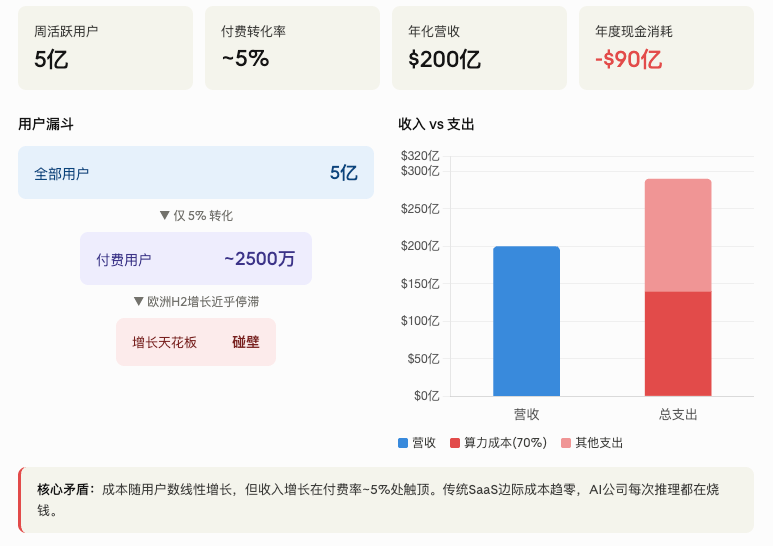
Furthermore, according to a report by Deutsche Bank analyst Adrian Cox, paid consumer user growth for ChatGPT in Europe nearly stalled in the second half of 2025. The ceiling for paid conversion rates may be much lower than anticipated, and the growth model driven by subscriptions is hitting a wall.
The problem with the subscription model is that while costs grow proportionally with the user base, revenue growth plateaus at a certain point. This isn't an issue in traditional SaaS, but it's fatal for AI companies.
So, what's the solution?
Advertising is one path. OpenAI has already started testing ads within ChatGPT and hired Meta's monetization expert, Fidji Simo, as its Consumer CEO. However, entering advertising means directly competing with Google, which has hundreds of billions in annual cash flow from search ads alone and a deep moat. OpenAI will likely struggle to capture a significant share of this market.
Enterprise services represent another path. Enterprise revenue currently accounts for over 40% of OpenAI's total revenue, and growth is indeed rapid. However, Anthropic's annualized revenue from enterprise coding tools surged to $30 billion by March 2026, with its secondary market valuation briefly surpassing OpenAI's. This path is also crowded with competitors.
This leaves a third path: Hardware.
Hardware Isn't a Dream, It's Financial Anxiety
OpenAI CFO Sarah Friar stated in a CNBC interview: "Hardware will become the next layer of value for ChatGPT and will help drive user upgrades and subscription growth."
In other words, OpenAI needs a vehicle to convert free users into paying ones. Sell a phone, bundle it with a ChatGPT subscription, and automatically charge the user monthly. No longer waiting for users to open their browser and upgrade to Pro on their own. Hardware locks in the entry point, making the subscription a default option. It's the same principle as Apple bundling iCloud storage with the iPhone.
Therefore, the vision Ming-Chi Kuo described—redefining the phone with an AI Agent, where users execute tasks directly through the device instead of opening a bunch of apps—sounds good as a technical narrative. But the underlying driving force is more primal: OpenAI needs a new monetization channel to plug the nearly $10 billion annual hole.
The fundamental motivation for OpenAI to make a phone has nothing to do with innovation. It needs a way to shift computing costs off its own balance sheet, and hardware serves as that transfer vehicle. When a user buys the phone, they implicitly start paying for cloud-based inference.
OpenAI plans an IPO as early as Q4 2026, targeting a $1 trillion valuation. Before going public, it must present a growth narrative to Wall Street beyond just "the model is getting better." Enterprise revenue is being chased by Anthropic, advertising has just started, and AI Agents are still in the conceptual phase. The smartphone is a compelling story. Over a billion phones are sold globally each year; capturing even a small slice makes for a promising revenue curve.
Lessons from the Past
The distance between a good story and a good business has been repeatedly demonstrated in the AI hardware space.
The Humane AI Pin, which raised $230 million, was priced at $699 with a $24 monthly subscription fee. It shipped fewer than 10,000 units. In February 2025, it was sold to HP for $116 million, and the product essentially became a brick, with all users' devices ceasing to operate.
The Rabbit R1 was the star of CES, a small orange box that sold 100,000 units before facing massive returns, as users found many demo features didn't work properly. A 10-second voice response latency made the device unusable for real-time interaction. By early 2026, reports emerged that the company could barely afford employee salaries. Furthermore, users discovered it was essentially just a repackaged Android app.
Both cases share a common cause of death: mistaking technical novelty for product-market fit. The demos were explosive, waitlists were long, and the teams thought this constituted market validation. However, when users got the product, they found they were better off just installing the ChatGPT app on their existing phone.
Jony Ive himself publicly described the Humane AI Pin and Rabbit R1 as "very bad products" in an interview, stating the industry "lacks products expressed with new thinking." He subsequently sold his company, io, to OpenAI for $6.5 billion.
Competitors in 2028 Won't Be Today's iPhone
The OpenAI phone is expected to enter mass production in 2028. That's two years from now.
What will the phone market look like in two years?
Apple has already integrated both Google Gemini and ChatGPT into the iPhone. A major AI overhaul for Siri is expected by 2026. Samsung Galaxy AI already covers its flagship and mid-range product lines. Google Pixel runs Gemini natively, and Android XR glasses are on the way.
In other words, by 2028, every mainstream phone on the market will be an "AI phone." AI capabilities will become a standard feature, just like cameras, GPS, and fingerprint scanners.
So, where is OpenAI's differentiation?
Ming-Chi Kuo's answer is that an AI Agent needs to continuously understand the user's context, and only the phone possesses all the user's real-time state information. OpenAI has the best models, so the phone experience it creates would be different.
This argument has a clear flaw: model capabilities can be provided via APIs. OpenAI already sells its models to Apple and Samsung through APIs. If the model is a core advantage, selling it to all phone manufacturers would be more profitable and less risky than building its own phone.
Unless OpenAI believes that simply selling model APIs won't generate enough revenue.
This brings us back to the core question: Is making a phone about a technical vision or financial survival?
The history of technology is filled with hardware failures, and successful cases of software companies moving into hardware are few and far between. Google has been making Pixels for a decade, holding less than 2% of the global market share. Microsoft's Surface line took years of losses just to break even. These companies had tens of billions of dollars in cash flow to support trial and error, but OpenAI does not.
A $852 Billion Bet
OpenAI's phone narrative is essentially a narrative requirement corresponding to its $852 billion valuation.
Model capabilities are converging. The competitive edge of a new model might only last a few months, as Gemini, Claude, and Llama are all catching up. When models become a commodity, profit margins from selling them will only get thinner.
Meanwhile, subscription revenue is hitting a ceiling. A 5% paid conversion rate already signals the market's true willingness to pay. The enterprise market is also being contested by Anthropic, whose secondary market valuation has briefly surpassed OpenAI’s. Investors are voting with their feet.
Against this backdrop, "making a phone" offers investors a new realm of imagination. If OpenAI can sell 100 million AI phones, each with a bundled $20 monthly subscription, that's $24 billion in new annual revenue. Combined with hardware revenue, total revenue would double instantly.
The math is easy enough. But the math was also easy for Humane and Rabbit at the time. It looked beautiful on paper but ended disastrously in sales. Consumers are unwilling to pay for a phone without an app ecosystem. No WeChat, no TikTok, no full Google Play ecosystem. No matter how powerful the AI Agent is, it can't meet everyday needs.
Ming-Chi Kuo suggests OpenAI might adopt a business model bundling subscriptions with hardware sales. This implies selling hardware at a loss and recouping costs through subscriptions. Yet another "lose now, profit later" story. OpenAI has been telling this story for the past three years, and investors have listened for three years.
But how long can the story last when the phone goes into mass production in 2028? By then, OpenAI will have burned through over $100 billion cumulatively. If the phone doesn't sell, the flywheel won't spin; it will spin in reverse.
CFO Sarah Friar has already expressed doubts about OpenAI's IPO timeline, stating that the company is not yet ready to go public and has expressed reservations about the massive $600 billion spending plan over the next five years. According to a Bloomberg report, a research firm, after contacting hundreds of institutions, found that "none were willing to buy OpenAI in the secondary market."
The most likely outcome of OpenAI making a phone is not redefining the phone industry, but adding a new slide to its IPO roadshow deck. As for how much that slide will ultimately deliver may depend on conditions none of which are within OpenAI's control.


