






Meta acquisition of Manus deal unwinding details: $2 billion must be returned, data must be isolated and deleted


- Core Viewpoint: China's National Development and Reform Commission (NDRC) officially prohibited Meta from acquiring AI agent company Manus, citing a violation of foreign investment security review regulations, and demanded a complete restoration of the transaction to its prior state. This move aims to curb the technology transfer pathway of "domestic R&D + offshore entity shell + foreign acquisition", establishing a regulatory red line for cross-border M&A in the AI field.
- Key Elements:
- Meta planned to acquire Manus' parent company, Butterfly Effect, for $3-5 billion. The deal lasted only four months and ultimately became one of the largest M&A deals blocked in Meta's history.
- Manus's core technology was developed domestically by a Chinese team, and the structure was relocated to Singapore to circumvent China's technology export controls, drawing focused scrutiny from regulators.
- The transaction was deemed a "cross-border M&A circumventing review" as it failed to undergo China's foreign investment security review process, involving sensitive areas such as core technology and cross-border data.
- Specific requirements for unwinding the deal include: reverting equity changes, fully refunding the approximately $2 billion payment, deleting all user data and training data, and destroying all transferred technical codes and algorithm models.
- Regulators imposed clear future constraints: Any future cross-border cooperation or financing activities involving Manus and its original shareholders must comply with security review and data cross-border assessment procedures as required by law.
Original author: Kyousuke
Original source: AI Ruipusi
On April 27, the National Development and Reform Commission's (NDRC) Office of the Working Mechanism for Foreign Investment Security Review officially issued a prohibition decision, blocking Meta's acquisition of AI agent company Manus.
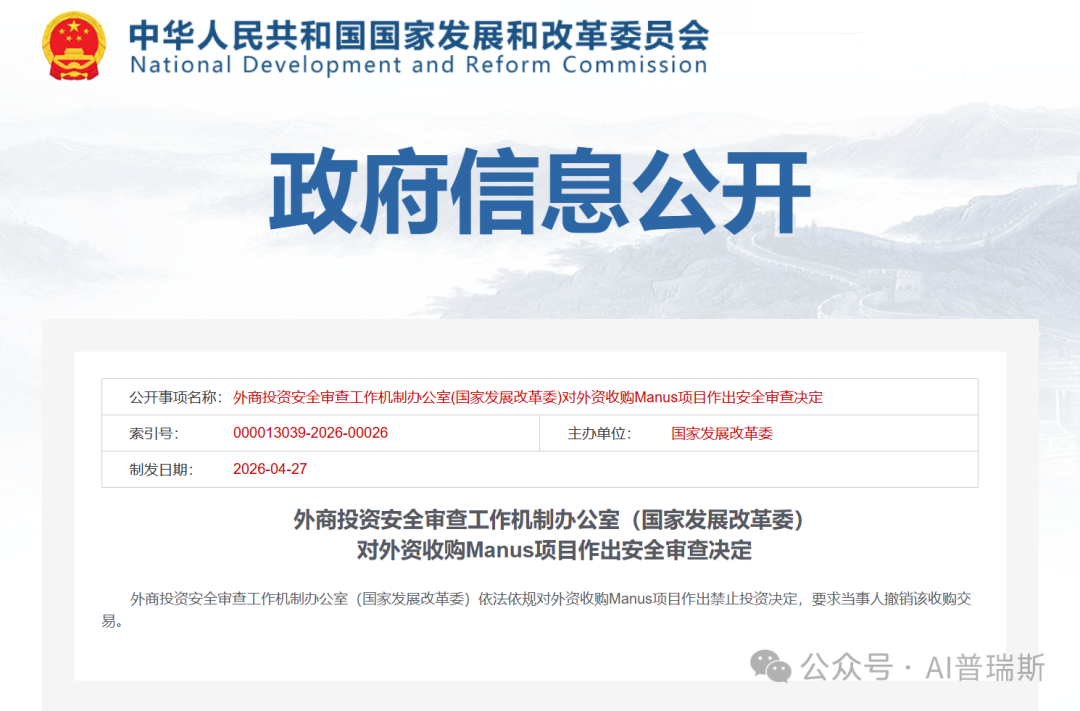
The deal, once considered Meta's third-largest acquisition ever, was announced in December 2025 and blocked in April 2026, lasting only four months.
Key Timeline of the Manus Acquisition
In March last year, Manus officially launched. The Monica.im team released the world's first general-purpose AI agent, which immediately took the market by storm. Invitation codes were highly sought after, and annualized revenue quickly exceeded $125 million.
On December 30 last year, Meta announced the acquisition of Manus's parent company, Butterfly Effect, for $3-5 billion. Negotiations took only about ten days, and founder Xiao Hong was set to become a Meta Vice President.
On January 8, regulatory review commenced. The Ministry of Commerce, in conjunction with relevant departments, initiated an assessment to verify compliance regarding technology export, cross-border data transfer, and foreign investment declaration.
In March, the NDRC summoned executives from both parties, highlighting risks related to technology transfer and data security, and ordered a halt to the proceedings.
On April 27, the Office of the Working Mechanism for Foreign Investment Security Review officially prohibited the transaction, requiring the acquisition to be unwound and the status quo ante to be restored.
Unwinding the Deal: Comprehensive Restoration from Equity to Data
According to Article 12 of the "Measures for the Security Review of Foreign Investments," following a national prohibition decision, the core requirement is to restore the situation to its pre-investment state within a specified period and eliminate the impact on national security. This is specifically divided into three modules:
(i) Equity and Transaction Entity Level
All parties shall sign a written termination agreement, cancel the acquisition, and terminate all ancillary documents (such as shareholder agreements, technology transfer agreements).
If Meta has already completed the equity transfer, it must transfer all acquired Manus equity back to the original shareholders/domestic entities and complete the corresponding change registration for both commercial and foreign entities.
Regulatory authorities will oversee the equity change to ensure no "disguised control" (e.g., through contractual arrangements, nominee holdings) persists.
(ii) Repayment of Funds and Consideration
Meta must fully refund the approximately $2 billion already paid (including deposits, advance payments, etc.) to the relevant transaction accounts.
After receiving the funds, the original shareholders must, in accordance with regulatory requirements, complete the return of foreign exchange along the original channel and report to the foreign exchange regulatory authorities.
Both parties shall handle intermediary fees, liquidated damages, etc. They are prohibited from completing consideration payments in disguised forms such as "compensation" or "consulting fees."
The foreign exchange administration will conduct a full review of the capital flow to prevent capital flight under the pretext of "terminating the transaction."
(iii) Data and Technology Security
Data Segregation and Deletion:
Meta must delete all obtained Manus domestic user data, training data, and business data, provide deletion certificates, and submit to verification. Manus must restore data localization storage and terminate all cross-border data transfer channels.
Technology and Code Restoration:
Terminate all technology licenses and code transfers to Meta, reclaim control over core AI technologies and algorithm models, and prohibit Meta from using any Manus technological achievements. Transferred technical documents and code copies must be destroyed.
Personnel and Management Segregation:
All management and technical personnel dispatched by Meta must withdraw, and all management agreements involving control rights must be terminated, ensuring that the domestic entity operates with full autonomy in management.
Core Reasons: Triggering Three Red Lines
1. Technology and Data Security
Manus's core technology was developed domestically by a Chinese team. During the transaction process, the corporate structure was moved to Singapore. Regulatory authorities scrutinized whether this constituted "technology laundering" to circumvent Chinese technology export controls. Core algorithms, training data, and user data could potentially flow overseas through the merger, directly threatening data sovereignty and technology security.
2. Compliance Loopholes in Foreign Acquisition
This transaction, an "American company acquiring a Singaporean entity," was essentially an acquisition of domestic Chinese AI technology by a foreign entity through a change in the overseas corporate structure, without undergoing China's foreign investment security review procedure. Regulatory authorities determined this to be a typical case of "cross-border mergers circumventing review."
3. Structural Restructuring to Evade Regulation
The "Measures for the Security Review of Foreign Investments" explicitly requires that foreign acquisitions involving key technologies and data must be submitted for security review. Manus attempted to transfer control via a path of "domestic R&D + overseas shell company + foreign acquisition." The unreported transaction was deemed invalid.
Regulatory Oversight and Subsequent Constraints
The parties involved must complete all the aforementioned operations within the timeframe stipulated by the regulatory authorities. The Office of the Working Mechanism, in conjunction with departments including the NDRC, Ministry of Commerce, Cyberspace Administration, and State Administration of Foreign Exchange, will conduct on-site inspections to confirm that the transaction has been completely unwound.
Failure to comply with the unwinding requirements may result in penalties imposed by the regulatory authorities, including fines, restrictions on domestic operations, and a prohibition on the relevant entities engaging in foreign investment activities. Responsible individuals will also face legal liability.
More importantly, for any future cross-border cooperation or financing activities, Manus and its original shareholders must fulfill statutory procedures such as the foreign investment security review and data export security assessment. They are prohibited from transferring control, data, or technology overseas by evading these review mechanisms.
No More Gray Areas for AI Cross-Border M&A
This prohibition decision is not targeted at a single case but establishes a clear boundary for the AI industry:
It explicitly prohibits the transfer path of "domestic R&D + overseas shell company + foreign acquisition." Cross-border M&A in the AI field must undergo a complete security review and data assessment process. Control over AI technology developed within China cannot be transferred overseas without review.
For Meta, the termination of the acquisition plan means missing out on a key AI agent technology asset, requiring a full refund of the amounts already paid. For the Manus team, it means restoring control to the domestic entity, terminating all cooperation with Meta, and returning to compliant domestic operations.


