Flipped over just 5 days into his new job at XIN HUO: Why is Fu Peng getting torn to shreds by the crypto community?


- Core Observation: Fu Peng, former Chief Economist at Northeast Securities, crossed over into the crypto industry. After making condescending remarks and mass-blocking his critics, he sparked strong backlash and ridicule from the crypto community. This highlights the fundamental clash between his traditional finance elitist mindset and the industry's decentralized, egalitarian communication culture.
- Key Elements:
- Fu Peng joined Xinhuo Group as Chief Economist on April 20, declaring that crypto assets were mature enough for portfolio inclusion. Just five days later, he was publicly ridiculed by the community for using patronizing language ("those who know, know") when commenting on Bitcoin's funding rate.
- The crypto community mocked him for "sounding like Zhaobei" (a reference to his past history of buying high and selling low). Fu Peng then blocked all KOLs and industry professionals who ridiculed him, further angering the community.
- Fu Peng's background is in traditional finance (Lehman Brothers, Galaxy Futures) and as a "celebrity economist." He had his account banned in late 2024 for controversial remarks. A paid crypto course he previously promoted was bullish, but Bitcoin has since fallen from $120,000 to $75,000-80,000.
- Xinhuo Group's core strategy in hiring Fu Peng was to transition into a private banking-grade digital asset manager, leveraging his credibility with traditional high-net-worth individuals, his ability to translate market narratives, and his client network.
- The core conflict stems from Fu Peng's inability to adapt to the crypto industry's anti-authoritarian, peer-to-peer communication culture. Even CZ and He Yi must face public scrutiny, while Fu Peng is accustomed to one-way broadcasting and using block-and-delete tactics.
- The crypto industry has already "disenchanted" celebrities (including Trump), valuing actual contribution over status. Fu Peng is criticized as an analyst who "talks a big game without holding any positions," widening the gap with the community.
- Latest update: Fu Peng claimed the blocking and deleting of comments was done by an outsourced team, not by himself. This explanation either reveals his distance from the crypto community or is seen as an attempt to shift blame.
Original: Odaily Planet Daily (@OdailyChina)
Author: Golem (@web3_golem)
It took Fu Peng only five days to go from officially announcing his entry into the crypto industry to being ridiculed by the community.
On April 20, Fu Peng, former Chief Economist of Northeast Securities, announced he was joining Hong Kong-listed company Sinofox Group as Chief Economist. The news sent Sinofox's stock price up over 12% intraday. Three days after joining, Fu Peng appeared at the 2026 Hong Kong Web3 Carnival and delivered a speech. He stated that the future financial market would usher in an "FICC+C" era, where traditional asset allocation would incorporate crypto assets. He also explained his cross-industry move: "Because your (crypto) industry has matured to the point where it can be included in an investment portfolio."
The lofty tone Fu Peng adopted in this speech may have foreshadowed the subsequent conflict with crypto KOLs. On April 25, Fu Peng posted that the funding rate for Bitcoin perpetual contracts is similar to the deferred fees for traditional gold spot trading. This statement, on its own, was unremarkable. However, he added that many people had no idea what he was talking about, and only early large-scale BTC holders and those with a certain level of understanding would grasp his meaning.
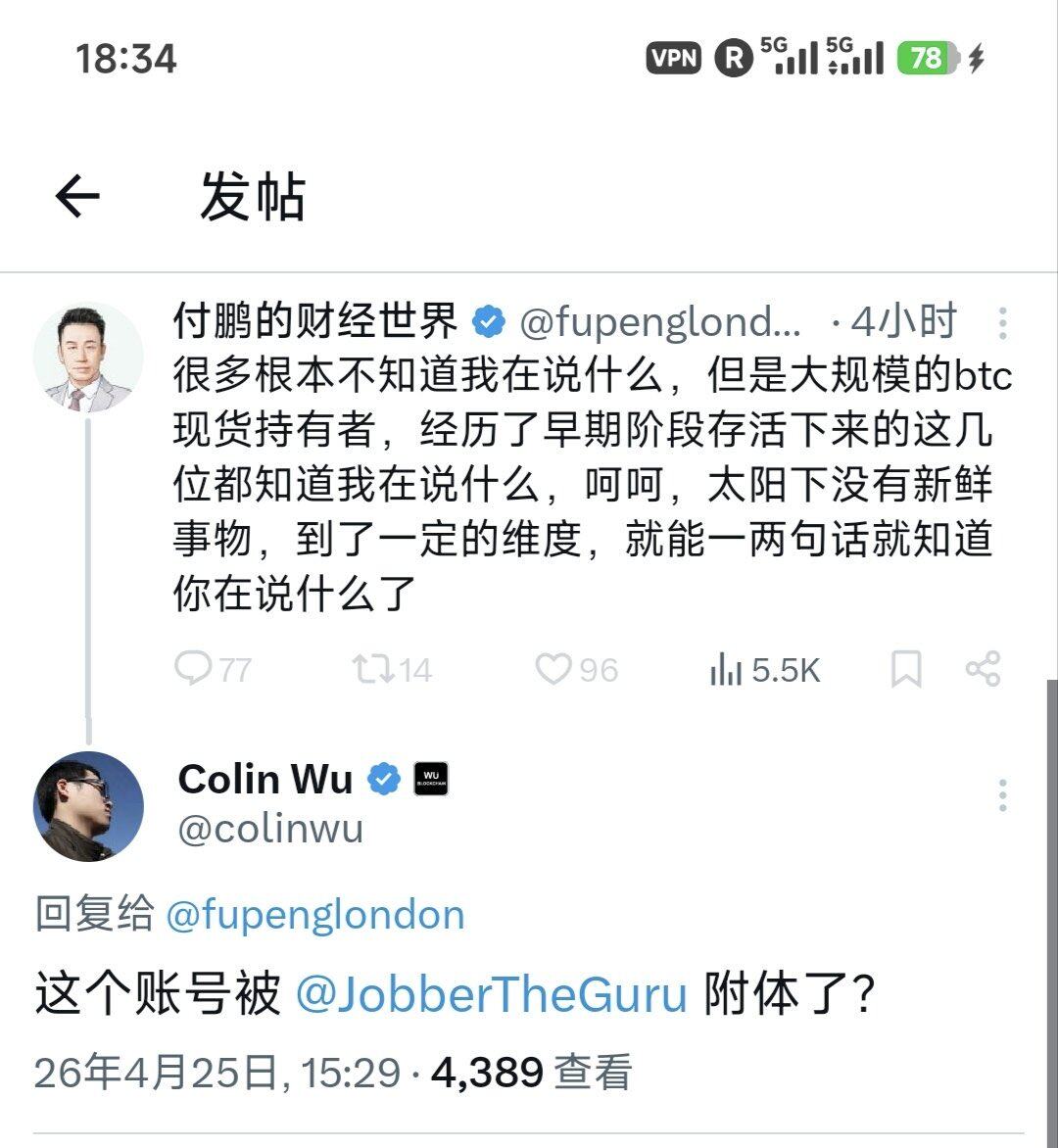
This self-important, "if you know, you know" attitude sparked backlash from the crypto community. The comments section was flooded with mockery of Fu Peng. The most representative meme was accusing him of channelling "Zhao Bei" (Zhao Bei is a crypto KOL who, as a fund manager, once lost over 20 million RMB worth of ETH, a loss rate of 99%), implying his past advice involved buying high and selling low, with no real substance (Odaily note: Zhao Bei is a crypto KOL who, as a fund manager, experienced significant losses, wiping out over 20 million RMB worth of ETH in one go, a loss rate of up to 99%).
Surprisingly, amidst the back-and-forth banter, Fu Peng was the first to break down. He blocklisted all the KOLs and crypto practitioners who mocked or joked about him. This impulsive act of blocking at the slightest disagreement thoroughly angered the crypto community, leading them to completely expose the reality behind Fu Peng's seemingly glamorous facade.
Fu Peng: The Man Behind the Glossy Resume
Who is Fu Peng? Native crypto players might not be familiar with him, but users who frequently follow macroeconomics, asset allocation, and similar financial topics will certainly recognize the name.
Public records show that Fu Peng's early career was based in the UK. He graduated from the University of Reading. In 2004, he worked at Lehman Brothers (then the world's fourth-largest investment bank) in the UK. From 2005 to the end of 2008, he worked at an event-driven strategy fund under Solomon International Investment Group, serving as Head of Global Macro Hedge Strategy Design for international financial markets. After returning to China in 2008, he held positions as Chief Macroeconomic Advisor/Chief Macro analyst at institutions like China CIFCO Group and Galaxy Futures.
Fu Peng truly became known to a wider public after joining Northeast Securities as Chief Economist in 2020. Initially, he served private banking clients, offering wealth allocation advice from a macroeconomic perspective for high-net-worth individuals. In 2024, he successfully broke out of his niche by giving several speeches that contradicted mainstream macroeconomic views, becoming a "internet celebrity economist." Clips of his talks were widely shared as short videos on social media, sparking discussions. According to public reports, at that time, Fu Peng had over 4 million followers on Weibo alone.
However, this fame was short-lived. By the end of 2024, Fu Peng had his accounts on multiple platforms suspended for consistently expressing bearish views on the Chinese economy and making controversial statements. In late April 2025, Fu Peng announced he was leaving Northeast Securities due to health reasons requiring surgery and recovery.
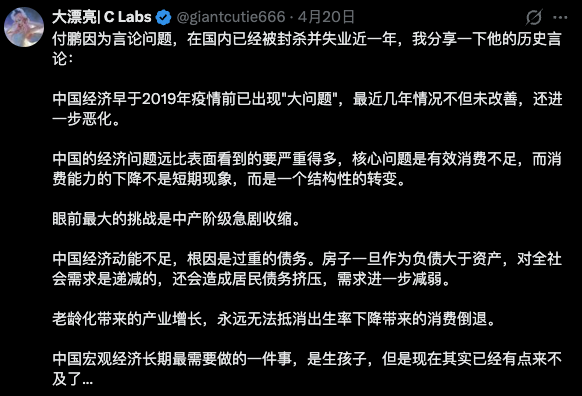
A community summary of some of Fu Peng's past statements
This is just his professional resume. After mass-blocking crypto KOLs, his past crypto-related experiences were also unearthed. In 2024, during a paid economic course analyzing gold, he expressed bearish views on both Bitcoin and gold. However, when his predictions diverged from actual price performance, many people demanded refunds.
In 2025, the sixth season of his video series "Fu Peng Says" also ventured into the crypto space, promoting paid courses like "BTC: A Financial Asset in the AI Era" and "Stablecoins Rebuilding the Global Monetary Order," packaged and sold for 1798 RMB. This was when Bitcoin was hitting new highs of $120,000; now, Bitcoin fluctuates between $75,000 and $80,000.

Fu Peng's paid courses
From this background, it's clear Fu Peng is not a traditional academic economist. His identity is more akin to an economic commentator or macro analyst, aiming to guide trading with directional predictions without personally executing trades. After being effectively blacklisted by domestic financial media in late 2024, his reputation and perceived credibility took a sharp dive. Even now, his views remain largely unpublishable on major domestic social media platforms.
So, why did Sinofox hire Fu Peng as Chief Economist?
This brings us back to last August, when former HashKey Exchange CEO Weng Xiaoqi formally joined Sinofox as CEO. A new broom sweeps clean. Upon taking office, Weng formulated a new strategy for Sinofox: to become a private banking-level digital asset manager, serving high-net-worth individuals and institutions, offering a one-stop service from crypto asset allocation to custody.
Under this new strategy, Fu Peng indeed became the most suitable candidate. He can act as a trust intermediary for Sinofox in the traditional finance realm, and leverage his past career to bring in valuable client resources.
Sinofox Group is a company that has undergone multiple name changes and streamlining from its origins as a "Huobi-listed platform." Despite holding a compliance license, the essence of the private banking business is selling trust. Relying solely on Sinofox's own track record and brand image makes it difficult to gain the trust of traditional family offices and high-net-worth individuals. Therefore, Fu Peng – with his background as a sell-side "Chief Economist" and considerable name recognition in the finance world – can add a layer of client recognition for Sinofox.
Secondly, as an "internet celebrity economist," Fu Peng possesses strong market translation skills. He knows how to explain obscure, complex topics like macroeconomics, asset classes, and debt cycles to the public and clients, and how to pique the interest of high-net-worth individuals. Finally, Fu Peng's past core influence radius likely already covered a group of mid-to-high net worth clients with asset allocation needs. Through his accumulated resources, Fu Peng can at least increase client acquisition rates for Sinofox's digital asset private banking business.
Why Is Fu Peng Struggling in the Crypto World?
A double-edged sword. The conflict between Fu Peng and the crypto community is essentially a clash between his traditional finance background and the crypto industry.
The integration of traditional finance and the crypto industry is a relatively recent phenomenon, occurring mainly in the last two years. Before this, and since Bitcoin's inception, the two were at odds. The crypto industry questioned the inefficiency and decay of the traditional financial system, giving rise to a core ethos of anti-authoritarianism, decentralization, and equality. Although the two fields have now ceased hostilities, this spirit persists.
Fu Peng, accustomed to the discourse of traditional finance, has yet to adapt to the crypto industry's public opinion environment. He is used to one-way communication formats like speeches and private seminars, adopting a didactic posture and unable to tolerate direct challenges from the audience. He doesn't understand the crypto industry's inherent equal and immediate mode of communication, nor does he realize that even figures like CZ and He Yi sometimes face public scrutiny from the community. Therefore, after being mocked, he resorted to the classic playbook of traditional financial bloggers: block and delete, opting for censorship over rebuttal.
Simultaneously, the crypto industry itself has changed. When crypto was still a niche sector, any endorsement from a figure with some fame – whether from traditional finance, entertainment, or regulation – would be welcomed, sometimes even generating hype they could capitalize on. But now that one of the most powerful people globally, US President Donald Trump and his family, actively court and profit from the crypto industry, the industry has become disenchanted with celebrities.
Today's crypto industry cares more about what you can bring to the table than who you are. Fu Peng, an economist on the surface but essentially an analyst who doesn't hold positions and merely talks, is clearly an unpopular figure in this environment.
In reality, Fu Peng has only one foot in the crypto industry. He still applies his traditional financial analytical frameworks to crypto, still serves traditional finance clients, and only acknowledges the intersection of crypto and traditional finance. A wall remains between him and the real crypto community. The two sides look down on each other, but Fu Peng probably doesn't care, as neither side represents his target clients.
Latest Developments
According to crypto KOL Biquan Laosiji, Fu Peng explained that his Twitter account is not managed by himself but is outsourced to a third-party team, claiming he was completely unaware of the mass blocking of crypto KOLs. This once again highlights the distance between Fu Peng, steeped in traditional finance, and the crypto industry. He seems unwilling to communicate directly with the crypto community. Of course, this could also just be a convenient excuse to deflect blame, perhaps to distance himself from some other controversy.