






What's Changing in the Global Asset Trading Structure


- Core Insight: The crypto industry is undergoing a structural shift from "single digital asset trading" to "global multi-asset allocation." Platforms like BitMart, by integrating a TradFi section, are promoting the unified management and trading of traditional financial assets within a crypto trading environment.
- Key Elements:
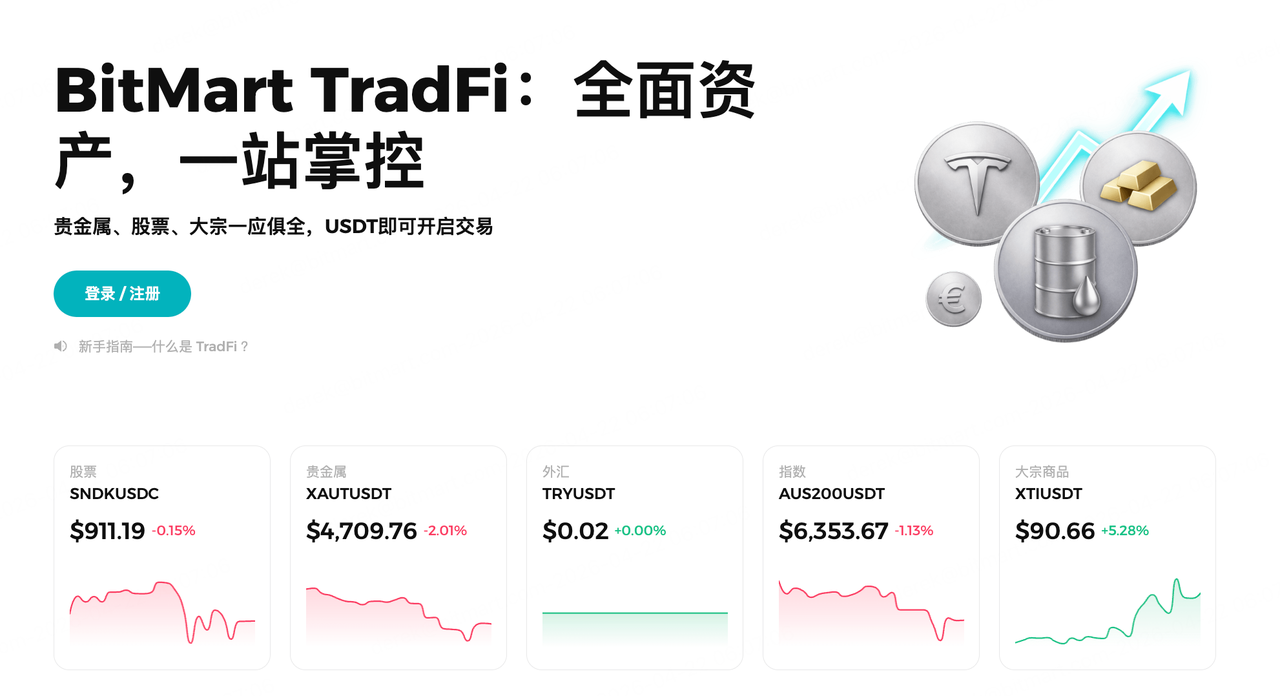
- BitMart has launched a TradFi aggregation page, integrating stocks (e.g., AAPL, TSLA), indices (SPY, QQQ), precious metals (XAU), forex (EUR), and commodities (XTI) into a unified interface.
- TradFi does not replace traditional finance but adds a new trading gateway via tokenization or derivatives on crypto infrastructure, reducing the complexity of cross-market operations.
- Traditional financial markets are highly fragmented, involving different systems like brokerages, forex, and commodities. TradFi aims to eliminate structural fragmentation and achieve efficient connections between capital and assets.
- A unified multi-asset platform allows investors to flexibly adjust their portfolios based on market risk appetite (e.g., shifting from stocks to gold), driving the investment logic towards "global asset allocation."
- Asset tokenization technology is the core driver, enabling traditional financial assets to be traded on-chain, with the boundaries between the crypto market and traditional finance becoming increasingly blurred.
Many times, real changes in the industry are not reflected in price fluctuations, but in the subtle adjustments of market structure.
Over the past few years, the crypto industry has gone through several cycles. However, taking a longer-term view reveals another noteworthy trend: the boundary between the crypto market and traditional finance is gradually blurring. On one hand, traditional financial institutions are entering the crypto market through instruments like Bitcoin ETFs and Ethereum ETFs. On the other hand, the tokenization of Real World Assets (RWA) is expanding, bringing more and more traditional assets onto the blockchain.
Simultaneously, the infrastructure for crypto trading itself is constantly evolving. Compared to traditional markets, crypto trading offers features like 24/7 operation, global liquidity, and more efficient settlement. As this infrastructure matures, it becomes a natural step to introduce traditional financial assets into the crypto trading system.
TradFi (Traditional Finance on Crypto) is increasingly becoming a focal point of industry discussion. It's not intended to replace traditional finance, but rather represents a new type of connection – allowing assets originally scattered across different market systems to be traded and managed within a unified trading structure via the blockchain trading environment.
The product structure at the exchange level is also adjusting accordingly. As the variety of tradable assets increases, efficiently organizing different asset classes within a single interface becomes a key practical challenge. Recently, BitMart integrated its TradFi sector and launched a dedicated TradFi aggregation page (https://www.bitmart.com/en/TradFi), consolidating assets like stocks, indices, precious metals, forex, and commodities into a unified entry point for display and trading.
Compared to the previous structure where these were scattered in different sections, this aggregated page better aligns with the actual usage pattern of multi-asset trading. Users can view market data, filter assets, and execute trades all on one interface, reducing the path cost of switching between pages. From a product perspective, this adjustment is not merely a simple feature addition, but a reorganization of the trading structure centered around multi-asset trading scenarios.
TradFi is More Like a Market Structure Change
If understood superficially, TradFi might seem like just moving stocks, gold, or forex onto a crypto exchange. But in reality, it reflects a change in trading structure.
Traditional financial markets themselves are highly fragmented. Stocks require a brokerage account, forex has its own trading system, and commodities belong to yet another market. Different markets have different trading hours, fund settlement paths, and rules. For institutional investors, these differences might not be significant, but for retail investors, operating across multiple markets often means higher complexity.
TradFi attempts to reduce this structural fragmentation. Through tokenization or derivative forms, some traditional assets can be traded based on their price within a crypto trading environment. This makes it possible to execute operations that previously required multiple platforms within a single trading system.
Of course, this does not change the operational methods of the traditional markets themselves, nor does it mean stocks or commodities are truly "moved onto the blockchain." More accurately, it adds a new layer of trading access on top of the existing financial system, allowing global assets to be connected more efficiently using crypto infrastructure.
BitMart is Expanding the TradFi Trading Structure
As TradFi gradually becomes a focus in the industry, some crypto exchanges are attempting to integrate traditional assets into their trading systems. BitMart is one of the platforms consistently advancing this strategy.
Beyond its original crypto asset trading system, BitMart is progressively expanding its TradFi sector, aiming to integrate more traditional financial assets on the same platform, allowing users access to a wider range of markets within a single account environment.
Looking at the current asset structure, BitMart TradFi already covers several major financial market directions. For instance, in the stock asset category, the platform offers trading instruments related to multiple US tech companies, including representative firms like AAPL, TSLA, META, AMZN, and GOOGL. These assets usually exist in tokenized or derivative forms, with prices linked to the corresponding stock market.
Besides individual stocks, the TradFi sector also includes important indices and ETFs, such as SPY, QQQ, TQQQ, US30, and SPX500. These indices reflect overall market trends and are thus commonly used reference points for macro traders.
In terms of safe-haven assets, gold and silver are also included in the TradFi system, such as XAU, XAG, XAUT, and PAXG. Furthermore, BitMart TradFi extends into the forex and energy markets, including major currencies like EUR, GBP, JPY, AUD, CAD, and commodity assets like XTI (Crude Oil) and XBR (Brent Oil). Through this asset structure, different types of global markets can be accessed within a single trading environment.
When Assets Are Centralized on One Platform, Investment Approaches Change
The truly noteworthy aspect of TradFi is its potential to change how investors think about asset allocation.
In the traditional financial system, if an investor wants to participate in the stock, gold, and forex markets simultaneously, they typically need different accounts and trading platforms. While mature, this structure increases operational complexity and slows the flow of capital between markets.
In a TradFi trading environment, multiple asset types can be traded and managed on a single platform. This unified structure reduces cross-platform operations and allows investors to more flexibly adjust their asset allocation in response to market changes.
For example, when market risk appetite rises, capital might flow towards stocks; when macro uncertainty increases, gold or forex assets might regain attention. If all these assets can be traded within the same system, investors can adjust their portfolios more directly and form cross-market trading strategies more easily.
In a sense, TradFi is shifting the investment logic from "single-market trading" towards "global asset allocation."
The Era of Multi-Asset Trading is Gradually Taking Shape
Looking back at the development of the crypto industry, the past decade has primarily revolved around digital assets themselves. The next phase is likely about the fusion between different asset types.
With the development of asset tokenization technology, more and more traditional financial assets may enter the digital trading system in new forms. From stocks to commodities, from indices to forex, the range of tradable assets will likely continue to expand. As these assets gradually flow within the same infrastructure, a multi-asset digital capital market may gradually emerge.
In this process, TradFi represents an evolution of market structure rather than a short-term trend. It reflects the long-term trends of gradual digitalization in the financial system and the unification of trading infrastructure.
Exchanges like BitMart, which are continuously expanding their TradFi asset categories, are essentially exploring the potential of this structure – enabling users to participate in a broader global financial market on a single digital platform. It remains to be seen how far this model will develop, but what is certain is that the boundary between the crypto market and traditional finance is no longer as clear as it once was.


