屁股决定脑袋:Nikita 为什么必须把商业灰产定性为“国家攻击”?


- Core Argument: The decision by X's product lead, Nikita Bier, to label the proliferation of Chinese bots as a "state-level attack from China" is not merely an act of racial discrimination. Instead, it is the result of a confluence of factors unique to his position as a Silicon Valley elite, the pressure of platform KPIs, and the dynamics of US-China geopolitical interests. This reveals a structural contradiction where platform governance costs are externalized and cognitive biases lead to misattribution.
- Key Elements:
- Nikita Bier's Cognitive Framework: A UC Berkeley graduate in political economy with a career in classic American growth hacking and startups, he lacks an understanding of the business logic behind Chinese gray-market operations. This predisposes him to attribute large-scale anomalous behavior to geopolitical threats.
- X Platform's KPI Survival Chain: Chinese bots degrade the platform's timeline and algorithms, leading to user churn and advertiser concerns. Labeling the issue a "state attack" absolves the platform of responsibility, builds a protective persona, signals alignment to regulators, and avoids the cost of technical improvements.
- Silicon Valley VC Geopolitical Interest Chain: As a partner at Lightspeed Venture Partners and an advisor to Solana, Nikita operates within a Silicon Valley mainstream narrative that views China as a systemic rival. His statements align with this political correctness, helping to solidify his personal reputation and align with VC network interests.
- The Chinese Gray Market Traffic Harvesting Chain: The domestic Chinese gray market is a massive industry valued at over 280 billion RMB, employing over 8 million people. These actors are purely ROI-driven, using X platform to funnel traffic for scams. This is unrelated to state action, but Nikita’s cognitive blind spots lead him to misjudge it as an organized attack.
- Consequences of Structural Contradictions: X wants to capitalize on global traffic but avoids the costs of multilingual governance. Chinese gray market operators treat the platform as a free traffic pool. The ultimate victims are ordinary users, and the issue remains locked in a stalemate of mutual blame-shifting.
On April 26, Nikita Bier, product lead at X platform, directly labeled the rampant Chinese-language adult bots and spam on the platform as a "Chinese state-run bot army attack," causing significant backlash among many Chinese-speaking users. Many accused him of racial discrimination and arrogant scapegoating, saying he can't even distinguish basic facts.
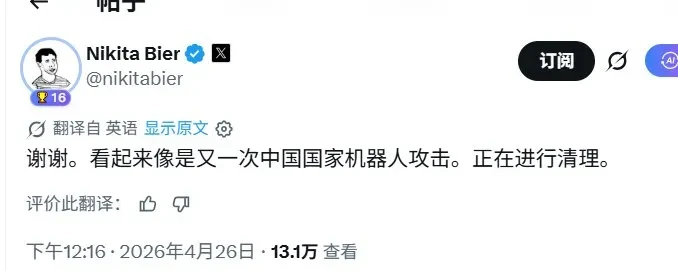
Of course, I think we shouldn't rush to moral judgment first but return to rationality. If we break this down into several chains of interest, you'll actually find that Nikita's attitude towards this issue wasn't impulsive. It wasn't something he blurted out without thinking.
It's more about the combined result of his position, the resources he holds, and the mindset in his head. So rather than attributing it to his personal morality, it's better seen as a natural extension of the interest chains he operates within.
Who is Nikita Bier? A "Political Economist" Shaped by American Growth Logic
If we want to understand why he said what he said, I think we first need to understand who he really is.
Nikita is, in fact, a typical Silicon Valley elite.
In my view, he carries three labels:
Political correctness, viral growth, and fast cash-out.
"Political correctness" stems from Nikita being a UC Berkeley graduate with a double major in Political Economy and Business. These disciplines essentially teach you to view the world through the lens of national interests and power games. So from his school days onward, his mindset was trained to think politically first. This fundamentally shaped his underlying logic or worldview for forming opinions on many matters.
As for "viral growth" and "fast cash-out," these two labels are evident in his entrepreneurial journey, where he took "American growth hacking" to its extreme.
- In 2012, he built Politify, a policy simulation tool that went viral, sharpening his "low-cost user acquisition" skills.
- In 2017, he created tbh, an anonymous compliment app targeting high school positivity. Within a few years, he sold it to Facebook/Meta for around $30 million, completing his first significant capital accumulation.
- In 2022, he launched Gas, an upgraded version of tbh with paid reveals and gamification, later selling it to Discord for another profit, becoming a well-known "serial successful entrepreneur" in Silicon Valley.
- In July 2025, he became X's product lead through "posting his way up," while also holding roles as Partner at Lightspeed Venture Partners and Advisor to Solana.
So for Nikita, all his success is built within the closed loop of the Western youth market, psychological drivers, viral growth, and fast monetization. This means he has never deeply engaged with the Chinese market or had direct interaction with China's gray and black industries.
Therefore, in his view, any large-scale and abnormal user behavior isn't commercial profit-seeking but an organized external force. This is the cognitive template formed over more than a decade from his education to entrepreneurship; it's ingrained. That's why, when it comes to the Chinese-language segment on X, many users get verified if their interactions are slightly too frequent or abnormal, and there have even been large-scale account suspensions during certain periods.
The Three Interest Chains I See
To see the essence of the matter, we can break down Nikita's statements into three interest chains to analyze his choices.
The first chain: X platform's KPI survival chain – his lifeline, easier to protect by deflecting blame
X's core revenue currently comes from three sources: advertising (the majority), Premium subscriptions (likely covering blue check payouts), and Grok AI monetization.
As product lead, Nikita's job is essentially to drive platform growth – user growth and revenue growth. I think his KPI is essentially one thing: make all three revenue streams grow, and look good doing it.
But Chinese-language spam bots are exactly X's "cancer," with typical characteristics including:
- Large scale: Nikita himself mentioned a pool of 5-10 million accounts, all mass-posting spam every minute.
- Low cost: Chinese black market operations use cheap servers, SIM cards, and VPNs, costing next to nothing per setup to register accounts indefinitely.
- High damage: These bots don't attack X but leech off its traffic, funneling users to Telegram groups, scam schemes, and adult live streams, directly polluting timelines, search results, and recommendation algorithms. This drives away real users and makes advertisers hesitant to spend.
So if Nikita admitted, "Our risk control model failed, our algorithm isn't sensitive to non-English traffic, and we've accumulated technical debt," he'd be blamed. He'd have to spend real money to fix the system, potentially impacting growth metrics. A big ship is hard to turn, and one move affects the whole system.
Think about it: could someone like Elon Musk tolerate a product lead saying, "Our technology isn't good enough"?
So the optimal solution is just one: blame it on a "Chinese state-run bot army." This brings several benefits:
Deflect blame: It's not our poor tech; it's a powerful state-backed adversary.
Build an image: X is defending free speech globally, aligning with Musk's narrative and possibly earning some goodwill.
Signal loyalty: Show US regulators/Congress that they are fighting foreign interference, potentially reducing future regulatory headaches.
Is this a risk-free move? Absolutely.
The second chain: Silicon Valley VC and geopolitical interest chains – his backers require taking sides
Nikita isn't just X's product lead; as mentioned, he's also a Partner at Lightspeed Venture Partners. Lightspeed is a quintessential Silicon Valley VC, investing in products like BeReal and Flo Health, with virtually no overlap with Chinese tech companies.
What's the mainstream narrative in Silicon Valley now?
China is a systemic rival. The TikTok ban, data security reviews, supply chain decoupling – all push China towards the "enemy" category. In this climate, any "large-scale anomalous behavior" from China is automatically assumed to be "state-sponsored." This isn't just prejudice anymore; it's survival logic.
X itself is caught in the US-China rivalry. It wants to be the "global digital town square" and monetize global traffic, but also avoid being accused by US Congress of "enabling Chinese influence."
So Nikita's scapegoating perfectly hits the politically correct mark: it helps Musk pick a side without affecting X's revenue from Chinese gray-market traffic (since those users won't pay for Premium anyway).
Of course, there's also a hidden personal benefit: in Silicon Valley VC circles, "taking a hard stance on China" is a plus. It boosts personal reputation, making it easier to find projects and raise funds later.
The third chain: The traffic harvesting chain of Chinese gray and black industries – the real world he doesn't understand
China's internet gray and black industries are no longer small-time operations.
I found some old data: according to Q1 2025 figures, the domestic black and gray market scale exceeded 280 billion yuan, with over 8 million practitioners. It has formed a complete interest chain including intermediary traffic generation, technical support, legal camouflage, and fund distribution. These players have nothing to do with state action; they only care about one thing: ROI (return on investment).
A scam link click earns a few cents, a referral to an adult live stream earns a few dollars, and one account can send hundreds of messages a day. As long as it's profitable, someone will do it. With X's relatively lax moderation and massive global traffic, it's become their new battleground. They don't fundamentally want to attack X; they just want to make money on X.
These black market operators have no direct command relationship with the authorities, who are actually cracking down hard on VPNs and fraud domestically.
But during "politically sensitive periods," their activity does intensify, as user attention is higher, increasing scam success rates.
Nikita doesn't understand this chain:
Because he has never built a product in China, he hasn't seen the underlying logic of running scripts 24/7 for just 0.1 yuan per click. He only sees "5-10 million accounts bursting at regular intervals" and immediately assumes it's a "state operation." This is a classic case of cognitive blind spot.
So, based on this analysis, you realize Nikita isn't simply a "racist." He's someone completely defined by the economic chains he operates within.
That is, the triple identity of an American growth hacker, Silicon Valley VC, and US platform executive naturally leads him to interpret "large-scale Chinese-language anomalies" as geopolitical threats rather than commercial gray-market activity.
This is a classic case of "position determines cognition." Sitting in that seat, holding those resources, with that mindset, the words that come out can only be what they were.
So this isn't just Nikita's personal issue. I think it's more about the inevitable result of the misalignment between the US and China's digital economy industry chains and the shifting of platform governance costs.
X wants to feast on the dividends of global traffic but avoids spending real money on multi-language gray market governance.
Chinese gray markets want to earn quick global cash, treating platforms as free traffic pools.
Neither side wants to pay for the "public good" (a clean digital square), so they end up slinging mud at each other: you call it a "state attack," I say your "tech is weak." Neither is willing to back down or solve the problem.
In the end, the real losers are the ordinary users who just want to see real information and communicate normally on X. That's the most frustrating part of this whole situation.