Polymarket's "2028 Presidential Election" Traffic King is... LeBron James???


- Core Viewpoint: In Polymarket's "2028 Presidential Election" prediction market, a significant portion of trading volume is concentrated on low-probability candidates. This counter-intuitive phenomenon is primarily driven by rational strategies where users seek risk-free returns from platform subsidies or optimize trade execution paths, rather than irrational speculation.
- Key Elements:
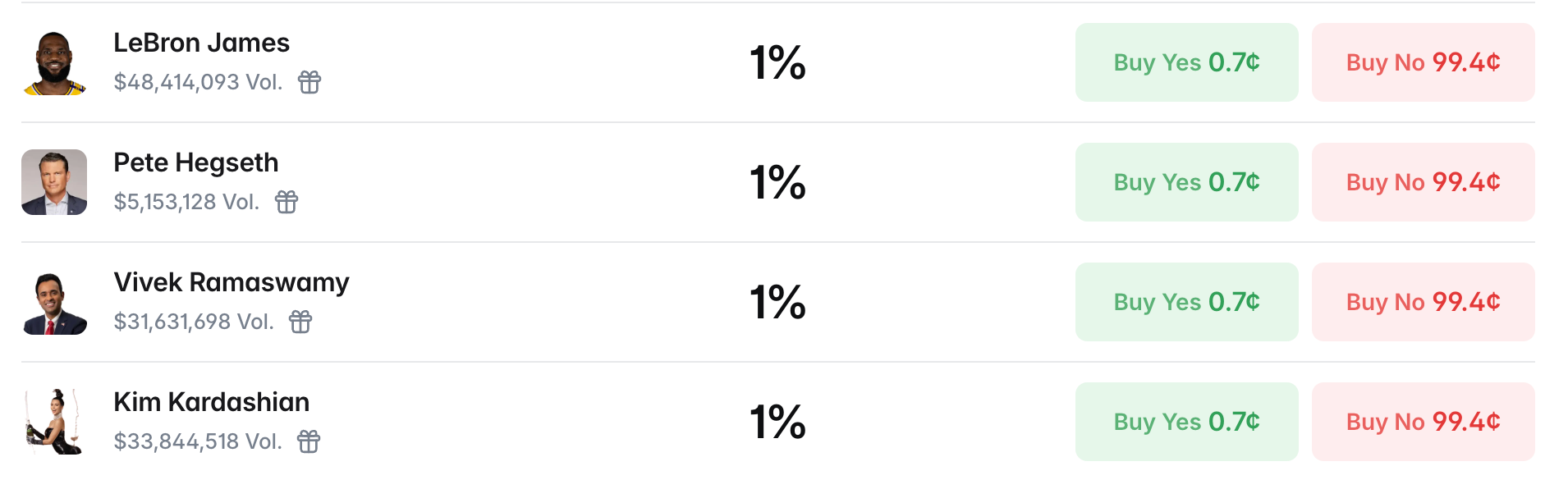
- Market data shows that trading volume is highly concentrated on "celebrity" candidates like LeBron James and Kim Kardashian, who have extremely low real-time probabilities (less than 1%), while trading volume for high-probability political figures is relatively low.
- One core reason is that whale addresses aim to earn the 4% annualized holding reward provided by Polymarket. They achieve risk-free returns exceeding those of comparable U.S. Treasuries by simultaneously holding YES and NO shares for specific candidates or by holding only NO shares.
- Another reason is that users leverage platform features. By first buying NO shares for low-probability candidates and then converting them into corresponding YES shares, they can obtain better liquidity or pricing, optimizing trade execution.
- The total trading volume for this event has reached $549 million, making it the platform's hottest betting event. This highlights the profound impact of financial engineering strategies on apparent trading behavior in crypto prediction markets.
Original | Odaily (@OdailyChina)
Author | Azuma (@azuma_eth)
This morning, Barron's reporter Nick Devor posted on X about a very "bizarre" phenomenon observed in the "2028 Presidential Election" prediction market on Polymarket — approximately 70% of the trading volume is concentrated on candidates who are nearly impossible to win (real-time probability less than 1%).
For instance, the highest trading volume is surprisingly on NBA star LeBron James (trading volume $48.41 million), followed closely by socialite Kim Kardashian (trading volume $33.84 million). Further down the list are candidates who aren't even eligible to run (lacking U.S. citizenship), such as the world's richest person Elon Musk (trading volume $23.14 million) and New York City Mayor Zohran Mamdani (trading volume $18.39 million)...
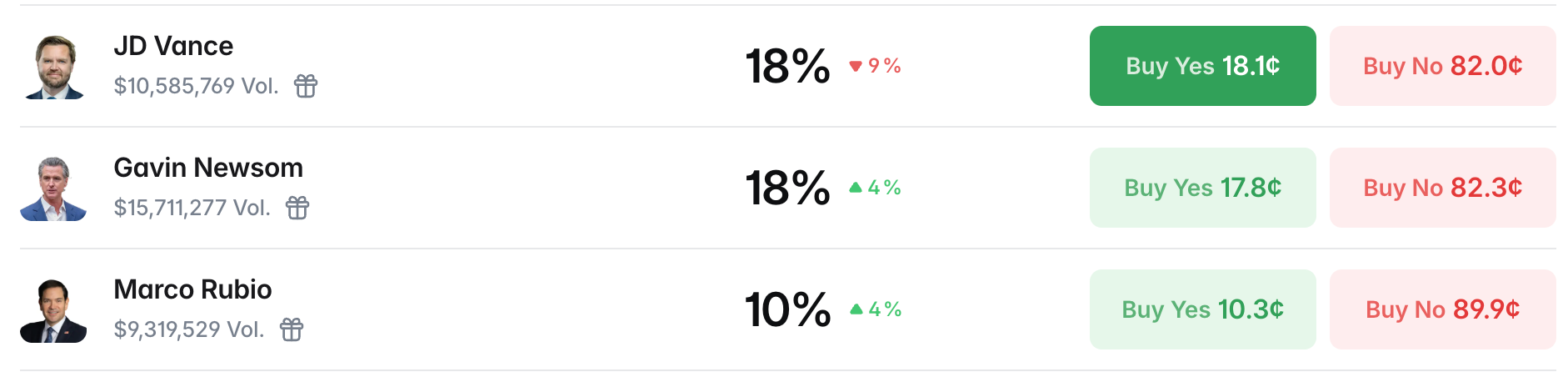
As for the truly high-probability candidates, such as the current frontrunner Vice President JD Vance (trading volume $10.58 million), California Governor Gavin Newsom (trading volume $15.71 million), and Secretary of State Marco Rubio (trading volume $9.32 million), their trading volumes are far lower than those of the aforementioned "celebrity candidates."
Official data from Polymarket shows that the total trading volume for the "2028 Presidential Election" has reached $549 million, making it the platform's hottest betting event. However, a closer look at the trading volume data for the 36 candidates reveals the counter-intuitive situation described above. Why is this? Are people crazy, betting on candidates who are almost or completely impossible to win?
The answer, of course, is no. Earlier this year, Odaily published an article titled "Who's Making Counter-Intuitive Bets in Prediction Markets?", which used examples like "The Second Coming of Christ" and "Flat Earth Theory" to explain that participants trading or providing liquidity in these absurd event markets can be categorized into three main groups: "lottery players, bots, and airdrop farmers."
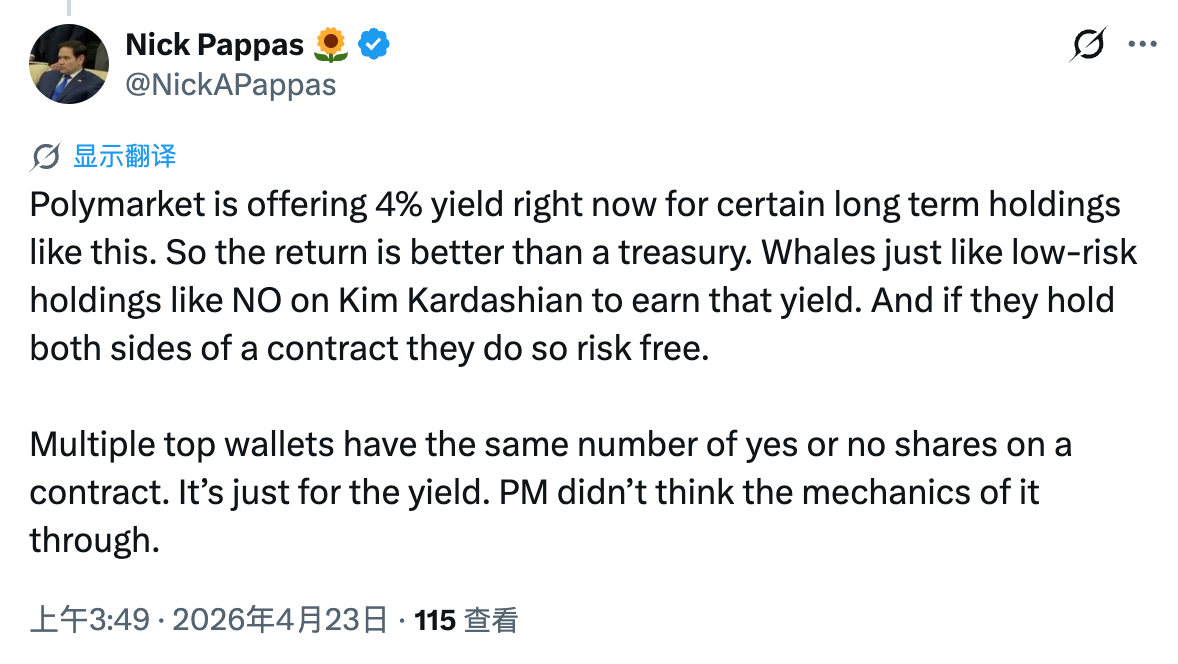
Nick Devor's own explanation aligns with the third logic we outlined. He discovered that multiple top addresses hold equal amounts of YES and NO shares for the same candidate, essentially aiming for risk-free profits from Polymarket subsidies — To maintain long-term pricing accuracy, Polymarket offers a 4% annualized holding reward based on total position value for holdings in certain markets, and the "2028 Presidential Election" is one of these subsidized events.
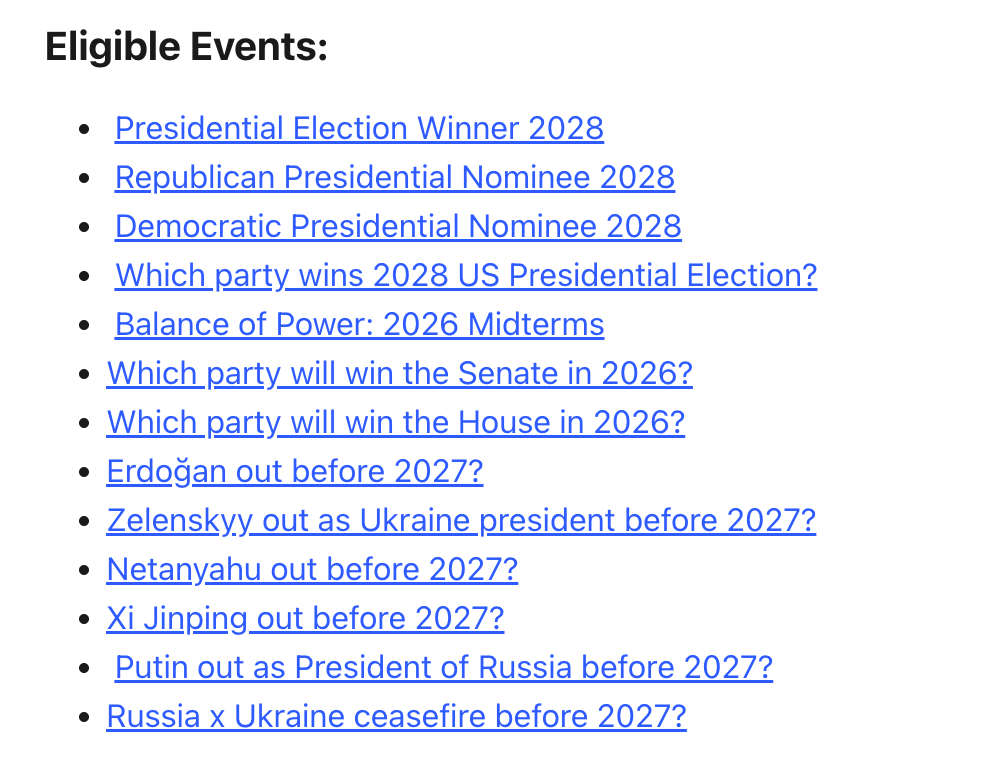
Nick Devor pointed out that a 4% annualized yield is higher than the current U.S. Treasury yield (3.98% for the 5-year note), making whales prefer this low-risk holding strategy. For example, they might buy NO shares for James or Kardashian (it doesn't matter who, just pick the popular ones) to capture this yield; holding both YES and NO shares for the same candidate can achieve risk-free returns.
As for why some users hold small, one-sided YES positions for such low-probability candidates, another X user A5 (@probablythenuts) explained that in these multi-option markets, Polymarket offers a feature allowing users to convert a set of NO shares into a corresponding set of YES shares.
Many users utilize this feature for better liquidity depth or pricing — meaning they don't directly buy YES shares for the candidate they think will win. Instead, they first buy NO shares for candidates they believe will lose, then convert those NO shares into a corresponding set of YES shares. Furthermore, they can buy NO shares for multiple candidates and, after conversion, hold a corresponding set of YES shares for other candidates, including any new candidates added to the event in the future.
Therefore, the users trading LeBron James or Kim Kardashian shares in Polymarket's "2028 Presidential Election" market are neither crazy nor foolish. They are either seeking stable annualized returns or optimizing their execution path. While the actions may seem absurd, they are ultimately driven by rational motives.