






When Wallets Start Embedding AI Agents: The New Interaction Paradigm of ERC-8211, Why Is It Worth Watching?


- Core Viewpoint: The ERC-8211 standard aims to address the core bottleneck when AI Agents execute complex on-chain operations (such as multi-step DeFi strategies), namely that the existing "static batching" model cannot adapt to dynamic changes in on-chain state. By introducing a "dynamic evaluator program" paradigm, it provides a native, secure on-chain execution layer for AI agents.
- Key Elements:
- Core Problem: Existing standards (like ERC-4337) allow multiple calls to be bundled with one signature, but the parameters are "frozen" at the time of signing and cannot be dynamically adjusted during execution based on real-time on-chain conditions (such as slippage, liquidity), making complex workflows fragile and prone to failure.
- Solution: ERC-8211 upgrades batching from a "static transaction sequence" to a "dynamic evaluator program." Through three primitives—Fetchers (real-time value fetching), Constraints (conditional constraints), and Predicates (trigger conditions)—it ensures that the input for each step is based on the actual output of the previous step and meets preset conditions.
- Execution Guarantee: This mechanism enables atomic execution. If any step fails to meet expectations (e.g., insufficient swap amount, slippage exceeding limits), the entire batch rolls back, avoiding risks of idle funds or leftover incomplete transactions.
- Impact on Wallets: The role of wallets will evolve from "secure signers" to "intent program interpreters." They will need to clearly present users with the complete execution program, which includes value-fetching logic and conditional judgments, rather than just individual transaction details.
- Ecosystem Positioning: ERC-8211 is compatible with account abstraction standards like ERC-4337. It adds a new layer of "programmatic execution semantics" on top of them, jointly advancing on-chain interactions towards a more advanced "intent" expression paradigm.
Starting in 2025, many people may have gradually become accustomed to a new way of interacting: telling GPT or Gemini, "Help me plan a trip to Hong Kong next week and recommend suitable flights and hotels." It will then silently complete a series of steps in the background—information searching, condition filtering, route selection, price comparison—and finally, only present the results for your confirmation.
However, bringing the same expectation on-chain tells a completely different story.
For instance, if you give an instruction to a DeFi Agent: "Swap the ETH in my wallet for USDC, bridge it to Base chain, and then deposit the full amount into Aave." Objectively speaking, in terms of "understanding the requirement" and "planning the path," today's Agents are not necessarily incapable. The real disconnect appears in the execution phase:
You will likely still need to complete operations step-by-step: signing, approval, swapping, bridging, and depositing. Each step is exposed to risks like slippage changes, Gas fluctuations, bridge delays, and on-chain state changes. This also means that if any single step deviates from expectations, the preceding actions may not be reversible, and the subsequent actions might fail to connect. What often remains on-chain is just an unfinished, half-completed process.
The problem isn't that the AI isn't smart enough; it's that the on-chain execution layer still lacks a truly Agent-adapted mode of expression.
Precisely because of this, in early April 2026, Biconomy and the Ethereum Foundation jointly released ERC-8211. It aims to address the "static limitations" in current smart contract execution, providing a more expressive execution layer for AI agents and complex DeFi workflows, attempting to fill in this missing piece of the puzzle.
I. The "Final Disconnect" for AI Agent On-Chain Integration
Over the past one to two years, the crypto industry's focus has clearly shifted from L2 scaling and RWA liquidity to the disruptive topic of how AI Agents can truly take over on-chain operations.
Objectively, from "issuing multi-step DeFi strategies in natural language" to "having autonomous agents manage an entire cross-chain portfolio," we have recently seen many practical attempts. Most concepts are already mature at the demo level, whether it's generating multi-step DeFi strategies from natural language, autonomous rebalancing, automatic yield migration, cross-chain position adjustments, or even more complex portfolio management.
From the perspective of reasoning and orchestration, AI capabilities have advanced quite rapidly. However, when it comes to putting them into a production environment, the shortcomings of the execution layer become increasingly apparent.
To put it bluntly in a production context, this shortcoming can be summarized in one sentence: DeFi is dynamic, but most batch processing today remains static.
Both the ERC-8211 official website and discussion threads articulate this problem clearly: existing standards like ERC-4337 and EIP-5792 have indeed progressed from the old model of "one signature corresponding to one call" to a new stage of "one signature can bundle multiple calls." However, the parameters within these calls are essentially still mostly frozen at the moment of signing.
In other words, the amounts, target values, and expected outputs entered by the user during signing do not automatically adjust based on on-chain state changes when it's time for actual execution.
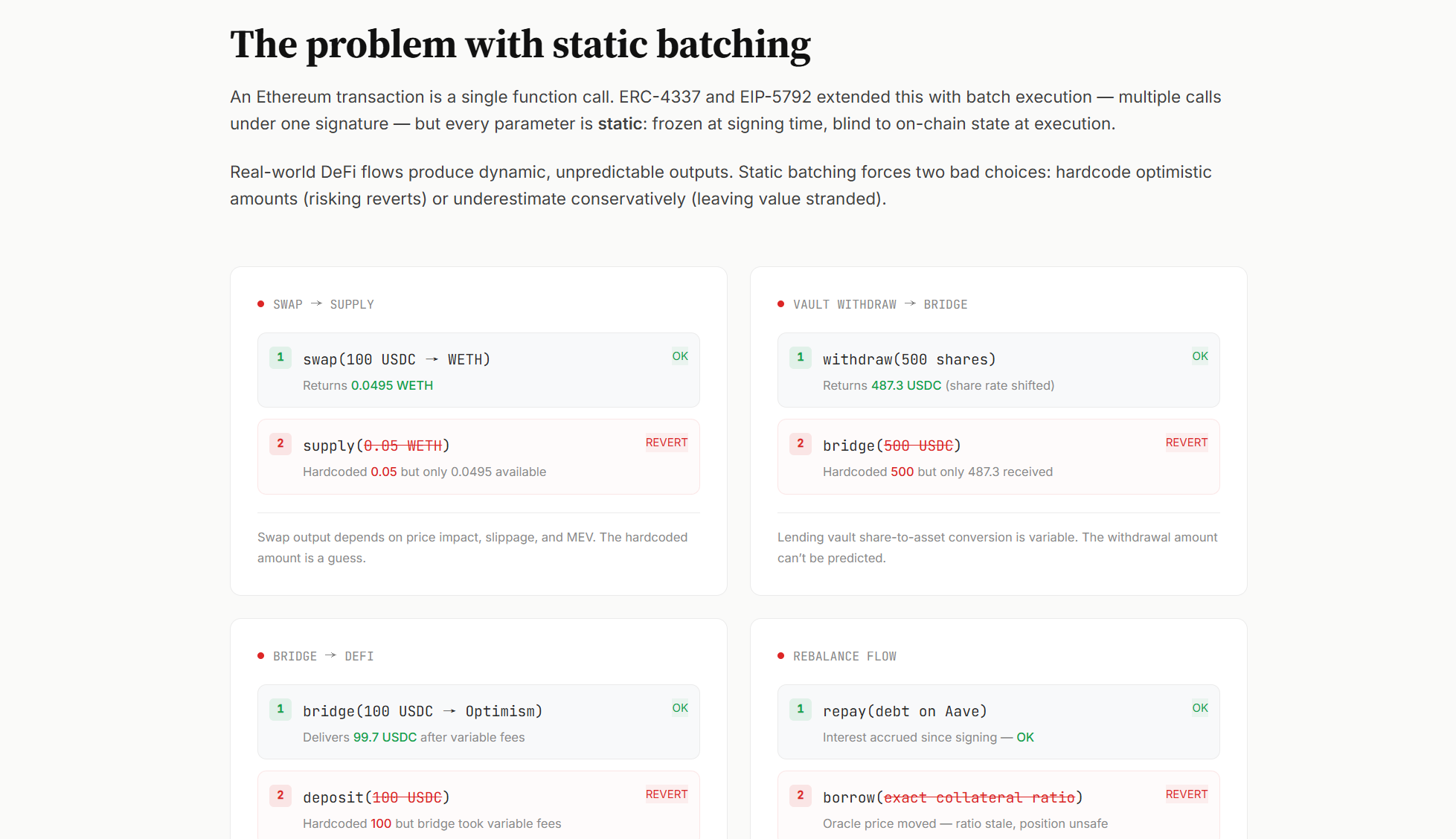
Yet DeFi itself is inherently full of uncertainty. The actual output of a swap depends on the slippage and liquidity in the block where it executes. The arrival time and final amount of a bridge transaction depend on the bridge's own mechanism and fees. The share-to-asset ratio in lending protocols or vaults is also constantly changing.
After all, the values seen by the user or Agent at the time of signing are often just current estimates, not the real results at execution time.
To understand what ERC-8211 solves, let's look at a classic example: suppose an Agent wants to do something seemingly simple—swap ETH in an account for USDC and then deposit the full amount into Spark to earn interest.
Under the current static batch processing model, the Agent must estimate how much USDC will be received after the swap before signing. This often forces you to predefine the input amount for the second step at signing time. If the estimate is too high and the actual received amount is insufficient, the entire batch rolls back. If the estimate is too low, a portion of funds remains idle in the wallet, unable to be utilized.
In other words, you are essentially caught in a dilemma: either bear the risk of failure or bear the opportunity cost. This is why many seemingly uncomplicated on-chain processes quickly become fragile once the steps extend to 5, 8, or even cross two chains. It's not because the strategy itself is too complex to describe, but because the current execution paradigm relies too heavily on predefined, hardcoded parameters.
In short, the capability ceiling of static batch processing essentially determines the upper limit of strategies an Agent can safely execute.
From this perspective, what ERC-8211 aims to solve is not *how* AI Agents make decisions, but *once* an Agent has made a decision, whether there is a more natural, stable, and secure way to execute it on-chain. This would allow on-chain execution to possess, for the first time, an expression form natively designed for AI Agents.
II. What Exactly Does ERC-8211 Change?
The core breakthrough of ERC-8211 is not about cramming more steps into one signature, but about upgrading batch processing from a sequence of transactions with hardcoded parameters to a "program where parameters are dynamically evaluated at execution time."
It sounds abstract, but it's not hard to understand. The official description uses one phrase: From transactions to programs.
This means ERC-8211 no longer views a batch as a checklist of actions to execute in order, but treats it as an execution program evaluated at runtime, with safety conditions. Breaking it down, it achieves this through three composable primitives:
- Fetchers: Define where a parameter gets its value from. It could be a query for the current balance of a certain address, making the parameter not a snapshot from signing time, but a real-time reading fetched from the on-chain state at the moment of execution.
- Constraints: After a parameter is resolved, it must pass inline constraint checks—for example, "the USDC obtained must be ≥ 2500," or "slippage cannot exceed 0.5%." These constraints are validated before the value is routed into the next call. If any constraint fails, the entire batch rolls back immediately.
- Predicates: Can be understood as gatekeepers between steps. They are not responsible for generating values but for judging whether to continue execution. For example, in a cross-chain scenario, the batch on the Ethereum side can use a predicate to wait for the condition "the bridged WETH has arrived" before submitting.
In this design, every parameter must answer two questions: First, where should this value come from at execution time? Second, what conditions must it satisfy before being actually used in a call? When these three are combined, a batch is no longer just a transaction sequence but a program with embedded safety checks.
Ultimately, the mental model for static batch processing is a checklist—execute steps A, B, C in order. The mental model for ERC-8211, however, is a conditional program—after A executes, take A's actual output as B's input; B must satisfy constraints to proceed to C; if any step fails to meet expectations, the entire batch rolls back.
We can simply understand it as a "smart batch processing" mechanism specifically designed for AI Agents and complex DeFi operations. This is because, in traditional on-chain operations, completing a complex DeFi strategy often requires multiple independent transactions: withdrawing funds from a lending protocol, swapping tokens, and depositing into another protocol (Extended reading: Crypto AI Protocol Landscape: Starting from Ethereum's Main Battlefield, How to Build a New Operating System for AI Agents?).
Each step requires separate signing and confirmation, which is already cumbersome for human users and becomes a bottleneck for AI Agents that require high-frequency autonomous operations. ERC-8211's solution is to allow multiple blockchain operations to be combined and executed in a single transaction, with each step dynamically resolving actual values at execution time and only proceeding to the next step if predefined conditions are met.
For example, an Agent can complete in one signed transaction: withdraw funds from Aave → swap the actual received amount on Uniswap → deposit the swap result into Compound—all executed atomically, without the need to write a new smart contract.
III. Why It Matters More to Wallets, Especially Smart Wallets
The reason ERC-8211 deserves attention from the wallet industry is not just because it suits Agents, but because it will redefine the wallet's position in the interaction chain.
In the past, wallets were more like secure signers. Their responsibility was to store private keys, display transactions, allow user confirmation, and then send out the signature. This role was crucial enough in the EOA era and continues to hold in the account abstraction era. However, if more and more on-chain operations are to be performed by Agents in the future, the wallet's role will become more central and critical.
The reason is simple: when users no longer control on-chain actions transaction by transaction but start authorizing an Agent to execute an entire set of objectives, the wallet must be capable of handling this higher-level interaction object. What it needs to display is no longer just a contract address and a piece of calldata, but an entire execution program encompassing "intent—value-fetching logic—condition evaluation—final result."
Therefore, future wallets need to understand not just transactions, but programs. ERC-8211 provides a clearer handle for wallets precisely at this layer because it explicitly encodes these execution semantics into the structure. It specifies where parameters come from, what conditions they must satisfy, when to continue, and when to roll back. These are not black-box logic hidden in the backend but objects that can be interpreted, simulated, and displayed by the wallet.
From the wallet's perspective, this entire mechanism ultimately points to the same thing: users are no longer signing a series of low-level calls they can hardly fully understand; they are signing a result-oriented, clearly bounded, condition-verifiable execution program:
- AI Agents can be responsible for understanding user intent and generating the path.
- Wallets are responsible for presenting this path in a clearer way for user review.
- Relayers are only responsible for submitting when conditions are met, without the authority to tamper with results.
This is precisely why non-custodial execution is considered a prerequisite for Agentic DeFi. Agents can participate, but sovereignty, constraints, and final settlement remain on-chain. This is also where ERC-8211 truly aligns with smart wallets: it encodes the act of "securely expressing complex intent" into the protocol layer standard.
It's worth mentioning that ERC-8211 is fully compatible with account abstraction frameworks like ERC-4337, EIP-7702, and ERC-7579. It does not replace account abstraction; rather, it adds a layer of programmatic execution semantics for Agents on top of account abstraction.
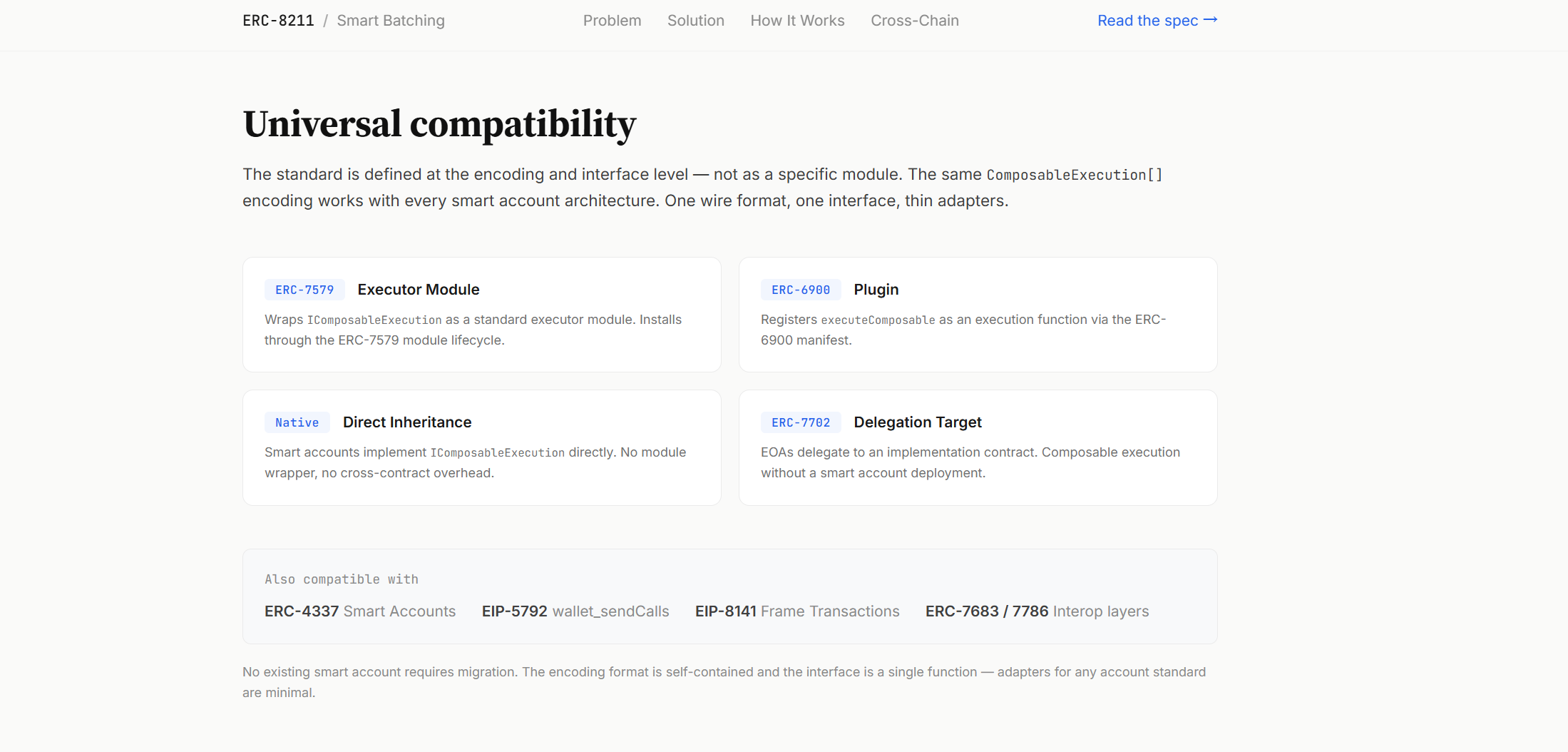
If ERC-4337 solves "who can initiate transactions on my behalf," and EIP-7702 solves "how can an EOA temporarily possess smart contract capabilities," then ERC-8211 solves: once an Agent starts operating on my behalf, can it complete an entire decision chain within one signature?
Looking back at the evolution of on-chain interaction paradigms on Ethereum over the past 10 years:
- Phase 1: One signature = One function call (EOA Era)
- Phase 2: One signature = A bundle of static calls (ERC-4337, EIP-5792 Era)
- Phase 3: One signature = A dynamically evaluated intent program (ERC-8211 Era)
Each leap means users (or Agents representing them) can express more complex goals with less friction.
Although ERC-8211 is currently still in the draft stage, with technical discussions ongoing and large-scale protocol adoption requiring time, the direction it points to is clear enough. When AI Agents truly start making on-chain decisions on behalf of humans, the chain needs an execution syntax that matches it natively.


