






2026 DeFi Sector's "True Buyback": JST Has Cumulatively Burned Over 1.35 Billion Tokens, JUST Demonstrates Long-Termism with Ecosystem Strength


- Core View: Against the backdrop of an overall sluggish crypto market, JST has constructed a deflationary model based on real ecosystem revenue through three rounds of large-scale buyback and burn, totaling over $60 million and destroying 1.356 billion tokens (approximately 13.7% of the total supply). This has achieved counter-trend growth in both price and market cap, demonstrating the ecosystem's self-sustaining capability and long-term value.
- Key Elements:
- The buyback and burn mechanism is deeply tied to the real revenue generated by the JUST ecosystem's core businesses (JustLend DAO lending and the USDD stablecoin). Funds are sourced from business profits, not token issuance or reserves, ensuring sustainability.
- The capital invested in the three rounds of burns has increased sequentially ($17.72 million, $21 million, $21.3 million), cumulatively exceeding $60 million. All operations are conducted transparently on-chain and are executed in a decentralized manner by the Grants DAO.
- The large-scale burns have permanently reduced the token supply by over 13.7%, enhancing scarcity. Since the plan's launch in October 2025, the JST price has risen from around $0.03 to over $0.08, an increase of over 160%, and its market cap has surged from $300 million to nearly $700 million.
- The core funding engine, JustLend DAO, operates robustly with a TVL of approximately $6.89 billion and cumulative net revenue exceeding $83.64 million, providing a continuous funding guarantee for buybacks and a reserve of over $20 million in accumulated profits.
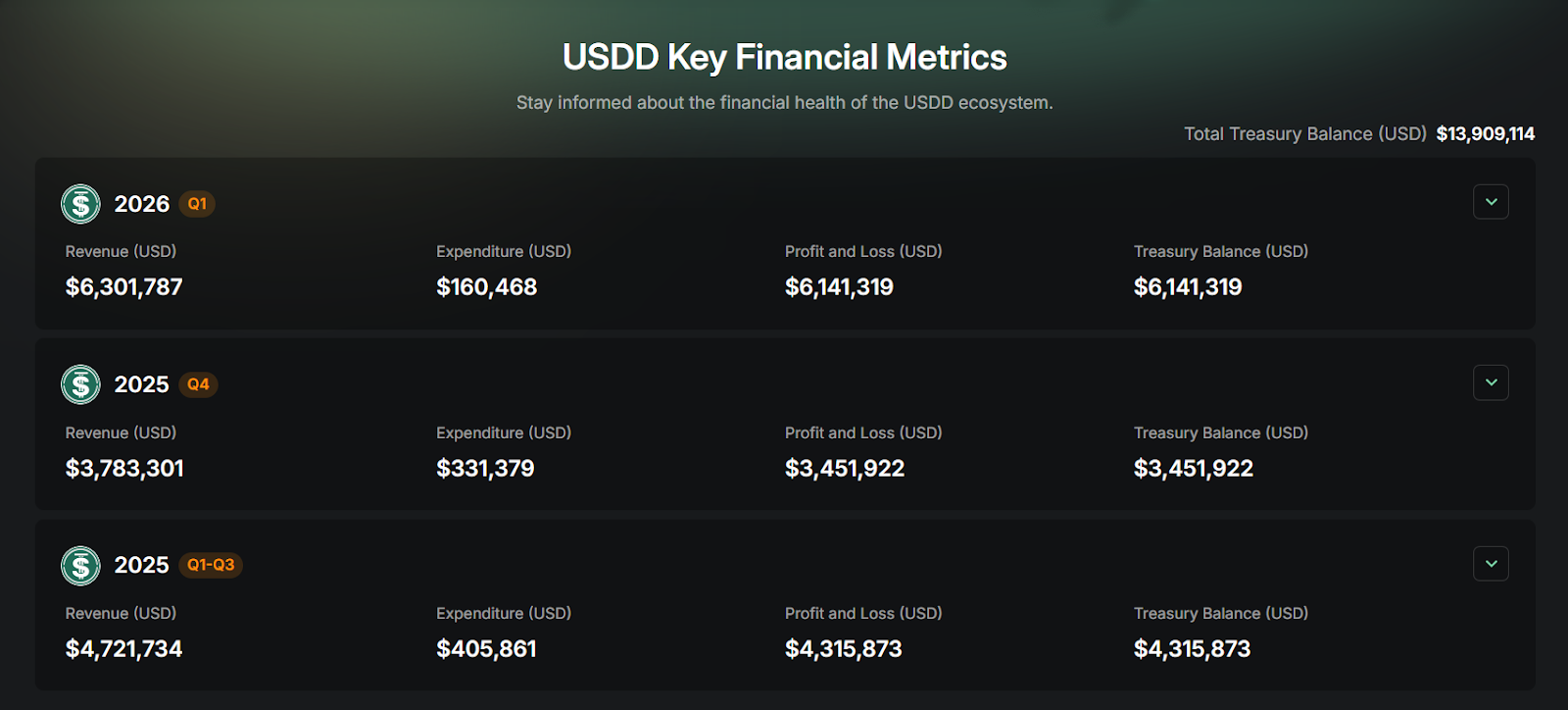
- The stablecoin USDD, serving as a potential second growth curve, has seen its total supply exceed $1.55 billion. Its future excess revenue (treasury funds have accumulated $13.9 million) will serve as incremental capital to further drive JST deflation.
- The JUST ecosystem's TVL is approximately $11.6 billion, accounting for nearly half of the entire TRON network's TVL ($27.3 billion). It has demonstrated strong ecosystem resilience and the ability to navigate market cycles amidst recent industry turbulence.
Against the backdrop of Bitcoin's volatile downtrend, tightening overall liquidity in the crypto market, and a sluggish trading atmosphere, JST has completed its third large-scale buyback and burn. With a "real buyback" strategy involving tens of millions of dollars, it has achieved a breakout against the trend, injecting precious long-term confidence into the cold industry like a ray of dawn. This action not only fully demonstrates its robust ecosystem strength to weather cycles but also confirms its steadfast commitment to long-term value.
Unlike many short-lived "marketing burns" in the industry, JST's buyback and burn program is deeply rooted in the real revenue generated by its ecosystem. It is a long-term value-adding plan with self-sustaining capabilities that can operate normally. Consequently, JST has formed a complete value loop and a logically rigorous deflationary governance mechanism, building a truly sustainable and implementable governance system.
Specifically, JST's buyback and burn mechanism is deeply tied to the real ecosystem revenue generated by the two core business lines of the JUST ecosystem: the lending hub JustLend DAO and the stablecoin USDD. Currently, all buyback funds come from JustLend DAO. The entire process is governed by transparent rules, with clear and verifiable fund sources. Every burn operation is fully recorded on-chain, open for verification by anyone, ensuring the sustainability and credibility of the deflationary governance at the foundational design level.
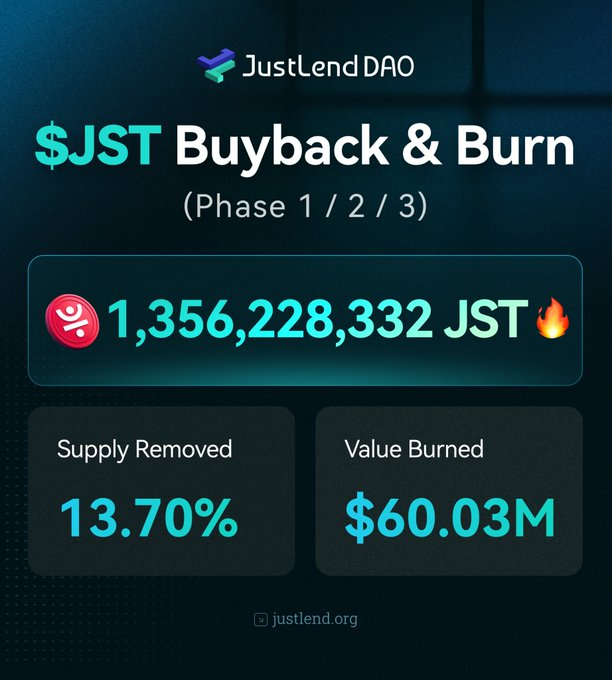
In just half a year, JST has efficiently completed three consecutive large-scale buyback and burn actions, with cumulative funds exceeding $60 million. The total amount of JST burned has reached a staggering 1.356 billion tokens, accounting for approximately 13.7% of the total token supply. Roughly estimated at the recent market price of about $0.08 per JST, the total value of JST tokens burned across the three rounds has surpassed $100 million.
Three Rounds of "Real Money" Burns Escalating Step by Step, Deflationary "Flywheel" Drives Dual Growth in JST Price and Market Cap
After three consecutive textbook-level large-scale buyback and burn actions in the industry, JST's deflationary strategy has delivered an impressive report card: the total supply has been directly reduced by over 1.356 billion tokens. As JST's buyback and burn mechanism progresses as a normal operation, its deflationary "flywheel" effect is accelerating, continuously highlighting the token's scarcity. This, in turn, builds a strong value moat, providing robust support for the steady simultaneous rise in JST's price and market capitalization.
Looking at the specific burn trajectory, the capital input for each round shows a strong trend of steady increase:
- Round 1 (October 2025): Breaking Ground, burned approximately 559 million JST, accounting for 5.66% of the total token supply, with an investment of about $17.72 million;
- Round 2 (January 2026): Exceeding Expectations, burned approximately 525 million JST, accounting for 5.30% of the total supply, with funds increasing to about $21 million, including $10.34 million from retained earnings and $10.19 million in new net profit from Q4 2025;
- Round 3 (April 15, 2026): Executed as Scheduled, burned approximately 271 million JST, accounting for 2.74% of the total supply, with funds further climbing to about $21.30 million, including $10.34 million from retained earnings and $10.97 million in new net profit from Q1 2026.
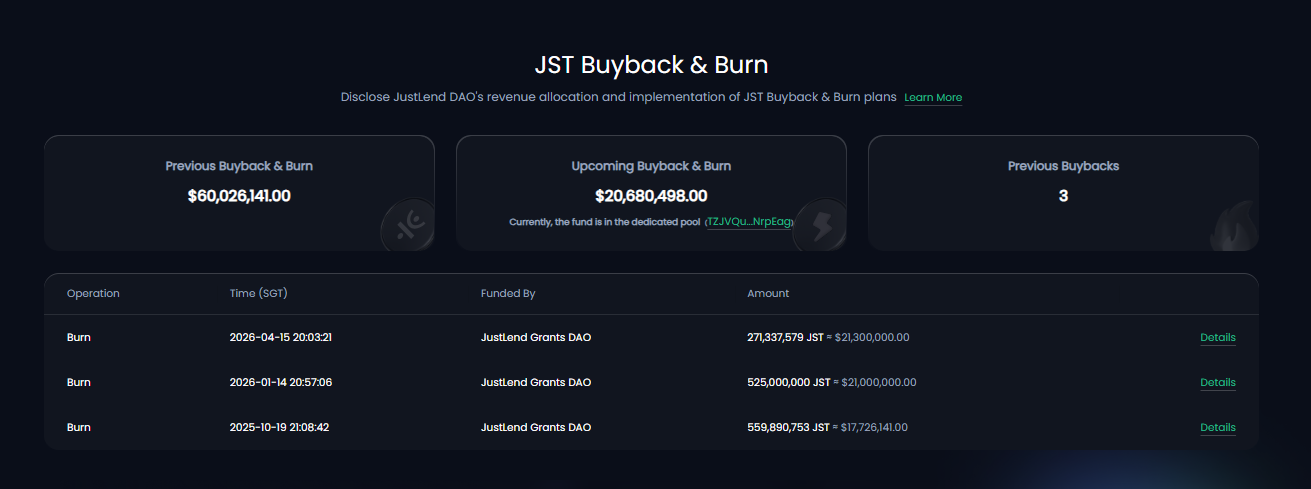 The cumulative investment across these three rounds of buyback and burn exceeds $60 million, showing a clear trend of "real money" gradually increasing: from $17.72 million in the first round, to $21 million in the second, and further to $21.30 million in the third, with the scale steadily climbing and progressing step by step. All funds originate from the real business revenue of the JustLend DAO platform—including both retained earnings and newly added net profits each quarter. No token issuance or reserve funds were used at any point; every investment represents genuine ecosystem profit reinvestment, fully demonstrating the solid self-sustaining capability of the JST ecosystem behind its buyback and burn.
Beyond the reliability of fund sources, JST has embedded the principles of "openness, transparency, and decentralization" into every operational aspect of its buyback and burn. Each round of burns is executed strictly according to decentralized rules by the Grants DAO, with all operations conducted publicly on-chain.
The cumulative burn of 1.356 billion JST across three rounds is far from a simple accumulation of numbers; it represents a profound reshaping of the token supply side—permanently removing over 13.7% of the token base from JST's total supply, equivalent to directly shrinking the circulating supply by 13.7%. With the execution of each burn round, JST's circulating supply continues to shrink sharply, and the scarcity value of the token becomes increasingly prominent. This positive change is directly transmitted to the market, driving a steady climb in JST's token price and overall market capitalization, forming a clear, strong, and sustainable upward value trend.
JST's tangible market performance also confirms the effectiveness of its deflationary model. Since the official launch of the buyback and burn plan in October 2025, JST has completely broken free from the constraints of broader market fluctuations, embarking on an independent and strong upward trajectory. According to recent data from CoinGecko, the JST token price started from a low of around $0.03 in October last year, surged forward, breaking through $0.08 at its peak, achieving a cumulative increase of over 160%, marking leapfrog growth. Simultaneously, its market capitalization has also grown steadily, rising from an initial $300 million to nearly $700 million, also achieving more than a doubling in size. This impressive performance of "price & market cap rising together" is not the result of short-term speculative capital but the highest praise from the market for JST's adherence to the core logic of "real money creating real deflation," and a strong recognition of its long-term value.
Now, the third round of buyback and burn has been executed as scheduled and smoothly. This not only marks the mature operation of JST's deflationary mechanism but also signifies that JST's "deflationary dividend" has officially entered a golden period of accelerated release.
Two Core Engines of the JUST Ecosystem Drive JST Deflation: JustLend DAO's Profits Grow Steadily, USDD Supply Expands Rapidly
JST's deflationary model is not built on sand but is deeply rooted in the real revenue generated by the two core pillars of the JUST ecosystem—the lending platform JustLend DAO and the stablecoin USDD. The core advantage of this mechanism lies in the hard linkage between the burn scale and the real profitability of the ecosystem protocols: the higher the protocol profits, the larger the capital input for buybacks, and the stronger the deflationary force.
It must be emphasized that the "real ecosystem revenue" here is absolutely not project teams misappropriating reserved fund pools, nor is it creating paper prosperity through token issuance for internal transfers. It originates from genuine business profits—including both the net income generated by JustLend DAO through core real business scenarios like lending and staking, and the excess revenue generated by USDD in scenarios such as issuance, exchange, and yield generation. Every cent comes from the ecosystem's own business operations, not from short-term speculation or external infusions.
As the well-known crypto KOL DADA previously analyzed: "The JST buyback essentially reflects that the TRON DeFi ecosystem has entered a 'profit realization stage.' Protocol revenue flows directly back to the token value layer through DAO treasury rules, forming a closed loop. The cumulative buyback scale is directly linked to protocol revenue, causing JST's supply-demand structure to show a continuous contraction trend. This buyback model driven by real use cases is more deterministic than designs heavily reliant on 'deflationary expectations.'"
According to the public mechanism rules, JST buyback funds primarily come from two core sectors of the JUST ecosystem, forming dual support from a "foundation + incremental pool":
- Foundation (JustLend DAO): The core funding source, extracting platform retained earnings and newly generated net profits each quarter, providing stable and continuous capital guarantee for buyback and burn;
- Incremental Pool (USDD): A potential growth source. When the USDD multi-chain ecosystem exceeds $10 million, the excess portion will be entirely allocated to the buyback fund pool, becoming an important incremental supplement to the deflationary mechanism.
As of the third burn round, the USDD ecosystem had not reached the $10 million activation threshold. Therefore, 100% of the funds for the first three rounds of JST buyback and burn came from the real business profit reinvestment of JustLend DAO.
As the absolute main force behind JST's buyback and burn, JustLend DAO has demonstrated extremely robust profitability. More importantly, its actions of consecutively increasing "real money" input across three rounds showcase a firm commitment to the deflationary strategy and powerful ecosystem strength. Particularly noteworthy is that these three rounds of escalating buyback actions by JST all occurred during a downward adjustment cycle in the crypto market. This "counter-trend growth," indifferent to the broader market's weakness, is entirely attributable to the substantial increase in JustLend DAO's quarterly net profits, thereby achieving an enhanced buyback force against the trend and delivering surprises far exceeding community and investor expectations.
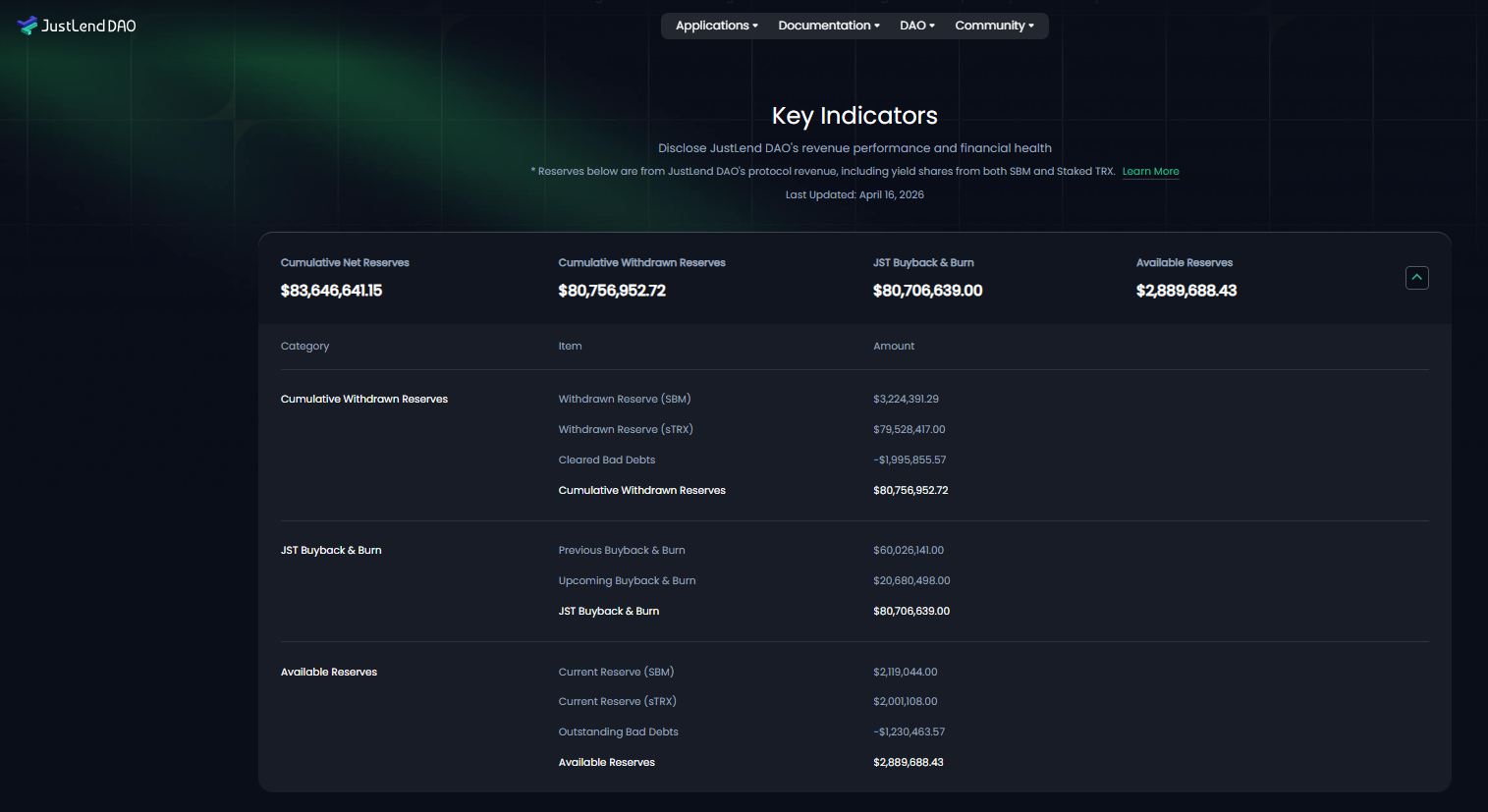
To date, JustLend DAO has cumulatively allocated (including executed and pending portions) over $80 million to the JST buyback and burn plan. Among this, approximately $60 million USDT has been used for completed burns, with over $20 million USDT in retained earnings still on the books, to be steadily invested in subsequent quarterly buybacks. Behind this ample capital reserve lies its strong business operational capability as support.
The confidence in this steady profitability stems from the all-encompassing DeFi aircraft carrier-level ecosystem moat built by JustLend DAO. As the core financial infrastructure of the TRON ecosystem, JustLend DAO has formed a full-scenario DeFi solution covering SBM lending, sTRX liquid staking, Energy Rental, GasFree smart wallets, etc., encompassing key aspects like asset storage, collateralized lending, on-chain staking, and Gas cost optimization. A diversified and high-growth core business matrix provides solid support for its continuous profitability and serves as an endless source of funding "ammunition" for JST's buyback and burn.
Currently, JustLend DAO's overall business maintains a steady growth trend, with user scale and profitability rising in tandem. As of April 16, the platform's Total Value Locked (TVL) has strongly climbed to approximately $6.89 billion, serving over 480,000 highly engaged users, with its ecosystem influence continuously expanding.
According to the latest data from JustLend DAO's financial page on April 16, the platform's cumulative net profit has exceeded $83.64 million. Of this, extracted profits amount to $80.75 million, with approximately $80.70 million allocated for JST buyback and burn (including $60.02 million from the three completed rounds and $20.68 million pending for future burns), and there are still nearly $2.89 million in reserve profits.
Specifically, the core funding for JST buyback and burn primarily comes from JustLend DAO's two main businesses: the SBM lending market and Staked TRX liquid staking. According to DeFiLlama data, the current TVL of the SBM lending market exceeds $3.58 billion, consistently ranking among the top three globally in the lending sector. Its asset scale is $1.5 billion higher than the fourth-ranked traditional platform SparkLend (formerly MakerDAO), showing a significant advantage. In the Staked TRX business, the amount of TRX staked has surpassed 9.53 billion tokens, valued at over $3 billion.
In addition, JustLend DAO also offers frequently used services like Energy Rental (which helps users significantly save on-chain Gas costs) and GasFree smart wallets (allowing users to pay on-chain fees with various transfer tokens).
If JustLend DAO is the current profit cornerstone for JST's buyback and burn, providing stable support for the deflationary mechanism, then the stablecoin USDD is the即将爆发的 "second growth curve," poised to inject new momentum into JST's deflation.
Since the beginning of 2026, USDD has officially entered a period of rapid expansion, with its ecosystem layout continuously accelerating. On April 8, USDD重磅推出 the WBTC vault, allowing users to use WBTC as high-quality collateral to mint USDD. This move significantly expands USDD's collateral asset portfolio, increases capital capacity, and lays a solid foundation for its further expansion. As of April 16, USDD's total supply has strongly突破 $1.55 billion, with its total market capitalization steadily跻身 the top ten in the global stablecoin sector. The related platform TVL has突破 $2.2 billion, with its ecosystem scale and influence持续提升.
More notably, according to the Q1 2026 data update, USDD's treasury funds have累计 reached $13.90 million. In the future, with the rapid development and expansion of USDD, the庞大超额收益 generated by USDD will be formally converted into巨额增量资金 for JST buyback and burn, injecting unprecedented strong momentum into JST's deflationary mechanism and推动 the continuous enhancement of JST's scarcity and long-term value.
JUST Demonstrates Long-Term Building with Ecosystem Strength, JST Value Capture Enters a New Era
By deeply binding the value of the JST token to the real development level and revenue-generating capacity of core protocols like JustLend DAO and USDD, JUST has achieved a high degree of synergy between overall ecosystem growth and the interests of JST token holders. As a one-stop DeFi solution within the TRON ecosystem, JUST's business not only covers lending, liquid staking, energy rental, GasFree, etc., centered around JustLend DAO, but also includes multi-dimensional products like the stablecoin USDD and the cross-chain solution JustCrypto.
This powerful business layout directly translates into leading ecosystem scale and influence: the asset规模 managed by the JUST ecosystem has long ranked first within the TRON ecosystem and consistently占据 about half of the entire TRON network's TVL. According to the latest official data on April 17, the TVL of the JUST ecosystem is approximately $11.6 billion, while the total locked value across the entire TRON network is $27.3 billion, highlighting its core position.
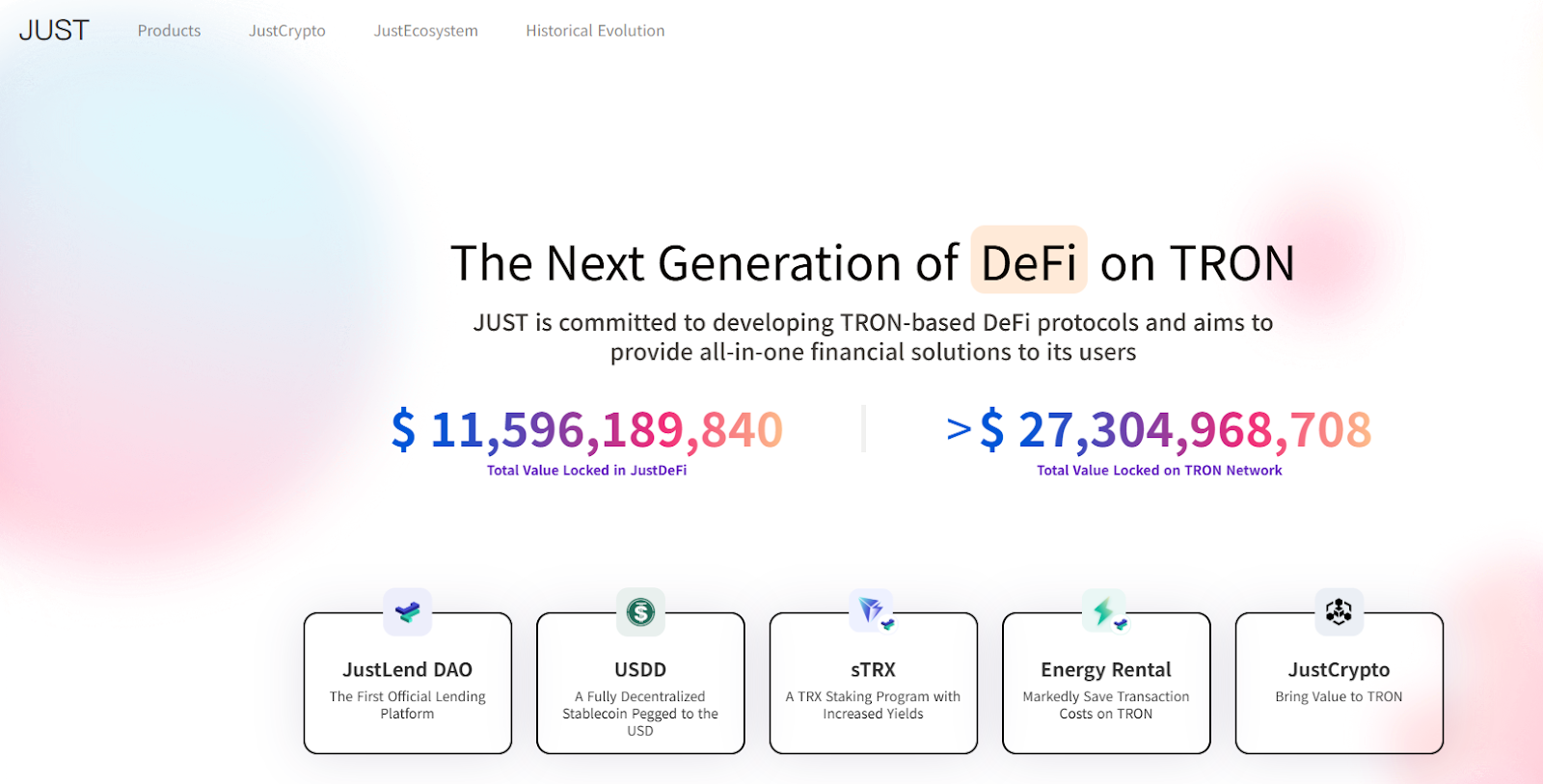
This strong ecosystem resilience is particularly evident during industry downturns. Especially in early April this year, the DeFi lending sector experienced frequent shocks and major crises: UX Chain announced its shutdown on April 1; Drift suffered a hacker attack with losses exceeding $280 million on April 3; Seamless Protocol officially ceased operations on April 8. In stark contrast, the JUST ecosystem has demonstrated completely counter-trend stability. Its core protocol, JustLend DAO, has平稳穿越 multiple bull and bear cycles since its launch, maintaining safe and stable operation throughout. It has further proven its profit resilience through actual buyback actions. More notably, the JustLend DAO platform still has over $20 million in retained earnings等待投入 for subsequent burns.
It is foreseeable that with the continuous development of JUST's two core ecosystems, JustLend DAO and USDD, larger-scale,源源不断的 real business funds will be injected into JST's buyback and burn pool. Empowered by持续强劲的造血能力, the deflationary flywheel of "ecosystem revenue → token burn → value feedback" will accelerate. JST's long-term value foundation will be不断巩固,有望 to carve out a solid upward value path amidst the cyclical fluctuations of the crypto market.


