






After the KelpDAO Hack, AAVE's Situation Is Worse Than You Think


- Core Viewpoint: The AAVE protocol incurred massive bad debt due to the rsETH vulnerability, triggering a large-scale liquidity run. This led to 100% utilization in its core markets (such as USDT, USDC, ETH), locking user funds and putting the protocol at systemic risk and a crisis of trust.
- Key Elements:
- The rsETH vulnerability caused AAVE to incur over $200 million in bad debt. Whales subsequently withdrew billions, instantly draining liquidity from core markets.
- Utilization in key markets like USDT, USDC, and ETH reached 100%, preventing users from withdrawing funds and hindering the protocol's normal liquidation processes.
- The liquidity crunch sparked panic, forcing remaining users to exit by borrowing funds from other markets at significant losses (10-25%).
- The protocol's TVL plummeted by over $6 billion within 24 hours. New liquidity was immediately snatched by bots upon appearance, prolonging the run.
- The AAVE team has remained silent for over 20 hours since the incident, raising questions about its governance structure and the decision to introduce high-risk collateral like rsETH.
- The crisis is highly contagious, trapping numerous protocols and their users that rely on AAVE, who may be forced to absorb the bad debt losses.
Original Author: Duo Nine
Original Compilation: TechFlow
I don't think people realize how bad the situation at @aave is right now.
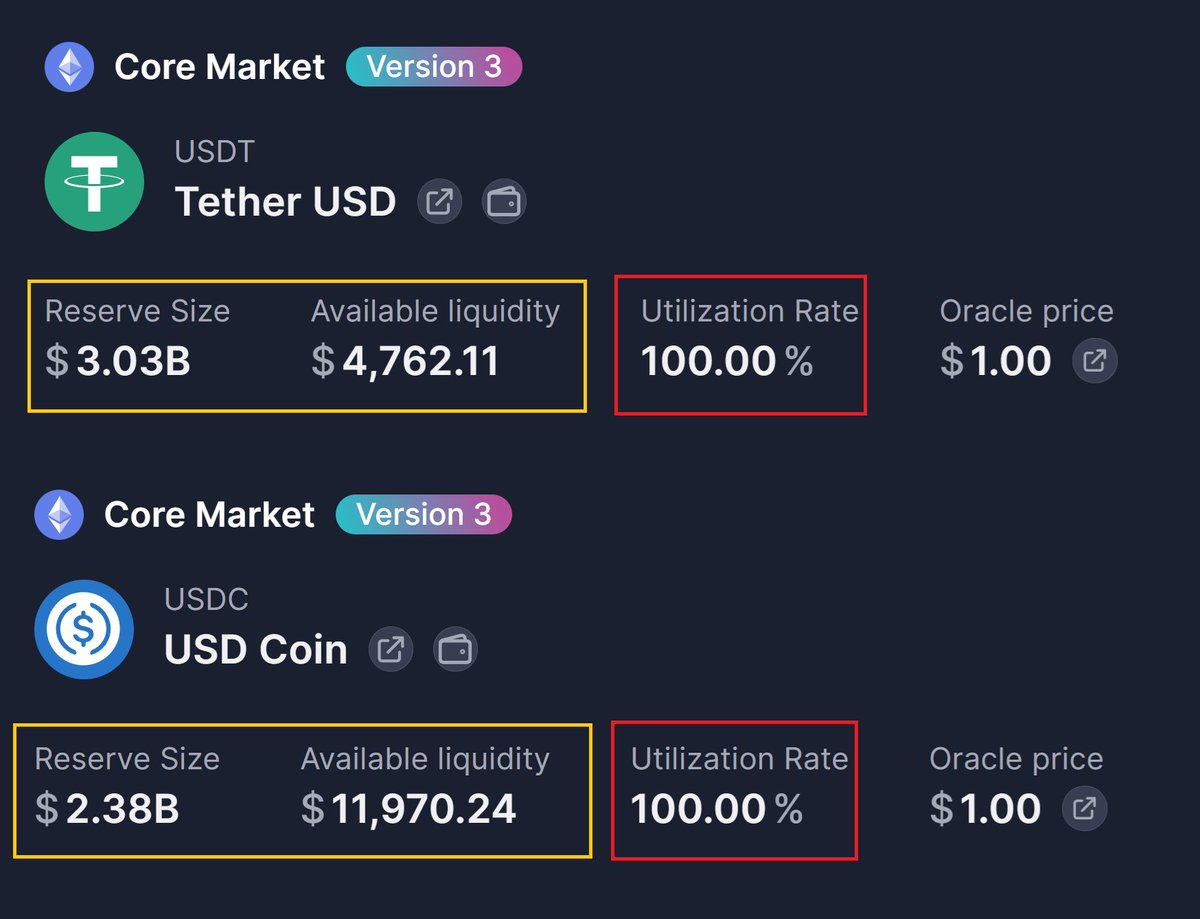
All core markets have reached 100% utilization, including $3 billion in USDT and $2 billion in USDC being stuck!
This means you cannot withdraw your funds.
A long thread explaining why and how we got here.
When the rsETH exploit happened and AAVE incurred bad debt, whales like Justin Sun, MEXC exchange, and others immediately withdrew billions from AAVE.
This instantly drained all available liquidity from key core markets like ETH, USDT, USDC, etc. The first to withdraw escaped, those who were slower got trapped.
Initially, the ETH market reached 100% utilization, meaning you couldn't withdraw your ETH from AAVE.
Worse, it also meant the protocol couldn't process ETH liquidations if the ETH price dropped/crashed. If you can't sell any ETH, you can't liquidate to cover debt obligations.
This means the risk of AAVE generating more bad debt increases as its markets remain stuck.
Despite this, users could still sell aETHwETH tokens on Uniswap or similar aggregators at a small loss. This was the last exit door for ETH depositors on AAVE.
USDT and USDC depositors couldn't do this. They are trapped.
This is because AAVE lost over $6 billion in liquidity in the past 24 hours. As whales pulled their funds, USDT and USDC also reached 100% utilization.
These markets are now also stuck, with funds locked. Panic is spreading, and desperate times call for desperate measures.
Some users decided to borrow USDT/USDC as collateral to exit through other markets at a 10-25% loss (90-75% LTV). Essentially, you borrow GHO/DAI/USDe against your locked USDT/C.
But as more liquidity leaves AAVE, more markets reach 100% utilization and get locked/stuck due to low liquidity. This is quickly spreading to all available markets.
Fortunately, the crypto market is fairly flat today, so liquidation risk is minimal, but if things change, the billions in stablecoins and other assets locked on AAVE won't be able to handle liquidations = more bad debt for AAVE.
If trapped users or related protocols need access to their funds to prevent liquidations or other critical functions, they face huge problems.
Furthermore, no one wants to deposit (or provide liquidity) in these markets now because your ETH, BTC, USDC/T could get stuck there, who knows for how long.
As soon as any available liquidity appears, it's instantly snatched by bots scrambling to escape. As I write this, I see $250k in USDC liquidity disappearing in seconds.
Then there's the bad debt issue.
AAVE incurred over $200 million in bad debt through rsETH, which is like a hot potato. No one knows who will ultimately foot this bill.
If you haven't removed your assets from AAVE, you risk receiving a portion of this bill in some form. Not being able to access your funds is part of that risk.
The contagion is also extremely high.
Many protocols and apps rely on AAVE for their yield mechanisms. These protocols and their users are also trapped and may be forced to incur bad debt for no reason.
October 10th was a CEX-driven crash, an epic failure of DeFi risk mitigation.
AAVE should never have introduced rsETH as a collateral asset, at least not to the tune of hundreds of millions of dollars, which allowed the hacker to borrow over $200 million in ETH after posting fake collateral.
Rumors on X suggest rsETH was introduced by AAVE due to a conflict of interest (lobbying) with a certain service provider. If true, this is a major failure of its governance structure (nothing new).
The @KelpDAO team managing rsETH also faces a tough decision: who will actually pay for the $200 million exploit. AAVE users? L2 rsETH users? Will everyone affected get haircut to cover the loss?
The AAVE team and its founder Stani have remained silent for over 20 hours since initially announcing the freezing of the rsETH market after the exploit.
They have a rather large problem on their hands because the entire protocol is now at risk. Trust is lost as AAVE's TVL is bleeding billions, to the point where all core markets have reached 100% utilization.
Perhaps some key players in the space will step in to provide liquidity to stabilize the markets on AAVE before things get worse.
I was lucky to escape AAVE early when I first saw this. I also removed all assets from DeFi and won't touch any protocol for the next few weeks. The risk is too great for a few percentage points of yield.


