






Prediction Market Boom Arrives: A Comprehensive Comparison of Crypto and Fiat-Based Platforms


- Core View: By 2026, prediction markets have evolved into significant financial forecasting tools. Their price discovery mechanism, based on real-money trading, surpasses traditional opinion polls in predictive accuracy and has attracted widespread participation from mainstream exchanges and institutions.
- Key Elements:
- Market size has grown significantly, with monthly total trading volume exceeding $20 billion. Intercontinental Exchange (ICE) invested $2 billion in Polymarket, valuing it at $9 billion.
- Research from the Federal Reserve and SSRN confirms that prediction markets are more accurate than traditional surveys in capturing macroeconomic expectations and event outcomes.
- Centralized exchanges (e.g., MEXC) have begun natively integrating prediction markets, offering zero fees, millisecond-level settlement, and seamless hedging functionality within unified spot/futures accounts.
- Fiat platforms (e.g., Kalshi) operate under CFTC regulation, with event contracts officially classified as a "financial asset class," achieving a valuation of $22 billion.
- By aggregating information through real capital trading, prediction markets effectively filter out noise, such as capturing the "silent voter" signal earlier during the 2024 US election.
- The industry is experiencing a wave of CEX integration and institutional adoption. Institutions like BitGo are launching large-scale OTC gateways, and event contracts are becoming legitimate macro-hedging tools.
Content Summary (TL;DR)
- By early 2026, prediction markets have evolved into a legitimate financial forecasting tool, with monthly total trading volume exceeding $200 billion.
- Crypto platforms (MEXC, Polymarket) offer fast execution and deep liquidity in global markets.
- Fiat platforms (Kalshi, PredictIt) operate within regulated frameworks, providing institutional trust and compliance.
- MEXC launched its public beta on March 16, 2026, offering zero trading fees and millisecond settlement, becoming one of the first major centralized exchanges (CEX) with a native prediction market.
- Academic research from the Federal Reserve (February 2026) and SSRN (December 2025) confirms that prediction markets outperform traditional polls in predictive accuracy.
What are Prediction Markets? Why Are They So Important in 2026?
Prediction markets are platforms where participants trade event contracts—the prices of these "yes/no" instruments reflect the collective probability of future outcomes. Prices are determined by real-money trading, a mechanism that economically penalizes overconfidence and rewards informed analysis.
This structurally distinguishes prediction markets from gambling. Bookmakers set fixed odds that favor the house. In prediction markets, each price is set by participant trading—the implied probability reflects the aggregated judgment of traders risking capital.
A Federal Reserve working paper from February 2026 confirms this, finding that platforms like Kalshi outperform traditional surveys in capturing macroeconomic expectations, serving as a "high-frequency, continuously updated benchmark."
The industry's growth reflects its credibility. Polymarket's total trading volume was $73 million in 2023. By early 2026, the broader market's monthly volume exceeded $200 billion, and the Intercontinental Exchange invested $2 billion in Polymarket at a $9 billion valuation.
Best Crypto Prediction Market Platforms in 2026
MEXC Prediction Market
MEXC launched its native prediction market on March 16, 2026, becoming one of the first major centralized exchanges to build prediction markets directly into its core trading infrastructure, two weeks ahead of Binance's third-party integration.
Unlike on-chain platforms, MEXC embeds event contracts into the same unified account as Spot and Futures, offering structural advantages with more features: Spot, Futures, and Prediction accounts share a single USDT balance. Traders can hedge their gold futures positions by opening an event contract for "Gold price reaching $5,500" within the same interface.
- Zero Trading Fees: Fixed 0% rate, no distinction between maker and taker, maximizing returns on every position.
- Lightning-Fast Settlement: Millisecond latency, approximately 30x faster than on-chain alternatives, with no blockchain confirmation windows or oracle dispute periods.
- Better Odds & Deep Liquidity: Exchange-level liquidity infrastructure ensures tighter spreads and more competitive "yes/no" pricing.
- Professional Trading UI: Supports full limit and market orders, unlike AMM-style DApp interfaces where traders must accept pool-determined prices.
- Seamless Capital Efficiency: Spot, Futures, and Prediction accounts share a single USDT balance. Traders can hedge their gold futures positions by opening an event contract for "Gold price reaching $5,500" within the same interface.
Current markets cover geopolitics, macro indicators, and crypto events, with new markets added via user voting. Refer to the MEXC Prediction Market Tutorial to get started.
Polymarket
Polymarket is the largest decentralized prediction market by volume, built on Polygon and settled in USDC. By Q1 2026, it has processed over $67 billion in cumulative notional volume, with monthly peaks reaching $10 billion. Market categories include Politics (42%), Crypto (31%), and Sports.
Polymarket employs a maker-zero/taker-fee model. Makers pay no fee; takers pay between 0.025% and 0.25%, depending on the market category, with effective rates reaching up to 1.56% in markets with prices near 50/50. Traders in high-volatility or near-even-odds markets should factor this cost into their strategy.
Its permissionless architecture allows global participation without KYC, with all settlement data publicly verifiable on-chain.
Best Fiat Prediction Market Platforms in 2026
Kalshi
Kalshi operates as a CFTC-licensed Designated Contract Market (DCM), placing it in the same regulatory category as the CME, making its event contracts federally recognized financial instruments.
Key Regulatory Milestones:
- October 2024: The D.C. Circuit Court vacated the CFTC's ban on Congressional control contracts, affirming political event contracts fall within Kalshi's DCM authority.
- January 2025: CFTC Letter No. 25-02 extended exemptive relief for variable payment contracts.
- March 2026: The CFTC formally classified event contracts as a "financial asset class" and initiated a rulemaking process.
- March 2026, Kalshi launched S&P 500 contracts. Integration with Coinbase in December 2025 expanded retail access to all 50 US states. Following a $10 billion funding round, the platform reached a $22 billion valuation, with annualized revenue hitting $1.5 billion as of March 2026.
Note: Kalshi faces ongoing state-level jurisdictional disputes. Arizona filed a criminal complaint in March 2026; Nevada imposed a temporary restraining order on sports contracts. The CFTC describes these as federal vs. state "turf" disputes, with its March 2026 rulemaking widely interpreted as a step towards exclusive federal jurisdiction.
PredictIt
PredictIt is a project of the Prediction Market Research Consortium, a non-profit operating for educational purposes, with technical support provided by Aristotle International, Inc. It operates under a CFTC "No-Action Letter" granted in October 2014.
The platform aims to test knowledge of political events through real-money share trading on outcomes from elections to Supreme Court rulings. Its conservative position limits and focus on US politics reflect its educational mission over commercial ambition. For capital-efficient active trading, Kalshi or the crypto platforms above are more suitable. For researchers, educators, or users wanting to test political knowledge with real but limited stakes, PredictIt remains a mature option.
Head-to-Head Comparison: Crypto vs. Fiat Prediction Markets
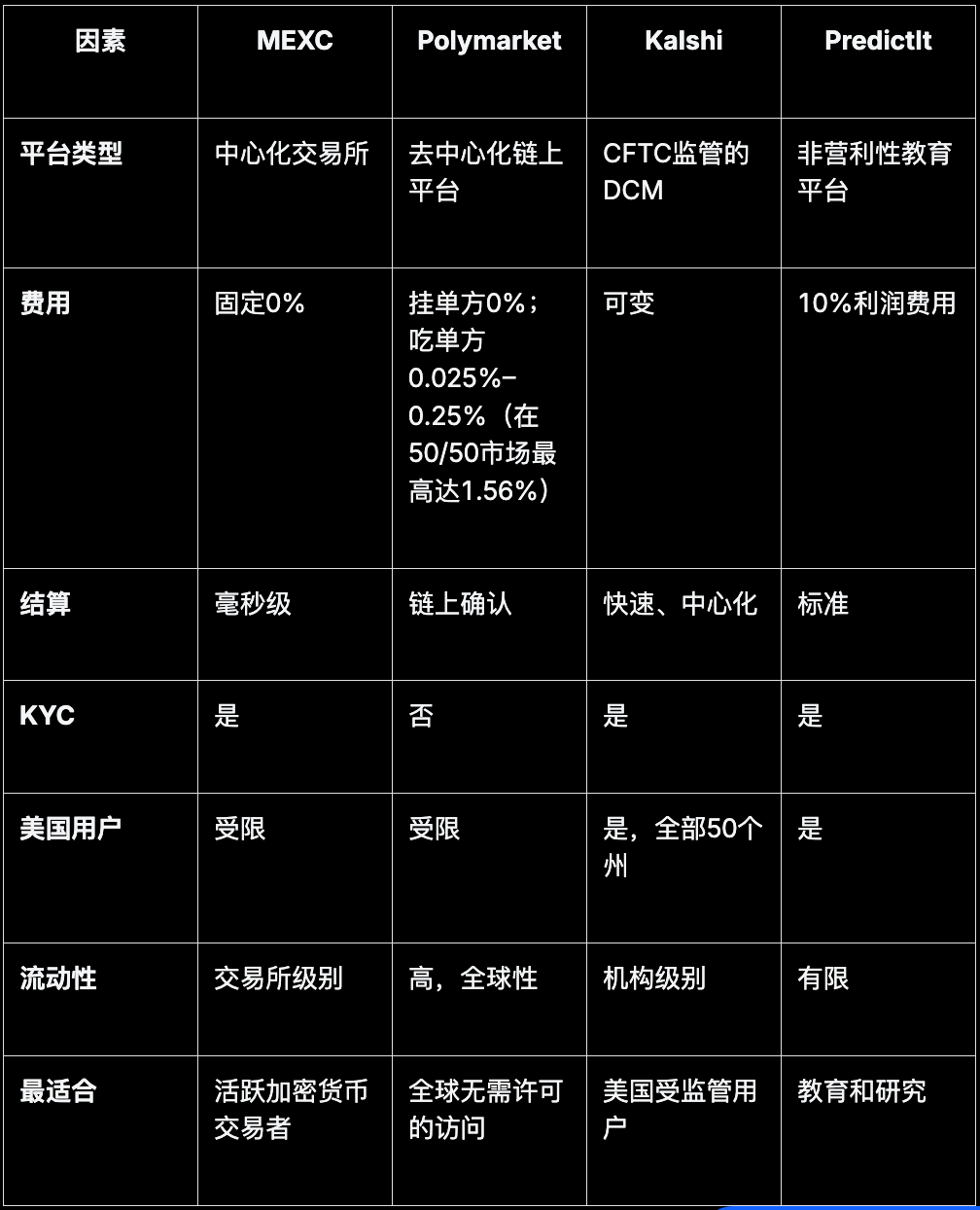
Case Studies: How Prediction Markets Outperform Mainstream Media
Case 1: 2024 US Presidential Election
In the final weeks before the 2024 US election, mainstream polls showed a race roughly at 48% vs. 52%. During the same period, Polymarket priced a Trump victory at 55% to 60%, aggregating what researchers call "shy voter" sentiment—preferences unwilling to be disclosed in surveys but visible in anonymous real-money trading. The market processed $3.68 billion in election volume. The outcome confirmed the market's signal.
A December 2025 SSRN study—"Predicting the Future: The Intelligence Community's Case for Prediction Markets"—found prediction markets achieved a Brier score of 0.18, compared to over 0.25 for polls, with accuracy advantages of 15% to 30% across more than 20 events analyzed.
Case 2: Information Filtering Under Uncertainty
When unverified news spreads rapidly, a liquid event contract provides an instant quantitative signal. A contract holding at 4-5 cents at the peak of a rumor conveys that informed, capital-committed traders see the claim as highly improbable—a signal emerging faster than traditional fact-checking cycles. This is why the Fed's February 2026 paper concluded prediction markets provide a "distributionally rich benchmark" unreplicable by periodic surveys.
The Competitive Landscape in 2026
The Wave of CEX Integration
MEXC (March 16) was among the first major exchanges to launch a native prediction market product. Binance followed on March 31 via Predict.Fun on BNB Chain. Crypto.com launched a standalone app in February 2026. Prediction markets are now standard exchange infrastructure.
Institutional Adoption
BitGo Prime and Susquehanna launched a BTC-collateralized OTC gateway for institutional trades over $100k in March 2026. ICE's $2 billion investment in Polymarket further cements event contracts' status as legitimate macro hedging tools.
Robinhood expanded event contracts in late 2025, with revenue growing 350% from Q3 to Q4 2025, but its product remains sports-centric, lacking the macro and geopolitical depth of MEXC, Polymarket, or Kalshi.
Metaculus remains a non-commercial forecasting benchmark for researchers. No commercial trading features were launched between 2025 and 2026.
Frequently Asked Questions (FAQ)
What is the best prediction market platform in 2026?
It depends on your needs: MEXC for active crypto traders, Polymarket for global permissionless access, Kalshi for US-regulated users, and PredictIt for education and research.
What is a prediction market application?
A platform where users trade "yes/no" event contracts, with prices set by participants' collective judgment on real-world outcomes like elections or macro indicators.
Is using the MEXC Prediction Market free?
Yes. During the current public beta phase, MEXC charges a fixed 0% fee for both trading and settlement.
How are prediction markets different from gambling?
In gambling, the house sets fixed odds favoring the operator. In prediction markets, prices emerge entirely from participant trading, reflecting aggregated informed judgment.
Can I use prediction markets to hedge my crypto portfolio?
Yes, MEXC's unified account allows you to pair a spot or futures position with a hedging event contract without transferring funds between platforms.


