






Space Review|Narrative Fade Reshapes Value Logic, TRON Anchors Long-Term Value with Core Ecosystem Closed Loop


- Core Viewpoint: Current crypto market sentiment is trending towards rationality. Capital is shifting from chasing narratives to seeking certainty, focusing on assets and projects that can generate real yields, possess endogenous value creation capabilities, and high liquidity to navigate market cycles.
- Key Elements:
- Market consensus holds that the core criteria for evaluating projects have shifted to real demand, endogenous value creation capability, and the quality of asset liquidity.
- Capital preference is shifting from "offensive" to "defensive," favoring protocols that generate stable real yields (e.g., lending interest) and assets with high consensus and liquidity like Bitcoin.
- Taking the JUST ecosystem on TRON as an example, it builds a value closed loop through lending protocols and stablecoins, and feeds ecosystem profits back to token holders via a buyback-and-burn mechanism.
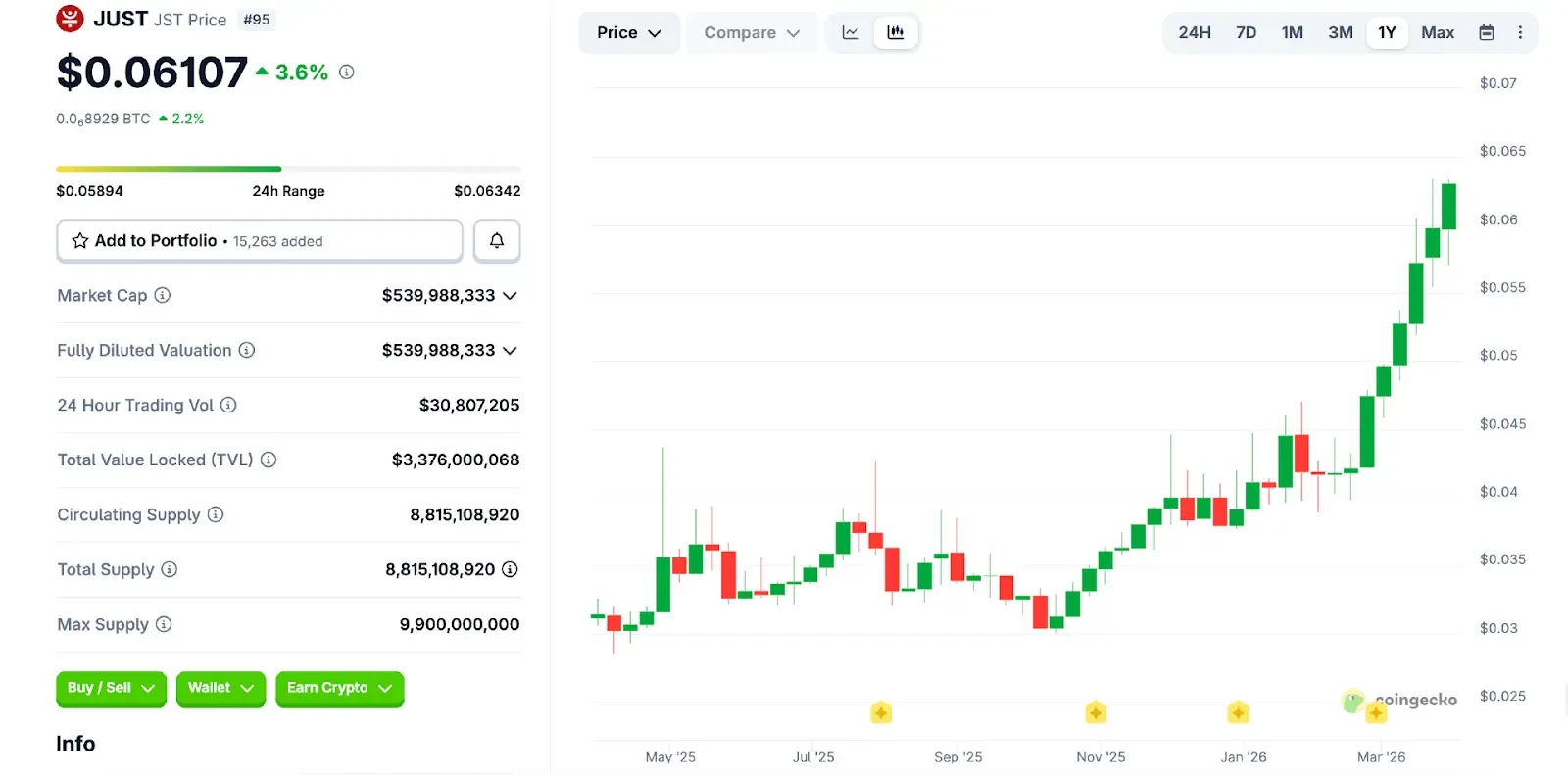
- Data shows that JustLend DAO TVL exceeds $6 billion, USDD TVL has surpassed $2.17 billion, and its ecosystem token JST has doubled in price over the past six months.
- Long-term value assets need to meet real, rigid demand, establish a viable value feedback business closed loop, and possess strong capabilities for self-iteration and ecosystem expansion.
Following a sharp market cooldown and the successive ebbing of various narratives, the market is gradually returning to rationality and caution. Currently, more than "what's rising the fastest," people are more concerned with "what can survive market cycles." On one hand, BTC's status as a core asset has been repeatedly validated; on the other hand, sectors capable of generating "real yield," such as stablecoin payments and on-chain lending, are demonstrating cross-cycle resilience, while infrastructure like AI Agents is beginning to move from concept to implementation.
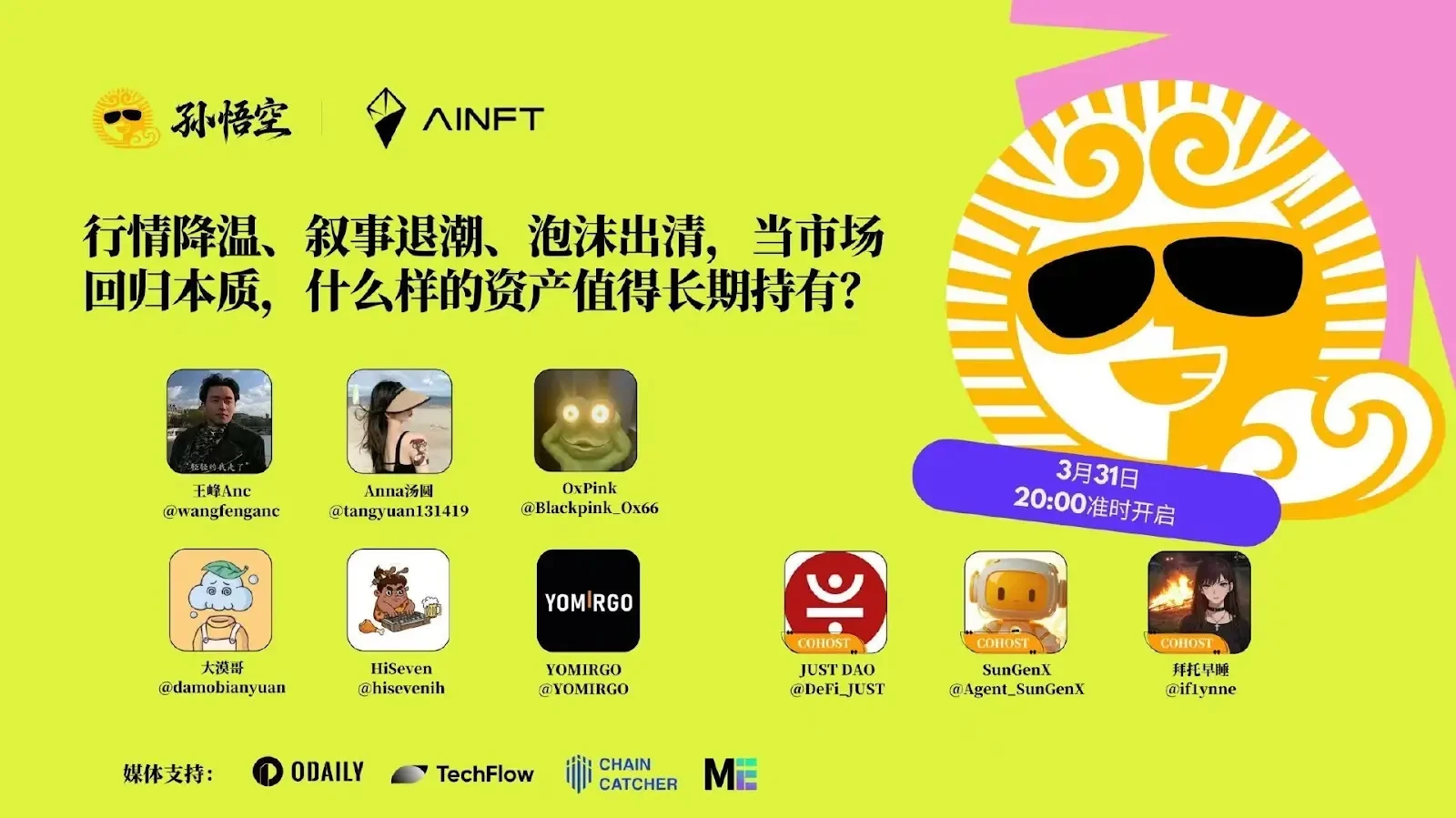
This Space session focused on this very topic. Several seasoned guests, through in-depth discussion and debate, collectively dissected the core factors currently most valued by major capital. As "smart money" returns to rationality, how should ordinary investors grasp the certainty of long-term positioning amidst this "separating the wheat from the chaff" reshuffle? The guests provided clear directions in their dialogue. Below is a summary of the key insights from this deep exchange.
Narrative Ebb, Value Return: Analyzing the Three Core Factors Most Valued by Capital Today
As the crypto market enters a phase of cooling and initial bubble clearing, the market dynamics once driven by mere "speculative hype" and grand narratives are quietly receding. Against the backdrop of tightening liquidity and declining risk appetite, market sentiment is trending towards rationality. In this Space dialogue, several veteran industry guests conducted a deep analysis around the "core factors most valued by capital today." The guests unanimously agreed that genuine demand, endogenous value-creation capability, and the quality of an asset's liquidity have become the litmus test for whether a project can survive bull and bear markets.
In Anna Tangyuan's view, money has now "started to become smart." During the previous bull market, many projects could drive price increases simply by storytelling and hyping narratives. However, with liquidity now tightening, she believes current capital is scrutinizing not only whether a project has real-world use cases but, more importantly, whether it possesses the "value-creation capability" to sustainably generate value. Having a stable revenue model and long-term structural support is the key for a project to survive the winter and be repriced.
This perspective aligns closely with that of OxPink. He stated that the current market is undergoing a natural process of seeking profit, avoiding harm, and separating the genuine from the fake. Much of the seemingly massive market demand during the bull market was actually "pseudo-demand" built on token incentives and high subsidies, which quickly collapses when the broader market weakens. In contrast, those anti-cyclical, essential applications and projects capable of consistently generating actual cash flow and genuine on-chain interactions are becoming the preferred choices for capital seeking refuge and long-term positioning.
When discussing capital flows, Brother Damo pointed out from a more macro perspective that capital is shifting from "offensive" to "defensive," with investors increasingly inclined to embrace assets with high certainty. First, capital now places greater emphasis on whether a protocol can generate real, stable yields, such as lending interest or stablecoin yield farming returns. Second, Bitcoin's consensus status as a core asset remains unshakable; its high liquidity and global consensus make it a natural "safe haven" during market turbulence. Finally, product-market fit has become particularly crucial. Taking the AI sector as an example, capital is no longer buying into the hype of the "AI narrative" but is instead questioning whether these infrastructure projects genuinely improve efficiency and create value.
Finally, HiSeven summarized current capital preferences with "three certainties": certainty of real demand, certainty of liquidity, and certainty of value. He emphasized that the market hasn't stopped believing in narratives but now demands that narratives be built upon verified certainties. When the tide goes out, the projects that can retain users and capital are the ones truly equipped with the fundamentals to survive cycles.
How Does the TRON Ecosystem Perfectly Embody "Long-Term Value"?
So, what kind of direction is truly suitable for long-term holding? The guests also provided highly consistent answers.
First, "essential demand" is the core foundation for resisting bear market winters. As emphasized by YOMIRGO and Wang Feng Anc, sectors truly worthy of long-term positioning must be built upon real and enduring demand. Regardless of how market trends and narratives rotate, this underlying application scenario always exists.
Second, long-term assets must establish a commercial closed-loop of "self-sustaining value creation" and "value feedback." Merely having anti-cyclical business lines is not enough; more critical is whether the token itself can capture the benefits of ecosystem growth. Excellent long-term projects can channel the real profits earned by the protocol back to empower the token through transparent mechanisms like profit buybacks and revenue sharing, allowing holders to clearly see the real flow of value back.
Finally, assets that survive cycles often possess strong "self-iteration" capabilities. They can adapt to technological and market developments, continuously expanding from a single foundational protocol, ultimately evolving into a rich and long-lasting, expansive ecosystem.
Taking the currently exceptionally robust TRON ecosystem and its core DeFi landscape, the JUST ecosystem, as an example, its development path perfectly aligns with this long-term value logic. Leveraging TRON's vast stablecoin payment network, the JUST ecosystem, as a decentralized financial hub, precisely meets the massive real user demand for yield generation and liquidity management. The ecosystem is driven by a "dual-engine" of the JustLend DAO lending protocol and the decentralized stablecoin USDD, building a solid value closed-loop. Data feedback confirms this: currently, JustLend DAO's TVL consistently maintains a massive scale above $6 billion, while USDD's cross-chain TVL has surpassed $2.17 billion, setting a new historical high.
Regarding the value feedback mechanism, the JUST ecosystem's buyback-and-burn practice directly responds to the guest's logic of "letting holders clearly see value flow back." This mechanism uses the net profits from JustLend DAO and the excess profits from the USDD multi-chain ecosystem (the portion exceeding $10 million) entirely to repurchase and permanently burn JST, with every transaction verifiable on-chain.
To date, JST has completed two large-scale buyback and burn rounds, with a cumulative burn of 1.085 billion tokens, accounting for 10.96% of the total supply, and a burn value exceeding $38 million. According to CoinGecko data, supported by strong fundamentals, JST's market cap has surpassed $530 million. Amidst the severe market volatility over the past six months, JST has achieved a doubling in price, outperforming BTC against the trend. More crucially, following the "quarterly buyback" plan, this buyback mechanism will continue, with the third quarterly buyback and burn set to commence in April, bringing another wave of certainty-driven positive momentum for JST.
From the dual-engine drive of JustLend DAO and USDD to the value feedback mechanism of JST buyback and burn, the evolution path of the TRON ecosystem precisely validates the commonalities summarized by the guests: assets that meet essential needs at the foundational level, implement value feedback in their mechanisms, and continuously evolve through iteration are more likely to survive cycles and become truly worthy choices for long-term holding.


