Huobi HTX Releases "2026 Digital Asset Trends White Paper": Global Liquidity Restructuring, Defining the New Sovereign Era of "On-Chain Finance"


- Core Viewpoint: The "2026 Digital Asset Trends White Paper" released by Huobi HTX points out that digital assets are transitioning from a high-volatility innovation field to a core component of global asset allocation, entering a new phase driven by "structural trends." It provides forward-looking analysis around ten major trends, including institutionalization, asset tokenization, and infrastructure upgrades.
- Key Elements:
- Consolidation of Macro Asset Positioning: Bitcoin will solidify its position as "digital gold," becoming a structural asset that hedges against U.S. Treasuries and gold; Ethereum, through staking and DeFi, will become the core carrier for yield-generating assets akin to "on-chain sovereign bonds."
- Stablecoins Becoming Infrastructure: The function of stablecoins is expanding from a medium of exchange to the infrastructure for global cross-border payments and settlements. Their scale is expected to exceed $300 billion, forming an on-chain settlement system.
- Acceleration of Institutionalization and RWA: Institutions are deeply involved through three main pathways: direct allocation, yield enhancement (e.g., RWA), and infrastructure participation. The global RWA scale has surpassed $340 billion, introducing stable yields to the on-chain ecosystem.
- Leap in Infrastructure Performance: Ethereum is moving towards a "10,000 TPS L1" era through zkEVM integration. Modular architecture is becoming mainstream, with value shifting from the protocol layer to "fat applications" and customized L2s.
- Rise of the AI Agent Economy: AI Agents are replacing humans as the core executors for on-chain trading and risk control, giving rise to a new "intent-driven" trading paradigm. The economic output they generate (aGDP) has already reached hundreds of millions of dollars.
- Platform Competition Shifting to Trust: The core differentiator for exchanges is shifting towards "transparency competition." Huobi HTX emphasizes making "Proof of Reserves (PoR) routine" a baseline for survival and strengthening compliant operations amid the trend of global regulatory clarification.
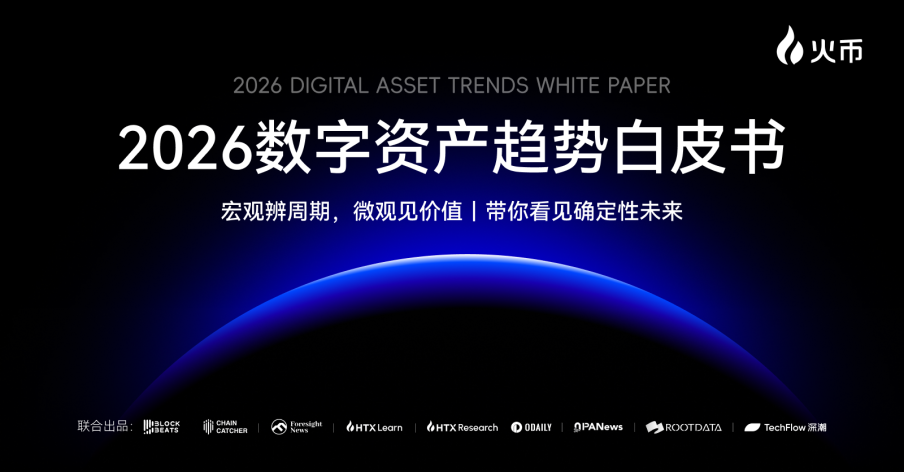
Recently, Huobi HTX officially released the "2026 Digital Asset Trends White Paper" (hereinafter referred to as the "White Paper"). This white paper was jointly released with multiple industry institutions and media outlets, including BlockBeats, ChainCatcher, Foresight News, HTX Learn, HTX Research, Odaily, PANews, Rootdate, and TechFlow. Against the backdrop of a currently sluggish market phase and cautious industry sentiment, this in-depth report, spanning tens of thousands of words, has emerged to re-examine the development path of digital assets from a structural perspective. It aims to provide the market with forward-looking judgments and a systematic framework, helping investors establish long-term confidence and cognitive anchors during uncertain cycles.
The White Paper provides in-depth analysis around ten core trends for the 2026 digital asset market, pointing out that digital assets are completing their historic establishment as an asset class. They have moved beyond being driven solely by "price cycles" and have formally entered a new era of "structural trend-driven" growth, gradually transitioning from a high-volatility innovation field to a core component of the global asset allocation system. In this wave of global liquidity restructuring, Huobi HTX, with its core strategy of "Stability, Transparency, Institutionalization, and AI Empowerment," is committed to becoming a trusted trading and asset service infrastructure for long-term capital under the dual drivers of technology and regulation, anchoring the course for the new era of on-chain finance.
New Macro Landscape: From the Solidification of "Digital Gold" to New Highs in Stablecoin Scale
The White Paper predicts that global monetary policy will enter a "rebalancing" phase in 2026, with interest rate differential fluctuations between the Federal Reserve and emerging markets no longer moving in lockstep. In this complex macro environment, BTC will solidify its positioning as "digital gold." Core assets like Bitcoin are no longer fringe "innovation experiments" but are deeply embedded structural assets within global asset allocation models, forming hedging portfolios with U.S. Treasuries and gold. Their pricing power is further shifting towards medium- to long-term capital. Meanwhile, ETH is poised to become a core carrier for yield-generating assets. With its mature staking and DeFi infrastructure, Ethereum has established its status as "on-chain sovereign bonds," becoming a growth asset driven by cash flow.
Regarding liquidity, stablecoin scale is set to reach new highs. The function of stablecoins has expanded from mere trading mediums to the infrastructure for global cross-border payments and settlements. Huobi HTX points out: "In 2026, the market is no longer asking 'Do digital assets have value?' but rather 'What is the allocation percentage?'" As stablecoin scale surpasses $300 billion, an "on-chain settlement system" with the U.S. dollar as its foundation has taken shape. Through its deep cultivation of liquidity depth, Huobi HTX has become a frontline position for global macro funds to gauge market temperature.
The Wave of Institutionalization and Asset On-Chaining: RWA Acceleration and Derivatives Explosion
In 2026, the way institutions enter the market has undergone a qualitative change. The proportion of institutional participation will continue to increase, while retail volatility will slow down. The White Paper outlines three main paths for institutional participation: direct asset allocation, yield enhancement (obtaining stable cash flow through staking, RWA), and infrastructure participation (deep investments in exchange and custodian equity). The addition of long-term capital is making market behavior more rational, with volatility gradually converging. Simultaneously, RWA (Real World Asset) scale is expected to grow rapidly. The tokenization of U.S. Treasuries and fixed-income assets is introducing stable yield sources on-chain. Data from the White Paper shows that the global RWA scale has exceeded $340 billion, with U.S. Treasuries, gold, and even commodities like electricity and soybeans being digitally mapped through blockchain.
Accompanying the increase in institutional participants, on-chain derivatives trading is poised for an explosion. Perpetual contracts and options products are gradually moving on-chain, with pricing mechanisms becoming more mature. In response to this trend, Huobi HTX has comprehensively upgraded its institutional service capabilities. Through robust API interfaces, customized risk control support, and deep integration with top global custodians, it has built a "compliance bridge" for professional capital to access the on-chain world, helping users lock in structural premiums amid macro volatility.
Infrastructure Upgrade and the Rise of the Agent Economy: Dual Drivers of zkEVM and AI Agent
In 2026, digital asset infrastructure is undergoing a dual-track transformation, pushing the industry into a new stage of "10k TPS L1" and "automated execution":
At the infrastructure level, Ethereum, through zkEVM protocol-level integration, has resolved 80% of the proof bottleneck, entering the "10k TPS L1" era. With its ultimate performance and security, it consolidates liquidity across the entire ecosystem, definitively ending the "Ethereum killer" narrative. Against this backdrop, modular blockchains will become the mainstream architecture. As underlying protocols become commoditized, value is shifting massively from the protocol layer to "fat applications." Customized L2s and the AI Agent economy driven by super dApps will become the core of the ecosystem.
Simultaneously, AI Agents will become the primary executors on-chain. AI agents are replacing humans as the core executors for trading, yield management, and risk control. As of March 2026, the economic output generated by AI Agents (aGDP) has reached hundreds of millions of dollars. Trading models are shifting from "manual operation" to "intent-driven," marking the rise of the agent economy.
Huobi HTX keeps pace with the technological frontier by launching HTX AI Skills. Users simply input natural language, and the AI can complete market analysis, strategy generation, and assisted execution. This new "intent-driven" trading paradigm significantly lowers the barrier to entry, allowing ordinary investors to enjoy professional-grade, intelligent on-chain financial services.
Embracing 2026: Huobi HTX's Strategic Foundation is Transparent Competition and Regulatory Certainty
In an era of structural differentiation, competition among platforms has shifted from vying for traffic to "competing on trust." Transparent competition will become the core differentiator for exchanges. Huobi HTX emphasizes in the White Paper that transparency is no longer a bonus point but a baseline for survival. Huobi HTX has taken the lead in the industry by implementing "Proof of Reserves (PoR) as a norm," using technical means to achieve clear and verifiable asset structures. Meanwhile, as regulations gradually become clearer, gray areas will further shrink. In 2026, with global regulations becoming more defined, Huobi HTX, operating in a compliant manner, is demonstrating strong resilience to risks.
Huobi HTX promises its global users: security and transparency are the foundation of the platform's development. In the future, Huobi HTX will strategically focus on three main lines: continuously upgrading institutional service capabilities, integrating on-chain assets and yield products, and advancing global compliance layout.
As stated at the end of the White Paper: the digital asset market is shifting from "across-the-board gains" to "survival of the fittest." This is an era belonging to professionals and long-termists. In 2026, Huobi HTX proposes four strategic keywords: "Stability, Transparency, Institutionalization, and AI Empowerment." It aims not only to be a transaction facilitator but also a builder of on-chain financial infrastructure. In the grand narrative of liquidity restructuring, Huobi HTX is willing to join hands with global participants to usher in the next golden decade for digital assets.
About Huobi HTX
Huobi HTX was founded in 2013. After 12 years of development, it has evolved from a cryptocurrency exchange into a comprehensive blockchain business ecosystem encompassing digital asset trading, financial derivatives, research, investment, incubation, and other businesses.
As a leading global Web3 gateway, Huobi HTX adheres to a development strategy of global expansion, ecosystem prosperity, wealth effect, and security & compliance, providing comprehensive, secure, and reliable value and services to virtual currency enthusiasts worldwide.
To learn more about Huobi HTX, please visit https://www.htx.com/ or HTX Square, and follow us on X, Telegram, and Discord. For further inquiries, please contact glo-media@htx-inc.com.