






How Hard Is It to Build Decentralized AI? A First-Hand Account from Gonka Founder David Liberman


- Core Viewpoint: Gonka Co-founder David Liberman believes the core value of decentralized AI lies in building a trustless computing infrastructure through the tokenomics model validated by Bitcoin. Its mass adoption will be driven by cost and may become a new path for nations to achieve AI computing sovereignty.
- Key Elements:
- In terms of project positioning, Gonka adheres to a Bitcoin-style Proof-of-Work mechanism, aiming to create strong infrastructure incentives rather than following Ethereum's path of transitioning to Proof-of-Stake.
- Regarding market adoption, developers are turning to open-source solutions due to the soaring costs of centralized AI services. The first wave of decentralized AI adoption will be driven by price sensitivity.
- On governance philosophy, Gonka chooses to fully delegate governance power to the community, believing that a high degree of decentralization is the foundation for accumulating long-term trust and carrying greater value.
- Concerning network resilience, after its launch, Gonka faced dozens of attacks, exposing the vulnerability of decentralized defenses. However, it also enhanced the system's resistance by modifying the incentive model through community voting.
- At the national strategy level, governments' interest in decentralized AI stems from three motivations: computing sovereignty, domestic industry development, and participation in the chip supply chain. Decentralized networks can provide a viable economic model.
- Regarding business model choice, Gonka prioritizes focusing on the inference market because it can generate sustained demand and attract capital, while viewing decentralized training as a potential "gift to humanity" in the future.
Source: DeAI Nation's "State of DeAI 2026" Report | Compiled by: Gonka.ai
David Liberman is the co-founder of Gonka, a decentralized AI inference and training network. Launched in August 2025, the network has accumulated over 10,000 GPUs (in NVIDIA H100 equivalents) in just a few months. This article is compiled from an interview with David in the DeAI Nation report "State of DeAI 2026", covering his in-depth analysis of the "Bitcoin of AI" assertion, the debate over decentralization boundaries, the numerous attacks faced by Gonka, and records of negotiations with various governments on AI sovereignty.
1. Everyone Wants to Be the Bitcoin of AI
When observing the decentralized AI ecosystem, one phenomenon is particularly striking: almost every project, every blockchain, tries to position itself as the new Bitcoin in the world of artificial intelligence. Is this merely a habit of the crypto industry, or is there a deeper structural reason behind it?
David offers his assessment: it's a combination of two motivations, with different projects emphasizing different aspects.
From a comparative logic perspective, this analogy is not unique to the crypto space; it permeates the entire tech industry and even the broader startup ecosystem. When a disruptive new field emerges, pioneers must prove the feasibility of the underlying logic from scratch, while later entrants can stand on the shoulders of giants, using established success stories to validate their own. Just as Silicon Valley investors ask entrepreneurs to introduce themselves at the beginning of a funding pitch deck: 'We are the Airbnb for dog owners'—this single sentence saves the tedious effort of repeatedly arguing the viability of the platform economy model.
Bitcoin was not the first decentralized project in history, nor the first open-source project. Even before it, BitTorrent was already a classic example of a decentralized network. What Bitcoin truly proved was that an incentive model based on tokenomics could operate autonomously in the real world. The value of this proof allows all subsequent projects built on tokenomics to confidently skip this validation step.
"We use the Bitcoin analogy partly to avoid the hassle of re-proving the feasibility of tokenomics. There are still some skeptics who believe Bitcoin will eventually go to zero, although such people are becoming fewer." —David Liberman
However, for Gonka, this analogy carries a deeper meaning. While most crypto projects have shifted to Proof-of-Stake (PoS) mechanisms, Gonka adheres to Proof-of-Work (PoW), building its computing infrastructure around it. David states clearly: Gonka is following Bitcoin's path, not modern Ethereum's. Ethereum initially used PoW and also spurred the development of infrastructure like mining rigs, but later transitioned to PoS, gradually drifting away from that infrastructure incentive system.
His judgment is: PoW can create stronger infrastructure incentives. Of course, it's also understandable for other projects to use the Bitcoin analogy to express themselves—the key is that no one is claiming to reach Bitcoin's market cap scale, but rather saying: the underlying propositions validated by Bitcoin also apply to us, with the only new variable being AI.
2. How Does Silicon Valley View Decentralized AI?
When the concept of "decentralized AI" reached Silicon Valley, the reaction it stirred was far more complex than outsiders might imagine—ranging from enthusiastic endorsement by crypto investors, to deep reflection from the AI safety research community, to silent observation from practitioners at large model companies.
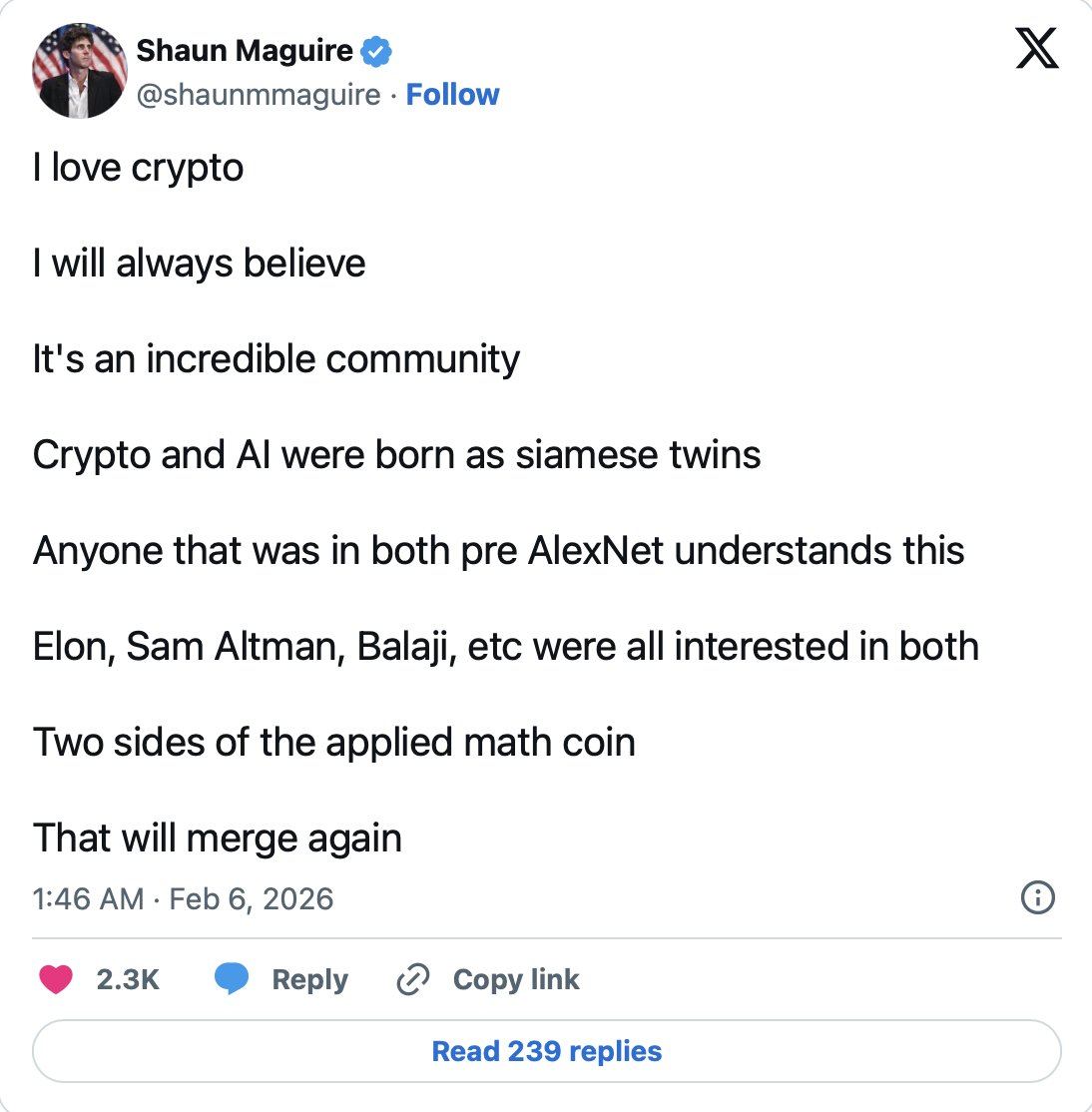
David mentions two representative voices: a16z partner Chris Dixon has long voiced support for decentralized AI and has made investments in the field; Sequoia Capital partner Shaun Maguire wrote an article pointing out that crypto and AI are a natural pair. Although some argue Dixon's stance stems from his crypto background, these voices still constitute positive footnotes for decentralized AI within Silicon Valley.
More noteworthy is the quiet shift within the AI safety research community. David points out that almost all foundational scientists of modern AI emerged from the AI safety research community. The birth of OpenAI itself stemmed from concerns about Google's potential monopoly on AI, intended as a counterbalancing alternative—only for that original intent to quietly dissolve as OpenAI itself approached a dominant position.
"The AI safety community once opposed decentralization; they didn't want to release AI capabilities to ordinary people. But when computing power became highly concentrated in the hands of a few giants, this community began to realize: without sufficient computing power, no AI safety research can advance. Thus, their attitude towards decentralization is undergoing a fundamental shift."
Meanwhile, among the broader developer community, the appeal of decentralized AI is increasingly clearly tied to cost. David's observation is: when a project is just starting out and has VC funding, using centralized inference services poses no cost pressure; but as scale grows, the bill can be a rude awakening. He gives a vivid example: many developers connected their AI Agents to Claude Opus, only to wake up the next morning to find the Agent had been running all night, with staggering token consumption, prompting an urgent search for alternatives.
Data changes on OpenRouter confirm this trend: two months ago, the top-ranked models on the platform were almost all closed-source; now, the proportion of open-source models has significantly increased. David's judgment is: "Every financial crisis pushes more people towards Bitcoin, and the mass adoption of decentralized AI will unfold in the same way—wave after wave, each leaving more users behind. The first wave will be driven by price."
3. Where Are the Boundaries of Decentralization?
While the entire industry chants the slogan of "decentralization," the term itself is quietly losing precision. David admits that the concept has been diluted to varying degrees—partly because true decentralization is extremely difficult to achieve at an engineering level, and partly because some projects, under the banner of "progressive decentralization," actually maintain long-term control over core power.
He understands the projects that make trade-offs: "Whenever you claim to be fully decentralized, you encounter obstacles at every turn. Some projects say 'we won't decentralize here, only there,' especially in AI infrastructure, where many early projects made excessive compromises. For me personally, excessive compromise can sometimes undermine the credibility of the decentralization concept itself."
Gonka's choice on this point is particularly clear: from the beginning, the team chose not to retain control for themselves, handing governance over to the community. This has attracted significant external criticism, but David insists: "Why should anyone have to trust a centralized authority? Decentralization is what truly attracts trust." The cost is real—every change must be negotiated with everyone.
In David's view, there is an imprecise but generally valid rule in this industry: projects with a higher degree of decentralization often carry greater value. The market caps of Bitcoin and Ethereum have long been higher than XRP and even Solana; projects discovered to have founders and foundations actually controlling the entire ecosystem often lose significant market value as a result.
"Decentralization is not a marketing label, but a mechanism for long-term trust accumulation. In this industry, filters around power structures are real, even if they don't always function in a timely manner."
He also explicitly expresses respect for Prime Intellect, considering it a highly capable team daring to tackle the hard problem of decentralized training. But he simultaneously points out that decentralized training still lacks a clear answer in terms of business model—because more capable, completely free open-source models keep emerging, making the training market increasingly difficult to compete in. Gonka's ultimate choice to focus on inference is based on a sober assessment of business reality: inference generates sustained demand, fosters real infrastructure, and is where capital is truly willing to flow.
4. Attacks, Crashes, and Resilience: Gonka's Trial by Fire
Since its launch in August 2025, Gonka has undergone pressure tests far more intense than anticipated.
David admits that Gonka faced not one DDoS attack, but dozens. Attacks began in the first month of launch, initially small-scale and simple in method, but by late December 2025 to January 2026, the scale and complexity of attacks significantly escalated. Attackers continuously sought any possible vulnerability, constantly probing the system's limits.
This exposed the downside of Gonka's strongly decentralized design: in a centralized system, an attack can be coordinated and responded to directly by the core team; but in a decentralized network, every miner must secure their own infrastructure. The network includes battle-hardened crypto veterans, but also many new participants attracted by the decentralized AI vision—the latter lack experience and tools to combat network attacks, making community-level security education an urgent priority.
At the peak of the attacks, several nodes still went offline daily due to attacks. But a more serious problem stemmed from Gonka's initial incentive mechanism design: when a miner couldn't prove availability due to an attack, their daily rewards would be confiscated and redistributed to the remaining miners—meaning taking down 30% of miners could increase one's own earnings by 30%. Attacking became profitable.
"We experienced a paradox firsthand: decentralization made us more vulnerable in responding to attacks, yet also made our defensive capabilities stronger due to community participation."
The community later voted to modify this mechanism, making attacking others no longer directly profitable. Attacks didn't disappear, but the underlying motivation was greatly reduced. David admits he now understands why some projects choose to centralize API access—protecting a distributed, publicly accessible API node is far more difficult than a centralized architecture. But Gonka's stance remains unchanged: the API should remain open and decentralized, as it's core to the project's philosophy.
Meanwhile, the downturn in the broader crypto market also brought pressure. Bittensor's GPU count declined, and Gonka's peak GPU numbers also dropped. But David characterizes this period as a "breather": "If Bitcoin were at $120,000 today, the number and scale of attacks might be several times higher than now. This is the best time, while the market is quiet, to fortify our defenses before the next bull run arrives."
Even after all this, the Gonka network currently still operates hardware assets worth approximately $200 million online, with GPU numbers still significantly leading other similar projects. David sees this as a concrete manifestation of community belief.
5. Governments Discuss AI Sovereignty: Compute is Power
In Gonka's development journey, another parallel storyline is equally compelling: David and Daniil frequently meet with government officials and large enterprise executives from various countries to discuss the strategic potential of decentralized AI at a national level. These conversations reveal a broader picture beyond commercial logic.
David observes that governments' interest in decentralized AI ultimately stems from three layers of motivation.
Motivation One: Compute Sovereignty
Currently, many governments' services are deeply reliant on AI, but the underlying compute power is controlled by external service providers. This dependency brings not just cost issues, but strategic risks: once an external supplier controls access, pricing, or infrastructure, they could potentially use it as leverage to restrict or even cut off critical services. This structural vulnerability is the issue that most alarms government officials.
Motivation Two: Local Industry Development
Governments want their domestic data center industries to truly take root locally, not just be "cloud access points" for foreign companies. They expect local employment, local capital accumulation, and long-term technological capacity building—not handing over data and profits to a handful of hyperscale cloud service providers.
Motivation Three: Participation in the Chip Supply Chain
Some countries are looking further upstream: not just operating data centers, but participating in semiconductor manufacturing. This isn't a pipe dream, as the entry point isn't the most advanced 3nm process, but more mature nodes like 16nm—which is realistically feasible for more countries.
At the intersection of these three motivations, the narrative of decentralized AI networks begins to demonstrate its unique persuasive power.
"What we show them is not just sovereignty, but a viable economic model. If a country participates in a decentralized compute network, it can build a 20,000-GPU data center and gain endogenous demand from the global market—instead of hoping Microsoft or some hyperscaler is willing to rent your compute at a reasonable price."
David uses Bitcoin as an analogy: Bitcoin achieved natural global growth of compute power without any single country needing to hold a structural advantage. Tokenomics created distributed economic incentives, allowing countries to choose to participate autonomously without attaching themselves to a centralized ecosystem leader. He believes the same logic can be transplanted to the global distribution of AI compute.
Of course, there are real-world complexities: local infrastructure often struggles to run at full capacity 24/7, and idle rates are a stubborn economic problem. David's solution is a "local + distributed" hybrid model: while the local cluster handles base load, idle compute power is connected to the global decentralized network, turning idle resources into continuous revenue; during peak periods, additional compute is drawn from the network to handle sudden demand. He cites the logic behind Amazon Web Services' birth—it was precisely the massive elastic compute demand during holiday peaks for the e-commerce platform that gave rise to the cloud computing business model, and today's AI compute scheduling faces the same structural problem.
6. The Other Shore of Training: A Gift to Humanity
As a future vision, Gonka proposes allocating 20% of inference revenue for decentralized model training. David maintains sincere anticipation for this while not shying away from its difficulties.
He states bluntly that decentralized training remains an unsolved engineering challenge, and its commercial viability is something almost no one has found an answer for. The reason is simple: the open-source community continuously produces more powerful, completely free base models, which almost kills the market space for independent training. Any project attempting to commercialize decentralized training will struggle to compete its output with free open-source alternatives—unless your goal is to become a frontier AI lab.
Gonka chose another path: focus on inference first, build the infrastructure and token economic system, achieve real scale, then dedicate part of the network's capacity to training. The logic of this path is: compute scale first, training possibility later, not the other way around.
"Training may not become our growth engine, but it can be our gift to humanity. Why not? No one loses anything, and we have the chance to give something truly valuable to the world."
David admits that reaching this point has many prerequisites: the physical engineering challenges, collective community consensus, and the continuous growth of Gonka's overall network scale. He clearly knows this won't happen quickly. But he also points out that any breakthroughs achieved by teams that have already poured tens of millions of dollars and worked day and night in this direction will ultimately belong to all of humanity—because replicating an achievement is usually far easier than achieving it the first time. He holds deep respect for these teams and positions Gonka's primary mission as: building decentralized compute infrastructure capable of truly competing with top frontier labs and hyperscale service providers.
Conclusion
David Liberman's account is a story of entrepreneurs navigating treacherous waters—they must respond to attacks from the network, prove the value of decentralized AI to still-hesitant government officials, and maintain community belief amidst the uncertain cycles of the crypto market.
Yet behind all this, a clear thread runs throughout: decentralization is not a marketing slogan, but a philosophy of infrastructure construction for long-term trust accumulation. Gonka chose the most difficult path, and precisely because of that, it has come this far.
This experiment in decentralized AI is far from reaching a definitive conclusion. But as David says, the price paid by every pioneer becomes the starting point for those who follow. And those who persevere through the most difficult times will ultimately see the meaning of what they did in the next wave.
About Gonka.ai
Gonka is a decentralized network designed to provide efficient AI compute power, aiming to maximize the utilization of global GPU resources to complete meaningful AI workloads. By eliminating centralized gatekeepers, Gonka offers developers and researchers permissionless access to compute resources while rewarding all participants through its native token, GNK.
Gonka was incubated by US AI developer Product Science Inc. The company was founded by Web 2 industry veterans, former Snap Inc. core product directors, the Liberman siblings, and successfully raised $18 million in 2023, with an additional $51 million in 2025. Investors include OpenAI backer Coatue Management, Solana investor Slow Ventures, Bitfury, K5, Insight and Benchmark partners, among others. Early contributors to the project include leading enterprises in the Web 2-Web 3 space such as 6 blocks, Hard Yaka, and Gcore.





