Bitwise: Bitcoin Reaching $1 Million Is Not a Pipe Dream


- Core Viewpoint: The article argues that, based on conservative assumptions of continued expansion in the store-of-value market and growth in Bitcoin's share, it is possible for one Bitcoin to reach a value of $1 million in the future; this is not a fantasy.
- Key Elements:
- Analytical Framework: Treat Bitcoin as a digital store-of-value asset, whose potential value equals (Total size of the store-of-value market × Bitcoin's share) ÷ Total Bitcoin supply (21 million).
- Market Growth: The current store-of-value market (primarily gold) is valued at approximately $38 trillion, having expanded at a compound annual growth rate (CAGR) of about 13% over the past 20 years. If this trend continues, the market size could reach $121 trillion in 10 years.
- Share Increase: Bitcoin currently accounts for less than 4% of this market. If its share rises to 17% in 10 years, combined with the projected growth in market size, its price per unit could reach $1 million.
- Supporting Trends: The rapid development of Bitcoin ETFs, the entry of institutional investors (such as endowments and sovereign wealth funds), and declining volatility provide a realistic foundation for an increase in Bitcoin's market share.
- Risk Considerations: The primary risks lie in stagnation of the store-of-value market's growth or Bitcoin's share expansion falling short of expectations. However, the author believes the baseline scenario is that both will continue their existing trends.
Original Author: Matt Hougan, Chief Investment Officer at Bitwise
Original Compilation: Saoirse, Foresight News
The other day, a financial advisor asked me, "Matt, do you really think one Bitcoin could be worth $1 million? That number is just crazy."
I understand his thinking. $1 million does sound outrageous. It would mean Bitcoin needs to increase another 14 times from its current price.
When I entered the crypto industry full-time in 2018, I would have laughed at such a statement. Back then, Bitcoin was around $4,000, and a $1 million target — even for me — seemed utterly absurd.
But I don't think that way anymore. The deeper I've studied this asset, the more I've realized: I, like my financial advisor friend, have been making a very fundamental mistake when analyzing Bitcoin's potential.
In this week's memo, I want to explain this mistake and show how a set of fairly conservative assumptions can lead to a Bitcoin price of $1 million.
How to Estimate Bitcoin's Value
I view Bitcoin as an emerging store-of-value asset. Its role is similar to gold — allowing people to hold wealth outside the traditional fiat currency and banking system, just in a digital form. It's more volatile and has a shorter history than gold, but it's competing for the same market.
Within this framework, the basic logic for estimating its value is simple:
- Estimate the total size of the store-of-value market;
- Estimate the share Bitcoin can capture;
- Divide by 21 million (Bitcoin's maximum supply).
This gives you its implied price.
Today, the store-of-value market is nearly $38 trillion:
- Gold: $36 trillion
- Bitcoin: $1.4 trillion
By this measure, Bitcoin currently holds less than 4% market share.
This is why many find "Bitcoin at $1 million" unrealistic, and it's the reason I didn't believe it for years.
At the current market size, Bitcoin would need to capture over 50% of the store-of-value market to reach $1 million — an extremely high bar.
But the key point most people miss is this: the store-of-value market is not static. In fact, it has expanded significantly over the past 20 years. And as concerns about fiat currency debasement spread, I believe this expansion will continue.
A Brief History of Gold
I first paid real attention to gold when the first US gold ETF launched in 2004. At that time, the entire gold market was worth about $2.5 trillion — not much larger than today's Bitcoin market.
Since then, it has grown to nearly $40 trillion, with a compound annual growth rate of 13%. The driving forces behind this are rising concerns about government debt, geopolitical risks, loose monetary policies, and other issues.
Gold Market Capitalization, 2004 to Present
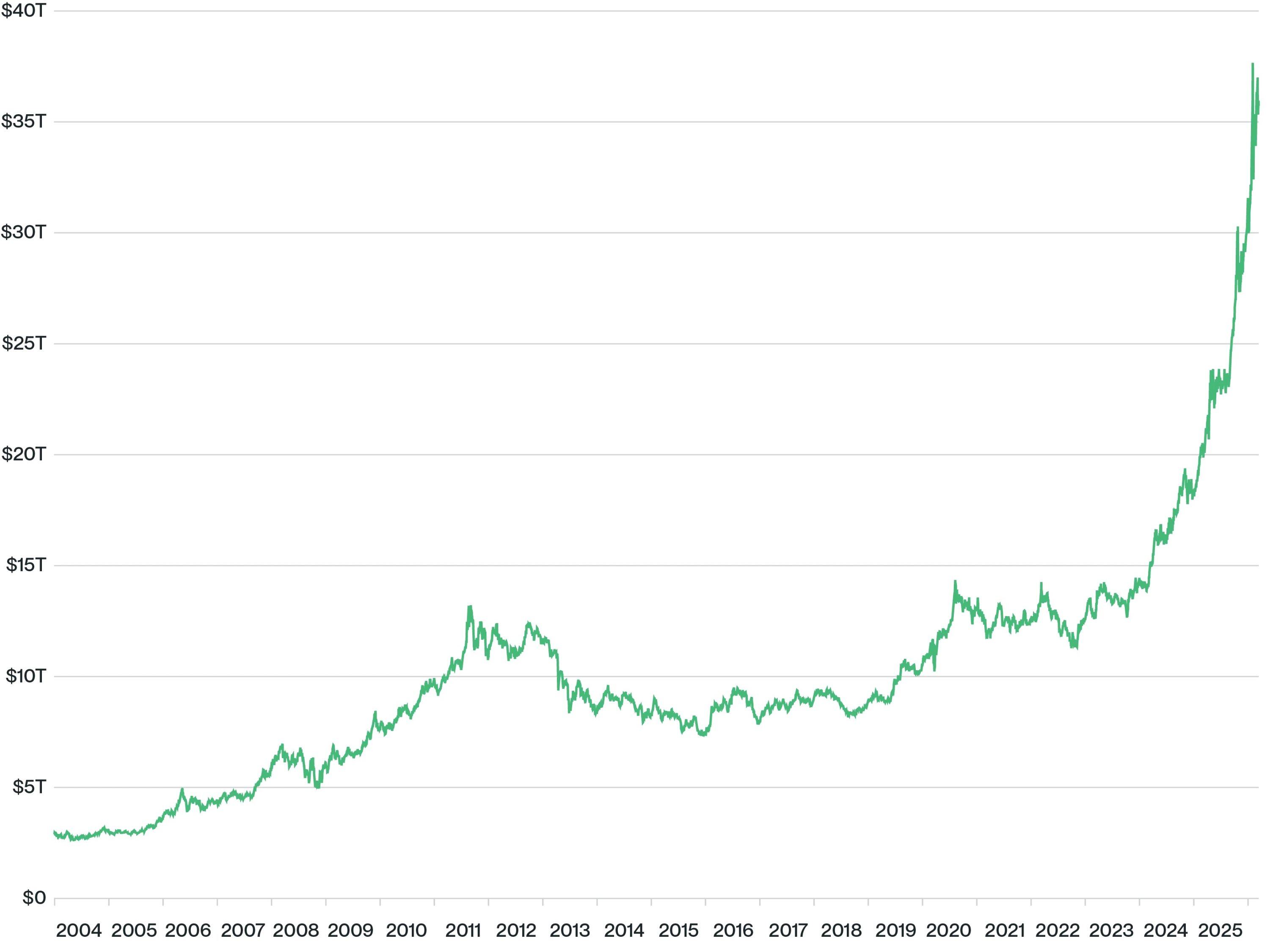
Source: Bitwise Asset Management, data from World Gold Council and Bloomberg.
The mistake people make when assessing Bitcoin's potential is ignoring this growth.
If this growth rate continues, in 10 years, the global "store-of-value market" will reach approximately $121 trillion. At that scale, Bitcoin would only need to capture 17% of the market for one coin to reach $1 million.
Growing from 4% to 17% is still a massive increase, but looking at Bitcoin's recent progress, this goal is entirely within reach.
A few years ago, there were no Bitcoin ETFs in the US, institutional holders were scarce, and Bitcoin was too volatile for almost anyone to allocate more than 1%.
Now:
- Bitcoin ETFs have become the fastest-growing ETFs in history;
- Institutions from the Harvard endowment to Abu Dhabi's sovereign wealth fund are holding it;
- Bitcoin's long-term volatility has decreased, and many professional investors are considering allocation targets of 5%.
The road is still long, but given these trends, capturing one-sixth of the store-of-value market within 10 years is not extreme; it's more like a natural continuation of existing trends.
Potential Risks
Of course, we must consider both sides of the issue.
The global store-of-value market might not continue to grow as it has over the past 20 years. The past two decades featured the global financial crisis, quantitative easing, and prolonged low interest rates. These conditions may not repeat, and gold prices could decline.
Another risk is that Bitcoin may fail to increase its market share.
However, I believe these predictions could also be overly conservative: as concerns about government debt reach crisis levels, the store-of-value market could grow even faster in the future, and Bitcoin's ultimate share in 10 years could be far higher than 17%.
In my view, the base case is:
- The store-of-value market continues to expand as it has in the past;
- Bitcoin continues to increase its share as it is doing now.
This would push Bitcoin's price far above today's levels.
Notes
(1) Long-time readers may recall I wrote on a similar theme in 2023. My views have become clearer since then.
(2) Worth noting: Including silver, platinum, and palladium would make the store-of-value market larger, but for ease of comparison, this article only compares gold and Bitcoin.