SBF's protege turned $225 million into $5.5 billion in one year


- Core Viewpoint: The article profiles former FTX member and current AI star investor Leopold Aschenbrenner's cross-industry journey and the astonishing growth of his fund, Situational Awareness LP. It analyzes his investment strategy focused on AI infrastructure and mining company transformations, reflecting the reconstruction of conviction within the crypto industry amid shifting narratives.
- Key Elements:
- Leopold Aschenbrenner previously worked at the FTX Future Fund, later joined OpenAI's Superalignment team, and was fired in April 2024 due to safety-related controversies.
- His lengthy essay "Situational Awareness: The Next Decade" garnered attention in Silicon Valley, and he founded the namesake fund Situational Awareness LP in September 2024.
- The fund's assets under management (AUM) skyrocketed from $225 million disclosed in Q4 2024 to $5.5 billion by Q4 2025, representing extremely rapid growth.
- The fund's holdings are highly concentrated (top ten positions account for 86%), primarily betting on upstream AI infrastructure, such as energy (Bloom Energy), computing power, optical communication, and storage.
- Holdings include several Bitcoin mining companies (e.g., Core Scientific, Bitdeer), but the underlying logic is betting on miners transforming into AI computing centers leveraging their resources like power and land.
- His portfolio avoids popular application-layer stocks like Nvidia and Microsoft, and uniquely shorts Indian IT outsourcing firm Infosys, betting that AI coding tools will replace traditional outsourcing.
Original | Odaily (@OdailyChina)
Author|Azuma (@azuma_eth)
Have you heard of Leopold Aschenbrenner?
He is currently one of the hottest names in the AI investment circle — at just 24 years old, the public holdings of his Situational Awareness LP fund were "only" $225 million in Q4 2024, but in the Q4 2025 holdings disclosure released last month, that number has skyrocketed to $5.5 billion.
What few people know is that Leopold Aschenbrenner was once a part of the crypto world — he worked for the FTX Future Fund team under FTX until the exchange's collapse.
The AI Prodigy from a Family of Doctors
Leopold Aschenbrenner was born in Germany to parents who are both doctors.
In 2021, at the age of 19, Leopold Aschenbrenner graduated from Columbia University as the top student in his class, earning dual degrees in Economics and Mathematical Statistics. During his time at Columbia, he co-founded the university's chapter of "Effective Altruism" (EA).
"Effective Altruism" was a creed often touted by FTX founder SBF. Perhaps due to shared beliefs, Leopold Aschenbrenner joined the FTX Future Fund team in February 2022. This was a philanthropic initiative created by the FTX Foundation to advance effective altruism. He worked with the team until just before FTX imploded in November 2022.
In 2023, after leaving FTX, Leopold Aschenbrenner joined what is now a leading AI giant, OpenAI. He entered the Superalignment team co-led by luminaries Ilya Sutskever and Jan Leike, which focused on technical breakthroughs to guide and control AI systems smarter than humans.
In April 2023, OpenAI's internal communication system was hacked, but the company did not disclose the incident publicly. Leopold Aschenbrenner promptly submitted a memo to the OpenAI board, arguing that OpenAI's security measures were inadequate. He later stated that this memo caused a rift between the board and management over security issues, and he himself received a warning from the HR department.
In April 2024, OpenAI fired Leopold Aschenbrenner for allegedly leaking information. However, Aschenbrenner countered that the so-called "leak" was simply him sharing a "brainstorming" document with three external researchers to solicit feedback. OpenAI claimed the dismissal was unrelated to his previous security memo, while Aschenbrenner said he was explicitly told the memo was the main reason. Just one month later, the Superalignment team disbanded, and other prominent AI researchers, including Ilya Sutskever, also left OpenAI.
Interestingly, the conflict between Leopold Aschenbrenner and OpenAI didn't end there. His fiancée, Avital Balwit, is now the Chief of Staff at Anthropic, OpenAI's biggest competitor... and FTX was once one of Anthropic's early major investors.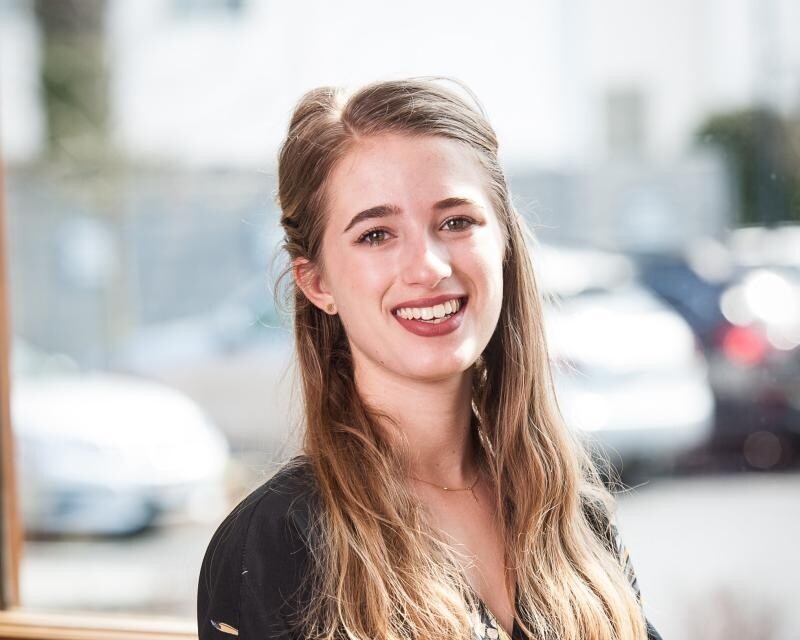
Leaving the Tech Frontlines, Entering the Investment World
In June 2024, just two months after leaving OpenAI, Leopold Aschenbrenner wrote a massive 165-page paper titled "Situational Awareness: The Decade Ahead." The paper contained multiple chapters predicting the emergence of Artificial General Intelligence (AGI), outlining the path from AGI to superintelligence, describing four major risks facing humanity, summarizing methods for humanity to cope with superintelligence, and expounding on the principles of "AGI Realism."
The paper "Situational Awareness: The Decade Ahead" sparked significant discussion in Silicon Valley, greatly boosting Leopold Aschenbrenner's reputation. Subsequently, in September 2024, he founded the eponymous fund Situational Awareness LP, serving as its Chief Investment Officer, focusing on investment opportunities across the AI industry chain.
There is no public information on the initial fund size of Situational Awareness LP. However, according to reports from mainstream media like WSJ and Fortune in mid-2025, the fund's total assets under management (AUM) at that time were approximately $1.5 billion. Its limited partners (LPs) included Stripe co-founders Patrick Collison and John Collison, former GitHub CEO Nat Friedman, and well-known investor Daniel Gross.
According to the 13F filings disclosed by Situational Awareness LP (quarterly disclosure documents required by the SEC for funds with AUM over $100 million), in Q4 2024, the total value of Situational Awareness LP's public holdings was "only" $255 million. However, in the Q4 2025 holdings disclosure released on February 16 this year, that number had grown to a staggering $5.5 billion.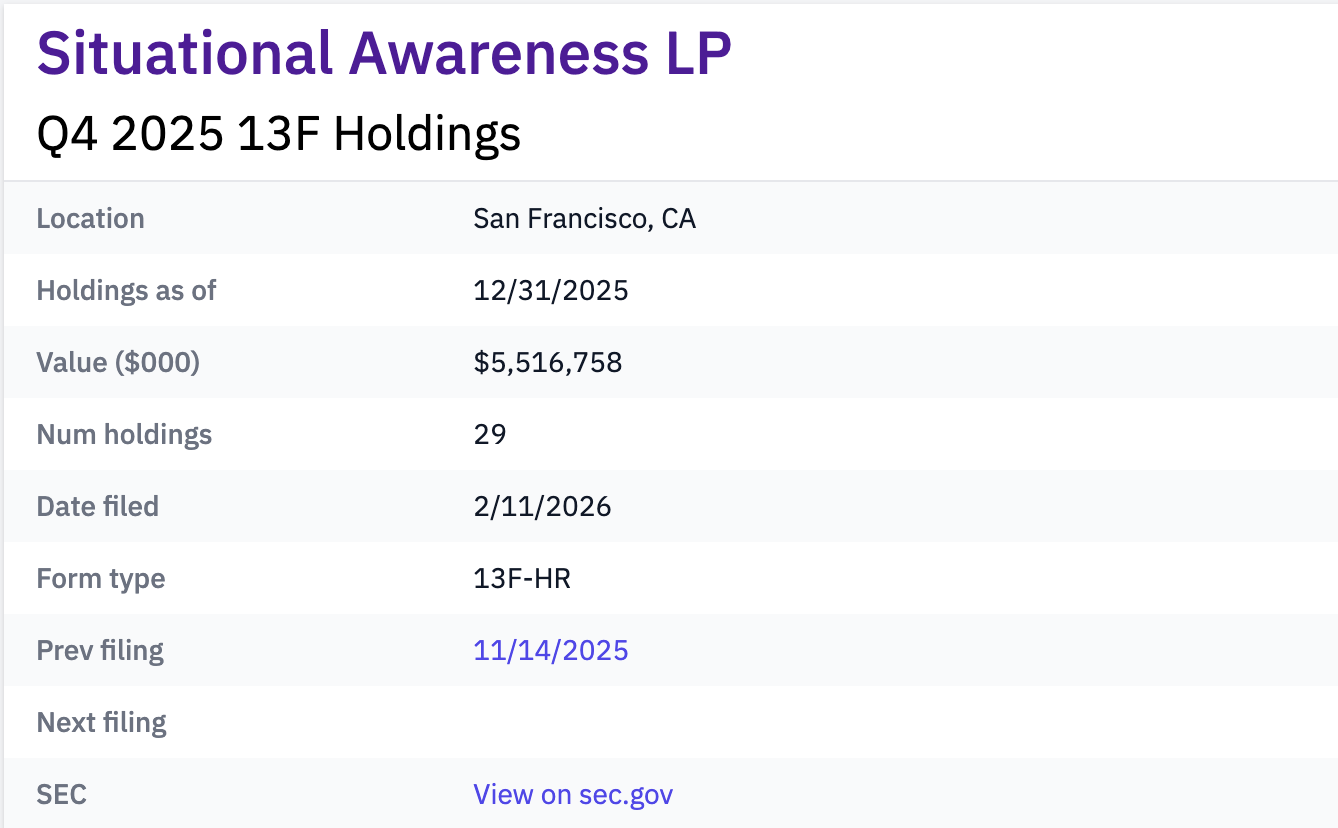

Considering that Situational Awareness LP was not long established by Q4 2024, the fund likely had some dry powder reserves beyond its disclosed $255 million position. However, even taking the mid-2025 AUM of around $1.5 billion as the starting line, the fact that its disclosed holdings grew to $5.5 billion by Q4 of the same year is astonishingly fast.
Holdings Analysis: Lingering Crypto Shadows
Situational Awareness LP disclosed its 29 main holdings in the 13F filing. Details can be seen in the chart below.
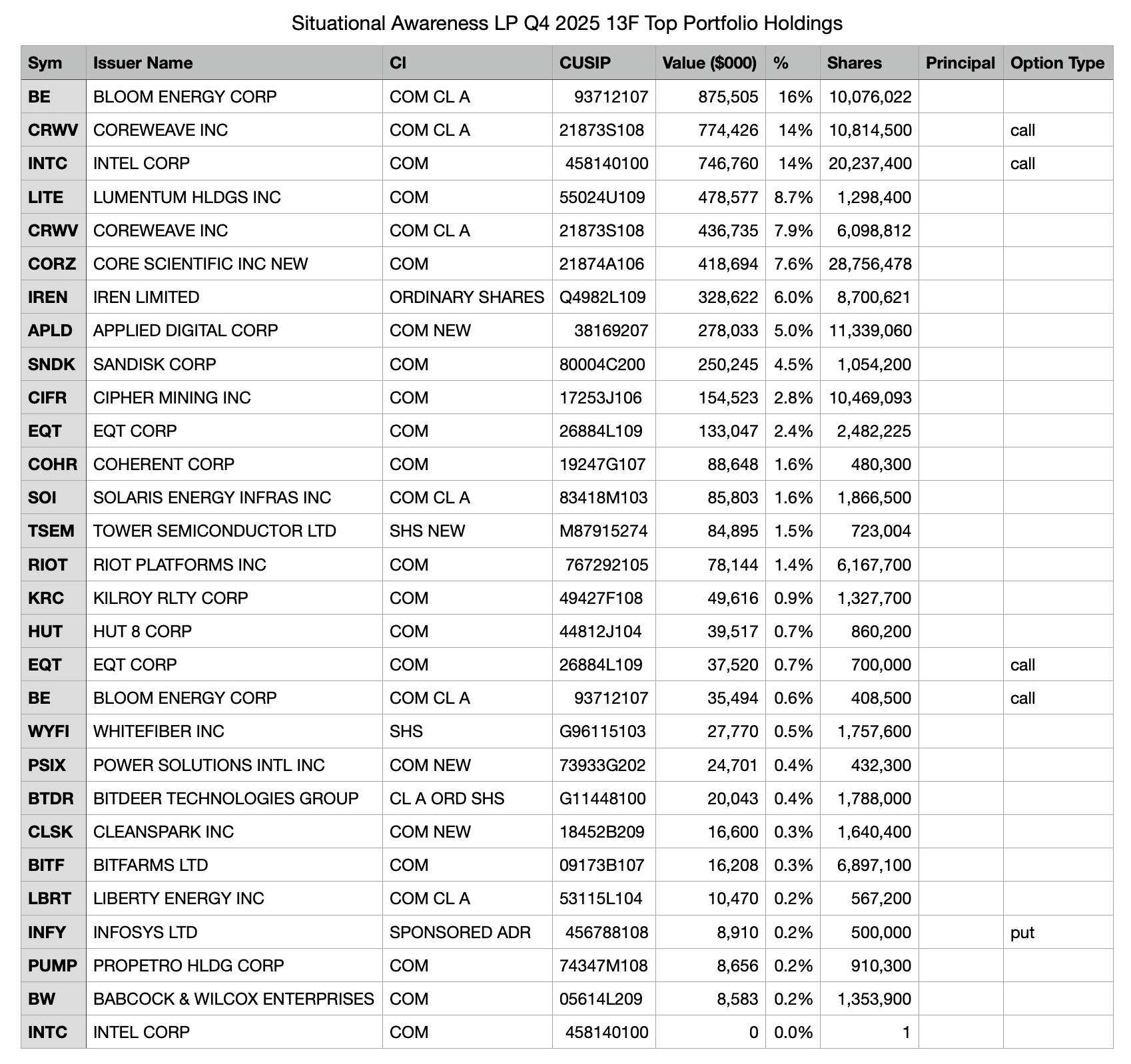
As shown, Situational Awareness LP's bets on AI are not concentrated on the more hyped application layer but rather focus on the upstream infrastructure supply chain.
- The fund's top ten holdings account for a high 86% of its portfolio, indicating a highly concentrated strategy, primarily deployed in energy, computing power, optical communication, and storage.
- The largest position, Bloom Energy, focuses on solid oxide fuel cell (SOFC) and solid oxide electrolyzer cell (SOEC) technology. Driven by demand from AI data centers, the company's performance has consistently exceeded expectations, with its stock price rising over 10x since the end of 2024.
- Hot stocks like Nvidia, Microsoft, Amazon, and Google are absent from the holdings, suggesting Situational Awareness LP prefers relatively "under-the-radar" picks.
- The fund's only disclosed short position is an options-based short on Indian software services exporter Infosys, seemingly betting that the development of Claude Code and Codex will replace traditional IT outsourcing work.
Another clue somewhat connected to the crypto world is that Situational Awareness LP's holdings include several Bitcoin mining companies, such as Core Scientific, Cipher Mining, Iren (formerly Iris Energy), and Jihan Wu's Bitdeer.
However, unfortunately, it's clear that Situational Awareness LP is not betting on these companies' direct crypto-related businesses but rather on their transition into AI computing centers. Amid the rising AI trend and a sluggish crypto market, more and more mining companies are actively transforming, leveraging their existing resource advantages in land, computing power, and electricity. A preview: we will soon publish another article on this trend.
The Fork in the Road, The Reconstruction of Belief
Looking back at Leopold Aschenbrenner's career, it's hard not to think of another once-glorified young prodigy, SBF. Both worked at FTX, both believed in Effective Altruism, and both delivered remarkable investment results. But after one misstep, SBF is now a prisoner facing decades of sentencing ahead. On the other hand, Leopold Aschenbrenner's life took a different fork in the road following FTX's overnight collapse, but fortunately, this seems to be a path better suited for him.
Time does not rewind, and fate never offers a chance to restart. Some are forever left in the ruins of the old era, while others are forced off their original tracks, only to uncover entirely new stories.
As a member of the Crypto industry, the thought that comes to my mind now is — the industry is at a pivotal moment of deconstruction and reconstruction, with confidence more fragile than ever since its inception. Some leave in disappointment, some watch hesitantly, but others actively embrace new technological waves and narrative shifts. History often repeats itself: the collapse of an old story is often the birth of a new one. The reconstruction of belief is, in itself, another form of opportunity.
Recommended Related Articles
"The Day CZ Missed the Best Investment of His Life, Crypto Missed AI";
"FTX, Dead for 3 Years, Donated $650,000. Who is Effective Altruism Really Helping?".