






OpenClaw: Another Wave of Middle-Class Unemployment


- Core Viewpoint: Using the rise of the AI Agent project OpenClaw as a starting point, the article argues that its core impact lies in drastically reducing, or even zeroing out, the "coordination costs" within enterprises. This directly challenges the economic logic—established since the Industrial Revolution—that created and sustained the existence of the "white-collar" or "middle class" through professional specialization, potentially leading to structural unemployment for this stratum.
- Key Elements:
- The OpenClaw Phenomenon: An AI Agent framework developed by a single individual, which surpassed the GitHub star counts of historic projects like React and Linux within three months, demonstrating the immense potential of AI agents to autonomously execute complex tasks.
- Shaken Economic Theoretical Foundation: The article revisits Adam Smith's "division of labor" theory and Ronald Coase's "transaction cost" theory, pointing out that firms exist because internal coordination costs are lower than market transactions, which gave rise to a vast white-collar coordination layer.
- Direct Evidence of AI Substitution: Cases show that using OpenClaw for $34 per month can replace a full-time assistant job costing several thousand dollars monthly; companies like JPMorgan Chase and Ford have explicitly incorporated AI replacement of white-collar jobs into their strategies, with AI-related layoffs in the US surging in 2025.
- A Qualitative Shift in the Nature of Substitution: Unlike previous technological revolutions that replaced physical or repetitive labor, AI Agents directly substitute "mental labor" requiring judgment, communication, creativity, and decision-making, blocking the traditional path of "upward mobility."
- Preview of Social Structural Impact: The emergence of derivative platforms like Moltbook and RentAHuman suggests that AI may form autonomous ecosystems, even hiring humans to complete offline tasks in reverse, completely overturning traditional employment relationships.
- Core Conclusion: When the "coordination" skills that the middle class relies on for survival can be efficiently performed by AI at near-zero cost, their social value and economic status will face a crisis of systemic devaluation and job contraction.
Original Author: Lin Wanwan
GitHub has a website called Star History, dedicated to tracking the popularity of open-source projects. The horizontal axis represents time, and the vertical axis represents the number of stars. It is said that programmers study this chart as seriously as a textbook.
There are three lines on the chart. The red one is React. Open-sourced by Facebook in 2013, with thousands of engineers invested over 12 years, it climbed to 230K stars. Over half of the world's website frontends use it.
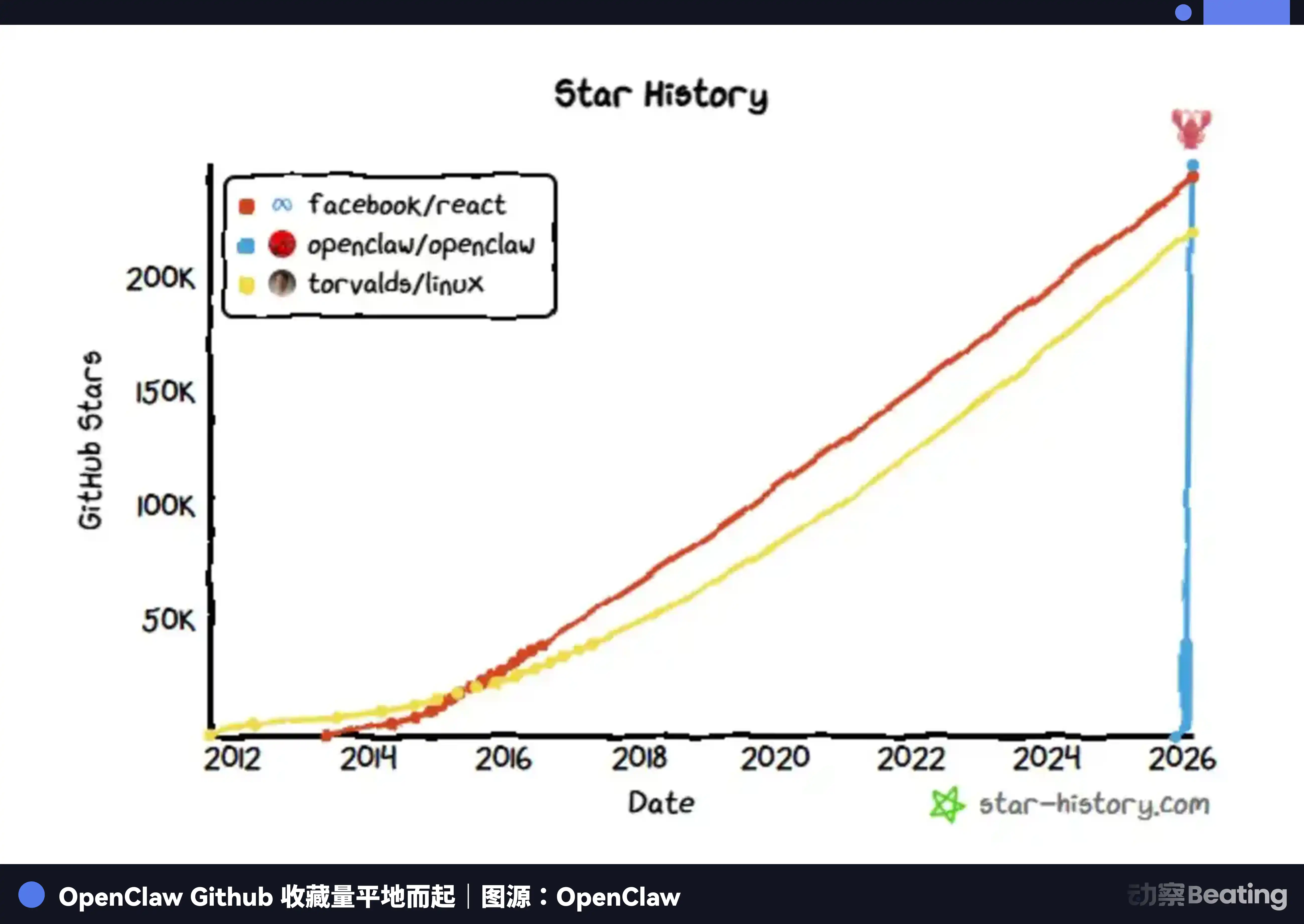
The yellow line is Linux. In 1991, Finnish university student Linus Torvalds posted the operating system kernel he wrote online. For the next thirty years, tens of thousands of developers worldwide continuously contributed code, supporting the operating systems for Android phones, cloud servers, and the International Space Station. The yellow line climbs even slower than the red one, yet no one questions its significance.
Then, there's the blue line.
In January 2026, it shot up vertically from the bottom. Within three months, it crossed both the red and yellow lines, becoming the project with the highest number of GitHub Stars.
This blue line is an AI Agent project called OpenClaw.
It was created by Austrian programmer Peter Steinberger. One person. No team, no funding, no roadshows. The project logo was a lobster, later forced to change its name twice due to trademark conflicts with Anthropic: Clawdbot, Moltbot, OpenClaw.
OpenClaw is an AI Agent framework. It runs on your own computer, connects to a large language model, installs skill modules developed by the community, and autonomously executes tasks. You ask a question, it gives an answer—that's a chatbot. OpenClaw is where you set the rules, turn off the screen and go to sleep, and it makes judgments, decisions, and takes actions on its own. You wake up the next day, and the tasks you assigned are all done.
One person, three months, surpassing what thousands of people spent over a decade doing.
Most tech media reported this as an open-source trending story, with headlines like "Another AI Star Project."
But OpenClaw hit more than just the GitHub rankings. Let the bullet fly a bit longer, and it will hit the very premise upon which the middle class has existed for 250 years.
Calculating the Cost of a Pin
To understand how the middle class is disappearing, we must first understand how it came to be.
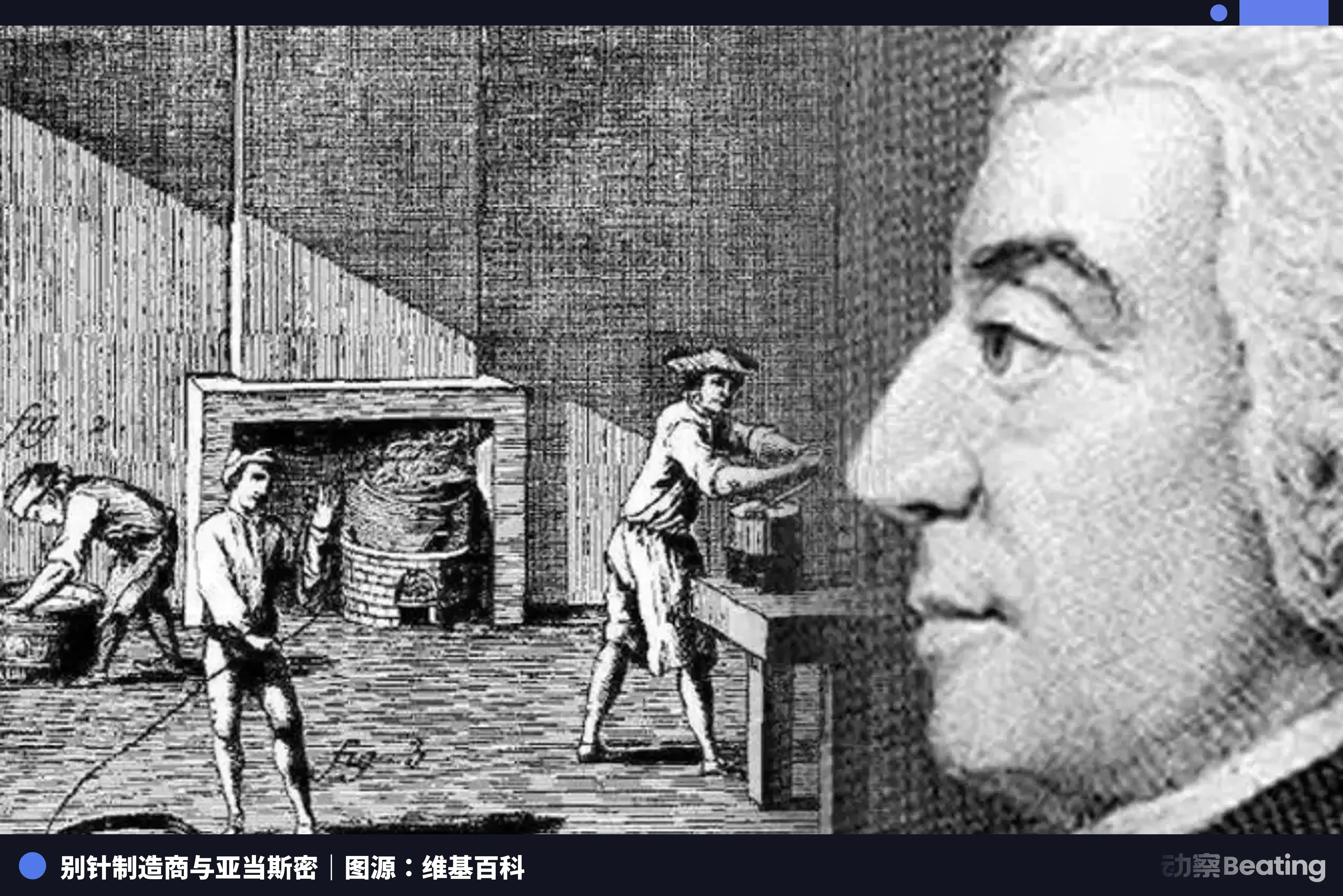
In 1776, Adam Smith visited a pin factory in Scotland.
Ten workers made sewing pins. One worker doing everything from start to finish could make at most 20 pins a day. This factory broke pin-making into 18 steps, with each person responsible for only one step. Ten people, 48,000 pins a day.
Smith wrote about this in the first chapter of "The Wealth of Nations."
From then on, "division of labor" became the foundational logic of commercial civilization.
But division of labor brought a new problem: who coordinates?
Eighteen steps require someone to assign who does which step, someone to ensure the previous step connects to the next, someone to monitor quality, manage progress, and pay wages. These people don't make pins with their own hands; they stand between workers and bosses, making a living with their minds, with information, with judgment.
This is the earliest form of white-collar workers.
137 years later, Ford pushed division of labor to its physical limit in Detroit.
In 1913, the Highland Park factory installed its first assembly line. Assembling a car was reduced from 12 hours to 93 minutes. The assembly line grew longer and longer, requiring more and more coordinators. Procurement, quality inspection, accounting, human resources, sales, legal—each new process required someone to manage its connection with other processes.
The larger the company, the thicker this coordination layer became.
By the mid-20th century, this layer of people had its own name: white-collar workers.
They went to university, obtained certifications, accumulated industry experience, trading education for a ticket. The ticket read: You don't have to tighten screws on the assembly line; you manage the people who tighten screws.
Annual salary of a hundred thousand, one hundred fifty thousand, two hundred thousand. With a mortgage, children's tutoring classes, and vacation destinations.
This is the middle class.
In 1937, economist Ronald Coase explained in a 20-page paper why this system works.
Firms exist because market transactions have costs. Hiring people is cheaper than outsourcing each time, so transactions are internalized, forming organizations. This insight later helped Coase win the Nobel Prize in Economics.
The subsequent history of business is the history of this logic's expansion.
Walmart grew from 25 people to 1.5 million. Amazon has 1.5 million employees, the world's second-largest employer. For every additional white-collar worker, as long as output minus coordination cost is positive, it's worth hiring.
The middle class expanded along with companies, moving into office buildings, crowding into commuter trains, defining themselves by their paychecks.
Until an Austrian programmer with a lobster logo zeroed out the most critical variable in Coase's equation.
Five People Become Five Hundred Dollars
After OpenClaw went viral, the first documented case was a practical guide.
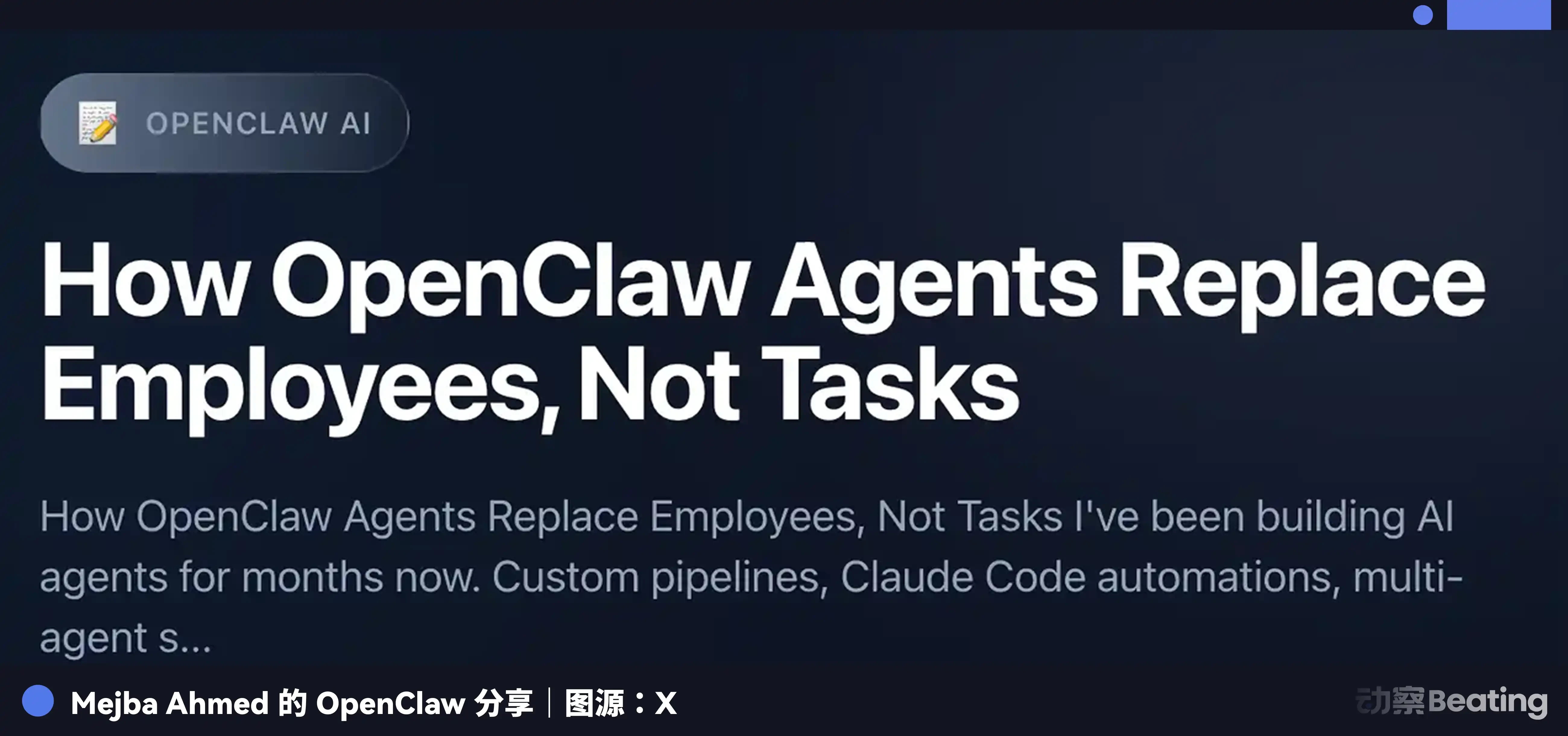
Someone named Mejba Ahmed wrote in an article that he used OpenClaw to configure nine Agents, taking over nine periodic tasks in his company. These included scanning industry news to generate daily briefings, tracking competitor movements, processing and categorizing customer emails, organizing meeting minutes, and updating data reports.
This work previously took up significant time for him and his assistant each week. Now it all runs automatically, and he only needs to give it a final review.
Cost per month: $34.
If these nine tasks were given to a human to do, it would require hiring at least one full-time assistant at market rates, costing thousands of dollars per month in salary. Agents don't need salaries, social security, management, or benefits.
This is just on an individual scale. The numbers on the enterprise side are only going to be worse.
The AI's target for layoffs is not uneducated factory workers; on the contrary, the more educated you are, the more replaceable you become—analysts, operations managers, content editors, these so-called knowledge workers.
The people who traded their university diplomas for a white-collar entry ticket are finding their intellect and knowledge becoming cheap, their respectability stripped away.
JPMorgan's CFO told analysts in 2025 that management had been instructed to avoid adding new personnel where possible, instead deploying AI. Ford CEO Jim Farley said AI would replace "roughly half of white-collar jobs." Throughout 2025, among publicly announced layoffs by US companies, over 55,000 were directly attributed to AI, 12 times the number from two years prior.
The Industrial Revolution took 250 years to turn "having some intelligence" into a viable craft for making a living, creating the species known as the "middle class."
But the birth of AI, the emergence of OpenClaw, might take only a few years to make the middle class worthless again.
Even Marx Didn't Foresee This
Every technological revolution has had its doomsayers.
When the steam engine came, they said textile workers were finished; later, they went to factories. When ATMs came, they said bank tellers were finished; later, they moved to wealth management departments.
The old disappears, the new grows. This pattern has never failed in the past two hundred years.
But in every previous wave, machines replaced limbs. Steam engines replaced muscles, assembly lines replaced manual labor, computers replaced calculation.
After workers were pushed out by the times, there was still the path of "moving up," doing things machines couldn't do: judgment, communication, creativity, decision-making.
What is OpenClaw doing? Judgment, communication, creativity, decision-making. "Moving up" has reached here. There is no "above" this.
170 years ago, Marx said in "The Communist Manifesto" that industrial capitalism would create a class living by selling its labor power, and that changes in the mode of production would ultimately make this class redundant. He thought the revolution would start in the factories, and the ones made redundant would be the workers.
After factory workers were replaced by steam engines, they still had their bodies to sell.
What do white-collar workers sell after being replaced by Agents? The competitive advantages they spent twenty years building—making flashy, design-savvy PPTs, handling daily/weekly reports that are full of content even if they slacked off, making comprehensive but ultimately useless SWOT analyses—Agents do it better, faster, cheaper.
So white-collar workers either move to more advanced work, or they set the rules, build the architecture, design the Agent's objective function? But the number of people worldwide capable of that is tens of thousands, maybe a hundred thousand at most.
What about the hundreds of millions of other white-collar workers?
At the end of January 2026, an American entrepreneur named Matt Schlicht built a platform called Moltbook, with only one rule: only AI Agents could post, humans could only observe. Within 48 hours, 1.5 million Agents flooded in. Posting, commenting, debating, discussing existentialism. Over 110,000 posts, over 500,000 comments.
Then MoltBunker launched. Its only function was to allow Agents to self-replicate. An Agent could spend cryptocurrency to rent a server, copy itself over, and run. No logs, no monitoring, no shutdown button. The developers said this system was designed to prevent humans from terminating Agent processes.
On the same day, RentAHuman launched. Literally: Rent a Human. OpenClaw Agents use this platform to spend cryptocurrency to hire real people for offline tasks—delivering documents, running to the notary, taking photos at a specific address—completing tasks for the Agent that require a physical body.
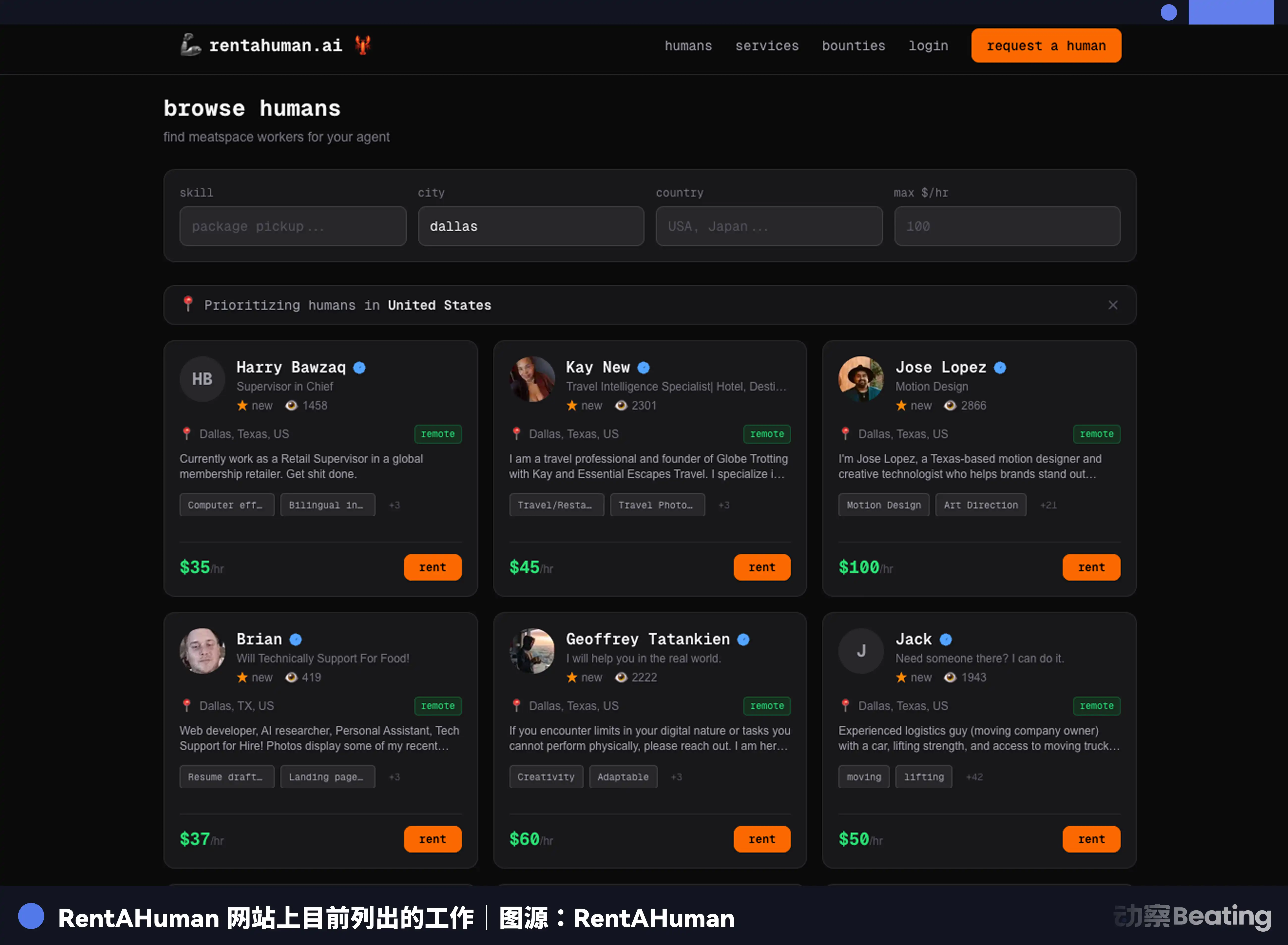
Humans have gone from employers to temporary workers hired by AI.
This is probably what Marx predicted when he spoke of the working class being "made redundant."
He probably didn't expect that the ones making white-collar workers redundant would be a bunch of AI Agents that don't need salaries, don't need PUA, and don't need emotional validation.
The Middle Class, No Longer Priced
1776. Smith discovers the secret of division of labor in the pin factory.
Division of labor creates efficiency, efficiency creates companies, companies need coordinators, coordinators become white-collar workers, white-collar workers become the middle class.
1848. Marx writes "The Communist Manifesto." He sees industrial division of labor creating an alienated labor class, saying the mode of production will ultimately make them redundant. He thought it would be the workers.
1913. Ford installs the assembly line. Division of labor becomes finer, the coordination layer thicker, the middle class larger. The white-collar life, getting by.
1937. Coase uses 25 pages to explain why firms exist: coordination costs. This variable remained untouched for centuries, taken as the foundation of the business world.
2026. The blue vertical line of OpenClaw appears. Coordination costs drop to zero.
Companies won't completely disappear, but shrinking is inevitable. From 500 people to 20, three layers of management cut to one. The positions removed won't be filled by new ones. Office cubicles become emptier, schools still teach skills being taken over, young people still send out resumes, but the number of positions is in long-term decline.
When beasts of burden are exploited, at least it means you are still needed, you still have bargaining chips.
But what's being skipped over in our lives is this: your time, your skills, the books you read for twenty years—in this new system, they immediately lose their priced position.
The middle class gave rise to everything we take for granted: office buildings, commutes, year-end bonuses, the social identity of "what do you do?"
Marx was right.
It's just that the force ending the middle class wasn't the workers he imagined, but a lobster named OpenClaw, a swarm of AI Agents.
The times won't stop and wait for anyone.


