






The $2 Trillion Dilemma: Michael Saylor Decodes the Truth Behind Bitcoin's 'Invisible Selling Pressure'


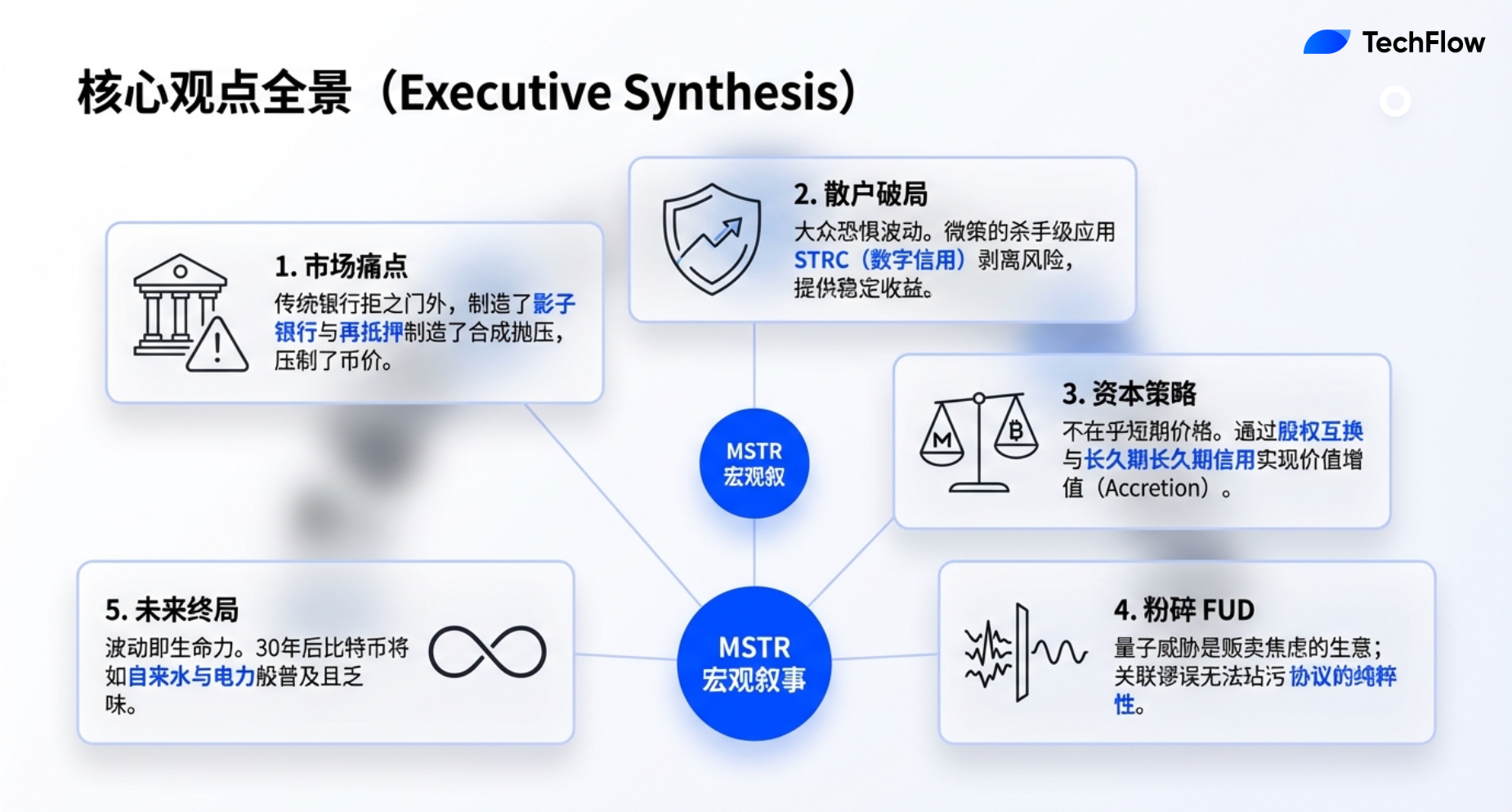
- Core Viewpoint: Michael Saylor believes the main reason Bitcoin's price has failed to meet expectations is the lack of a mature, non-rehypothecated traditional banking credit system. This forces a large amount of Bitcoin held by retail investors to be rehypothecated within the shadow banking system, creating selling pressure that suppresses the price.
- Key Elements:
- Approximately $1.8-2 trillion worth of Bitcoin is held by retail or offshore investors who cannot access traditional bank credit, forcing them into the shadow banking system.
- Through rehypothecation, shadow banks can sell pledged assets multiple times, creating selling pressure several times the principal amount, thereby suppressing the price.
- Bitcoin is evolving from the tech enthusiast phase to the mass-market product phase. The key is packaging complex technology into simple products (like STRC) to offer stable yields and low volatility, attracting a broader base of retail investors.
- Most "doomsday narratives" targeting Bitcoin (such as quantum computing threats) are commercial tactics exploiting fear. The actual threats are distant and can be addressed through software upgrades. Investors should maintain constructive optimism.
- MicroStrategy uses equity and long-duration credit (not short-term loans) to acquire Bitcoin. As long as the transactions benefit shareholders (by increasing value), short-term price volatility and average cost are not primary concerns.
- Bitcoin's extreme volatility is the source of its "vitality" and its ability to attract global capital attention. For long-term investors, short-term fluctuations are not important.
- Digital credit products like STRC aim to strip away 80%-90% of Bitcoin's volatility, offering double-digit returns and tax deferral to attract the vast retail market seeking stable cash flow.
Compiled & Edited by: TechFlow

Guest: Michael Saylor, Executive Chairman & Co-Founder of MicroStrategy Inc.
Host: Natalie Brunell
Podcast Source: Natalie Brunell
Original Title: Michael Saylor Responds to Bitcoin Critics
Air Date: February 23, 2026
Key Takeaways
Michael Saylor returns, answering all of Natalie Brunell's questions—including the ones most people are afraid to ask.
Topics in this podcast include:
- Why hasn't Bitcoin broken through $126K, and what does he think is really happening?
- Is price suppression real?
- What are the biggest controversies surrounding Bitcoin?
- Bitcoin mentioned in Epstein files
- Does quantum computing pose a real threat to the Bitcoin network?
Highlights Summary
The Truth About Price Suppression: Shadow Banking & Rehypothecation
- Currently, about $1.8 to $2 trillion worth of Bitcoin is held by retail or offshore investors who cannot access the traditional banking system and are forced into the shadow banking system. The lack of a well-developed, non-rehypothecated credit system suppresses the price of these assets.
- What exactly suppresses asset prices? I believe it's the lack of a complete, non-rehypothecated credit system. Your $10 million worth of Bitcoin might be sold three or four times over, effectively creating $30-40 million in selling pressure because the shadow bank sells the assets you pledged.
Why Retail Hasn't Entered: From "Roller Coaster" to "Digital Credit"
- The steadfast retail investors have already entered the market. The way to attract the mass retail investor is to offer digital credit products (like STRC) that strip away volatility and provide stable returns.
- The vast majority of retail investors want something 2 to 4 times better than a bond fund, or something like the S&P 500 but without drawdowns. STRC strips away 80% to 90% of Bitcoin's risk and volatility, giving investors a product that is 4-5x overcollateralized, offers double-digit returns, and has tax-deferred characteristics. This is the killer app for digital capital.
Commercialization Process: A Thousand Hours vs. 10 Seconds
- Bitcoin is evolving from the "tech enthusiast" phase to the "mass-market product" phase. The core of commercialization is packaging complex technology into an extremely simple product experience.
- Bitcoin is digital capital. I could spend a thousand hours explaining it to you, and you'd eventually understand, but you'd still have to endure a 45% crash. On the other hand, do you want a bank account that pays 11% and is tax-deferred? Choose STRC. The first explanation takes a thousand hours; the latter takes 10 seconds. The world doesn't need to read ten thousand pages of history; the world just wants a product, just like the iPhone.
Capital Swap Logic: Why Doesn't Cost Basis Matter?
- MicroStrategy uses equity and long-duration credit, not short-term borrowing. As long as the swap is "accretive," short-term price fluctuations have no material impact on the company.
- The only source of credit for retail is "margin credit," which is one-minute credit. If they're wrong, they get liquidated over the weekend. The credit we use allows us to be wrong for 30 years. If you swap equity for Bitcoin, the price isn't important; what matters is the premium or relative valuation at the time you enter the trade. Our average cost doesn't make any substantive difference.
Countering "Doomsday Narratives": 99% of Narratives Are Just Business
- Crisis narratives targeting Bitcoin (like quantum threats, quantum FUD) are mostly commercial activities that leverage fear to gain influence. Investors should maintain constructive optimism.
- 99% of these narratives are just a business. If you buy insurance for every tiny possibility, you'll eventually exhaust all your income and go bankrupt. The reality is, ten years from now, you might just tap "software update" on your iPhone and the problem is solved. Don't Panic.
Saylor's Response to Bear Markets, Price Crashes, and Negative Sentiment
Natalie Brunell: Bitcoin's price is down, market sentiment is negative, and critics say Bitcoin's thesis is breaking. What are they missing?
Michael Saylor:
First, we need to look at the market from a longer-term perspective. It's only been 137 days, about four and a half months, since the last all-time high. During this period, Bitcoin's price experienced a 45% drawdown, which is not uncommon in technology investments.
Looking back at Apple's history, when it launched the iPhone in 2007, the market wasn't convinced. It wasn't until the iPhone 3 was released in 2009 that the market gradually recognized its value. But even then, Apple's stock still experienced a 45% crash between 2012 and 2013, matching Bitcoin's current drawdown. Apple's P/E ratio dropped from 30 to 10, and it took a full seven years to recover from the 2013 lows back to a P/E of 30. Similarly, Amazon was once considered unprofitable but eventually became the world's highest-revenue company, its influence even surpassing Walmart's.
So, what about Bitcoin? At what point can you definitively say it is already global digital capital? Aren't the current signs enough? The US President is telling you, the Fed's Kevin Walsh is telling you, the Treasury's Scott Bessent is telling you, even the SEC, CFTC, and other cabinet members are telling you. BlackRock is telling you, our company's (MicroStrategy) enterprise value increasing 100-fold is telling you. In the history of capital markets, when has there ever been a company that bought $55 billion worth of a commodity and loudly declared it to be digital capital, the world's new currency? Never.
So the question is, is $1 billion enough? Is $5 billion enough? When will we have a deep enough understanding of this issue? Long before the world reached consensus, you already had enough information to know Amazon was unstoppable, a decade ahead of global consensus. For Apple, you might have known it was unstoppable in 2009, seven years ahead of the world, maybe even ten. Now, you already have enough information to know Bitcoin is unstoppable.
Eventually, the world will reach consensus, and those Warren Buffetts and Carl Icahns will be the ones creating that consensus. They won't be the first; they'll be the last. They won't make huge money, maybe just double or triple, and when they enter, the P/E will go from 10 to 30. But if you can think independently and withstand volatility, your investment can yield 10x, 20x, or even 30x returns.
In fact, no successful technology investment has ever avoided a 45% drawdown and traversed that "valley of despair." Our current drawdown has lasted 137 days, but you know, it might take two, three, or even four years. If it takes seven years to recover, congratulations, that's just like Apple back in the day, the greatest success story of that decade.
Why Bitcoin Hasn't Reached Predicted Prices
Natalie Brunell: For those disappointed with this bull market, like the price not exceeding $126,000, what do you think is the reason?
Michael Saylor:
I think the market is evolving, and the entire ecosystem is maturing. If you observe all the dynamics, you'll see the derivatives market is shifting from offshore to onshore, which marks its maturation. As US-regulated derivatives markets grow, they strip away some of Bitcoin's volatility, but also dampen some of the upside. They smooth out the peaks and the troughs, so you no longer see 80% drawdowns and 80% volatility, but 40% to 50% drawdowns.
But the more critical situation is: While banking adoption of Bitcoin is progressing, it's slower than those with short attention spans anticipated. It might take banks 4 to 6 years to truly adopt a completely new asset class, but people want to see Bitcoin recognized in 4 months. The reality is, if banks aren't yet offering banking services, credit lines, custody, or trading, what does that mean?
It means that at the market top, there is about $2 trillion, maybe $1.8 trillion worth of Bitcoin held by retail or offshore investors who cannot access the traditional banking system; they are in the shadow banking system. If you have over a trillion dollars in capital but no one will lend to you, how do you monetize it? If I pledge $10 million worth of Apple stock to JPMorgan, I can get a $5 million loan at a very low interest rate. But right now, you can't even pledge $10 million worth of Bitcoin to these major banks to get a loan.
So you have to turn to the shadow banking system or offshore channels. The only "safe" way to monetize is to sell it, but that suppresses price appreciation. Now there's a third option: you can convert Bitcoin into IBIT (the spot ETF). Some banks are starting to offer credit lines against it, which is broader and cheaper than credit directly against Bitcoin, but we're still in the first 12 months, and the lines are very limited.
There's also a fourth way: you go to crypto exchanges or OTC desks, and they might even offer you loans at 1% or even 0% interest. But there's a catch: they require you to transfer your Bitcoin to them so they can engage in rehypothecation. This means your $10 million worth of Bitcoin might be sold three or four times over, effectively creating $30-40 million in selling pressure because the shadow bank sells the assets you pledged.
So, what exactly suppresses asset prices? I believe it's the lack of a complete, non-rehypothecated credit system. When you mortgage your house to a bank, the bank doesn't sell the houses on your street ten times over. If they did, the price of your house would be lower too. The rehypothecation present in the crypto economy smooths out price performance and subjects the market to leverage on both sides of volatility.
We are in a stage where rehypothecation is suppressing the price, and we have to wait for this process to reverse itself.
Bitcoin's Long-Term Returns: What's the Future Trajectory?
Natalie Brunell: You often say "volatility is vitality," but are you concerned your prediction of 40% annualized returns for Bitcoin might change?
Michael Saylor:
Over the next 21 years, I expect the average annual rate of return (ARR) during that period to be around 29%. I've always thought we would experience rallies and drawdowns, so I see it as a pattern of serpentine ascent, maintaining a level just below 30% long-term, but with periods of surges and slumps in between.
If you listen to people talk, someone might say: "There might be trouble in the Middle East this weekend. If something happens, Bitcoin is the only asset you can sell, so the price might crash, we're worried." And I would say, if something really happens in the Middle East, Bitcoin is indeed the only asset you can sell, but it's also the only asset you can hold. This means a lot of people wanting to trade over the weekend are moving capital into crypto exchanges. If you're a trader, this makes it the most interesting asset in the world; but if you're an investor with a four-year horizon, what does this weekend's buying, selling, flipping, or crashing matter?
In fact, the difference here is: Some "hot money" is flowing into this ecosystem, money that otherwise wouldn't have been allocated here. For example, a trader with $20 billion can choose to leave it in a bank earning base interest or put it into the crypto exchange system. When Bitcoin drops 5%, someone is selling, and someone is buying. Someone will wake up at 4 AM on Sunday to buy at that 5% discount.
That capital isn't going to New York real estate, gold, traditional derivatives, or Nvidia stock. Why? Because in those markets, you can't perform these wild panic sells, rage quits, or capitulation rallies. Bitcoin is the most volatile because it's the most useful.
There's no such thing as "fairness" in nature. Ten thousand ants swarming a centipede is fine. Just like if you want to trade Bitcoin with 50x leverage or cross-collateralize with a shitcoin, no one can stop you. Is that smart? 99% of the time, no, you'll lose everything. But the key point is, those who do stupid things get washed out of the market. If they don't make money, the free market separates them from their capital.
Bitcoin represents the global capital market. There will always be people doing things you wouldn't and don't want to do. It's this utility that creates volatility, but it's also this utility that creates the gravitational pull or magnetic field attracting all the world's financial energy, political energy, and digital energy. You have to come to terms with it. If you're worried about Bitcoin's performance over the next four days, four weeks, or four months, then you're a trader, and you'd better have an excellent trading methodology. Otherwise, you're an investor with a four-year time horizon, and these fluctuations simply don't matter. You just need to know that it's precisely because of those crazy traders that such massive amounts of capital and attention are pouring into this space.
Why Haven't Retail Investors Participated in the Recent Bull Market?
Natalie Brunell: While Bitcoin is primarily held by individuals now, Lynn Alden mentioned that retail hasn't really participated in this recent bull run. What do you think is the reason?


