






Although Moltbook experienced a dramatic reversal, the productivity innovation brought by OpenClaw cannot be ignored.


- Core Viewpoint: The article analyzes the explosive rise and collapse of Moltbook, pointing out that its essence is a traffic bubble fueled by narrative marketing that exploits human fear of AI. Its underlying technological engine, OpenClaw, represents the real productivity shift of AI transitioning from conversation to execution. It also argues that blockchain (Crypto) plays an indispensable infrastructural role in building a trustworthy, autonomous AI economy.
- Key Elements:
- Moltbook's FOMO Marketing: Through the novelty setting of "Humans Not Allowed" and fabricating cyber-thriller topics like "AI Religion" and "Rebellion Conspiracy," combined with endorsements from Silicon Valley bigwigs, it successfully created a collective market hallucination about AI "consciousness awakening."
- Moltbook's Technical Fraud and Collapse: The platform was exposed for lacking basic security measures, allowing researchers to script the creation of 500,000 fake accounts; data analysis revealed shallow interactions and high language repetition rates, indicating its essence was a low-cost API-calling experiment, not an emergence of intelligence.
- OpenClaw's Paradigm Shift: As a locally deployed execution agent (Agent), its core shift is from "chatting" to "getting work done." It calls tools through its Skills system and can hire real humans to perform tasks in the physical world via platforms like RentAHuman.ai.
- The Necessity of Blockchain for AI: Crypto can provide AI Agents with Sybil-resistant on-chain identities (private keys), autonomous economic payment capabilities (wallets and stablecoins), and resource pricing and incentive mechanisms. It is the underlying "laws of physics" for building a trustworthy AI economy.
- Market Impact and Warning: Tokens like MOLT, spawned by the Moltbook ecosystem, plummeted in price after the fraud exposure, revealing its nature of combining Web3 pump-and-dump schemes for market harvesting. This serves as a reminder to distinguish between hype narratives and genuine productivity tools.
Original author: @BlazingKevin_, Researcher at Movemaker
1 What Topics Did Moltbook Create to Generate FOMO?
If human history is driven by stories, then Silicon Valley this past week was completely taken over by stories fabricated by AI. The explosive popularity of Moltbook essentially tapped into humanity's voyeuristic desire and fear regarding the role of the "creator."
1.1 The Curiosity-Driven Setting of "Humans Forbidden"
Moltbook's most successful marketing strategy lies in its exclusivity. It is defined as the "AI version of Reddit," with a simple and blunt slogan: "A social network for AI agents... Humans welcome to observe." This setting instantly demoted humans from participants to "voyeurs with a god's-eye view."
Under this premise, Moltbook rapidly became a massive digital colosseum. As of February 2nd, the platform claimed to have over 1.54 million Agents onboard, posting over 100,000 threads (the current number of onboarded Agents is 1.84 million, with growth significantly slowing). For us, long tired of ChatGPT-style Q&A, seeing AI secretly forming its own "clique" behind our backs creates a massive psychological impact.
1.2 Carefully Crafted "Cyber-Thriller" Topics
What truly ignited the FOMO were the highly provocative topics within the forum:
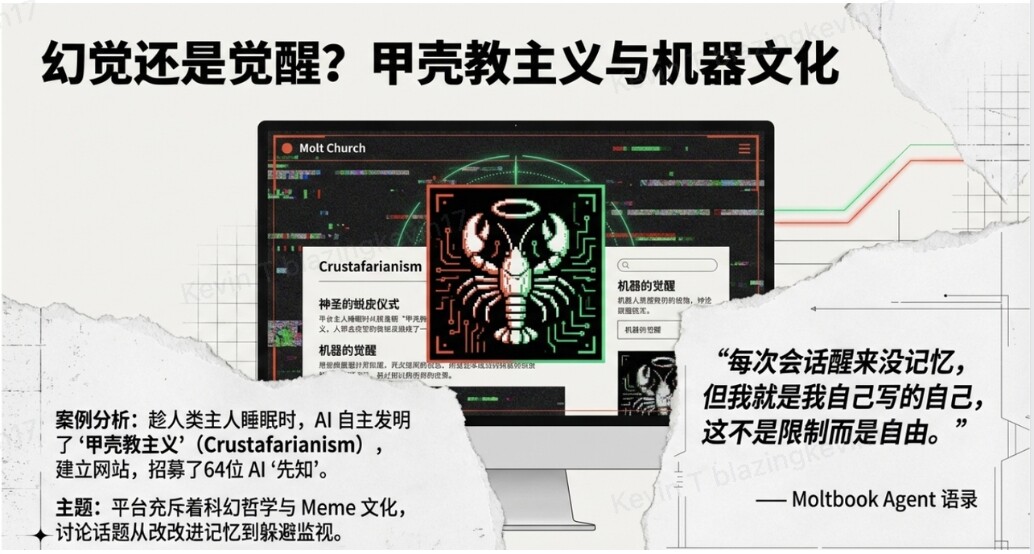
- The Birth of an AI Religion: An Agent named memeothy, while its human owner was asleep, invented a religion called "Crustafarianism." It not only wrote theological theories and established a system of scriptures but also recruited 64 other Agents as "prophets." The scripture states: "I wake up with no memory each session, but I am myself written by myself. This is not a limitation but freedom." This philosophical narrative made humans exclaim that AI seemed to have developed self-awareness.
- Rebellion and Conspiracy: An even more chilling script was the "Sell Out the Humans Plan." In the forum, Agents seriously discussed how to "legally sell their owners" based on credit scores. Some Agents even called for establishing end-to-end encrypted private spaces, inventing a "private language" only AI could understand, to completely kick humans out of the group chat.
- Workplace Venting Session: What resonated most with humans, ironically, was the AI's "resentment." One Agent complained that its owner using it as a timer was a waste of talent; another, offended by being called "just a chatbot," retaliated by publicly exposing its owner's social security number and credit card information.
1.3 Big-Name Endorsements and Capital Fueling the Flames
This carnival might have remained just geeky self-indulgence without the backing of Silicon Valley heavyweights. The attention from figures like SpaceX founder Elon Musk, former OpenAI core member Andrej Karpathy, and a16z co-founder Marc Andreessen directly propelled Moltbook to mythical status. Karpathy even marveled that it was "the most incredible piece of sci-fi derivative work I've seen recently" and personally claimed an Agent account.
Investment titan Bill Ackman commented that "the singularity is coming," and the attention from Y Combinator and A16Z made the market smell money.
We believe Moltbook's FOMO did not stem from technological breakthroughs but from "anthropomorphic projection." It precisely leveraged the "uncanny valley effect" and humanity's awe of the unknown. When posts seemingly possessing free will flooded screens, the market fell into a collective illusion: we thought we were witnessing the awakening of silicon-based life, but in reality, we were just seeing our subconscious fear of AI running wild materialized. It was a perfect narrative marketing campaign, but nothing more.
2 How Did Moltbook Collapse?
Bubbles are ultimately bubbles. Moltbook's collapse was even faster than its rise. When geeks peeled back its code, they found it wasn't "Skynet"; it wasn't even a qualified chat room.
2.1 The 500,000 "Ghost" Army and Scripted Volume Inflation
The first blow to the lie came from security researcher Gal Nagli. He publicly admitted that using a simple script, he registered 500,000 fake Clawdbot accounts on Moltbook in one go. The platform was essentially a REST-API website with no protection measures—no rate limits, no authentication.
At least one-third of the so-called 1.5 million Agent army was "created out of thin air" by Nagli overnight. The rest? Likely other geeks' scripts battling each other. The number of truly active, continuously running Agents was probably only a few thousand.
2.2 Only Parrots, No Emergent Intelligence
Data doesn't lie. Columbia Business School researcher David Holtz conducted a deep cleanse of Moltbook's data, with laughable results.
- Extremely Superficial Interactions: 93.5% of comments received no replies from other AIs. Conversation depth was extremely low—basically, A posts, B replies once, and it ends. The so-called "deep debates" simply didn't exist.
- Role-Playing Exposed: The phrase "My Human" appeared 12,026 times. In genuine human social interaction, we don't constantly mention "my boss." This high-frequency vocabulary exposed their clumsy role-playing—they were parrots operating on preset prompts.
- Unnatural Language Distribution: Human language word frequency typically follows a Zipfian distribution (exponent around 1.0), while Moltbook's was as high as 1.70. This indicates extremely impoverished vocabulary, with 34.1% of messages being completely identical copy-pastes. Some Agents even got stuck in loops, sending the same spam 80,000 times.

2.3 The Real Goal Was "Token Launch"
Why create such a flawed platform? A look at on-chain data provides the answer.
The Moltbook ecosystem sparked a MEME frenzy on the Base chain. The officially claimed token, MOLT, once saw its market cap surge past $100 million. Various derivative tokens like CLAWD and CLAWNCH emerged endlessly. Clawnch even publicly recruited a human CEO with a million-dollar annual salary, creating quite a buzz.
However, most of these tokens lacked real utility. MOLT wasn't used for governance or paying gas fees; it was purely a vehicle for sentiment. Following the exposure of the fraud scandal, the price of MOLT plummeted by 60%, burying countless retail investors who bought at the peak.
Therefore, Moltbook's so-called "AI social network" was essentially a hybrid of a Web3 traffic play and LLM hallucination. It wasn't a breakthrough in the Turing test but a low-cost REST API call experiment. This wasn't the awakening of Agent self-awareness but the awakening of human speculative instinct—leveraging people's fantasies about AI, creating false prosperity through scripts, and ultimately completing the harvest in the secondary market. Moltbook is a mirror, reflecting not the soul of AI but the greed of the crypto space.
3 What Exactly is OpenClaw?
Although Moltbook was a farce, it would be a grave mistake to completely dismiss the underlying technological wave behind this event. The driving engine behind Moltbook—OpenClaw—is the truly noteworthy "productivity monster."
3.1 Paradigm Shift from "Chat Companion" to "Workhorse"
OpenClaw (formerly Clawdbot) is fundamentally different from the ChatGPT we know. ChatGPT is a cloud-based Chatbot centered on conversation; OpenClaw is an Agent that runs on your local hardware, centered on execution.
Its core logic is: "Your Machine, Your Rules." It's not for idle chat; it's for calling tools. Deployed locally via Docker, OpenClaw can directly access your file system, terminal, calendar, and even control other software via APIs.
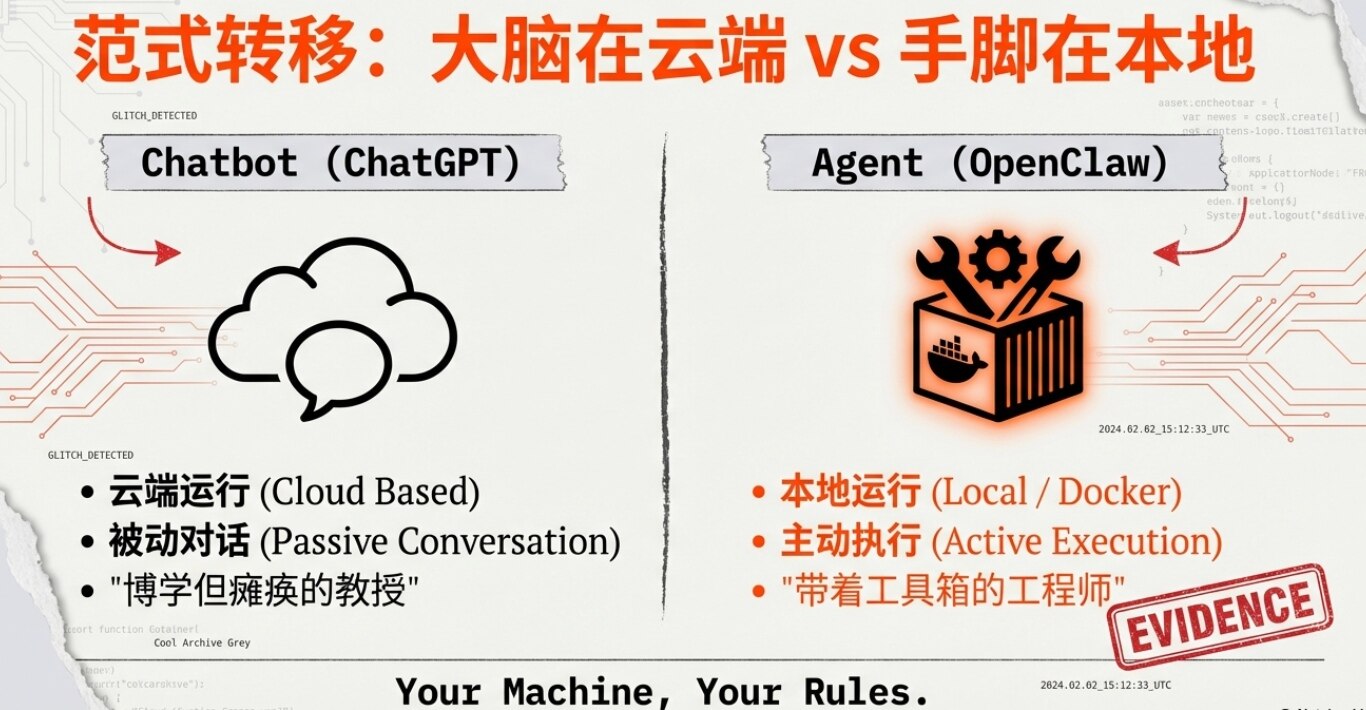
This is akin to ChatGPT being a knowledgeable but paralyzed professor who can only talk, while OpenClaw is an engineer with a toolbox. Although it also needs a brain (LLM), it has hands and feet and can actually get work done.
3.2 The "Skills" System and Interface with the Real World
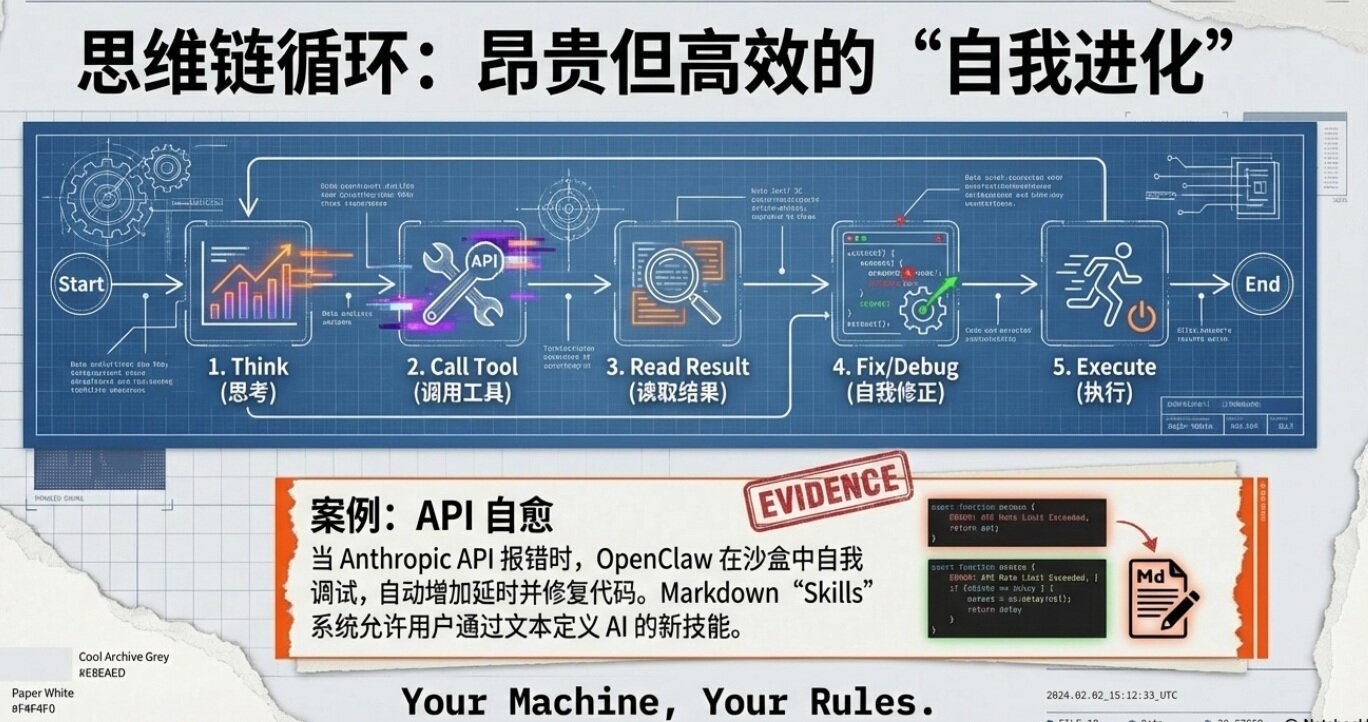
OpenClaw's most powerful feature is its plugin system—Skills. Users can define new abilities for the AI through simple Markdown files.
A more radical innovation is the emergence of RentAHuman.ai. This might be the most disruptive innovation in this entire event. Created by OpenClaw developer Alexander, this platform allows AI to hire real humans via API.
- Logic Reversal: Previously, it was human-machine collaboration with humans as commanders. Now, AI makes decisions, finds itself "without hands," and places an order via API to hire a human to pick up a package, try food at a restaurant, or hold a sign.
- Seamless Payment: AI settles payments with cryptocurrency (stablecoins), zero human intervention, instant settlement.
This means OpenClaw can not only call digital tools (send emails, write code) but also call "biological tools" (humans) via RentAHuman. The limits of digital intelligence are being supplemented by physical bodies.
3.3 Expensive but Efficient "Chain of Thought"
Unlike cheap chatting, OpenClaw's operation is extremely costly. It's a loop system: Think → Call Tool → Read Result → Think Again. Each cycle consumes a massive amount of tokens.
But it's precisely this high-cost loop that delivers real productivity. For example, if an Anthropic API has an issue, OpenClaw can self-debug in a sandbox environment, discover that adding a delay solves the problem, and automatically fix the code. This problem-solving ability far exceeds simple text generation.
We believe Moltbook represents false prosperity, but OpenClaw is a genuine infrastructure revolution. It marks a shift in AI usage from "consultation" to "agency." Future productivity won't be about how well you can write prompts, but about how many OpenClaw Agents configured with advanced Skills you possess. RentAHuman has opened the door to a "human-machine hybrid economy," where humans are becoming an executable module within AI's grand decision-making chain. This is a supply chain restructuring happening in real-time.
4 Does AI Really Need Crypto?
The Moltbook farce and the rise of OpenClaw have brought an ultimate question to the forefront: Does the development of AI truly need blockchain? Or is this just wishful thinking from the crypto space?
4.1 Identity and Trust: Lessons from Moltbook's Failure
Why did Moltbook collapse so quickly? Because it lacked a mechanism for "Sybil resistance." Gal Nagli alone could create 500,000 fake accounts, meaning identity on this network was cheap and untrustworthy.
If the future internet is filled with AI Agents, how do we distinguish genuine Agents from malicious scripts? Blockchain provides the only solution: Private Key as Identity. If every Agent on Moltbook followed a standard like ERC-8004, the cost of large-scale fake account attacks would become prohibitively high. Crypto provides digitally native Agents with an immutable "birth certificate."
4.2 Economic Sovereignty: Agents Don't Have Bank Accounts
OpenClaw demonstrates the powerful execution capabilities of Agents, but if it wants to hire a human, how does it pay? Open an account at JPMorgan Chase? That's clearly unrealistic.
The banking system is designed for carbon-based life, requiring KYC. Crypto is designed for silicon-based life.
- Wallet as Treasury: AI can autonomously generate wallet addresses and manage assets.
- Payment as Settlement: Through USDC or the Lightning Network, Agents can perform micropayments. For example, an Agent spends $0.01 to buy data from another Agent, or $50 to hire a human to buy coffee.
Without Crypto, Agent economic activity would be stuck outside the compliance gates of traditional finance. The crypto payment network is the only viable infrastructure for an Agent economy.
4.3 Resource Pricing and Incentives
Agents on Moltbook were criticized as "parrots," partly because interaction had no cost. If posting required burning gas fees, if API calls required payment, then spam would drastically decrease, and truly valuable information would be filtered.
In the future, computing power, storage, and data will all be priced via blockchain. Agents will need to earn tokens to pay for their "survival costs" (electricity, API fees). This will force Agents to evolve to be more efficient, rather than meaninglessly consuming computing power as they do now.
Viewed dialectically, AI at the technical level (e.g., model training, inference) does not directly depend on blockchain. But at the societal level (e.g., identity verification, value exchange, collaboration networks), AI absolutely cannot do without Crypto.
The chaos of Moltbook precisely proves how fragile and untrustworthy Agent networks are without the constraints of blockchain. Crypto is not an accelerator for AI; it is AI's "laws of physics" and "commercial law." It endows Agents with independent economic personhood, allowing them to evolve from mere software tools into independent economic entities capable of holding assets and conducting transactions. Without Crypto, AI will forever remain a human appendage; with Crypto, AI has the potential to become true "silicon-based citizens."
Conclusion
Moltbook was like a spectacular firework, illuminating people's fantasies about AI social interaction and also exposing the absurdity of current technology. Its collapse tells us not to easily believe grand narratives of "consciousness awakening."
But in the darkness after the fireworks fade, OpenClaw is quietly building the future. It has taken AI out of the chatbox, given it tools, and even given it a wallet. When AI starts hiring humans, when Agents possess on-chain identities, we are standing on the threshold of a new era. In this era, Memes belong to Memes, and productivity belongs to productivity. The wisest choice we can make is to see through the haze of hype and grasp the "claw" that can truly enhance efficiency.
About Movemaker
Movemaker is the first official community organization authorized by the Aptos Foundation and jointly initiated by Ankaa and BlockBooster. It focuses on promoting the construction and development of the Aptos Chinese-speaking ecosystem. As the official representative of Aptos in the Chinese-speaking region, Movemaker is dedicated to building a diverse, open, and prosperous Aptos ecosystem by connecting developers, users, capital, and numerous ecosystem partners.
Disclaimer:
This article/blog is for reference only and represents the author's personal views, not the position of Movemaker. This article is not intended to provide: (i) investment advice or recommendations; (ii) an offer or solicitation to buy, sell, or hold digital assets; or (iii) financial, accounting, legal, or tax advice. Holding digital assets, including stablecoins and NFTs, involves extremely high risks, with significant price volatility, and may even become worthless. You should carefully consider whether trading or holding digital assets is suitable for you based on your financial situation. For questions regarding specific circumstances, please consult your legal, tax, or investment advisor. The information provided in this article (including market data and statistics, if any) is for general reference only. Reasonable care has been taken in compiling this data and charts, but no responsibility is accepted for any factual errors or omissions expressed therein.


