Kyle Criticizes Hyperliquid, Arthur Hayes Responds with a $100K Bet


- Core Viewpoint: The article centers on the fierce criticism of the Hyperliquid project by former Multicoin co-founder Kyle Samani and his public confrontation with BitMEX founder Arthur Hayes. It explores the fundamental divide within the crypto industry regarding project value assessment (price performance vs. ethics and decentralization ideals), and reveals the potential vested interests and shifting industry cycle mentality behind the criticism.
- Key Elements:
- Core Conflict: After leaving his position, Kyle Samani publicly criticized Hyperliquid for issues related to founder background, closed-source code, and facilitating crime. Arthur Hayes responded only with a bet on the HYPE token's price performance over the next five months, highlighting the misalignment between "moral critique" and "price-first" logics.
- Stance and Interests: Around the time Kyle issued his criticism, on-chain data showed his former fund, Multicoin Capital, was accumulating a large HYPE position (approximately $46 million), casting doubt on the objectivity of his critique within the community. It was suggested to be related to his fund's position and anxiety over ecosystem competition.
- Industry Cycle Phenomenon: The article points out that in the mid-to-late stages of each market cycle or during bear markets, individuals (like Kyle, who has exited) often begin reflecting on the industry's fundamental issues. Meanwhile, those still actively involved (like Hayes) tend to use price performance as their most powerful defense, creating a cyclical pattern of dialogue.
- Personal Transformation: Before leaving his role, Kyle expressed feeling that the cryptocurrency industry had become "less interesting." His subsequent uncompromising criticism of Hyperliquid is seen as a break from his past role and no longer represents the investment stance of his former institution.
- Market Reality: Hyperliquid has shown relative strength in a declining market. Its HYPE token has nearly doubled from its January low, and its silver contracts are considered to be starting to compete with traditional exchanges (like CME) in terms of spreads and execution.
Original Author: David, TechFlow
There aren't many projects worth mentioning during this downturn, but Hyperliquid is one of them.
$HYPE has nearly doubled from its January low. Regardless of your opinion on the project, the market is voting. However, Kyle Samani, the former co-founder of Multicoin, cast a dissenting vote.
On February 8th, Blockworks Research published a report stating that Hyperliquid's silver contracts have begun to directly compete with traditional futures exchanges like CME in terms of spreads and execution.
Many in the crypto community shared it, viewing it as a signal that on-chain finance is truly starting to encroach on traditional finance's territory.
But Kyle poured cold water on the enthusiasm.
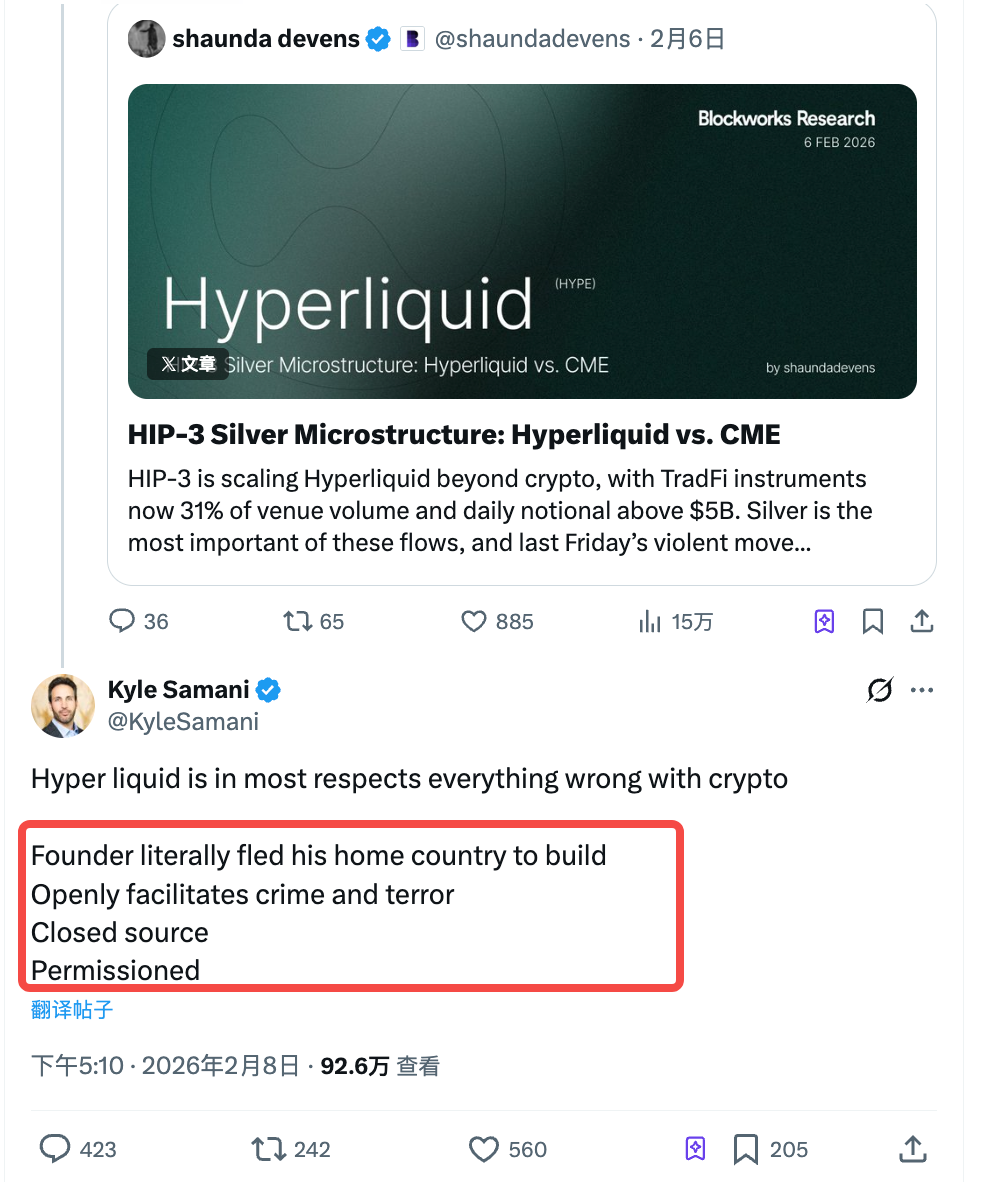
He believes Hyperliquid represents, in almost every aspect, the classic problems of the crypto industry:
- The founder fled his home country to build this project
- The platform publicly facilitates crime and terrorism
- The code is closed-source
- The product operates with permissions, not fully open
In the past, this kind of statement would have been a common project-bashing post on Crypto Twitter.
But don't forget, just four days ago, Kyle announced his departure from Multicoin Capital, and before that announcement, he posted (and quickly deleted) a tweet:
"Crypto is not as interesting as many people (including myself) once thought."
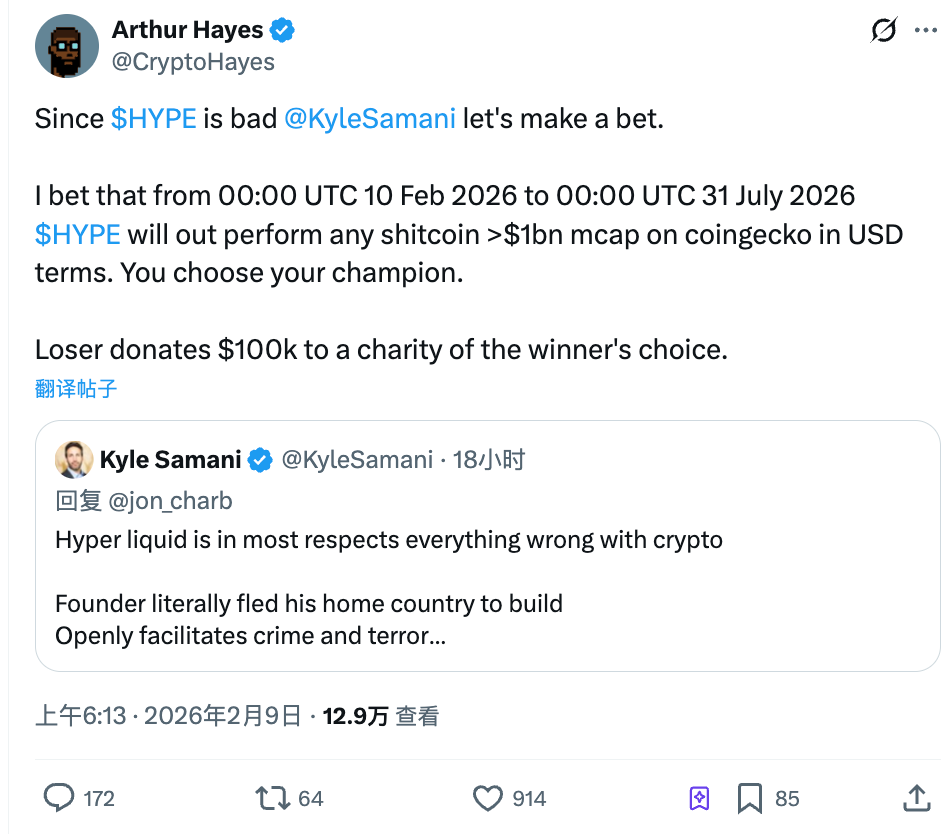
An old acquaintance, Arthur Hayes, clearly disagrees with this assessment. He directly expressed his confidence in HYPE after Kyle's comments:
"Since you think HYPE is so bad, let's make a bet. From February 10th to July 31st, HYPE outperforms any coin with a market cap over $1 billion that you choose. The loser donates $100,000 to a charity of the winner's choice. You pick the coin, I'm betting HYPE wins."
Criticism, Leaving the Table
As of publication, Kyle has not accepted Arthur's bet and likely won't.
Someone who just said "crypto isn't as interesting anymore" is unlikely to sit back down at the table to compare whose coin pumps more.
However, Kyle's accusations against Hyperliquid are worth discussing.
Take "the founder fled his home country." Hyperliquid founder Jeff Yan grew up in Palo Alto, California, graduated from Harvard, and previously worked as a quant at the high-frequency trading firm Hudson River Trading.
The team is based in Singapore, the company is registered in the Cayman Islands, and the platform blocks US users.
This structure is used by everyone from Binance to dYdX. Having been in the industry for nearly a decade, Kyle must know this is standard offshore compliance practice.
Calling it "fleeing his home country" for someone who grew up in Palo Alto seems a bit deliberate.
The points about being closed-source, permissioned, and facilitating crime aren't without merit. But in the past, Kyle might not have publicly voiced such criticism. At Multicoin, his job was to find, invest in, and promote projects. These gray areas were an unspoken cost everyone in the industry accepted.
The change is that Kyle is no longer in that position.
What one sees after leaving the table is different from what one sees while sitting at it.
Pumping, No Need for Words
On the other hand, notice that Arthur Hayes didn't refute any of Kyle's accusations. He didn't defend Hyperliquid's closed-source nature or explain why Jeff Yan moved to Singapore.
His response was simply a price bet.
This is familiar crypto logic: pumping equals a good product. Choosing to respond with price is because, for those still working full-time in this industry, price is the only language that matters.
You say Hyperliquid has ethical flaws, he says HYPE will outperform any large-cap altcoin in five months.
These two statements seem to be about the same thing but are actually on completely different planes.
Kyle is talking about "should it be," Hayes is talking about "will it pump."
This kind of talking past each other happens every crypto cycle. When a bull run reaches its mid-to-late stages or during a bear market, a group of people always stands up to point out the industry's problems, and those remaining at the table always respond with the same phrase:
Then look at the price.
Token price is the most convenient weapon for players still in the game because, as long as it's rising, all criticism can be temporarily shelved.
The problem is, Kyle may no longer be entirely an "in-game" player. For a fund's co-founder to publicly express disillusionment with the entire industry before officially leaving is somewhat inappropriate in any circle.
The post was deleted, but the thought remains.
Now, his criticism of Hyperliquid carries a tone of uncompromising finality. It doesn't sound like he's criticizing a project; it sounds more like he's cutting ties with something from his past eight years.
However, while an individual can cut ties, Multicoin itself is still in the game.
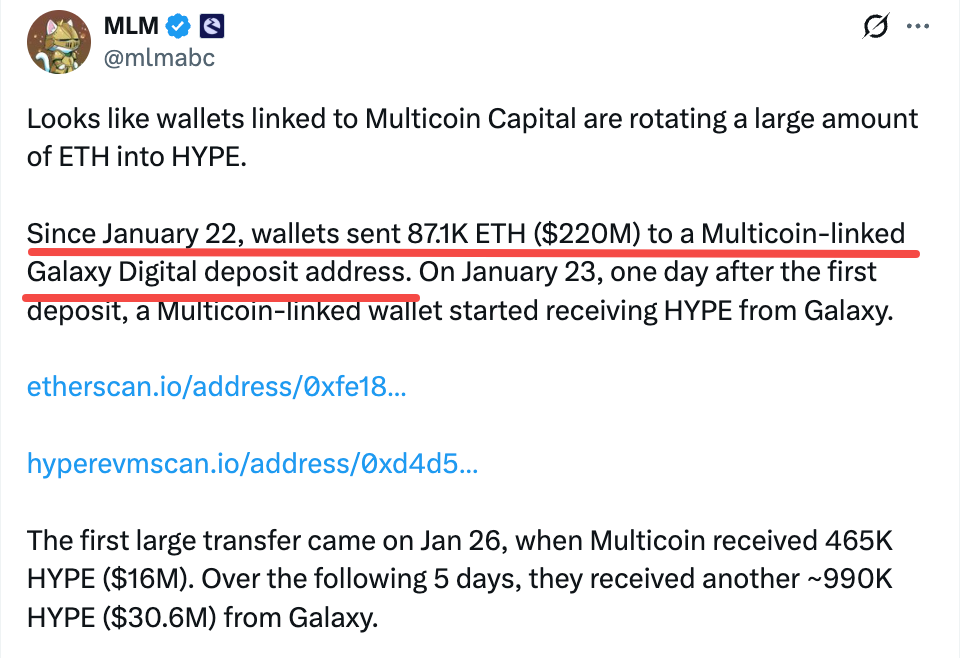
Starting January 22nd this year, on-chain analysts discovered that a wallet suspected to be linked to Multicoin deposited approximately 87,000 ETH to Galaxy Digital. The next day, it began buying HYPE in 17 batches, totaling around $46 million.
In other words, around the time Kyle was leaving Multicoin, his former fund was making a large-scale investment in the project he had just lambasted.
The 17 batch purchases strongly suggest that someone inside Multicoin made a judgment call and committed capital.
Kyle thinks Hyperliquid represents all the problems of crypto, but at least someone at Multicoin thinks it's worth voting for with real money. Holding it is an attitude in itself.
Kyle left, but his old firm's money might have taken a seat. And it sat at the very table Kyle despises the most.
Beyond the Arthur-Kyle showdown, the reactions in the comments are also interesting.
A Hyperliquid community member named Max dug up an old post he made in September 2024. The context of that post was that people were questioning Multicoin's operations in the space. Max criticized Multicoin back then, essentially saying:
"You're always trying to use LPs' money to chase the beta returns of your own heavily invested assets, while also giving your portfolio a lift."
A year and a half later, with Kyle now criticizing Hyperliquid, Max believes the pattern hasn't changed:
Kyle is still the same Kyle, always viewing criticism through the lens of his own portfolio. Defending Solana back then, souring on Hyperliquid now—the root lies in Multicoin's ecosystem interests and competitive anxiety.
Kyle couldn't resist and replied with a characteristically crypto "wealth flex": The amount of money I have directly invested in crypto is at least 10 times the total amount you will ever have in your lifetime.
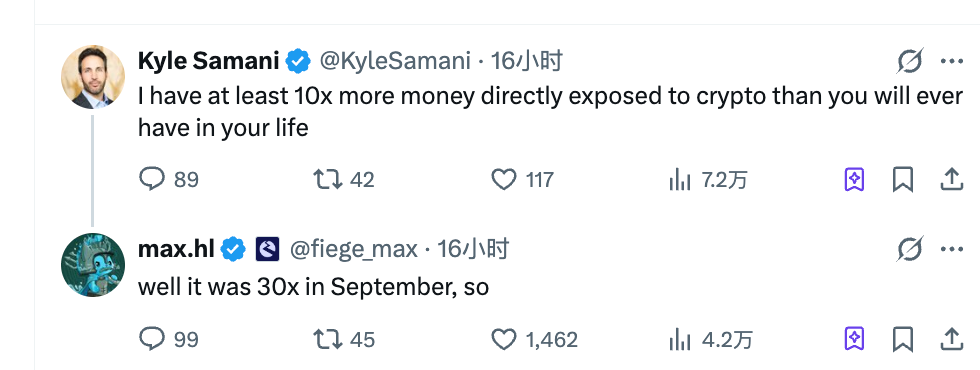
And Max delivered a precise counter: In September last year, your assets might have been 30 times mine...
From September 2025 to February 2026, the market experienced several ups and downs. The crypto assets of Multicoin, which Kyle previously represented, have clearly shrunk significantly; meanwhile, Hyperliquid has remained relatively resilient.
Positioning is never separate from portfolio.
When a project begins to threaten the traffic and valuation of an existing ecosystem, criticism is often quickly labeled as "conflict of interest"; conversely, defenders counter with "you're just jealous."
This time, Kyle tried to attack Hyperliquid from the high ground of morality and decentralization purity, only to be easily pulled back into the jungle law of "whoever made money is right" by his opponent.
In the end, rational discussion drowns in tribal revelry, leaving behind only screenshots and memes.
Every cycle is like this. Some sit down, some stand up. Those sitting talk about price, those standing talk about morality.
But whether one becomes disillusioned with the industry first and then sees the problems, or sees the problems first and then becomes disillusioned, the sequence is actually unclear.
Regardless of whether HYPE rises or falls five months from now, Kyle probably won't care. He's already looking at other things.