






Will "Assets Dormant for Three Years" Be Confiscated? Understanding the Truth Behind California's New Bill SB 822


- Core Viewpoint: The California bill regulates dormant crypto assets; it is not about arbitrary confiscation.
- Key Elements:
- Applies only to accounts on centralized exchanges with no activity for three years.
- Mandatory notification is required before asset transfer, and assets are not liquidated for 18-20 months after transfer.
- Self-custody wallets and on-chain assets are not affected by this bill.
- Market Impact: Promotes exchange compliance and clarifies user asset protection rules.
- Timeliness Note: Long-term impact.
Original | Odaily (@OdailyChina)
Author | Ethan (@ethanzhang_web3)

Recently, discussions within the crypto community regarding "California officially seizing dormant exchange account assets" have intensified. Don't panic just yet. Upon closer examination, you'll find this is actually the delayed amplification of an "old news" story.
The bill, known as SB 822, was actually signed by California Governor Newsom as early as October 2025 and is set to take effect in 2026. Its essence is to formally replicate the "dormant account management system" that has operated in the traditional banking system for decades (officially called the Unclaimed Property Law, or UPL) into the crypto world.
However, there are far too many misinterpretations and panics within the community, with many mistakenly believing that simply "hodling without moving" will lead to seizure. Odaily will clarify for readers in this article: Who exactly does this bill govern and who does it not? Is the so-called "regulatory takeover" a pitfall or protection? As ordinary investors, how can we take simple actions to securely safeguard our coins.
Core Mechanism: When "HODL" Turns into "Lost Contact," How Does the Three-Year Rule Operate?
According to the provisions of the SB 822 bill, if a digital asset account shows no "indication of owner interest" for three years, and communications sent by the exchange are returned or undeliverable, the asset will be deemed "unclaimed" and trigger the escheatment process.
This sounds terrifying, as if simply being a long-term holding "diamond hands" will lead to asset seizure. But that's not the case. The bill's definition of "indication of owner interest" is extremely broad, which actually constitutes the first line of defense for active users.
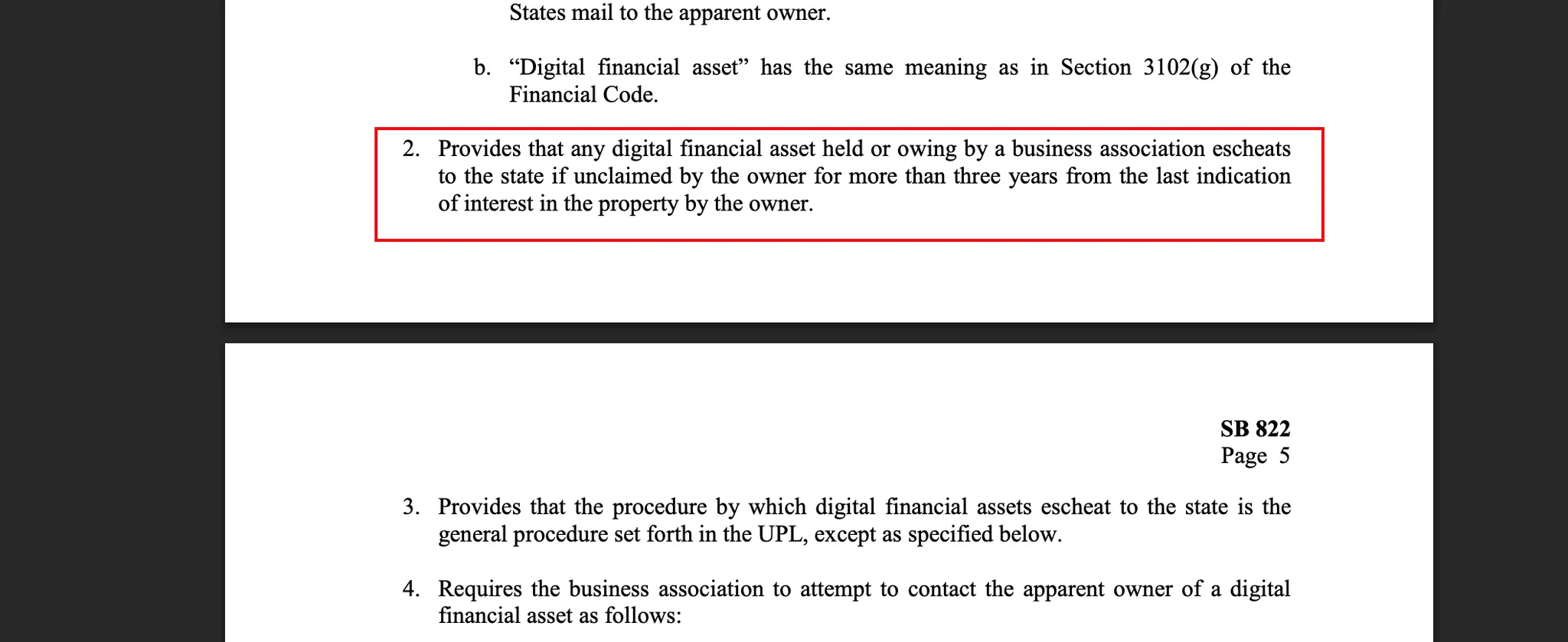
Original text of SB822 bill
The so-called "indication of owner interest" is not limited to on-chain transfers or crypto-to-crypto trades. According to the bill's text, the following actions are all considered proof that you still control the account, which can directly reset the three-year countdown:
- Logging into the account: Even if you just open the app to check your balance, or log in once via the web interface, it counts as an "electronic access," sufficient to reset the timer.
- One-time or recurring transactions: Whether buying, selling, depositing/withdrawing fiat, or even an automatic deduction from a recurring investment plan you set up years ago executing once, it counts as activity.
- Cross-account activity: If you have multiple accounts on the same exchange (e.g., a spot account, an earn account), as long as you have activity on one of them, other linked accounts will also be considered active.
- Simple communication: Sending a customer service email, or clicking a confirmation link in a query email received from the exchange, qualifies as an "indication of owner interest."
This means that unless you are completely out of contact—neither logging in, nor trading, nor responding to any emails or notifications—your assets will absolutely not be transferred without warning.
Is There a Warning Before "Escheatment"?
To prevent users from having their assets escheated due to forgetfulness, the SB 822 bill establishes a clear mandatory notification procedure.
According to the regulations, the exchange, as the asset holder, must send a notification to the user 6 to 12 months before reporting the asset to the state government. This notification is not a regular user agreement update; its format has strict legal requirements. The top of the notice must be prominently written in bold: "The State of California requires us to notify you that your unclaimed property may be transferred to the State if you do not contact us."
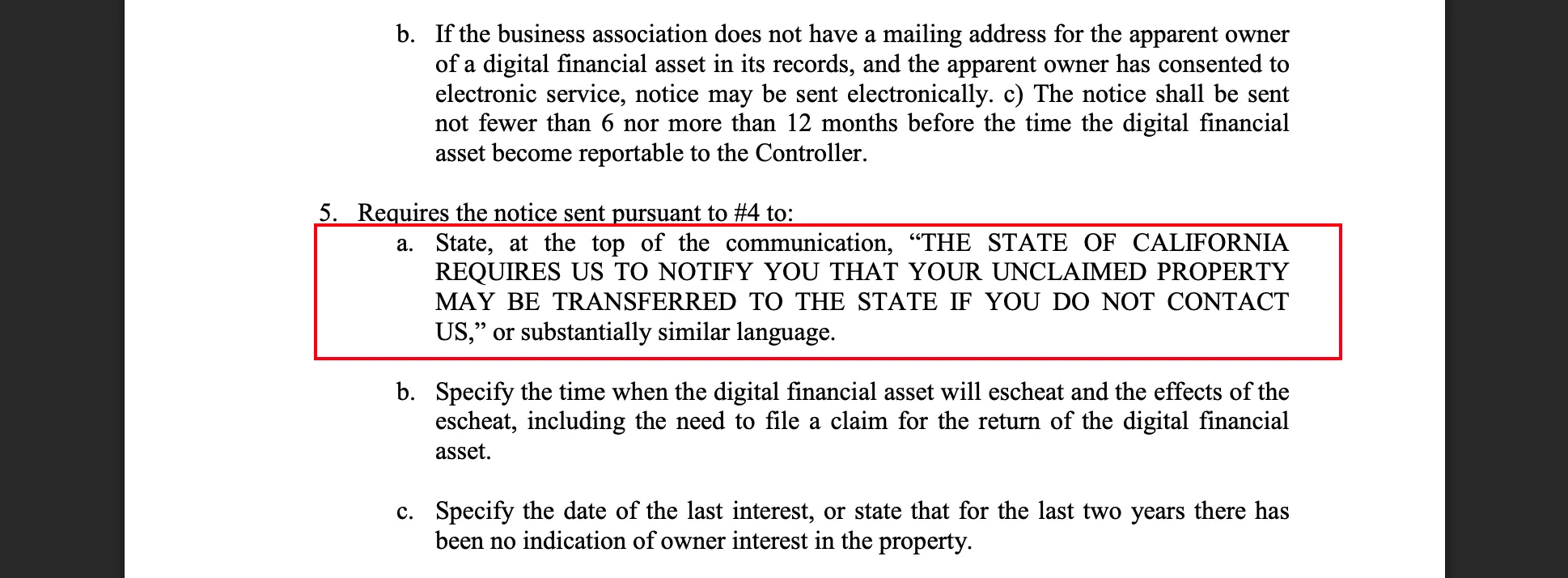
Original text of SB822 bill
Furthermore, the notice must include a form prescribed by the State Controller's Office. The user only needs to fill out and mail back this form, or contact the exchange via phone, online chat, etc., to confirm their identity, and the account's dormant status will be immediately lifted, and the so-called three-year countdown will also reset to zero.
The Biggest Misconception: Does Transfer Equal "Forced Liquidation"?
Before SB 822's implementation, the community's biggest concern was that assets would be forcibly sold off after transfer, like traditional securities. However, SB 822 explicitly prohibits immediate forced liquidation, making California the first state in the U.S. to legislate the protection of unclaimed crypto assets for "transfer-in-kind." Here, "in-kind" includes the asset itself and the associated private keys.
To achieve this operation, the bill even details the handling of "private keys." If an exchange only holds partial private keys (e.g., a multisig wallet), the bill requires it to attempt to obtain the remaining keys within 60 days; if ultimately unsuccessful, the exchange must continue to maintain the asset until transfer conditions are met, thereby technically avoiding asset loss.
Going further, after assets enter the state's custodial account, they will enjoy a protection period of 18 to 20 months. During this time, the state government typically will not sell the assets, and the original owner can still apply to reclaim the original quantity of tokens. Only after this protection period ends does the state government have the authority to liquidate them.
Who Will Be the Custodian?
Facing the massive demand for digital asset custody, the SB 822 bill authorizes the State Controller to select one or more "qualified custodians" to manage these assets. These custodians must hold a valid license issued by the California Department of Financial Protection and Innovation (DFPI) and must meet a series of strict standards, including:
- Security Level: Must possess top-tier cybersecurity measures and private key management capabilities.
- Compliant Status: Must qualify as a "financial institution" under the Bank Secrecy Act, bearing anti-money laundering obligations.
- Industry Experience: Possess proven experience in handling digital assets (e.g., institutional service providers like Coinbase Custody or Anchorage Digital).
Are Cold Wallets Affected?
In community discussions, many experienced players are most concerned about: Are my cold wallets where I hold the private keys affected? Are my LP tokens in Uniswap affected?
The answer is clear: They are not affected.
The bill's regulatory target is defined as the "Holder," meaning the third-party centralized institution with control over the assets. Since self-custody wallets are directly controlled by the user's private keys, there is no third party that can report or transfer assets to the government. As long as the private keys are in your own hands, the assets fall outside the jurisdiction of this bill.
Furthermore, the bill makes precise distinctions regarding "digital financial assets," explicitly excluding in-game virtual currency, commercial loyalty/reward points (like airline miles), and tokens already registered as securities with the SEC, avoiding over-regulation.
Practical Guide: How to Reclaim Transferred Assets?
As mentioned earlier, even if assets have been transferred to the state's name, the property rights of the original owner and their lawful heirs do not disappear, and the right to file a claim with the California State Controller's Office has no time limit. The specific claim outcome depends on the timing of the application: if applied for before the asset is liquidated (i.e., within the 18-20 months after government receipt), the owner can reclaim the original quantity of cryptocurrency; if applied for after liquidation, they can only reclaim the net cash proceeds from the asset sale.
It is important to be vigilant here, as with the bill's生效, fraudulent intermediaries offering claim services may appear on the market. The California State Controller's Office website (sco.ca.gov) is the only official channel for inquiry and claims, and the process is free of charge. Any request for an upfront fee to "unfreeze" assets carries a high risk of fraud.
How to Avoid Custodial Risk?
The core of avoiding SB 822 risk lies in periodically breaking the account's silent status. Since the bill's trigger is "three consecutive years of inactivity," long-term holders only need to perform simple indications of owner interest regularly. For example, logging into the exchange account once a year, clicking to view the balance, or conducting a very small transaction. These actions will be recorded by the system as active status, thereby causing the three-year countdown to restart.
For users holding large amounts of assets, the most thorough solution is to withdraw assets to a non-custodial wallet. Once assets leave the exchange and enter a cold wallet where you control the private keys, they no longer fall under the bill's definition of "custodial assets," thus being exempt from the Unclaimed Property Law's jurisdiction at the root. This not only avoids policy-driven transfers but also defends against potential misappropriation or collapse risks of the exchange itself (think of the FTX lesson).
Additionally, there is a frequently overlooked angle: estate planning. Often, assets become "unclaimed" because the holder passes away unexpectedly, and family members are completely unaware of this digital wealth. SB 822 objectively provides an administrative safety net mechanism for these accidentally lost digital assets. Therefore, acting responsibly towards family wealth, creating a memo detailing asset locations and properly informing family members ensures that in extreme cases, family can search through official channels and reclaim these digital inheritances.
Conclusion: The Double-Edged Sword of Compliance
The enactment of the SB 822 bill is undoubtedly another milestone in the process of crypto assets moving towards mainstream adoption. It grants digital assets legal status equivalent to bank deposits and stocks, offering special treatment particularly in preventing forced liquidation. This move also signifies that regulators are genuinely acknowledging the unique attributes of crypto assets and striving to find a balance between protecting consumer rights and adapting to technological characteristics.
At first glance, the state government's action might seem like "meddling," but delving into its underlying logic reveals it is actually a powerful constraint on third-party custodial power. Without a mature legal framework for establishing rights, the massive wealth lying dormant due to forgetfulness, accidents, or user disconnection could ultimately become the exchange's "private property."
The SB 822 bill, through administrative safety net measures, establishes a permanent "lost and found" for digital assets, successfully pulling personal wealth that might otherwise vanish due to platform shutdowns back within the red line of legal protection.


