






Predicting the market's endgame: Only one can remain, public blockchains are placing their bets in advance.


- 核心观点:预测市场正成为公链争夺的下一类基础设施。
- 关键要素:
- DeFi增长放缓,Meme情绪衰减,需新增长载体。
- 预测市场具备高频、持续、非情绪依赖的交易需求。
- 公链通过扶持龙头,争夺链上预期的定价权。
- 市场影响:推动公链竞争从协议数量转向预期定义能力。
- 时效性标注:中期影响。
1. Why is it predicted that the market will become a new growth driver in 2024–2025?
The collective surge in prediction markets is not an isolated event, but rather occurs at a clear cyclical turning point: DeFi growth has entered a phase of zero-sum game, the emotional drive of memes has begun to decline, and public chains and capital are rediscovering high-frequency, sustainable, and non-emotionally dependent application models.
The emergence of this round of prediction markets is not essentially a "new way of playing," but rather a shift in narrative and demand structure .
1.1 DeFi: The scale remains, but the potential for "new growth" is shrinking.
Entering 2024–2025, DeFi did not decline, but its growth pattern has changed significantly.
Funds and users are highly concentrated in leading protocols , with a strong head effect observed in new active addresses and transaction fee contributions, while the marginal contribution of long-tail protocols to overall growth continues to decline. Meanwhile, DeFi is experiencing severe involution —whether it's restaking, LRT, or yield aggregation—essentially still revolving around the redistribution of risk and return around the same core assets, rather than introducing new incentives for participation.
From a blockchain perspective, this trend is highly consistent. This does not mean that DeFi has failed, but rather that it has completed the phased construction of "financial infrastructure" and entered a mature stage focused on efficiency optimization and competition for existing resources.
Such a system naturally has limited appeal to new attention and new users.
1.2 Meme: The emotion remains, but it no longer has the capacity to sustain the cycle.
Meme was once the most explosive sector in 2024, but in 2025, its structural problems began to emerge.
First, the price discovery cycle is drastically compressed , with consensus forming for most memes in a very short time, and subsequent transactions quickly degenerate into a zero-sum game. Participant behavior shifts from "forming consensus" to "rushing to exit."
Secondly, the marginal effect of chain-level incentives has significantly decreased . Memes can boost active addresses and transaction volume in the short term, but they are difficult to cultivate a developer ecosystem, retain users long-term, or build platform brand loyalty. After several meme cycles, public chains have become noticeably more cautious about investing resources in this model.
Memes haven't disappeared, but their role has degenerated from a "growth engine" to a cyclical emotional tool , making it difficult to continue supporting ecosystem-level growth expectations.
1.3 Market Prediction: From "Demand Established" to "Being Selected by the Platform"
As the marginal effects of DeFi and Memes decline simultaneously, the prediction market has achieved self-consistency on the demand side.
It doesn't rely on a single market cycle, nor does it require continuous emotional stimulation. Instead, it generates trading motivation naturally based on events that occur in both the real world and the on-chain world. This makes it one of the few sectors that can maintain activity even in a low-volatility environment .
At the same time, prediction markets are not lightweight applications:
- High-frequency settlement requires stable on-chain throughput and low latency.
- Multi-event parallel pricing relies on continuous liquidity and composability.
- Settlement of real-world results is highly sensitive to security and credibility.
Once scaled up, prediction markets inevitably become deeply coupled with the performance, fee structure, and infrastructure of public blockchains. This also means that prediction markets cannot remain "unaware of the blockchain" indefinitely—they will naturally be incorporated into the strategic vision of platforms.
2. Why is each blockchain supporting its own prediction market leader?
If the first chapter answers the question "Why did prediction markets emerge in this cycle?", then the more crucial question is: Why did almost all mainstream public blockchains choose to bring prediction markets to the forefront at the same time?
Solana, Ethereum L2, Base, Arbitrum, Optimism, and emerging modular chains are almost all explicitly supporting an "ecosystem-level prediction market," providing structural advantages through funding, traffic, and product integration. This is not a bet on a single application, but rather a collective judgment made by public chains in the current cycle on "what kind of applications are worth becoming infrastructure-level components."
2.1 Prediction markets are not an application innovation, but rather the next type of "basic trading need".
From the perspective of public blockchains, prediction markets possess a rare combination of attributes: high frequency, continuous operation, multiple events, and non-one-way consensus .
DeFi interactions are highly dependent on market fluctuations; memes rely on emotional outbursts; and the trading motivation for predicting the market comes from the judgment itself.
The event will not stop:
- Macroeconomic policies, elections, and regulatory changes;
- On-chain upgrades, token issuance, and governance voting;
- Protocol parameter adjustments and systemic risks.
These events inherently possess continuity and uncertainty, forcing users to repeatedly express their stances and constantly revise their judgments. For public blockchains, this means that prediction markets are not about creating one-off events, but rather about building a long-term, operational judgment engine on the blockchain.
During market downturns, it provides basic trading density; during market upturns, it amplifies trading intensity. Following DeFi and Memes, prediction markets have become one of the few application formats that can still simultaneously carry information, sentiment, and capital .
2.2 The support provided by public blockchains to market leaders is essentially a competition for "on-chain pricing power over predictions."
Prediction markets are not applications that can coexist, but rather infrastructure where only one can win .
Once liquidity is dispersed, prices become distorted; distorted prices lead to rapid user migration . Therefore, prediction markets naturally follow a single-point convergence logic, rather than the coexistence of multiple protocols. This means that for public blockchains: supporting multiple prediction markets is equivalent to voluntarily relinquishing pricing power; clearly betting on a leading market is equivalent to building an in-chain expected pricing center.
More importantly, what predicts market competition is not trading volume, but cognitive density . It transforms opinions into positions, compresses emotions into prices, and condenses scattered judgments into signals that everyone must face.
When a blockchain has a stable prediction market, it gains more than just a financial product; it gains an on-chain expectation system: odds are checked before project launches, risk changes are reflected in prices before governance decisions are made. This is why prediction markets have evolved from "ecosystem applications" to cognitive infrastructure . Furthermore, competition among public blockchains is shifting from "who has more protocols" to "who can define future expectations."
3. Who is likely to survive? Three screening criteria for "de-bubbling"
A truly predictive market capable of navigating cycles must complete three leaps.
Based on three dimensions—product stability, compliance acceptance, and ecosystem building—a quick assessment of Polymarket, Limitless, Opinion Labs, Kalshi, and Probable reveals that Kalshi andPolymarket have the highest certainty of survival, Opinion Labs offers differentiated opportunities, and Limitless and Probable carry significantly higher risks.
3.1 Product performance stability (survival basis)
The core factors are the maturity of the technical architecture, the reliability of transactions and settlements, and the system's ability to withstand risks, which directly determine user trust.
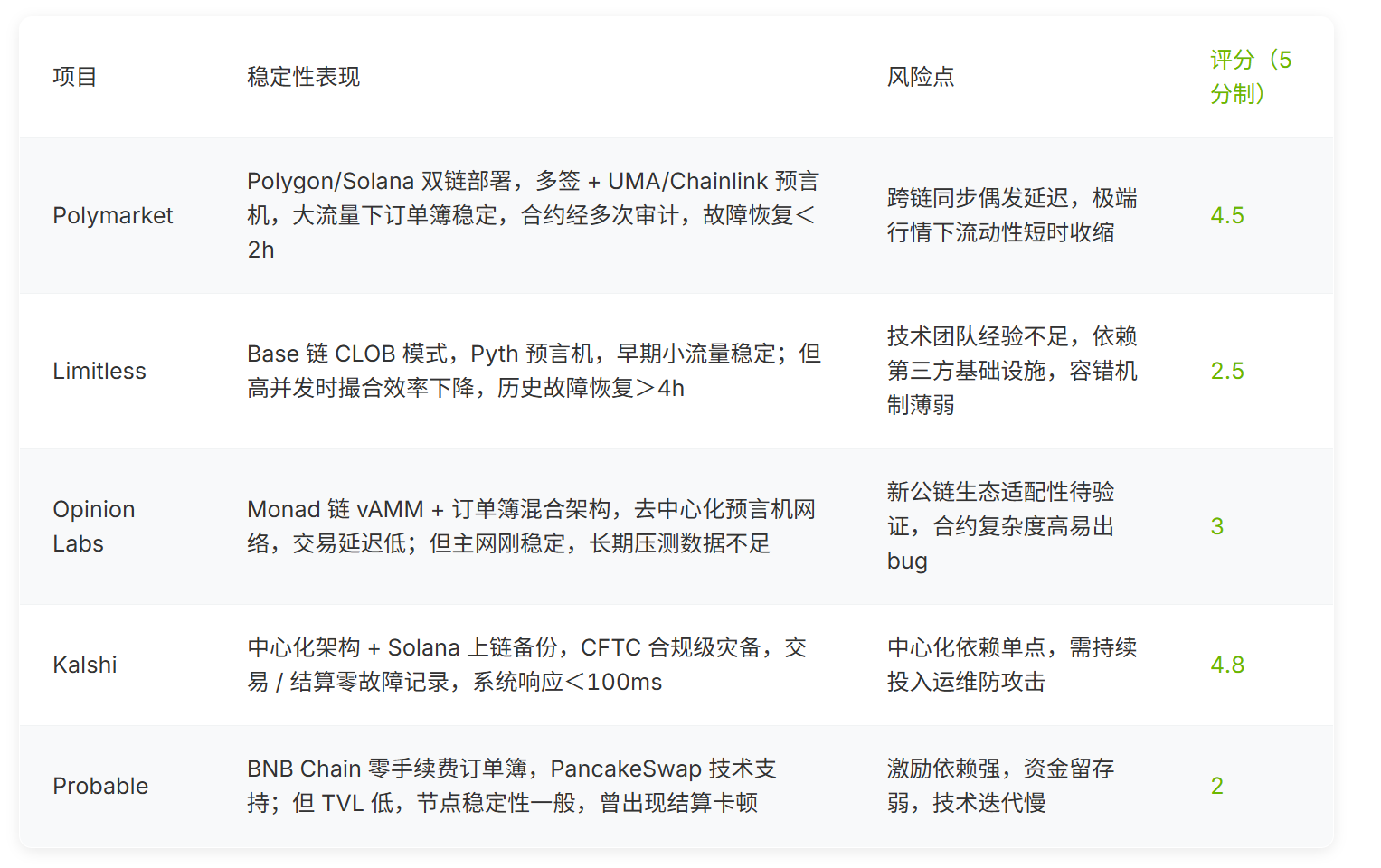
Conclusion: Kalshi > Polymarket > Opinion Labs > Limitless > Probable. Centralized, compliant platforms have an advantage in stability, while emerging blockchain projects lack technological maturity.
3.2 Compliance and Global Recognition (Lifeline for Survival)
Compliance is not a bonus, but a determining factor in business boundaries.
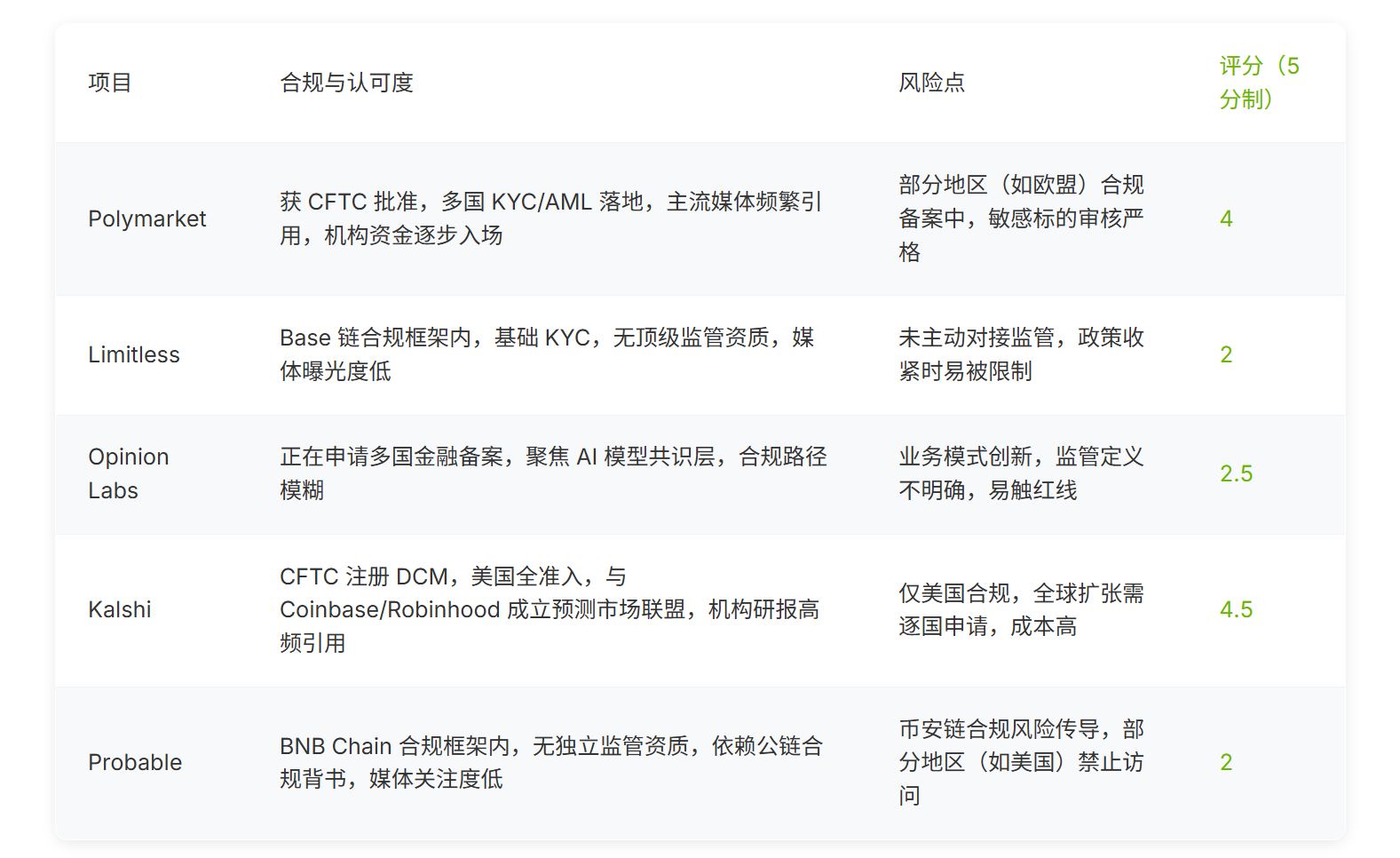
Conclusion: Kalshi > Polymarket > Opinion Labs > Limitless ≈ Probable. Compliance qualifications are the core barrier to long-term survival; projects without regulatory backing are extremely risky.
3.3 Ecosystem Setup (Survival Amplifier)
The real barriers to entry come from a genuine user base, a stable liquidity network, and long-term partnerships.
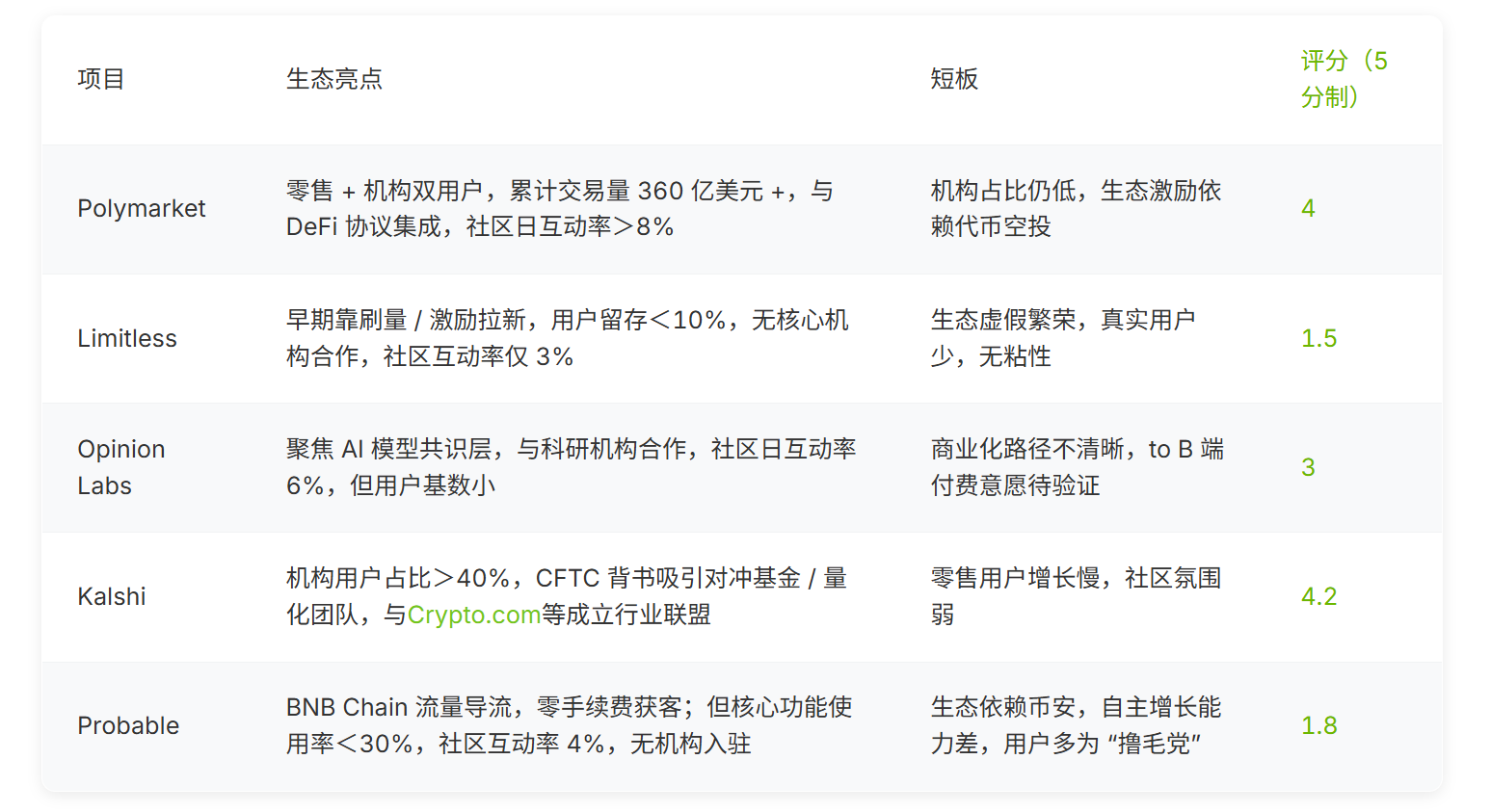
Conclusion: Kalshi > Polymarket > Opinion Labs > Limitless > Probable. An institutional and real-user ecosystem is key to sustainable growth; incentive-driven ecosystems are prone to collapse.
In summary
- Those destined to survive : Kalshi (compliance + stability + perfect closed loop of institutional ecosystem), Polymarket (dual-chain + compliance + retail ecosystem, strong fault tolerance).
- Opinion Labs has a chance to survive (AI consensus layer differentiation; if it is implemented in compliance with regulations and grows in user base, it can capture a niche market).
- High-risk elimination : Limitless (weak in both technology and compliance, and a fake ecosystem) and Probable (reliant on incentives and traffic, with no core barriers).
Recommendations: Prioritize investments in Kalshi/Polymarket; monitor Opinion Labs' compliance progress; avoid purely incentive-driven projects such as Limitless/Probable.
Prediction markets are a newly activated on-chain sector. Ultimately, who survives depends on the background and the operators. These are the key factors for ultimate victory. As the saying goes, ants can eat an elephant. The above suggestions are only some conclusions based on the current situation. The prediction market sector is huge, and many more projects will emerge in the future.
4. Conclusion: Prediction markets are becoming the next layer of infrastructure.
The prediction market's warming up in 2024–2025 is not a short-term narrative shift, but rather a structural choice by the crypto ecosystem to meet the "demand for sustainable transactions" after DeFi matures and meme sentiment fades.
Unlike sectors that rely on market trends and sentiment, prediction markets are event-driven, characterized by high frequency, continuity, and non-unidirectional consensus. This allows them to maintain activity during periods of low volatility and amplify trading intensity during periods of high volatility. Furthermore, their requirements for throughput, latency, liquidity, and settlement reliability naturally align them deeply with the underlying capabilities of public blockchains, leading platforms to elevate them to a strategic level.
This is why prediction markets are evolving from "ecosystem applications" to cognitive infrastructure : they compress fragmented judgments into price signals, becoming a crucial entry point for on-chain expectation formation and risk forecasting. For public blockchains, supporting a leading prediction market is essentially about vying for pricing power over on-chain expectations, rather than chasing short-term trading volumes.
Under this structure, competition in the prediction market will not be a long-term multi-polar competition. Projects that ultimately survive will inevitably possess stable products and settlement systems, sustainable compliance boundaries, and an ecosystem network comprised of genuine users and liquidity. Incentives and inflated metrics can generate buzz, but they cannot replace trust and structural advantages.
The divergence in the prediction market will ultimately depend not on who grows faster, but on who can become the long-term operating on-chain expectation center . What we are seeing now is only the beginning, not the end.


