






Four key words to herald the four seasons of Cryoto in 2025.


- 核心观点:2025年加密市场受特朗普政策主导,波动剧烈。
- 关键要素:
- 特朗普就职推动监管明朗化与TRUMP币暴涨。
- DAT财库公司热潮兴起但后续普遍亏损。
- 10月关税政策引发史诗级暴跌,清算超300亿美元。
- 市场影响:政策与情绪主导市场,加剧波动与风险。
- 时效性标注:中期影响。
Original article by Odaily Planet Daily ( @OdailyChina )
Author/ Wenser ( @wenser2010 )
2025 is drawing to a close. Standing at the end of what has been a "major year for crypto mainstreaming," it's time to summarize the four quarters of this year with some keywords, and to get a glimpse into how cryptocurrencies have gradually penetrated and transformed the world.
The crypto world in 2025 experienced numerous ups and downs: from Trump's inauguration as US president in early January to the US launching a tariff trade war in April; from Strategy leading the DAT treasury company trend and once generating hundreds of billions of dollars in profits, to the flourishing and subsequent stagnation of ETH, SOL treasury companies and even altcoin treasury companies; from stock tokenization platforms being seen as "the best combination of DeFi and TradeFi," to Nasdaq's self-revolution to join the stock tokenization craze; from the wealth-creating frenzy sparked by on-chain Perp DEXs like Hyperliquid and Aster, to the prediction market duopoly Polymarket and Kalshi with valuations exceeding tens of billions of dollars; from the GENIUS stablecoin regulatory bill to the stablecoin craze where PayFi was always mentioned; from crypto IPOs to crypto ETFs. Normalization... Amidst the struggles, battles, and reconciliations of countless funds, attention, and regulatory forces, amidst numerous wealth-creating projects, memes, and hacking incidents, amidst frenzied FOMO, new highs, and rushing to buy, amidst extreme fear, massive crashes, and black swan events, the cryptocurrency industry, like a mature tree, has added another ring to its tree.
Behind the relentless flow of money lies the fluctuating fortunes of Memecoin players, the financial struggles of ATM collectors, Wall Street's massive acquisitions, and the lenient approval of US regulators. This year is somewhat complex—it's neither a complete bull market nor a bleak bear market. Compared to the previously distinct hot and cold, sector-rotating crypto market, the 2025 crypto industry, influenced by Trump and numerous authoritarian government forces, resembles a monkey leaping about; some have fallen from grace, while others have risen to prominence. As for the successes and failures, perhaps our upcoming "2025 Crypto Investment Memoir" will reveal more answers.
In this article, Odaily Planet Daily will use four quarterly keywords to review Crypto 2025.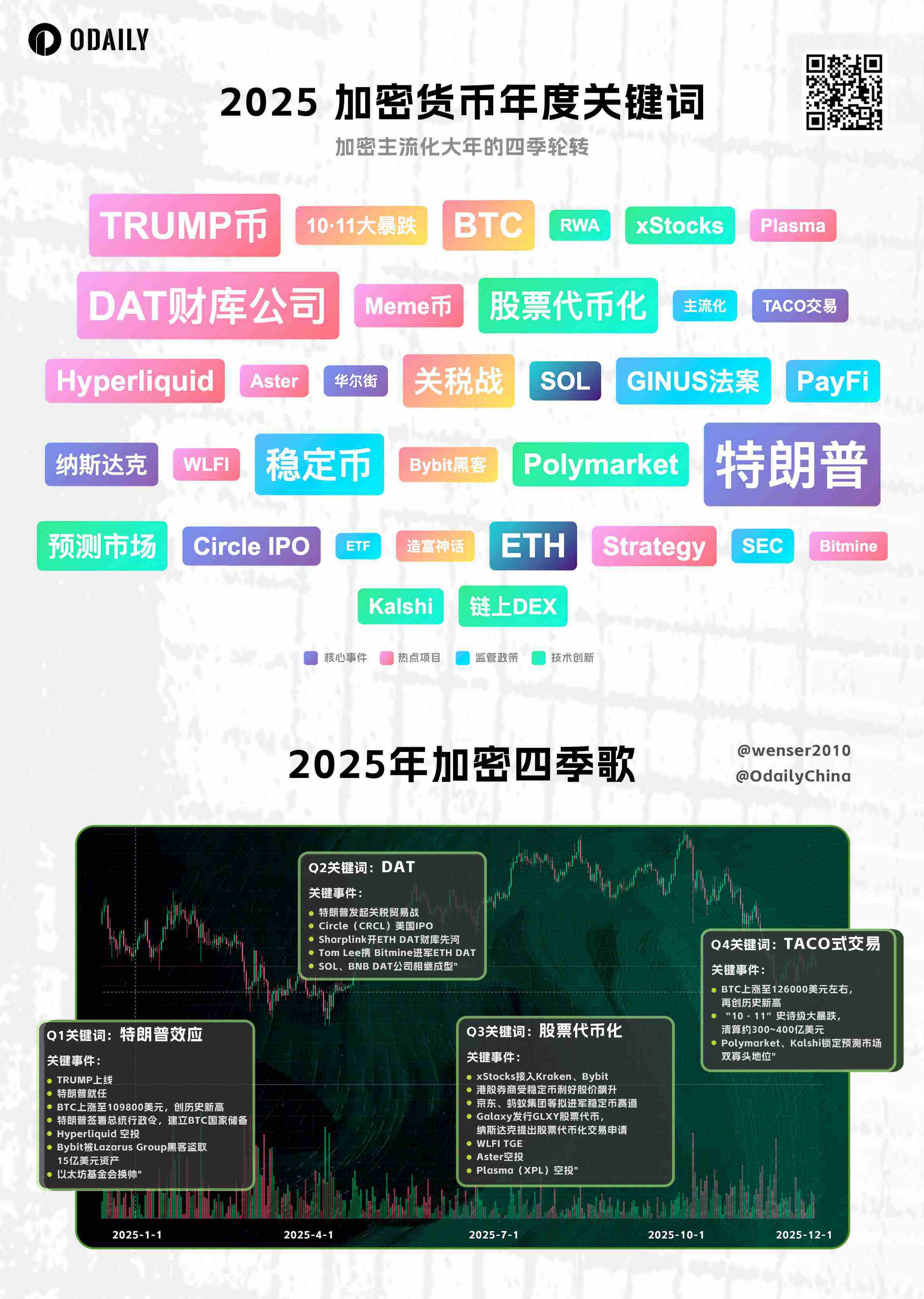
Crypto Spring: The Trump Effect Continues, Trump Creates Wealth, and the Crypto Regulatory Framework Becomes Clearer
In January, Trump was officially inaugurated as President of the United States.
Following the momentum that followed Trump's election victory last year, the cryptocurrency market, after a brief period of consolidation, saw the price of BTC once again approach the $100,000 mark.
Just three days before Trump took office, Trump, touted as the "official Trump Meme coin," unleashed the first wave of wealth creation this year on numerous crypto participants.
I still vividly remember that morning when my colleague first shared the Trump token contract. Its total market capitalization (FDV) was only around $4 billion. Amidst doubts such as "Was Trump's account hacked?", "Does the US president dare to issue a cryptocurrency?", and "Is Trump trying to make a final profit before becoming president?", Trump's total market capitalization soared, quickly breaking through $10 billion, $30 billion, and eventually reaching over $80 billion.
In this astonishing wealth-creation frenzy, many Chinese-language meme players have made a fortune, with some earning millions or even over $20 million. For a list of Trump traders who have made a fortune, we recommend reading "Who are the Trump traders who have profited over a million dollars? Winning KOLs and Disappointing ETH Maxi" .
This marks the second wave of growth in the crypto market, following Trump's election as US president in November 2024, driven by his personal influence.
Soon, the crypto market also presented its own "gift" to Trump's inauguration as US president - on January 20, a month later, BTC broke its all-time high again , with the price rising to $109,800.
At the time, everyone regarded Trump as the undisputed "first crypto president." Perhaps many people did not realize then that "the people can make or break a crypto market," and what Trump brought to the crypto market was not only favorable macro policies and regulatory environment, but also a series of controversies, exploitation, and repeated fluctuations brought about by his family's crypto projects.
On the other hand, the key to the "Trump effect" lies in whether his inauguration can directly improve the US cryptocurrency regulatory environment.
Firstly, it's about whether it can bring clearer boundaries and more favorable rules to crypto regulation through legislation and executive orders. In this regard, Trump has gradually fulfilled some of his promises, including replacing the SEC chairman with Paul Atkins, appointing David Sacks as White House AI and cryptocurrency director, and pushing for the passage of the GINUS stablecoin regulatory bill.
Secondly, there's the "BTC national strategic reserve," a topic of great interest to the crypto market and many crypto-friendly politicians. In early March, Trump signed an executive order to establish a U.S. Bitcoin strategic reserve using previously confiscated BTC assets. He specifically emphasized that it "would not increase the burden on taxpayers." For more details, we recommend reading the article "Trump Establishes BTC Strategic Reserve as Promised, But Is the Funding Purely from Confiscated Assets?"
Nevertheless, the final verdict on Polymarket that "Trump will establish a national strategic reserve of BTC within 100 days of taking office" was "No" (Odaily Planet Daily note: the reason being that the rules of the betting event stated that assets confiscated by the US government do not belong to the BTC reserve) still frustrated many people, with many even calling it a "scam website" in the comments section of the event.
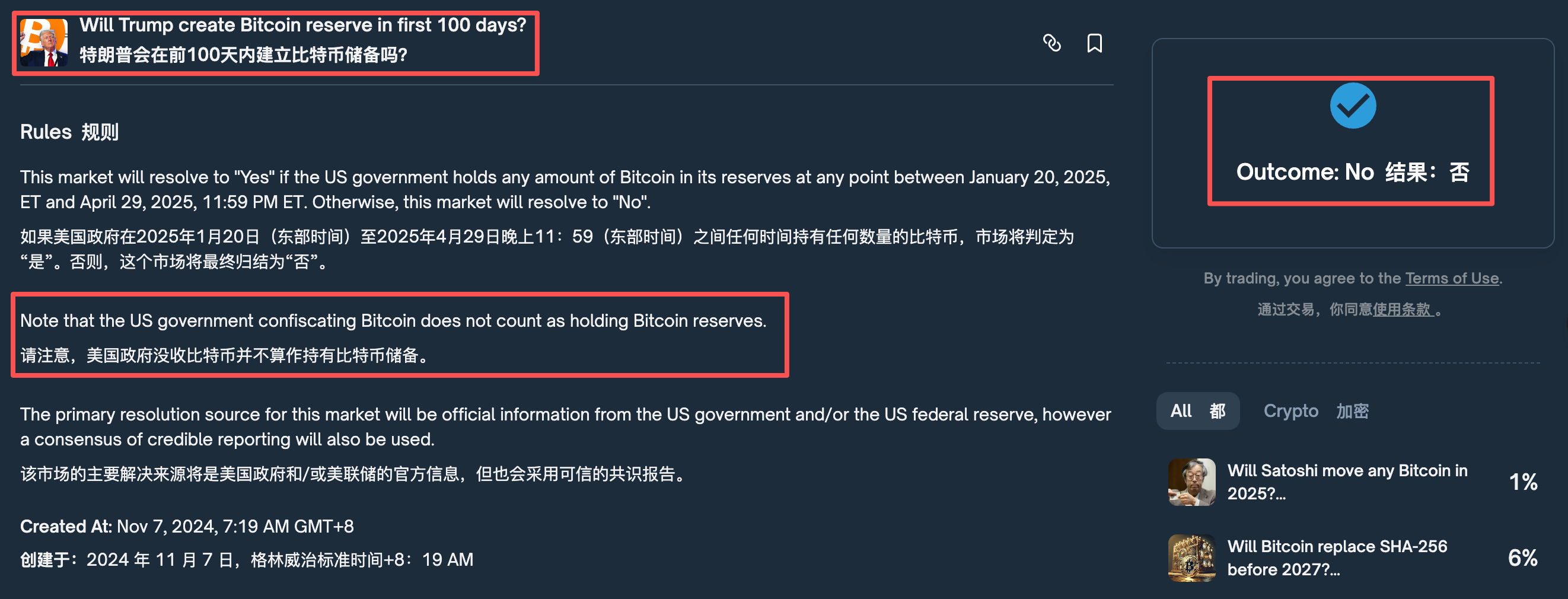
Polymarket betting event rules information
At that time, the "insider whale" had already begun to emerge, with the "50x leverage insider" on Hyperliquid profiting millions of dollars from news such as "Trump establishing a cryptocurrency reserve." For details, please refer to the article "Reviewing the 'Insider Whale's' Slick Operations on Hyperliquid Contracts: Precise Opening and Closing of Long and Short Positions."
This period also saw numerous controversies surrounding Trump, including the "Melania token" incident following Trump and the LIBRA token incident triggered by Argentine President Milley, both considered "masterpieces of the Trump crypto group." In addition, the first quarter of the cryptocurrency market witnessed a series of "historic events," including:
- Hyperliquid's "largest airdrop of the year" has aroused envy among many on-chain players;
- Bybit was attacked by the North Korean hacker group Lazarus Group, resulting in the theft of $1.5 billion in assets .
- The much-criticized Ethereum Foundation has undergone a leadership change, with former executive director Aya promoted to chairman .
The industry did not anticipate that Trump, this disruptive force, would soon demonstrate to the market an American version of "what goes around comes around."
Crypto Summer: DAT Treasury, ETH hits new high, stablecoins take center stage
At the start of the second quarter, the crypto market was hit hard – in early April, Trump launched a global "tariff trade war," which created a tense atmosphere in the global economy, and the US stock market and the crypto market suffered heavy blows.
On April 7th, "Black Monday," the US stock market capitalization evaporated by over $6 trillion in nearly a week, including over $1.5 trillion in market value loss for the "Big Seven" companies, including Apple and Google. After nearly a month of volatility, the cryptocurrency market experienced a delayed but inevitable crash— BTC briefly fell below $80,000, reaching a low of $77,000; ETH fell to a low of $1,540, a new low since October 2023; the total market capitalization of cryptocurrencies fell to $2.6 trillion, a single-day drop of over 9%. Recommended reading : "Deep Dive into the 'Culprit' Behind the Trade War: Over $6 Trillion Evaporated Overnight—Is It All Because of Him?"
It was from that point onward, after months of market downturn and organizational reforms within the Ethereum Foundation, that ETH finally showed some momentum and potential for a rebound. Recommended reading : "A New Broom Sweeps Away: Ethereum Foundation's New Executive Director Reveals Where EF is Heading?"
Meanwhile, riding the wave of Circle's US IPO , stablecoins and PayFi have gradually entered the mainstream of the crypto market, seen by many as the key to "mass adoption of crypto." Recommended reading: "Stablecoins' 10-Year Journey: Finally Becoming the US Officially Designated 'Peer-to-Peer Electronic Cash'" , "The Golden Age of Stablecoins Begins: USDT to the Left, USDC to the Right"
In late May, with an order from Joseph Lubin, co-founder of Ethereum, Consensys, and founder of MetaMask, Sharplink, a US-listed company , transformed from a sports marketing company into the first "ETH Treasury Public Company." From then on, the DAT craze began to sweep across the entire cryptocurrency market , and the price of ETH finally emerged from its continuous decline, successfully breaking through the previous all-time high of $4,800 a few months later, soaring to a high of nearly $5,000.
Subsequently, Tom Lee, the "Wall Street strategist," also joined the "DAT Treasury craze" with Bitmine, a US-listed company. Since then, ETH Treasury companies have become another "crypto landscape" after Strategy led the BTC Treasury companies.
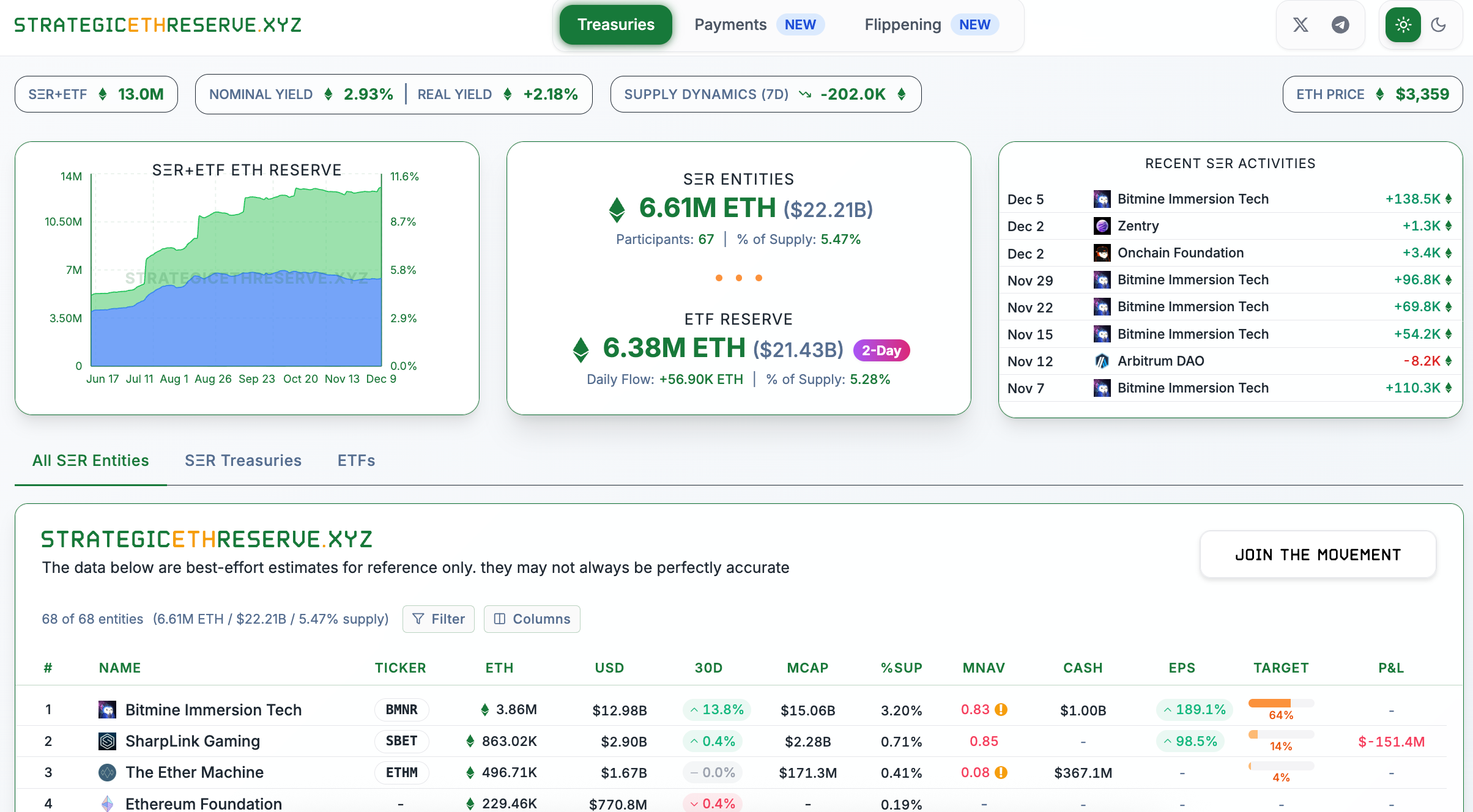
A glimpse of ETH Treasury Company information
As of the time of writing, according to data from the strategythreserve website , the total number of ETH treasury companies has increased to nearly 70, among which,
- Bitmine (BMNR) tops the list with 3.86 million ETH in holdings;
- Sharplink (SBET) holds a solid second position with over 860,000 ETH in holdings;
- ETH Machine (ETHM) ranks third with over 490,000 ETH in holdings.
It is worth mentioning that the ETH holdings of the above three DAT companies all significantly exceed the holdings of the Ethereum Foundation (less than 230,000 ETH).
Following the success of ETH Treasury, companies like SOL DAT , BNB DAT, and a series of altcoin DAT companies have sprung up like mushrooms after rain, with their stock prices fluctuating wildly amidst the clamor of competition.
Having passed through the initial frenzied FOMO phase of the transformation and now that the crypto market has entered a period of calm, ETH DAT companies, represented by Bitmine, are facing billions of dollars in unrealized losses. Meanwhile, DAT treasury companies, including many BTC reserve companies, are facing a situation where their market capitalization is even lower than their crypto asset value due to the lack of real business support. The mNAV (crypto asset/company market capitalization) of dozens of DAT companies has fallen below the level of 1.
The DAT companies in the midst of the crypto summer were jubilant, yet they still didn't quite understand Zweig's saying that "all gifts in the world come with a price tag," and that price was the plummeting stock price.
Of course, just as death often gives birth to new life, as DAT surged forward like oil being poured on a raging fire, the winds of stock tokenization gradually blew into the crypto market and subsequently became an unstoppable trend. Even the Nasdaq, a US stock exchange, could not ignore it and could only join this "feast of capital" in a self-revolutionary manner.
Crypto Autumn: Stock Tokenization, On-Chain Perp DEX and Stablecoin Public Chains in a Dual Battle
After Circle (CRCL) made a strong debut on the US stock market at the end of June and achieved a milestone of "10 times stock price increase", the enthusiasm of the crypto market and the traditional financial market for stablecoins and crypto concept stocks has reached an unprecedented level.
Fueled by positive news, Hong Kong-listed stablecoin and brokerage stocks surged. Numerous internet giants, including JD.com and Ant Group, announced their upcoming entry into the stablecoin market, attracting considerable attention. Recommended reading : "Hong Kong Stock Market's Altcoin Season Arrives: Can Crypto Concept Stocks Support the Bull Market?"
Riding this wave, the RWA sector has finally reached a major turning point – the time is ripe for stock tokenization.
In early July, exchanges Kraken and Bybit announced the opening of tokenized stock trading through the xStocks platform, supporting trading of dozens of tokenized US stocks, including popular US stocks such as AAPL, TSLA, and NVDA. Since then, xStocks, which focuses on the concept of "on-chain US stock tokenized trading platform", has become the sole focus of the market spotlight, and MyStonks (now renamed MSX.com) has also attracted a large number of users and investors.
If the launch of the BTC spot ETF in early 2024 and the ETH spot ETF in July of that year gave cryptocurrency traders the prestigious title of "distinguished US stock traders," then the emergence of stock tokenization platforms this year has truly bridged the "last mile" of on-chain trading of US stocks , and has also given "a lousy crypto trader" like myself the possibility of diversifying asset allocation through on-chain tokenization platforms for the first time.
Odaily Planet Daily previously provided a detailed introduction to xStocks and the underlying mechanisms of tokenized US stock trading platforms in its article "10 Questions about xStocks: What are we actually trading when trading US stock tokens?" Looking back now, its basic principles and asset management model have not changed much. The difference is that, following many US stock tokenization platforms, traditional giants have also begun their own path of awakening.
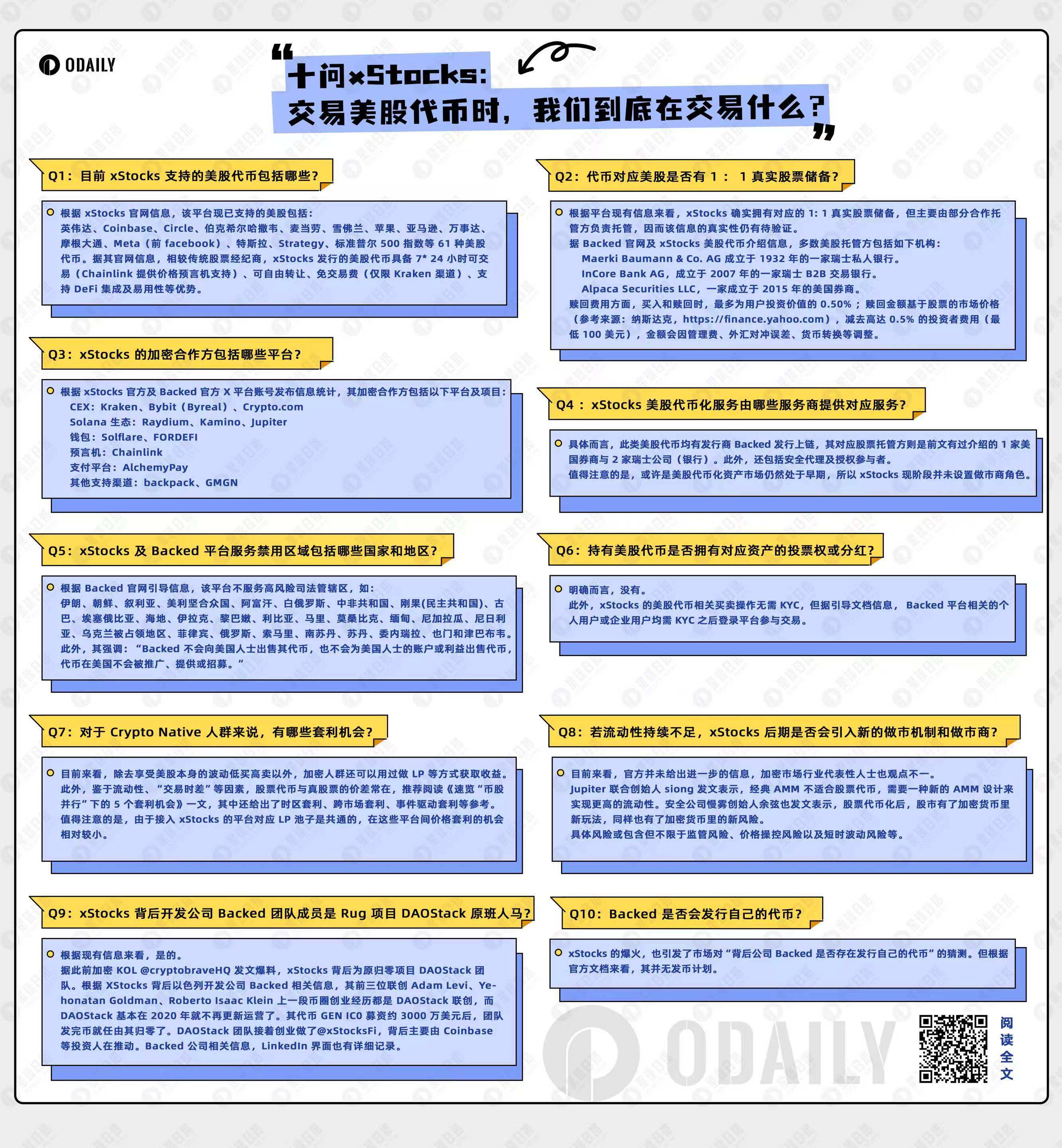
10 Questions about xStocks Overview
First, Galaxy, a crypto asset management giant, took the initiative to issue tokenized shares ; then , Nasdaq, a US stock exchange with a quarterly trading volume of up to 10 trillion, proactively submitted an application to the US SEC for "tokenized stock trading" . In the vast field of asset issuance and trading, traditional giants are not lacking in acumen.
Meanwhile, the crypto-native market boom belongs to two major segments:
First, there was the " on-chain Perp DEX war " following Hyperliquid—Aster in the BNB Chain ecosystem contributed another wealth-creating miracle to the crypto market with an extremely violent "pump and dump" operation, with many people saying they "sold millions of dollars too early."
Secondly, there are two remarkable wealth-creating phenomena in the stablecoin sector: one is the generous airdrops offered by Plasma , which boasts the title of "a stablecoin public chain supported by Tether's CEO," to numerous participants in its "investment savings program." Some even received over $9,000 worth of XPL tokens as a return of over 900 times by depositing just $1. The other is the official launch of WLFI , a crypto project of the Trump family. Leveraging the momentum of its stablecoin USD1, people reaped returns of up to 6 times at the public offering prices of $0.05 and $0.15.
Looking at the prices of XPL and WLFI now is quite disheartening. According to Coingecko data, XPL is currently priced at $0.17, a drop of nearly 90% from its peak of $1.67; WLFI is currently priced at $0.15, a drop of nearly 50% from its peak of $0.33.
At a time when countless people were marveling at the endless opportunities, little did they know that what awaited the crypto industry was an "epic liquidation" far exceeding any crash in history.
Crypto Winter: Following the 10/11 crash, TACO's trading strategy is validated once again, and the prediction market is poised to welcome a giant with a valuation of over 10 billion.
After BTC prices hit a new high of $126,000 in early October, people were hoping that the crypto market could continue its "Uptober" trend of previous years. However, an "epic liquidation" on October 11 shattered all their dreams and hopes.
This time, the trigger was once again Trump – on the evening of October 10th, Trump announced a 100% tariff increase, causing the fear index to surge. All three major US stock indices fell to varying degrees: the Nasdaq fell nearly 3.5%, the S&P 500 fell 2.7%, and the Dow Jones Industrial Average fell 1.9%.
The cryptocurrency market suffered from exchange system problems, coupled with the market's fragile and easily frightened sentiment. BTC hit a low of $101,516, a 16% drop in 24 hours; ETH hit a low of $3,400, a 22% drop in 24 hours; and SOL fell by 31.83% in 24 hours. Altcoins were particularly hard hit.
The losses caused by this epic liquidation far exceed those of previous major crashes such as March 12, May 19, and September 4. The actual liquidation scale in the cryptocurrency market is at least around 30 to 40 billion US dollars.
Of course, risks also present opportunities. As Odaily Planet Daily mentioned in articles such as "Who Made a Fortune Amidst the Crash? What Wealth-Making Opportunities Are Within Reach?" and "The Whale Battle Behind the Biggest Liquidation Day in Crypto History: Short Sellers Leave with Knives in Hand," various "wealth-making opportunities"—whether it's high-leverage short selling or bottom-fishing at low prices—have allowed many to profit from the chaos.
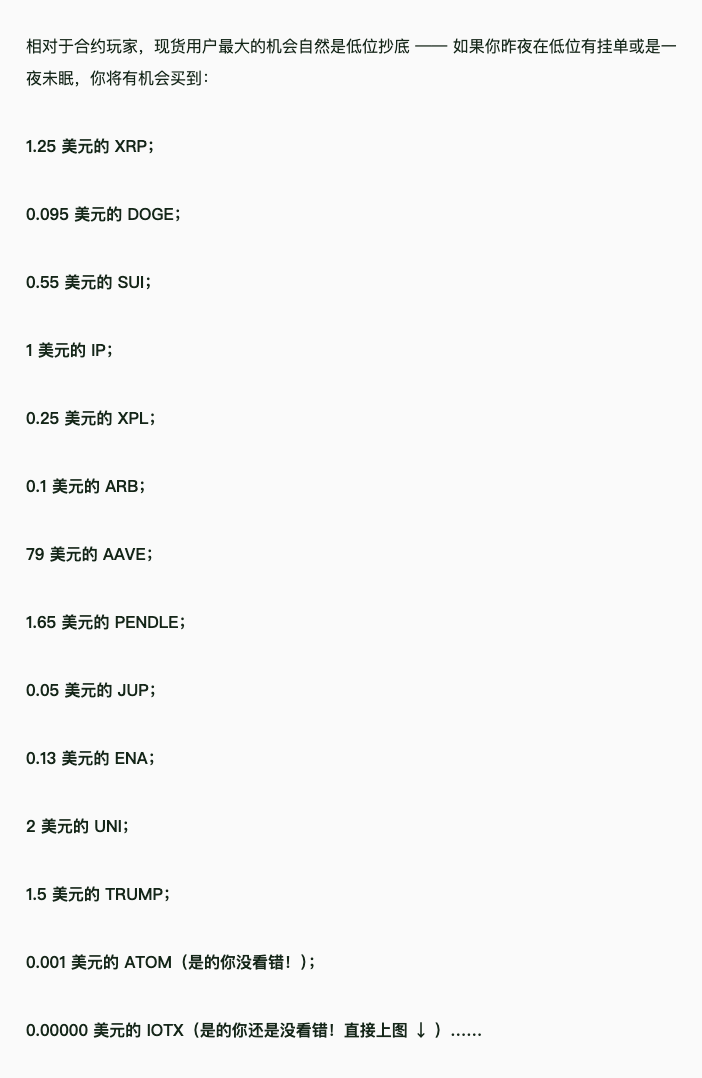
Risk also represents opportunity.
When the “TACO” trading style (Trump Always Chicken Out) was validated once again, the crypto market finally began a slow self-repair. Unlike in the past, many traders had already lost most of their assets in that “Black Friday” and were devastated, leaving the market in despair.
It was in this challenging market environment that prediction market platforms, such as Polymarket and Kalshi, gradually became one of the few hot spots and trading platforms in the crypto market. Their valuations soared within just a few months. After completing a $1 billion Series E funding round led by Paradigm, Kalshi's valuation surged to $11 billion; Polymarket, after completing a $2 billion funding round led by ICE Group, the parent company of the NYSE, is seeking a new round of funding with a valuation of $12 billion to $15 billion.
After many twists and turns, the crypto market has returned to Polymarket, the prediction market platform that successfully predicted Trump's election in the "2024 US presidential election" event. And after all four seasons, the mainstreaming and popularization of the cryptocurrency industry continues.
Where will the future lead? US regulation and traditional finance still largely determine the direction of the tide and the duration of spring and winter. We, the crypto gold miners, can only find our own treasures by closely following the trends and assessing the situation. Original/ Odaily Planet Daily ( @OdailyChina )
Author/ Wenser ( @wenser2010 )
2025 is drawing to a close. Standing at the end of what has been a "major year for crypto mainstreaming," it's time to summarize the four quarters of this year with some keywords, and to get a glimpse into how cryptocurrencies have gradually penetrated and transformed the world.
The crypto world in 2025 experienced numerous ups and downs: from Trump's inauguration as US president in early January to the US launching a tariff trade war in April; from Strategy leading the DAT treasury company trend and once generating hundreds of billions of dollars in profits, to the flourishing and subsequent stagnation of ETH, SOL treasury companies and even altcoin treasury companies; from stock tokenization platforms being seen as "the best combination of DeFi and TradeFi," to Nasdaq's self-revolution to join the stock tokenization craze; from the wealth-creating frenzy sparked by on-chain Perp DEXs like Hyperliquid and Aster, to the prediction market duopoly Polymarket and Kalshi with valuations exceeding tens of billions of dollars; from the GENIUS stablecoin regulatory bill to the stablecoin craze where PayFi was always mentioned; from crypto IPOs to crypto ETFs. Normalization... Amidst the struggles, battles, and reconciliations of countless funds, attention, and regulatory forces, amidst numerous wealth-creating projects, memes, and hacking incidents, amidst frenzied FOMO, new highs, and rushing to buy, amidst extreme fear, massive crashes, and black swan events, the cryptocurrency industry, like a mature tree, has added another ring to its tree.
Behind the relentless flow of money lies the fluctuating fortunes of Memecoin players, the financial struggles of ATM collectors, Wall Street's massive acquisitions, and the lenient approval of US regulators. This year is somewhat complex—it's neither a complete bull market nor a bleak bear market. Compared to the previously distinct hot and cold, sector-rotating crypto market, the 2025 crypto industry, influenced by Trump and numerous authoritarian government forces, resembles a monkey leaping about; some have fallen from grace, while others have risen to prominence. As for the successes and failures, perhaps our upcoming "2025 Crypto Investment Memoir" will reveal more answers.
In this article, Odaily Planet Daily will use four quarterly keywords to review Crypto 2025.
Crypto Spring: The Trump Effect Continues, Trump Creates Wealth, and the Crypto Regulatory Framework Becomes Clearer
In January, Trump was officially inaugurated as President of the United States.
Following the momentum that followed Trump's election victory last year, the cryptocurrency market, after a brief period of consolidation, saw the price of BTC once again approach the $100,000 mark.
Just three days before Trump took office, Trump, touted as the "official Trump Meme coin," unleashed the first wave of wealth creation this year on numerous crypto participants.
I still vividly remember that morning when my colleague first shared the Trump token contract. Its total market capitalization (FDV) was only around $4 billion. Amidst doubts such as "Was Trump's account hacked?", "Does the US president dare to issue a cryptocurrency?", and "Is Trump trying to make a final profit before becoming president?", Trump's total market capitalization soared, quickly breaking through $10 billion, $30 billion, and eventually reaching over $80 billion.
In this astonishing wealth-creation frenzy, many Chinese-language meme players have made a fortune, with some earning millions or even over $20 million. For a list of Trump traders who have made a fortune, we recommend reading "Who are the Trump traders who have profited over a million dollars? Winning KOLs and Disappointing ETH Maxi" .
This marks the second wave of growth in the crypto market, following Trump's election as US president in November 2024, driven by his personal influence.
Soon, the crypto market also presented its own "gift" to Trump's inauguration as US president - on January 20, a month later, BTC broke its all-time high again , with the price rising to $109,800.
At the time, everyone regarded Trump as the undisputed "first crypto president." Perhaps many people did not realize then that "the people can make or break a crypto market," and what Trump brought to the crypto market was not only favorable macro policies and regulatory environment, but also a series of controversies, exploitation, and repeated fluctuations brought about by his family's crypto projects.
On the other hand, the key to the "Trump effect" lies in whether his inauguration can directly improve the US cryptocurrency regulatory environment.
Firstly, it's about whether it can bring clearer boundaries and more favorable rules to crypto regulation through legislation and executive orders. In this regard, Trump has gradually fulfilled some of his promises, including replacing the SEC chairman with Paul Atkins, appointing David Sacks as White House AI and cryptocurrency director, and pushing for the passage of the GINUS stablecoin regulatory bill.
Secondly, there's the "BTC national strategic reserve," a topic of great interest to the crypto market and many crypto-friendly politicians. In early March, Trump signed an executive order to establish a U.S. Bitcoin strategic reserve using previously confiscated BTC assets. He specifically emphasized that it "would not increase the burden on taxpayers." For more details, we recommend reading the article "Trump Establishes BTC Strategic Reserve as Promised, But Is the Funding Purely from Confiscated Assets?"
Nevertheless, the final verdict on Polymarket that "Trump will establish a national strategic reserve of BTC within 100 days of taking office" was "No" (Odaily Planet Daily note: the reason being that the rules of the betting event stated that assets confiscated by the US government do not belong to the BTC reserve) still frustrated many people, with many even calling it a "scam website" in the comments section of the event.
Polymarket betting event rules information
At that time, the "insider whale" had already begun to emerge, with the "50x leverage insider" on Hyperliquid profiting millions of dollars from news such as "Trump establishing a cryptocurrency reserve." For details, please refer to the article "Reviewing the 'Insider Whale's' Slick Operations on Hyperliquid Contracts: Precise Opening and Closing of Long and Short Positions."
This period also saw numerous controversies surrounding Trump, including the "Melania token" incident following Trump and the LIBRA token incident triggered by Argentine President Milley, both considered "masterpieces of the Trump crypto group." In addition, the first quarter of the cryptocurrency market witnessed a series of "historic events," including:
- Hyperliquid's "largest airdrop of the year" has aroused envy among many on-chain players;
- Bybit was attacked by the North Korean hacker group Lazarus Group, resulting in the theft of $1.5 billion in assets .
- The much-criticized Ethereum Foundation has undergone a leadership change, with former executive director Aya promoted to chairman .
The industry did not anticipate that Trump, this disruptive force, would soon demonstrate to the market an American version of "what goes around comes around."
Crypto Summer: DAT Treasury, ETH hits new high, stablecoins take center stage
At the start of the second quarter, the crypto market was hit hard – in early April, Trump launched a global "tariff trade war," which created a tense atmosphere in the global economy, and the US stock market and the crypto market suffered heavy blows.
On April 7th, "Black Monday," the US stock market capitalization evaporated by over $6 trillion in nearly a week, including over $1.5 trillion in market value loss for the "Big Seven" companies, including Apple and Google. After nearly a month of volatility, the cryptocurrency market experienced a delayed but inevitable crash— BTC briefly fell below $80,000, reaching a low of $77,000; ETH fell to a low of $1,540, a new low since October 2023; the total market capitalization of cryptocurrencies fell to $2.6 trillion, a single-day drop of over 9%. Recommended reading : "Deep Dive into the 'Culprit' Behind the Trade War: Over $6 Trillion Evaporated Overnight—Is It All Because of Him?"
It was from that point onward, after months of market downturn and organizational reforms within the Ethereum Foundation, that ETH finally showed some momentum and potential for a rebound. Recommended reading : "A New Broom Sweeps Away: Ethereum Foundation's New Executive Director Reveals Where EF is Heading?"
Meanwhile, riding the wave of Circle's US IPO , stablecoins and PayFi have gradually entered the mainstream of the crypto market, seen by many as the key to "mass adoption of crypto." Recommended reading: "Stablecoins' 10-Year Journey: Finally Becoming the US Officially Designated 'Peer-to-Peer Electronic Cash'" , "The Golden Age of Stablecoins Begins: USDT to the Left, USDC to the Right"
In late May, with an order from Joseph Lubin, co-founder of Ethereum, Consensys, and founder of MetaMask, Sharplink, a US-listed company , transformed from a sports marketing company into the first "ETH Treasury Public Company." From then on, the DAT craze began to sweep across the entire cryptocurrency market , and the price of ETH finally emerged from its continuous decline, successfully breaking through the previous all-time high of $4,800 a few months later, soaring to a high of nearly $5,000.
Subsequently, Tom Lee, the "Wall Street strategist," also joined the "DAT Treasury craze" with Bitmine, a US-listed company. Since then, ETH Treasury companies have become another "crypto landscape" after Strategy led the BTC Treasury companies.
A glimpse of ETH Treasury Company information
As of the time of writing, according to data from the strategythreserve website , the total number of ETH treasury companies has increased to nearly 70, among which,
- Bitmine (BMNR) tops the list with 3.86 million ETH in holdings;
- Sharplink (SBET) holds a solid second position with over 860,000 ETH in holdings;
- ETH Machine (ETHM) ranks third with over 490,000 ETH in holdings.
It is worth mentioning that the ETH holdings of the above three DAT companies all significantly exceed the holdings of the Ethereum Foundation (less than 230,000 ETH).
Following the success of ETH Treasury, companies like SOL DAT , BNB DAT, and a series of altcoin DAT companies have sprung up like mushrooms after rain, with their stock prices fluctuating wildly amidst the clamor of competition.
Having passed through the initial frenzied FOMO phase of the transformation and now that the crypto market has entered a period of calm, ETH DAT companies, represented by Bitmine, are facing billions of dollars in unrealized losses. Meanwhile, DAT treasury companies, including many BTC reserve companies, are facing a situation where their market capitalization is even lower than their crypto asset value due to the lack of real business support. The mNAV (crypto asset/company market capitalization) of dozens of DAT companies has fallen below the level of 1.
The DAT companies in the midst of the crypto summer were jubilant, yet they still didn't quite understand Zweig's saying that "all gifts in the world come with a price tag," and that price was the plummeting stock price.
Of course, just as death often gives birth to new life, as DAT surged forward like oil being poured on a raging fire, the winds of stock tokenization gradually blew into the crypto market and subsequently became an unstoppable trend. Even the Nasdaq, a US stock exchange, could not ignore it and could only join this "feast of capital" in a self-revolutionary manner.
Crypto Autumn: Stock Tokenization, On-Chain Perp DEX and Stablecoin Public Chains in a Dual Battle
After Circle (CRCL) made a strong debut on the US stock market at the end of June and achieved a milestone of "10 times stock price increase", the enthusiasm of the crypto market and the traditional financial market for stablecoins and crypto concept stocks has reached an unprecedented level.
Fueled by positive news, Hong Kong-listed stablecoin and brokerage stocks surged. Numerous internet giants, including JD.com and Ant Group, announced their upcoming entry into the stablecoin market, attracting considerable attention. Recommended reading : "Hong Kong Stock Market's Altcoin Season Arrives: Can Crypto Concept Stocks Support the Bull Market?"
Riding this wave, the RWA sector has finally reached a major turning point – the time is ripe for stock tokenization.
In early July, exchanges Kraken and Bybit announced the opening of tokenized stock trading through the xStocks platform, supporting trading of dozens of tokenized US stocks, including popular US stocks such as AAPL, TSLA, and NVDA. Since then, xStocks, which focuses on the concept of "on-chain US stock tokenized trading platform", has become the sole focus of the market spotlight, and MyStonks (now renamed MSX.com) has also attracted a large number of users and investors.
If the launch of the BTC spot ETF in early 2024 and the ETH spot ETF in July of that year gave cryptocurrency traders the prestigious title of "distinguished US stock traders," then the emergence of stock tokenization platforms this year has truly bridged the "last mile" of on-chain trading of US stocks , and has also given "a lousy crypto trader" like myself the possibility of diversifying asset allocation through on-chain tokenization platforms for the first time.
Odaily Planet Daily previously provided a detailed introduction to xStocks and the underlying mechanisms of tokenized US stock trading platforms in its article "10 Questions about xStocks: What are we actually trading when trading US stock tokens?" Looking back now, its basic principles and asset management model have not changed much. The difference is that, following many US stock tokenization platforms, traditional giants have also begun their own path of awakening.
10 Questions about xStocks Overview
First, Galaxy, a crypto asset management giant, took the initiative to issue tokenized shares ; then , Nasdaq, a US stock exchange with a quarterly trading volume of up to 10 trillion, proactively submitted an application to the US SEC for "tokenized stock trading" . In the vast field of asset issuance and trading, traditional giants are not lacking in acumen.
Meanwhile, the crypto-native market boom belongs to two major segments:
First, there was the " on-chain Perp DEX war " following Hyperliquid—Aster in the BNB Chain ecosystem contributed another wealth-creating miracle to the crypto market with an extremely violent "pump and dump" operation, with many people saying they "sold millions of dollars too early."
Secondly, there are two remarkable wealth-creating phenomena in the stablecoin sector: one is the generous airdrops offered by Plasma , which boasts the title of "a stablecoin public chain supported by Tether's CEO," to numerous participants in its "investment savings program." Some even received over $9,000 worth of XPL tokens as a return of over 900 times by depositing just $1. The other is the official launch of WLFI , a crypto project of the Trump family. Leveraging the momentum of its stablecoin USD1, people reaped returns of up to 6 times at the public offering prices of $0.05 and $0.15.
Looking at the prices of XPL and WLFI now is quite disheartening. According to Coingecko data, XPL is currently priced at $0.17, a drop of nearly 90% from its peak of $1.67; WLFI is currently priced at $0.15, a drop of nearly 50% from its peak of $0.33.
At a time when countless people were marveling at the endless opportunities, little did they know that what awaited the crypto industry was an "epic liquidation" far exceeding any crash in history.
Crypto Winter: Following the 10/11 crash, TACO's trading strategy is validated once again, and the prediction market is poised to welcome a giant with a valuation of over 10 billion.
After BTC prices hit a new high of $126,000 in early October, people were hoping that the crypto market could continue its "Uptober" trend of previous years. However, an "epic liquidation" on October 11 shattered all their dreams and hopes.
This time, the trigger was once again Trump – on the evening of October 10th, Trump announced a 100% tariff increase, causing the fear index to surge. All three major US stock indices fell to varying degrees: the Nasdaq fell nearly 3.5%, the S&P 500 fell 2.7%, and the Dow Jones Industrial Average fell 1.9%.
The cryptocurrency market suffered from exchange system problems, coupled with the market's fragile and easily frightened sentiment. BTC hit a low of $101,516, a 16% drop in 24 hours; ETH hit a low of $3,400, a 22% drop in 24 hours; and SOL fell by 31.83% in 24 hours. Altcoins were particularly hard hit.
The losses caused by this epic liquidation far exceed those of previous major crashes such as March 12, May 19, and September 4. The actual liquidation scale in the cryptocurrency market is at least around 30 to 40 billion US dollars.
Of course, risks also present opportunities. As Odaily Planet Daily mentioned in articles such as "Who Made a Fortune Amidst the Crash? What Wealth-Making Opportunities Are Within Reach?" and "The Whale Battle Behind the Biggest Liquidation Day in Crypto History: Short Sellers Leave with Knives in Hand," various "wealth-making opportunities"—whether it's high-leverage short selling or bottom-fishing at low prices—have allowed many to profit from the chaos.
Risk also represents opportunity.
When the “TACO” trading style (Trump Always Chicken Out) was validated once again, the crypto market finally began a slow self-repair. Unlike in the past, many traders had already lost most of their assets in that “Black Friday” and were devastated, leaving the market in despair.
It was in this challenging market environment that prediction market platforms, such as Polymarket and Kalshi, gradually became one of the few hot spots and trading platforms in the crypto market. Their valuations soared within just a few months. After completing a $1 billion Series E funding round led by Paradigm, Kalshi's valuation surged to $11 billion; Polymarket, after completing a $2 billion funding round led by ICE Group, the parent company of the NYSE, is seeking a new round of funding with a valuation of $12 billion to $15 billion.
After many twists and turns, the crypto market has returned to Polymarket, the prediction market platform that successfully predicted Trump's election in the "2024 US presidential election" event. And after all four seasons, the mainstreaming and popularization of the cryptocurrency industry continues.
Where will the future lead? US regulation and traditional finance still largely determine the direction of the tide and the duration of periods of boom and bust. We, the crypto gold miners, can only find our own treasures by closely following the trends and assessing the situation.


