GONKA: Why I Consider It "The Bitcoin of AI"


- 核心观点:Gonka是继比特币后最重要的基础设施机会。
- 关键要素:
- 采用PoW 2.0,算力100%用于AI推理。
- 网络已具规模,拥有超6000块H100等效算力。
- 经济模型与比特币类似,代币由真实算力背书。
- 市场影响:推动AI基础设施民主化,挑战中心化格局。
- 时效性标注:长期影响
"First they ignore you. Then they laugh at you. Then they fight you. And then you win."
I wrote this sentence at the beginning of my book , *And Then You Win* , because it accurately summarizes the trajectory of every technological revolution I've witnessed. Bitcoin has grown along this path—I've personally experienced it, witnessing it rise from $20 to $100,000, transforming from a target of ridicule into a reserve asset.
Now, I see the same pattern repeating itself with GONKA.
Today, Bitfury announced a $50 million investment in Gonka – our first formal investment under our $1 billion Ethical Emerging Technologies Initiative. This is not a speculative bet, but an investment based on unwavering conviction: we firmly believe that Gonka represents the most significant infrastructure opportunity since Bitcoin.
Next, let me break down the logic behind it for you.
A core issue that no one is discussing
We are unknowingly heading towards a future where a few companies control most of the world's intelligence. OpenAI, Google, Microsoft, Anthropic—their achievements are certainly remarkable, but this highly centralized structure has never been stable in history.
Whenever something becomes critical—be it currency, communication, or computing power—the world ultimately demands an open alternative. This doesn't mean overthrowing the centralized version, but rather ensuring access to progress is independent of privilege, political, or geographical factors.
Bitcoin has become an open alternative in the monetary field.
Gonka is striving to become the next best option in the field of artificial intelligence.
Gonka also possesses the underlying logic behind Bitcoin's success.
When people ask me why Bitcoin succeeded while thousands of other cryptocurrencies failed, my answer is simple: Bitcoin aligns incentives with the laws of physics.
Miners deploy hardware, which consumes energy, and energy costs money; rewards compensate for this investment. This creates a positive flywheel: competition drives efficiency improvements, efficiency promotes scaling, and scale enhances network resilience.
The core of Proof-of-Work (PoW) is not "guessing numbers," but rather linking digital value to real-world labor.
The Liberman siblings—Anna, David, Daniil, and Maria—grasped this understanding when designing Gonka at their US software company, Product Science , backed by investments from Coatue Management, Slow Ventures, and K5. Instead of following the trend of Proof-of-Stake (PoS) architectures, they returned to first principles and asked: How can artificial intelligence infrastructure possess the unstoppable vitality of Bitcoin's monetary network?
Their answer is: replace meaningless random hash calculations with useful artificial intelligence reasoning.
Proof-of-Work 2.0: The Core Engine of Open AI Infrastructure
Gonka borrows the core mechanisms of Bitcoin and repurposes them for the age of artificial intelligence.
Miners connect GPUs (and ASIC chips in the future) to the network, developers submit real AI inference tasks, the protocol verifies the inference results and rewards miners based on the actual computing power completed. Each GNK token is backed by quantifiable computing power, not speculative expectations.
This is precisely the fundamental difference between Gonka and mainstream Proof-of-Stake (PoS) networks in the crypto space. In typical PoS systems, over 90% of GPU computing power is consumed in consensus tasks, which have no practical value other than ensuring blockchain security. Rewards flow to stakers—passive capital holders—rather than participants who actively contribute computing power.
Gonka completely revolutionized this model: almost 100% of its resources were invested in AI with real value. There were no staking intermediaries, no wasted computing power, only truly useful labor.
This model has brought about three immediate and significant changes:
- Idle GPUs around the world are being activated into productivity – from gaming devices and university clusters to regional data centers, they are all becoming providers of AI computing power;
- Developers can access inference services without a license, at a cost that is only a fraction of that of centralized cloud services;
- GNK has acquired intrinsic value rooted in production costs—which is entirely consistent with the value logic of Bitcoin.
As more GPUs connect to the network, the difficulty of tasks will increase accordingly, the computing power carried by each GNK will increase, and the production cost of tokens will also rise, ultimately laying a solid economic foundation for the asset.
This is value backed by infrastructure, not value supported by narrative.
Key data witnesses real growth
Since its launch in August 2025, Gonka's organic growth trajectory has validated its intrinsic value:
- Network scale: The computing power provided by the distributed hosts is equivalent to more than 6,000 NVIDIA H100 GPUs, fully supporting artificial intelligence inference tasks;
- Global footprint: 448+ active operating nodes and validators are located all over the world, with a level of geographical redundancy that a single data center cannot match;
- Developer adoption: 2200+ developers are building applications online, with the number of active builders far exceeding Bittensor's valuation at the same time.
- Community status: Discord has over 4,000 members and continues to grow, forming a community composed of miners, developers, and believers;
- Real-world load: Five large language models (LLMs) are in use, processing over 103 million AI tokens in recent cycles;
- Community Governance: The network launched fairly, with all control transferred to an on-chain autonomous mechanism. There is no foundation or gatekeeping entity. A community fund pool holding 120 million GNK (12% of the total supply) has approved Bitfury's purchase of $12 million worth of GNK through transparent on-chain voting.
Such a growth curve cannot be achieved through marketing gimmicks; only a solid architectural design can make it possible.
As Bitfury founder Val stated in today's announcement, "Decentralized machine intelligence is rapidly becoming one of the most important frontiers in the field of artificial intelligence infrastructure, and Gonka is advancing this frontier at an astonishing pace. Its proof-of-work model directly directs hardware computing power to productive AI workloads, which aligns perfectly with Bitfury's mission to support open, resilient, and high-impact digital infrastructure."
Currently, the mining cost of one GNK token is approximately $1. Once the token gains wider exchange liquidity and price discovery accelerates, I believe more GPU holders and ASIC developers will flock to the network in pursuit of profit—just as they flocked to Bitcoin in the past.
We witnessed this process firsthand: GPU mining emerged in 2011, and Bitfury launched its first-generation Bitcoin ASIC chip in 2013. At that time, the network hashrate was less than 1 PetaHash; now it has exceeded 1000 ExaHashes.
The Coming Era of ASICs
In "And Then You Win," I described the evolution of Bitcoin hardware: CPU → GPU → FPGA → ASIC, with each stage achieving efficiency improvements of 10 to 1000 times. A complete industry has formed around custom chips, significantly reducing costs and continuously breaking through performance barriers.
Gonka was designed to replicate this trajectory.
GPUs are the foundational layer that boots up the network, while ASICs are the ultimate solution.
Once dedicated inference chips become available, the cost of running AI models will drop by orders of magnitude—just as the cost of hash calculations plummeted. Companies that plan to amortize the costs of their H100 clusters over six years may find their assets "stranded," while decentralized networks running custom chips will have a clear advantage in both cost and efficiency.
Imagine that the cost of AI inference doesn't decrease by 10% annually, but rather decreases exponentially. This is precisely the future that the Gonka Network is striving to create.
Why focus on reasoning rather than training?
Critics often ask: Can decentralized networks really compete with massive training clusters? This question exposes a fundamental misunderstanding of the market.
Training is inherently centralized—it relies on large-scale, centrally deployed GPU clusters with high-bandwidth interconnects. Cutting-edge labs will continue to build these "skyscrapers."
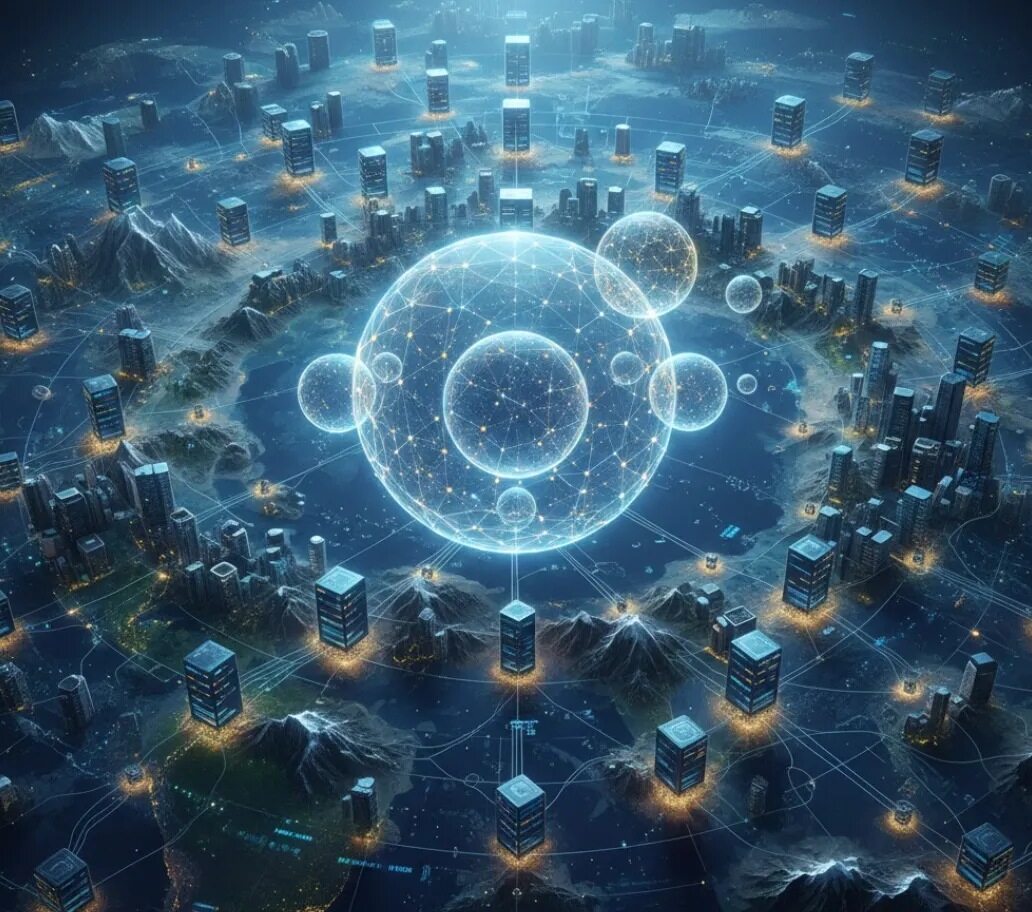
Inference is inherently distributed—it benefits from geographically close-to-user, cost-effective, and redundant architectures. What the world needs are "roads" that deliver intelligence to every corner, not "monuments" concentrated in a few data centers.
This is precisely the core reason why Gonka has focused on inference from the very beginning. As David Liberman, CTO of Product Science and co-founder of the Gonka protocol, stated: "Bitfury's participation is a strong validation of our design model—open, permissionless, and built for productive computing, not a fake consensus task. This is not only progress for our community, but also a leap forward for the entire decentralized AI field."
The inference market is already 10 times the size of the training market, and it's growing even faster. This is precisely the structural advantage of decentralized architectures. Gonka's goal isn't to beat OpenAI in GPT-5 training, but to provide the infrastructure for intelligent services to the 99% of the world's population who cannot afford massive computing power.
Skyscrapers without roads are nothing more than solitary towers in the desert. The world needs both skyscrapers and well-connected roads.
A positive flywheel is forming
As I wrote in the book: "Being ahead often feels like you're wrong, but that's just an initial illusion. After a while, the world will gradually catch up with the idea—and then everything will seem to make sense."
The operating logic of Gonka's growth flywheel is as follows:
- Price discovery launched → Miners deploy more hardware
- Increased hardware quantity → further reduction in computing power cost
- Lower costs → Developers launch more applications
- Increased applications → Accelerated growth in inference needs
- Increased demand → Enhanced network value
- Value enhancement → More miners join
This is how decentralized networks grow—not through marketing budgets, but through economic incentives that align with reality. Early adopters of Bitcoin understand this all too well.
The price fluctuations of Bitcoin in 2013 were not speculative, but rather a form of coordinated action. It told the world where capital should be invested, how much hardware should be deployed, and at what speed the network should expand.
Gonka is now entering this phase.
Why Bitfury is making such a big bet – $50 million is just the beginning.
In November 2025, Bitfury announced the launch of a $1 billion "Ethical Emerging Technologies Advancement Initiative." Today's $50 million investment in Gonka is the first investment under this initiative—aimed at accelerating the development and adoption of the Gonka protocol and its ecosystem.
Why was Gonka chosen as the first investment target?
- The architecture is sound: a proof-of-work mechanism that links tokens to real computing power. In many proof-of-stake systems, over 90% of GPU computing power is wasted on consensus tasks with no real value, while Gonka reverses this model, with nearly 100% of computing power used for real-world AI productivity tasks.
- The economic model is correct: it adopts a Bitcoin-style halving issuance mechanism to create scarcity;
- The governance model is correct: fair start, all control is transferred to the on-chain autonomous mechanism, there is no foundation, no gatekeeper, and no single entity can unilaterally decide the future of the network;
- The vision is correct: to promote the democratization of global artificial intelligence infrastructure.
Supporting Bitcoin in 2011, though seemingly going against the grain, had an inherent logic to its success. Supporting Gonka today evokes the same feeling—though in its early stages and rife with misunderstandings, it is built on sound foundations.
Four-stage development framework
In my book, I described the four stages that every transformative technology goes through:
- Ignoring period: The mainstream group considers the idea unimportant and ignores it;
- The mockery period: early believers were ridiculed as naive or delusional;
- Opposition period: Those who have vested interests realize the threat and begin to resist;
- Victory period: Technology is unstoppable due to its practicality, wide distribution, and deep embedding.
Bitcoin took ten years to go through these stages. Now, decentralized artificial intelligence is between the first and second stages. Most people still choose to ignore it, while some have begun to ridicule it.
For those seeking asymmetric opportunities, this is the ideal time to enter the game.
A message to builders and believers
If you wait for certainty, you'll miss out on great opportunities. The essence of cutting-edge technology lies in the fact that only by embarking on the journey can you see the path ahead.
As I often tell entrepreneurs: "If you stay in the barbershop long enough, you'll eventually get someone to come for a haircut. Persistence is more important than timing."
The competition has begun. “Gonka” means “competition” in Russian—a fitting name for a network aspiring to become a pillar of global artificial intelligence infrastructure.
But this name has a deeper meaning worth exploring. In Tibetan Buddhism, Gonkhang (Gön-khang) refers to a "protector deity hall"—a sacred space in a monastery where protector deities are enshrined, who safeguard Buddhist teachings and the prosperity of the community. Gön means to protect, and khang means dwelling place.
Gonka embodies both meanings. It is a race—against centralization, against gatekeepers, against the centralization of intelligence; it is also a sanctuary—a safe space where open AI infrastructure can flourish, free from the control of any single entity.
This is not a confrontation between centralized and decentralized artificial intelligence, but a contest between two futures: one is a future where intelligence is limited, and the other is a future where intelligence is widespread; one is a future where a few people control the tools of creation, and the other is a future where billions of people participate together.
Centralized AI will build skyscrapers, decentralized AI will pave the way. Only one of these paths guarantees access, only one path upholds openness, and only one path ensures that the future belongs not to a few institutions, but to everyone willing to contribute.
Bitcoin has proven to us that when the moment of truth arrives, decentralized infrastructure will ultimately prevail.
Decentralized artificial intelligence is the next chapter in this story.
As Victor Hugo said, "No force can stop the idea that the time has come."
Gonka embodies just such a concept.
George Kikvadze is the author of *And Then You Win: A Startup's Untold Story of Grit, Grind, and Glory* and the Vice Chairman of Bitfury Group. A Bitcoin pioneer since 2013, he has helped three tech unicorn companies grow to a combined valuation of over $12 billion. His Twitter account is @BitfuryGeorge.
Disclaimer: This article represents personal opinions only and does not constitute any financial advice. Cryptocurrency investment involves significant risks; please conduct your own research before making any investment decisions.