






The end of Ethereum islands: How can EIL reconstruct the broken L2 into a "supercomputer"?


- 核心观点:EIL旨在实现L2间无缝互操作。
- 关键要素:
- 结合账户抽象与跨链消息传递。
- 利用ERC-4337智能账户解决Gas等问题。
- 依赖L2自身安全性,最小化信任假设。
- 市场影响:大幅降低用户跨链门槛与风险。
- 时效性标注:长期影响。
In the previous article in the Interop series, we introduced the Open Intents Framework (OIF), which is like a universal language that allows users to express their intent, "I want to buy NFTs across chains," and have it understood by solvers across the entire network (further reading: " When 'Intent' Becomes the Standard: How Does OIF End Cross-Chain Fragmentation and Return Web3 to User Intuition? ").
But simply "understanding" isn't enough; you also have to "get it done." After all, once your intention is expressed, how do the funds safely travel from Base to Arbitrum? How does the target chain verify the validity of your signature? Who will cover the target chain's gas costs?
This involves the core of the "Acceleration" phase in the Ethereum interoperability roadmap—the Ethereum Interoperability Layer (EIL). At the recent Devconnect event, the EF account abstraction team officially brought EIL to the center stage.
In short, EIL's goal is extremely ambitious: to make all L2 users "look like they are on the same chain" without making a hard fork or changing Ethereum's underlying consensus.
I. What exactly is EIL?
In fact, the premise of understanding EIL is not to be misled by the word "Layer", because EIL is not a new blockchain, nor is it a traditional cross-chain bridge.
It is essentially a set of standards and frameworks, but it combines "account abstraction (ERC-4337)" and "cross-chain messaging" capabilities to build a virtual unified execution environment.
In the current Ethereum ecosystem, each L2 is an isolated island. For example, your account on Optimism (EOA) and your account on Arbitrum may have the same address, but their states are completely isolated.
- Your signature on chain A cannot be directly verified on chain B.
- Your assets on Chain A are not visible on Chain B.
EIL attempts to break this isolation through the following two core components:
- ERC-4337-based smart accounts: leverage account abstraction capabilities to decouple user account logic from keys; solve the problem of no gas on the target chain through the Paymaster mechanism; and achieve multi-chain state synchronization through Key Manager.
- Trust-minimized messaging layer: Establish a standard that allows UserOp (user action object) to be packaged and securely passed to another chain through Rollup's official bridge or light client proof.
To illustrate, cross-chain technology used to be like traveling abroad. You needed to exchange currency (cross-chain assets), apply for a visa (reauthorization), and follow local traffic rules (purchasing gas from the target chain). However, cross-chain technology in the EIL era is more like using a Visa card for purchases.
No matter which country you are in, once you swipe your card (sign), the underlying banking network (EIL) will automatically handle the exchange rate, settlement, and verification, so you won't feel the existence of national borders.
The EIL solution proposed by the Ethereum Foundation's Account Abstraction team envisions a future where users can complete cross-chain transactions with just a single signature, without relying on centralized relayers or adding new trust assumptions. Transactions can be initiated directly from wallets and settled seamlessly between different L2s.

This is actually closer to the ultimate form of "account abstraction." Compared to the current high-barrier and fragmented operations, this experience will help users automatically create accounts, manage private keys, and handle complex cross-chain transactions.
In particular, the native account abstraction (AA) feature can turn all accounts into smart accounts, allowing users to focus on the on-chain experience and asset management without having to worry about gas fees (or even know that gas exists).
II. A Paradigm Shift from "Cross-Chain" to "Chain Abstraction"
If EIL is truly implemented, it is highly likely to bridge the "last mile" to the large-scale adoption of Web3. This marks a shift in the Ethereum ecosystem from multi-chain competition to chain abstraction and integration, potentially solving the most troublesome problems for users and developers.
First and foremost, it enables users to achieve a true "single-chain experience".
In short, under the EIL framework, users no longer need to manually switch networks. For example, if your money is in Base but you want to play a game on Arbitrum, you can simply click "Start" in the game, your wallet will pop up a signature box, you sign it, and the game will start.
In the background, EIL will automatically package the UserOp on the Base and send it to Arbitrum through the message layer. The Paymaster in the middle pays the Gas and entry fee for you, so it is as smooth as playing this game on the Base.
Secondly, from a security perspective, it completely eliminates the single point of failure risk associated with multi-signature bridges.
Traditional cross-chain bridges often rely on a group of external validators (multi-signature). If this group of validators is compromised by hackers, billions of dollars in assets will be at risk. EIL, on the other hand, emphasizes "trust minimization" and tends to use the security of L2 itself (such as storage proofs) to verify cross-chain messages, rather than relying on external third-party trust. This means that as long as the Ethereum mainnet is secure, cross-chain interactions are relatively secure.
Finally, it also provides a unified account standard for developers. Currently, if a DApp wants to implement multi-chain applications, developers have to maintain several sets of logic. With EIL, developers can assume that users have a full-chain account. They only need to write interfaces according to the ERC-4337 standard to naturally support users across all chains, without needing to know which chain the user's funds are actually on.
However, to realize the above vision, we still face a huge engineering challenge: how can we enable the existing hundreds of millions of EOA users to enjoy this experience as well? (Further reading: From EOA to Account Abstraction: Will the Next Leap of Web3 Happen in the "Account System"? )
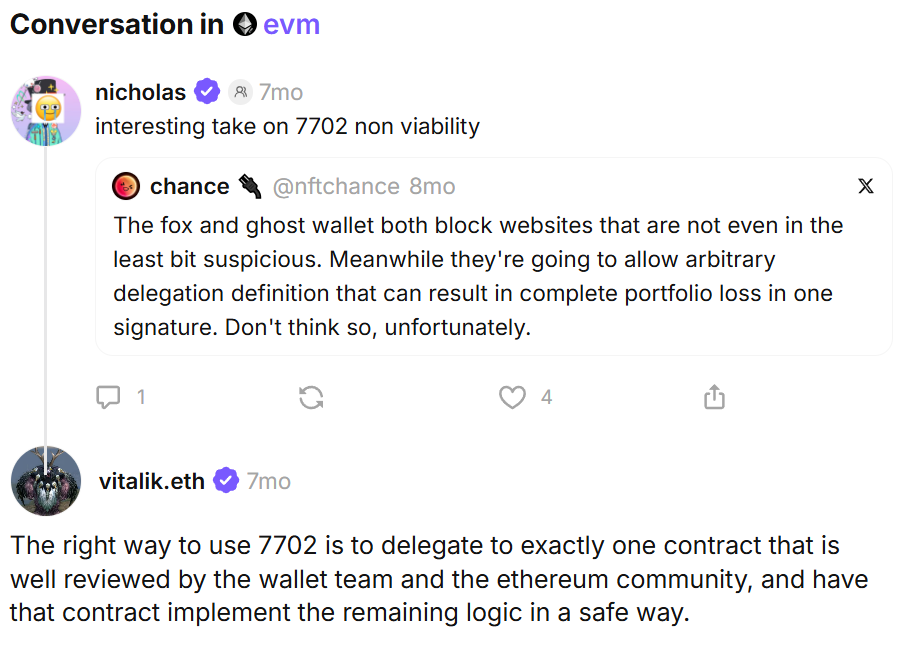
After all, migrating from EOA to AA requires users to transfer their assets to a new address, which is too troublesome. This leads to Vitalik Buterin's EIP-7702 proposal, which cleverly solved the compatibility problem that had been debated by the previous three proposals (EIP-4337, EIP-3074, and EIP-5003), and did something amazing: it allows existing EOA accounts to "temporarily transform" into smart contract accounts during transactions.
This proposal means you don't need to register a new wallet or transfer your assets from your current imToken wallet to a new AA account address. Instead, through EIP-7702, your old account can temporarily gain smart contract functionality (such as bulk authorization, gas payment on behalf, and cross-chain atomic operations). After the transaction ends, it reverts to the highly compatible EOA.
III. The Implementation and Future of EIL
In fact, compared to OIF, which is built from the bottom up by multiple parties in the community, EIL has a stronger official character and can be considered an engineering reality led and promoted by the EF account abstraction team (the creators of ERC-4337).
Specifically, the current progress is mainly reflected in the following three key dimensions:
- Multi-chain extensions of ERC-4337: The community is researching how to extend the UserOp structure of ERC-4337 to include cross-chain information such as the target chain ID. This is the first step in giving smart accounts "all-seeing eyes".
- ERC-7702 Collaboration: With the advancement of EIP-7702 (which enables EOAs to have smart account capabilities), ordinary EOA users will be able to seamlessly access the EIL network in the future, which greatly lowers the user threshold.
- Standardized Message Interface: Similar to the OIF solution for intent standardization mentioned in our previous article, EIL is promoting the standardization of underlying message transmission. Optimism's Superchain, Polygon's AggLayer, and ZKsync's Elastic Chain are all exploring interoperability within their respective ecosystems, while EIL aims to further connect these heterogeneous ecosystems and build a universal message layer for the entire network.
What's even more interesting is that EIL's vision goes beyond "connectivity"; it is also adding another crucial underlying capability: privacy.
If EIP-7702 and AA solved the "accessibility" problem, then Vitalik's Kohaku privacy framework, released on Devconnect, may become the next piece of the EIL puzzle. This also echoes another core element of the "Trustless Manifesto," namely "censorship resistance."
At Devconnect, Vitalik stated that "privacy is freedom," and indicated that Ethereum is on a privacy upgrade path, aiming to provide real-world privacy and security. To this end, the Ethereum Foundation established a privacy team of 47 researchers, engineers, and cryptographers, dedicated to making privacy a "primary property" of Ethereum.
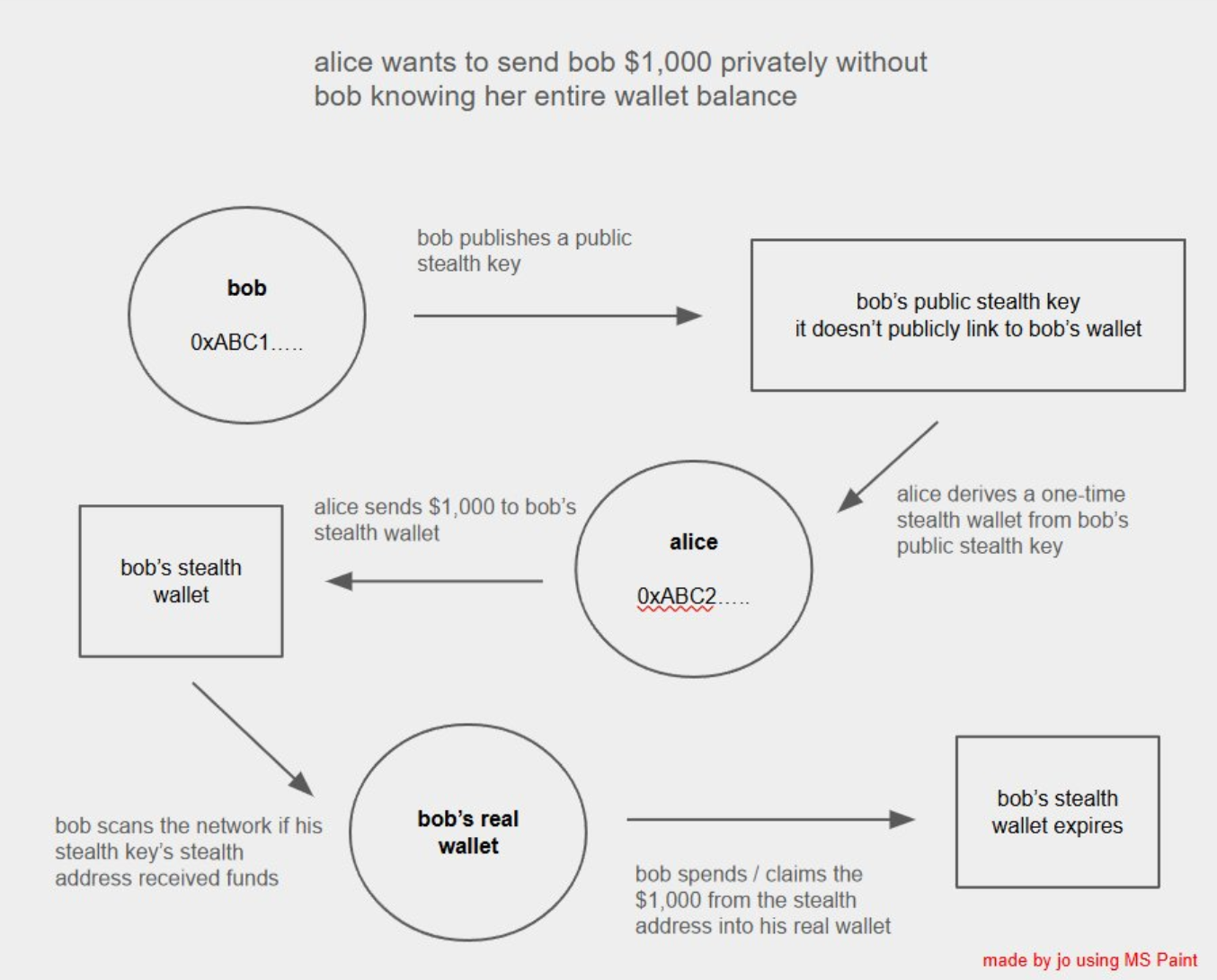
This means that future privacy protection will no longer be an optional plugin, but a fundamental capability as natural as transferring money. As a way to realize this vision, the Kohaku framework was created—essentially, Kohaku uses your public key to create temporary, stealth addresses, allowing you to perform private operations without revealing your connection to your main wallet.
With this design, the future AA account will not only be an asset management tool, but also a privacy shield.
By integrating protocols such as Railgun and Privacy Pools, AA accounts will allow users to provide "proof of innocence" in compliance with regulations while protecting transaction privacy . This allows any user to prove that the source of funds is not illegal, without having to expose the specific spending path to the outside world.
At this point, we can clearly see the full picture of the Ethereum interoperability roadmap:
- OIF (Intent Framework): Enables the application layer to "understand" the user's needs;
- EIL (Interoperability Layer): Paves the way for implementation at the infrastructure layer.
This may also be a clear signal that the Ethereum Foundation wants to convey: Ethereum should not be a loose collection of L2 databases, but rather a huge, unified supercomputer.
In the future, when EIL is truly implemented, we may no longer need to explain to new users what L2 is or what a cross-chain bridge is. At that time, you will only see assets, without the barriers of chains.


