Mining giant Bitfury has invested a whopping $50 million in Gonka, which boasts 6,000 H100 equivalent computing power. What makes Gonka so appealing?


- 核心观点:矿企巨头Bitfury重金投资去中心化AI算力网络Gonka。
- 关键要素:
- Bitfury投资5000万美元,系其10亿美元AI基金首笔。
- Gonka网络算力超6300张H100等效GPU。
- 代币GNK总量10亿,68%用于激励算力贡献者。
- 市场影响:推动去中心化AI算力基础设施发展。
- 时效性标注:中期影响。
Original article by Odaily Planet Daily ( @OdailyChina )
Author|Wenser ( @wenser2010 )

At the crossroads of cryptocurrency and AI, crypto mining companies and computing networks have become the greatest common denominator.
On November 28th, Bitfury Group, a cryptocurrency mining company (whose subsidiaries include two US-listed mining companies, Cipher Mining and Hut8), announced a $12 million strategic investment in the decentralized AI computing network Gonka.ai through a token fund. Just days later, on December 2nd, Bitfury's Vice Executive Chairman, George Kikvadze, announced another investment in Gonka, bringing the total investment to $50 million . This is the company's largest investment in decentralized AI computing to date. Furthermore, he praised Gonka's architecture as representing a "Bitcoin moment" in the field of artificial intelligence and published a lengthy article elaborating on this view.
Thus, the decentralized GPU computing power market, founded by the Lieberman brothers, serial entrepreneurs spanning both Web2 and Web3, has suddenly become incredibly popular. The reason is simple: this investment is Bitfury's first publicly disclosed investment since establishing its $1 billion AI fund. This also indicates that traditional mining companies are not only extending their reach into the booming AI model and internet giant territories, but are also systematically deploying resources in the decentralized AI infrastructure sector.
According to the latest data, Gonka.ai's computing power once reached over 6,300 H100 GPUs equivalent, and it supports access to nearly 20 mainstream AI devices, including 3080, 4090, H100, and H200. Its distributed computing cluster is expected to break the monopoly of NVIDIA and major cloud service providers, significantly reducing AI development costs. In this arms race based on computing power, what role will Gonka.ai play? And what returns will it bring to the market? With these questions in mind, Odaily will provide a detailed analysis of its background, actual business operations, and mining incentives in this article.
Gonka's grand vision: to solve the AI computing power dilemma and inference bottleneck with a decentralized computing network.
According to the official white paper and official information, the Gonka mainnet, which focuses on the concept of a "decentralized AI network," officially launched in September of this year. This network adopts a permissionless design, allowing all hardware owners (i.e., computing power devices such as GPUs) to connect instantly and earn rewards. To incentivize early adoption, Gonka has established a six-month "grace period," during which AI inference services are completely free. Simultaneously, GNK tokens will be distributed daily to reward early contributors.
Unlike other centralized or decentralized computing networks, Gonka, which pursues the ultimate balance between efficiency and technology, is committed to directing nearly 100% of its GPU computing power to meaningful AI training and inference tasks, rather than wasting computing power on intermediate processes such as buying, selling, and transmission. This solves the problem of wasted computing power to some extent.
The most important reason why Gonka was able to achieve this is the strong support from its experienced team and prestigious investment institutions.
Gonka.ai's two cornerstones of development: "internet veterans" with over a decade of experience and elite investment institutions that have invested $40 million.
Public information shows that Gonka was incubated by Product Science Inc., an American AI developer. The company was founded by the Libermans siblings, veterans of the Web2 industry and former core product directors of the well-known American internet platform Snap Inc. Since 2021, its AI service clients have included globally renowned companies such as Walmart, the largest employer in the United States, JP Morgan Chase, the world's largest bank, and Airbnb, a technology giant.
Behind Product Science is Libermans Co., the innovative venture capital studio of the Libermans family, an internet venture capital firm that has attracted a host of seasoned investors, including a16z founder Marc Andressen and partner Chris Dixon, OpenAI investor Coatue Management leader Arielle Zuckerberg, Josh Kushner, Notion founder Akshay Kothary, and Slow Ventures.
Based on their established customer service system and impressive professional resumes, Product Science, led by the Libermans (brothers David and Daniil Liberman and sisters Anna and Masha Liberman), has enjoyed remarkable success in the US venture capital world.
Product Science reportedly raised $18 million in 2023, valuing the company at $200 million. Investors included a number of high-profile figures such as Coatue Management (an investor in OpenAI), Slow Ventures (an investor in Solana), K5, and partners at Insight and Benchmark. Early contributors to the project also included well-known leading companies in the Web 2-Web 3 fields such as 6blocks, Hard Yaka, Gcore, and Bitfury.
Based on the latest round of financing information, we will provide a detailed explanation of Bitfury, the latest investor in Gonka. Bitfury owns two major US-listed mining companies, Cipher Mining (market capitalization of approximately $7.2 billion) and Hut 8 (market capitalization of approximately $4.5 billion), making it a "giant with a market capitalization exceeding $10 billion in the crypto mining industry." Besides its pivotal role in the crypto mining industry, it has also co-founded an AI infrastructure company, the data cooling center LiquidStack, and the AI hardware and software design company Axelera AI, making it a "big player" that dominates both the crypto and AI ends .
Now, Bitfury has purchased 20 million Gonka ecosystem tokens (GNK) at $0.6 per token, thus realizing its strategic investment in decentralized AI computing networks. This is Bitfury's first major investment since announcing its $1 billion investment plan focusing on ethical technology and AI innovation , demonstrating its strong commitment to Gonka. The recent increase in investment to $50 million further illustrates its ambitious plans in decentralized AI computing networks.
It's no exaggeration to say that in the astute US investment and crypto mining circles, Gonka has become the "best choice" among decentralized computing network projects, thanks to its unique industry niche and rapidly growing real business data.
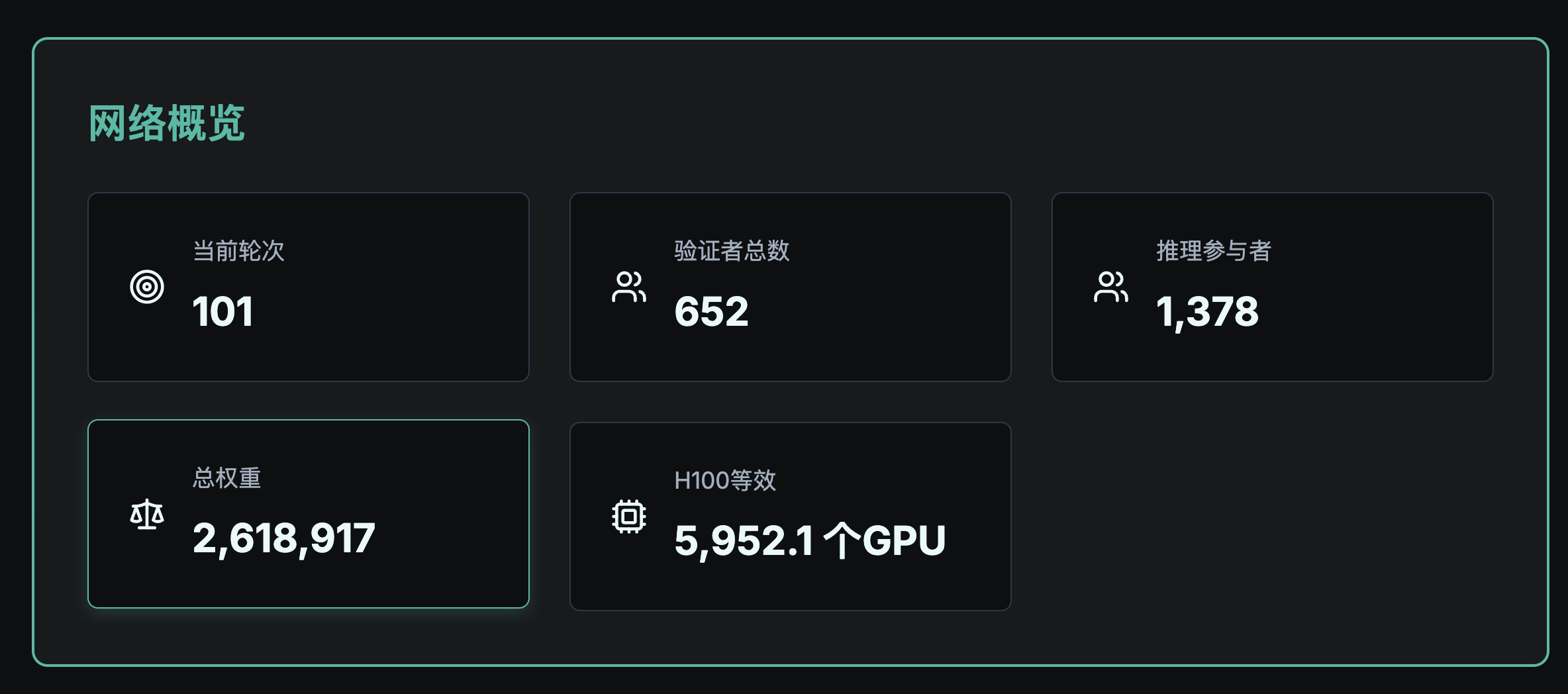
According to Gonka miner data dashboard information, the Gonka network currently has 626 active nodes globally, 1314 AI inference network participants, and a total network computing power of 5854.9 H100 equivalent GPUs. Previously, the data had exceeded 6300 H100 equivalent computing power.
Moreover, Gonka's GPU computing network is growing rapidly at a rate of approximately 50% per month. It must be said that once a computing network leveraging the advantages of decentralized networks is operational, its growth rate is truly terrifying.

As mentioned earlier, Gonka aims to solve AI computing power and inference challenges using a decentralized computing network, and introduces new industry roles such as AI miners to address previous industry-level problems such as insufficient computing power, wasted computing power, and idle computing power. Once it achieves a certain scale, Gonka's computing network is also expected to break the monopoly of traditional centralized technology companies such as Nvidia and Google.
Gonka's unique niche in the industry ecosystem: a computing network focused on AI inference.
Within the crypto industry, Gonka's future prospects are equally promising. For reference, we have selected the following projects for brief comparison:
- Bittensor (TAO), a decentralized machine learning network, currently boasts over 12,000 GPUs and focuses more on model collaboration than pure computational leasing; the project has a market capitalization of approximately $3.14 billion.
- Render Network, a decentralized GPU rendering and computing marketplace, supports AI graphics and video tasks. It shares GPU resources but focuses on rendering. It raised $30 million in funding in 2024.
- In October of this year, Telegram founder Pavel Durov announced the launch of a decentralized AI computing network called Cocoon, in which GPU miners will receive Toncoin (TON) rewards, with a greater emphasis on data privacy and integration with Telegram's 1 billion users. The mainnet officially launched on December 1 , but its GPU computing power still needs further development.
- Aethir, a leading project in the DePIN computing track, achieved revenue of $39.8 million in the third quarter of 2025, with annual recurring revenue (ARR) exceeding $147 million. Recent news indicates that Aethir has deployed over 435,000 enterprise-grade GPU containers (covering H100, B200, etc.), delivering over 1.4 billion hours of AI computing services. Its enterprise users include Kluster.ai and Attentions.ai, demonstrating a strong focus on enterprise-level computing power needs.
Compared to the projects mentioned above, Gonka is targeting a more inclusive and tangible AI inference training approach that is more readily accessible to individual users and AI companies, and is more broadly applicable.
Its main advantages lie in the following four aspects:
1. Rapidly growing AI computing power network;
2. Facilitate the development of real-world AI model inference;
3. Low-barrier AI mining incentives;
4. Fair distribution and long-term incentives for the ecosystem token GNK.
The specific ways to participate in Gonka AI computing network mining, and the principles and methods that provide direct economic incentives to computing network participants, will be explained in detail below.
Gonka sparks an "AI mining craze": Let AI mining miners get rich first.
In the article "A Complete Analysis of Gonka's Reward Mechanism: How to Become a Top AI Miner?" previously published by Gonka, we can see in detail that the core force supporting Gonka's development mainly comes from the computing power contributed by "AI miners." In return, Gonka provides three types of rewards, including work tokens, incentive tokens, and top miner incentives. For details on the specific types, please refer to the following information—
- Work tokens can be understood as immediate earnings, which come from the AI task fees paid directly by users. They are distributed according to the proportion of computing power contribution × quality score and are released linearly over 180 days (approximately 0.56% released daily).
- Incentive tokens serve as long-term incentives for network development. New tokens are minted every epoch, and the distribution formula follows the mechanism of "miner reward = total pool × (PoC weight / total network weight)". They are released linearly over 180 days (approximately 0.56% released daily).
- Top-tier miner incentives are available only to the top 5% of miners. This group receives additional GNK tokens, and the evaluation criteria include hashrate stability (uptime > 95%), model diversity (supporting all governance models), task completion rate ( > 90%), and reputation score (community recognition).

The specific operational process behind the reward incentive is shown in the following diagram:
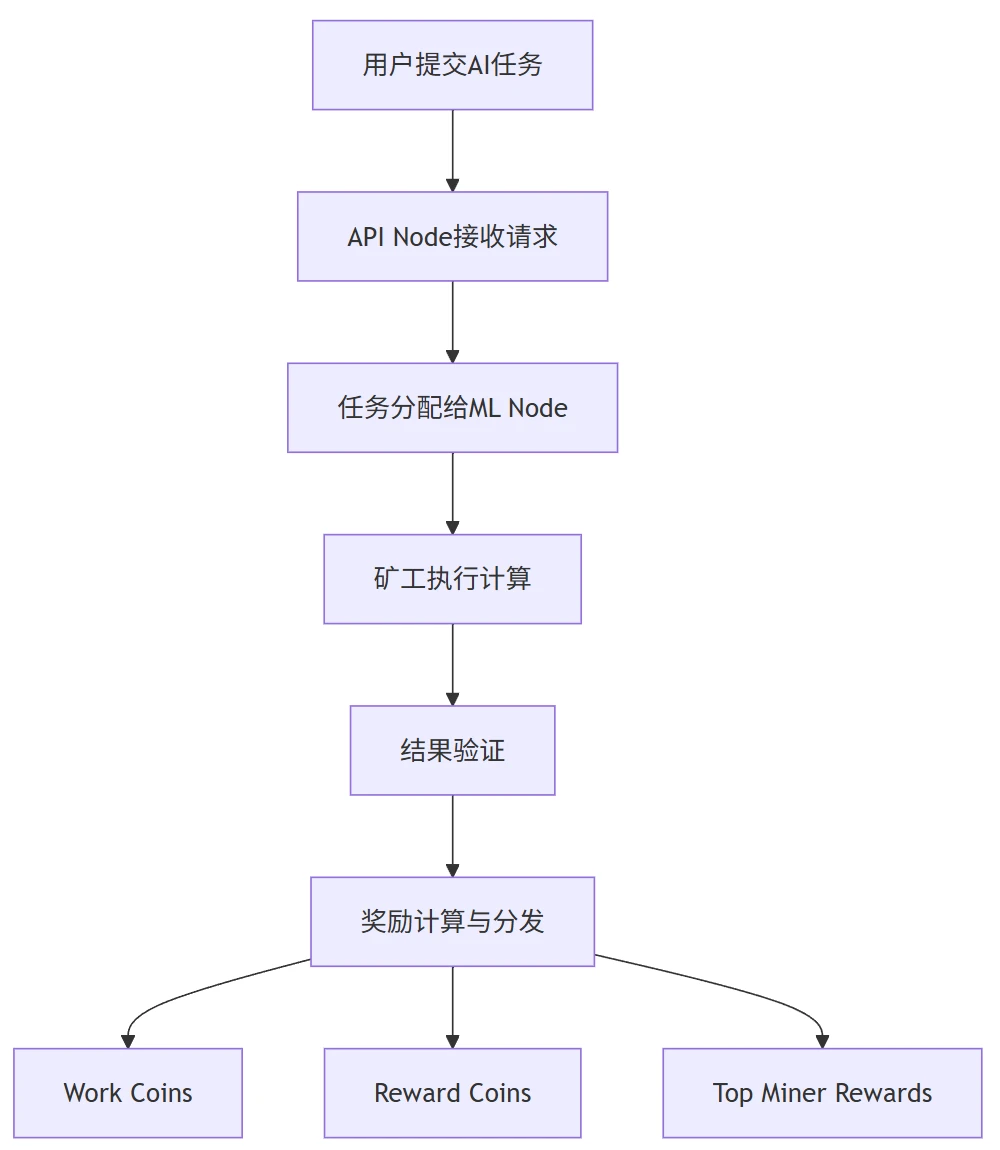
In short, the Gonka computing network operates according to the POW 2.0 incentive mechanism under the Sprint competition mechanism, which serves as proof of work and distributes token incentives to corresponding miners. This mechanism can flexibly and directly reflect information such as miners' current computing power contribution, reward incentives, and token release. The dynamic changes in data can be seen every day on the Gonka miner data dashboard .

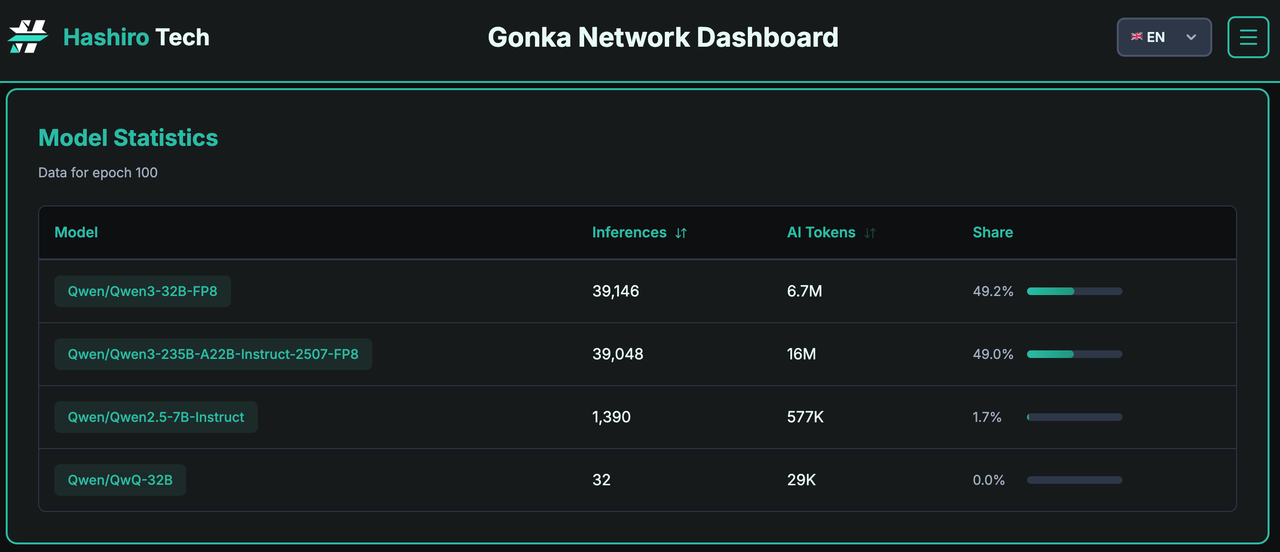
Based on current information, the Gonka network primarily supports AI applications with different parameters, such as Qwen/Qwen3 and Qwen/Qwen 2.5. It will also support training for over 20 mainstream AI models, including Llama and Stable Diffusion, in the future . Each GNK token is pegged to one hour of H100 equivalent computing power. More information on the operation and deployment of the Gonka mining software can be found here .
Finally, considering Gonka's halving mechanism, nearly 50% of GNK tokens will be distributed during its first halving cycle (4 years). In the first year (i.e., Epoch 0-365), the incentive distribution of GNK tokens reached as high as 95.6 million, which can be described as a rare golden period for "early participation and early returns".
Detailed Explanation of Gonka's Ecosystem Token Economic Model: Total Supply 1 Billion Tokens, 120 Million Tokens Allocated to the Community Pool
According to the official economic model documentation , the total supply of Gonka's ecosystem token, GNK, is fixed at 1 billion, with the specific allocation information as follows:
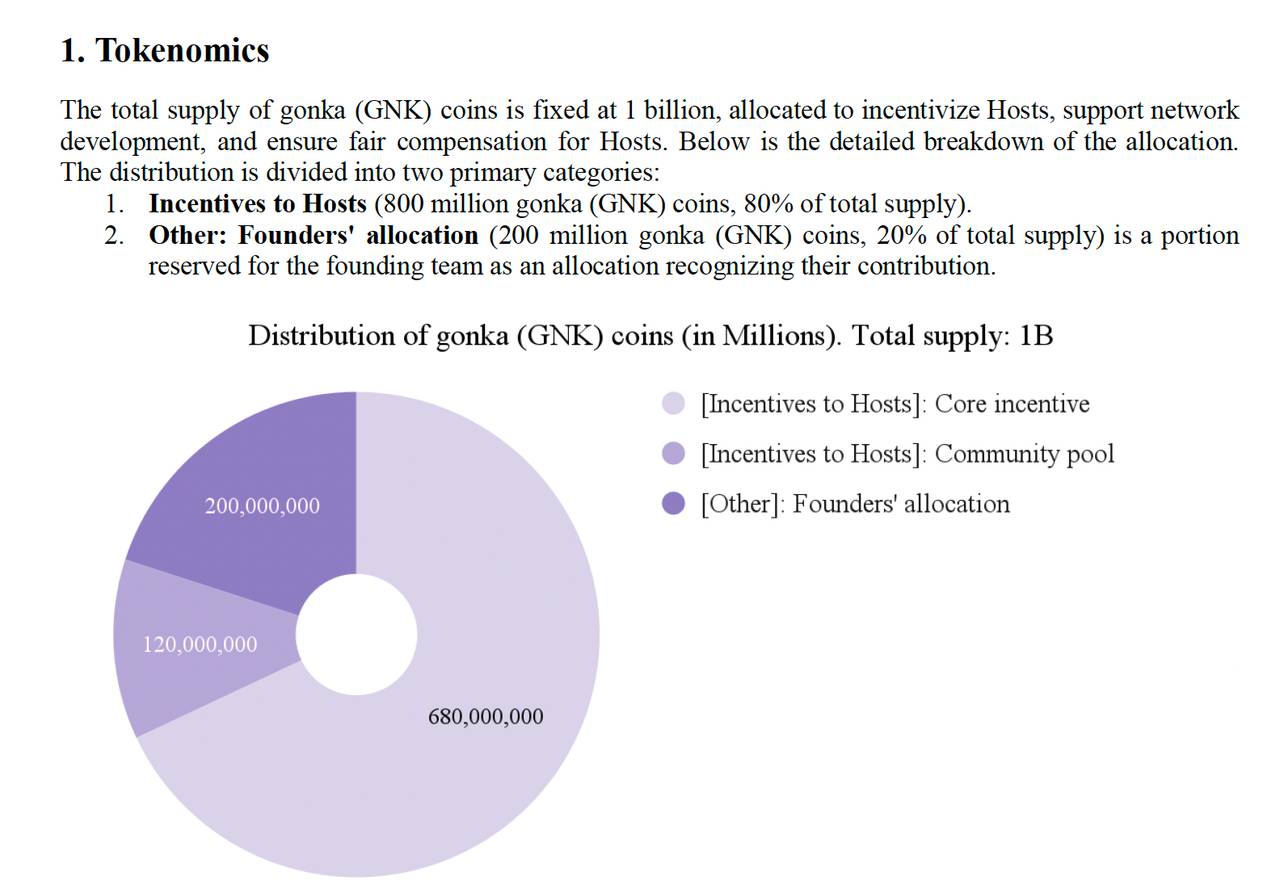
- Total token supply: 1 billion GNK, of which:
- Community pool incentive allocation: 120 million GNK tokens
- Founding team incentive allocation: 200 million GNK tokens, representing 20% of the total FDV (cannot be sold within four years).
- Core incentive allocation: 680 million GNK tokens, used for reward incentives for participation in the computing network.
According to the official description, the Gonka project is fair and decentralized . The only way to obtain GNK tokens is to provide GPU computing power for the Gonka network (mining) or to purchase them from the community pool at a pre-set bonding curve sale ratio.
As for the 20% of tokens allocated to the founding team, they mainly belong to the early developer Product Science, and the founders had previously committed to a lock-up period of up to 4 years.
In a previous community AMA, the founding team addressed various key questions raised by the community, including explanations of the token distribution mechanism, tax rates for community public offerings and training funds, and a reward distribution mechanism based on performance. Specifically, they mentioned:
1. The collateral itself in the Gonka network does not provide any rewards to miners; miners' voting rights and incentive shares can only be obtained by contributing more computing power. Gonka is a pure Proof-of-Work (PoW) network and does not contain any Proof-of-Stake (PoS) components, which are intended to reward participants who build the infrastructure.
2. Fair token sale: The “Token Sale” will be initiated and defined by the Gonka community, and will provide all users with an equal opportunity to purchase tokens.
3. Regarding the "20% mandatory tax rate on training funds" mentioned in the token economics document, this is only a long-term vision. The specific "tax rate" will be determined by the mining community. In the early stages of the Gonka network's development, the contribution rate to the training fund will be set to 0%. The community will decide whether to increase this rate based on the activities and achievements of the research community. The ultimate goal is to ensure that Gonka can compete with top centralized AI companies and attract capital to train its own models.
4. Unlike the Bittensor network, 10% of the TAO token rewards go to subnet owners; 45% of the TAO token incentives go to stakers; while the Subnet 64 (Chutes) hardware provider, which contributed the most NVIDIA graphics cards to the ecosystem network, only received 5% of the network token incentives. In contrast, Gonka allocates 68% of the tokens to computing power contributors, demonstrating its friendly attitude towards computing power miners and the fairness of the community.
In addition, combined with the information mentioned earlier that "Bitfury invested $12 million in Gonka", Gonka's current project valuation is only $600 million. Although this is only calculated based on a small token share (2%), Gonka officials have clearly stated that all funds raised will be managed by the community and used to support developer incentives, rewards, and project ecosystem development.
As a decentralized AI computing network, Gonka knows its biggest advantage lies in its thousands, even tens of thousands, of computing power miners.
Conclusion: AI miners will become mainstream, and Gonka is taking the lead.
Gonka 's mainnet launched in September of this year , and in less than three months, its computing power has grown to nearly 6,000 H100 equivalent computing power. In addition, the official team previously launched the "Ten Million GNK Token Incentive Program" to support developers in building the ecosystem in three major areas: core technology, infrastructure, and ecosystem security.
While Nvidia dominates the market with its Blackwell chips, achieving quarterly profits exceeding $56 billion; Google releases its Ironwood TPU hoping to break Nvidia's monopoly; and even Amazon joins the brutal arms race for AI computing resources with its Trainium 3 chip, Gonka's existence opens a door for us to transition from GPU feudalism to an era of AI democratization .
In a sense, Gonka is not merely a decentralized AI computing network, but a computing profit-sharing scheme that drives the efficient operation of AI inference and training and returns the benefits to participants. This is precisely its advantage over traditional graphics card suppliers, centralized tech giants, and crypto mining companies. Facing the "new gold mine" of AI, backed by a mature team, strong capital, and adhering to the initial intention of "standing with the community," Gonka has already forged its own path to success through accumulated strength.
In the near future, AI miners will become another influential industry player after crypto miners, and Gonka's development will undoubtedly be equally anticipated.