






With $1.44 billion in dividend reserves secured, Strategy's stock price plummeted by 10%. What is Strategy's real problem?


- 核心观点:MicroStrategy高杠杆模式在熊市下风险凸显。
- 关键要素:
- 设立14.4亿美元储备金应对债务与分红压力。
- 股价跌破比特币持仓价值,mNAV仅0.87。
- 商业模式依赖比特币波动、杠杆和持续融资。
- 市场影响:加剧市场对其流动性与可持续性的担忧。
- 时效性标注:短期影响。
Originally Odaily Planet Daily ( @OdailyChina )
Author | Dingdang ( @XiaMiPP )

On December 1, Strategy announced the establishment of a $1.44 billion dividend reserve, primarily to support preferred stock dividends and debt interest payments. This funding comes from proceeds from the sale of Class A common stock through an “ATM” (Auction at Market) offering program and is expected to cover related expenses for at least 12 months, with plans to extend it to 24 months to enhance financial buffer capabilities.
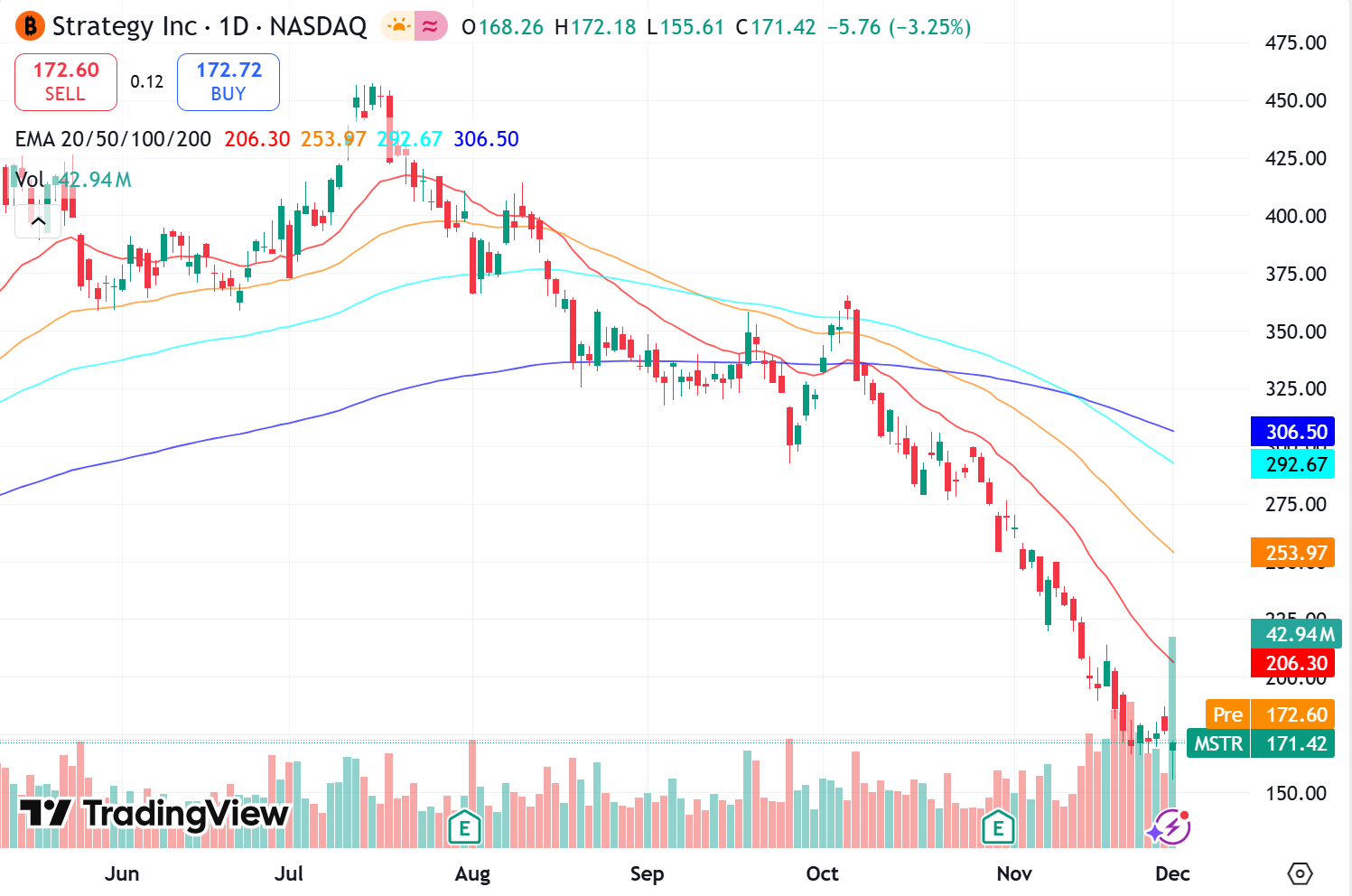
However, the market reaction was not favorable. Following the announcement, Strategy's stock price fell by approximately 5-10%, reflecting growing concerns about its liquidity and long-term sustainability.
Currently, pessimism surrounding Strategy is rapidly spreading in social media and the media.
Some have likened Strategy& to a "central bank for Bitcoin," arguing that it's caught in a power struggle between the traditional financial system (the Federal Reserve, Wall Street, JPMorgan Chase) and emerging systems (treasuries, stablecoins, Bitcoin-backed financing). The article points out that JPMorgan Chase has recently significantly increased its short-selling of Strategy&, including delaying stock settlement, suppressing the Bitcoin derivatives market, and creating panic through "dumping" in the options market. This has led to a continuous decline in Strategy&'s stock price since its July 2025 high, with a cumulative drop of over 60% , and it faces the risk of being removed from the MSCI index. (Recommended reading: " Federal Reserve vs. Treasury: The Currency War Hidden Behind the Bitcoin Crash ")
These pressures are amplifying Strategy's inherent vulnerabilities and fueling market concerns about a "death spiral."
Reserves: a short-term "stopgap measure," but unable to change the fundamental nature of the business model.
According to data from bitcointreasuries.net , Strategy currently holds approximately 650,000 Bitcoins, with a market capitalization of about $56.5 billion, making it the largest publicly traded company in terms of Bitcoin holdings. Its average cost basis is approximately $74,431. After Bitcoin's price fell from a high of $126,000 to its current level of $93,000, its unrealized gains were quickly compressed to 25%, and the volatility of its assets became more apparent.
More importantly, the company's market capitalization/Bitcoin net asset value (mNAV) has fallen below 1, currently standing at only 0.87. This means the market is valuing Strategy's stock below the value of its Bitcoin holdings. To put it more bluntly: the market can buy MSTR stock containing $1 worth of Bitcoin for less than $1.
The core of Strategy's current predicament is a liquidity crisis. High dividends from the company's preferred stock (such as STRC, with an annualized yield of 10.75%) and over $4 billion in debt constitute rigid expenditures, requiring hundreds of millions of dollars in payments every quarter. These expenditures will continuously amplify leverage costs during a bear market. From this perspective, reserves are more like a financial "firewall" the company has built for the coming year. It can prevent defaults on preferred stock or debt, avoid triggering credit downgrades, and temporarily stabilize expectations for external financing. However, it remains a buffer measure rather than a structural repair.
However, the limitations of this measure are also obvious. First, the money comes from the sale of common stock, meaning the risk shifts from debt and preferred stock investors to common stockholders. Second, while the reserves can provide a short-term buffer, they cannot solve the root problem. If Bitcoin continues to fall or financing channels cool down, these reserves will be depleted faster than expected. Market reactions confirm this: the drop in stock price after the announcement reflects investor concerns that the reserves are merely a "delaying tactic," not a fundamental solution.
Nevertheless, Strategy founder and executive chairman Michael Saylor emphasized that the move was intended to "improve the stability of the Bitcoin holding strategy," rather than a panic measure. At the same time, the company lowered its 2025 profit target (from $1 billion) and its Bitcoin yield forecast (from 20% to 15%).
Overall, in the short term, the reserve is intended to stabilize preferred stock investors and alleviate credit pressure. However, the key lies in whether Bitcoin can stage a decent rebound in the coming months; otherwise, the negative effects of leveraged trading will be difficult to reverse.
It's worth noting that Strategy CEO Phong Le recently stated in an interview that the company would consider selling Bitcoin if its share price fell below net asset value and it couldn't secure new funding. This marks the first time Strategy has signaled a possible Bitcoin sale to the market, and such a sale could potentially trigger a more severe chain reaction.
Today, Michael Saylor emphasized at Binance Blockchain Week that Strategy currently has an enterprise value of $68 billion, reserves of Bitcoin worth $59 billion, and an LTV (Loan to Value) of only 11%. Based on current financial data, the dividend margin is sufficient to cover the next 73 years.
The challenges didn't appear suddenly; they were written into the Strategy's DNA.
Strategy is indeed in a precarious situation, but it must be pointed out that this is not a problem caused by the Bitcoin crash this year, but rather a structural risk that has existed since the company switched to a Bitcoin strategy in 2020. This is because its business model has been based on a "three-high model" from day one: high volatility, high leverage, and high reliance on financing.
Specifically, firstly, Bitcoin's volatility means that a company's assets fluctuate wildly with market movements: when BTC rises, the company's assets expand, and the stock price is amplified many times over; when BTC falls, the same leverage effect has the opposite effect, and assets shrink much faster than the market average. Secondly, high leverage involves using low-interest bonds (some with interest rates below 1%) to buy Bitcoin, which is quite effective in a bull market; however, in a bear market, although the debt may not trigger margin calls, it may lead to increased cash repayment pressure due to the price conversion mechanism. Finally, reliance on financing makes the company highly sensitive to market sentiment. While "market price issuance" plans are flexible, they can quickly become "high-cost financing" during market downturns, and may even face the risk of financing depletion.
This is why strategies can present drastically different narratives in different cycles. For example, the bull markets of 2021 and 2024 were described as "financial alchemy" or "Bitcoin-based government bonds." However, in the 2022 correction and the current downturn, it has been relabeled as a "high-leverage time bomb" or a "Ponzi scheme." This pattern can amplify both the gains of a bull market and the pain of a bear market. Furthermore, as one's Bitcoin holdings increase, both the gains and the pain become more pronounced.
Of course, these narratives often spread so rapidly when prices are rising or falling continuously. Their spread is part of market sentiment, rather than an "objective fact" independent of price fluctuations.
Narratives never change because logic changes, but because prices change.
Risks don't appear out of nowhere, but market prices can make them seem like they have. When stock prices fall by 60%, the term "death spiral" is naturally mentioned frequently; when stock prices multiply several times in a bull market, the same structure is praised as "strategic genius."
Prices amplify market noise. Strategy's pressures are real, concrete, and warrant attention, but they are far from being "out of control" or "the end of the model."
It is important to understand this: this is not a sudden problem with the pattern, but a long-standing risk that is simply amplified rapidly when prices fall.


