






From dYdX to Hyperliquid and SunPerp: The Breakthrough of On-Chain Derivatives


- 核心观点:Perp DEX正从技术竞争转向生态整合。
- 关键要素:
- 高性能公链实现低延迟交易。
- 资本与流量驱动流动性聚集。
- 生态闭环提升用户体验。
- 市场影响:加速去中心化衍生品市场成熟。
- 时效性标注:中期影响
The development history of decentralized exchanges (DEX) is essentially a history of the evolution of crypto market infrastructure.
The earliest DEXs were primarily in the rudimentary stage of matching transactions. Due to their lack of depth, complex interactions, and limited user base, they were barely able to compete with centralized exchanges. It wasn't until 2018, when Uniswap introduced automated market makers (AMMs) to the crypto market, that DEXs truly became a viable and independent sector.
The significance of AMMs lies in lowering the barrier to entry for liquidity provision, allowing anyone to become a liquidity provider. However, AMMs also have significant limitations: excessive slippage, low capital utilization, and an inability to meet the complex tool requirements of professional traders. With the maturity of Ethereum's Layer 2 technology and the development of cross-chain bridges and on-chain settlement systems, the infrastructure for DEXs is gradually becoming operational.
At the same time, evolving user demands are driving the expansion of DEX functionality. The DeFi summer of 2020 saw a surge in crypto users' demand for leverage and derivatives, and perpetual swaps have gradually become a battleground in the DeFi world. This is because perpetual swaps have long been one of the most attractive product categories on centralized exchanges, boasting massive trading volumes and user loyalty. As a result, the DEX market has transitioned from a "liquidity experiment" to a "derivatives arena," truly entering a highly competitive fast lane.
dYdX and GMX, early exploration of Perp DEX
Early attempts at Perp DEX can be traced back to dYdX in 2021. As one of the earliest on-chain derivatives projects, it adopted a hybrid model of "off-chain matching + on-chain settlement," leveraging the StarkEx Layer 2 network to address performance bottlenecks. dYdX's success lies in proving for the first time that "on-chain contracts are possible," but its limitations are also very obvious: matching remains centralized, cross-chain operations, and the structure is complex, making it limitedly trader-friendly.
Later, in 2022, GMX offered another solution: providing depth through a multi-asset AMM pool, allowing users to trade directly against the pool. GMX's advantages lie in its user-friendly experience and transparency, making it easy for ordinary users to open contracts and truly bringing Perp DEX into the context of "decentralization." However, the AMM model lacks sufficient professional tools and is subject to pool losses in extreme market conditions (GLP's risk exposure), limiting its potential for further development.
At this stage, Perp DEX is more focused on experimentation and exploration. The market recognizes the value of "decentralized contracts," but there is still a huge gap between performance, depth, and professionalism compared to CEX.
High-performance public chains and full-chain order books: The rise of a new generation of DEX
The turning point is 2023-2024.
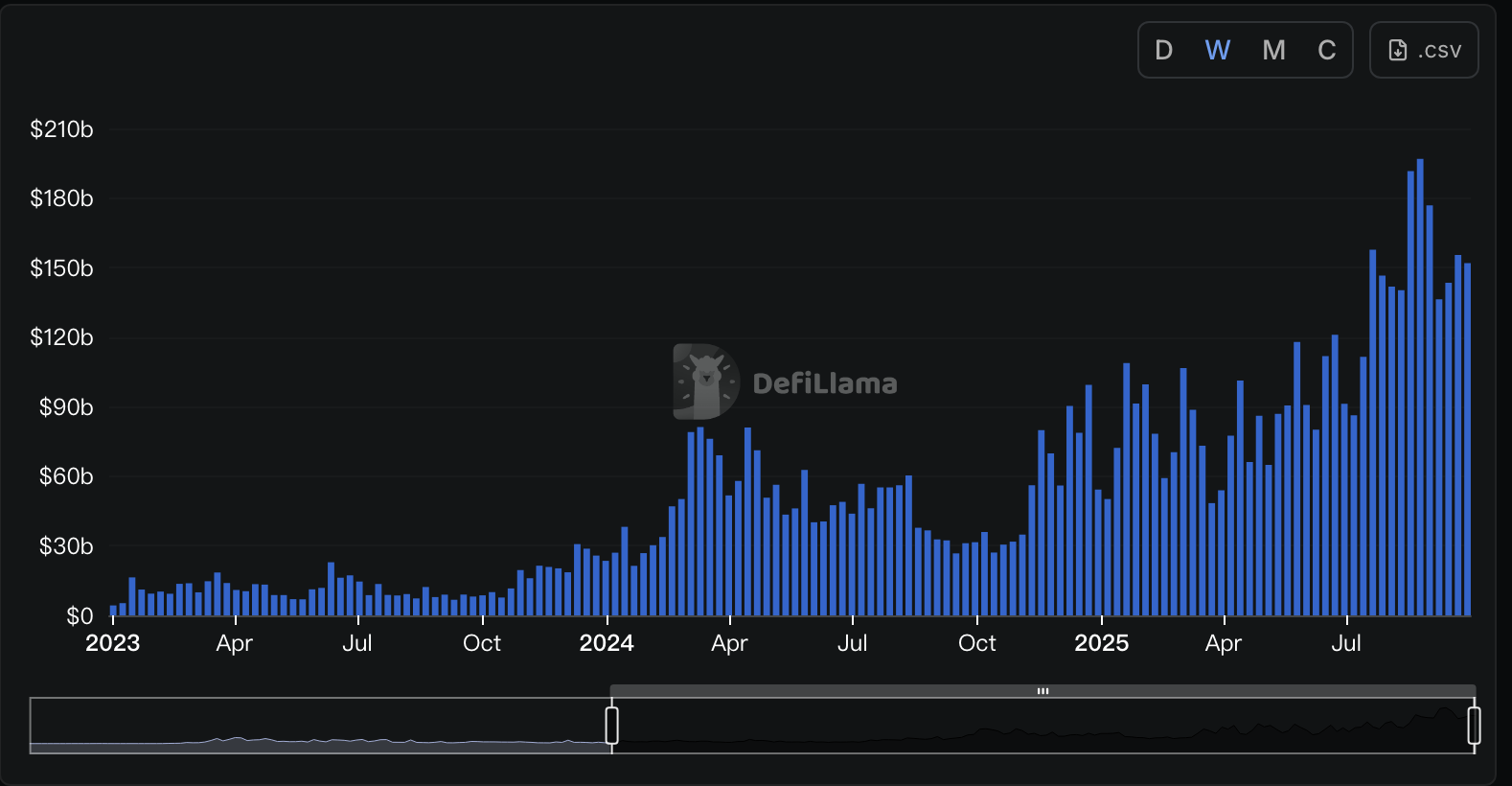
*DefiLlama data shows that DEXs TVL has shown a clear upward trend since the second half of 2023
A new generation of projects is no longer content to cobble together solutions on Ethereum or Layer 2. Instead, they are building their own high-performance infrastructure, delivering a fully on-chain matching experience with near-centralized performance. Hyperliquid, one of the leading projects, is considered a prime example.
Hyperliquid is not only a Perp DEX, but also a high-performance Layer 1 platform built to support all financial transactions, aiming to become a blockchain and a high-performance on-chain financial trading infrastructure. Its architecture consists of two components: HyperCore and HyperEVM. HyperCore is responsible for on-chain order book matching, while HyperEVM provides a compatible environment. It can be said that it provides a complete on-chain open financial system where every order, trade, and settlement is transparent and has extremely low latency. This is why the community calls it "Binance on Chain."
Furthermore, Hyperliquid relies on the spread of community and KOLs to form a growth flywheel. In terms of valuation logic, it also attempts to interpret the value of DeFi protocols using traditional internet-style user growth and retention models.
In contrast, Aster, backed by Binance's powerful resource advantages, won a beautiful victory in the TGE stage and embarked on a breakthrough path that was more "platform-supported".
Leveraging a combination of "airdrops, price pumps, and wealth creation," Aster not only rapidly gained users and exposure, but also successfully siphoned off significant liquidity from competitors like Hyperliquid. Aster's product strategy employed a multi-chain entry strategy, offering both a professional mode (order book) and a simplified mode (similar to an AMM). It also introduced features like "hidden orders" to optimize the security of large order execution. This short campaign vividly illustrates the true nature of the crypto market: when it comes to traffic and capital, all technical pros and cons are secondary.
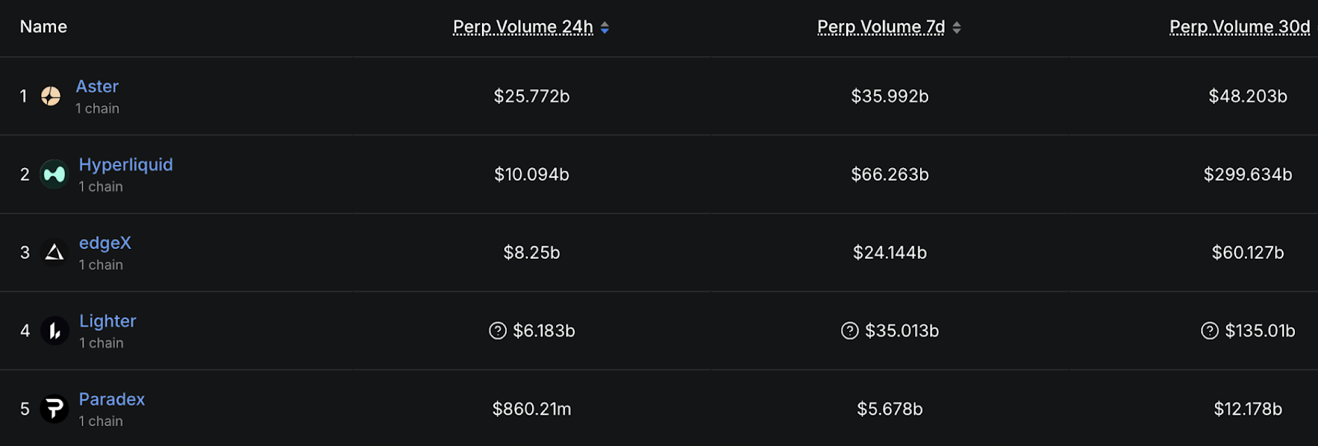
*DefiLlama data shows that as of midnight on September 24, Aster's perpetual contract trading volume in the past 24 hours reached US$25.772 billion, exceeding Hyperliquid's US$10.094 billion, and is more than 2.5 times the size of Hyperliquid.
If Aster demonstrates the leverage effect of capital and traffic, then Lighter represents another path of exploration. It attempts to differentiate itself in its trading mechanism, allowing LLP (liquidity pool, similar to Hyperliquid's HLP) positions to be used as margin and emphasizing zero-knowledge proofs, enhancing transparency and fairness while maintaining high performance.
In terms of market performance, edgeX's performance is undoubtedly even more impressive. In September 2025, it broke the Perp DEX revenue record with total revenue of $49.47 million. Over the past 30 days, it has generated $20.46 million, a 147% year-on-year increase. In terms of mobile experience, edgeX is even more unique. Its v2.9 mobile app integrates the Privy MPC wallet and a CEX-level experience, significantly lowering the barrier to entry for DeFi and gaining traction in the Asian market.
Obviously, the characteristic of this stage is the approach of CEX-style experience.
Traders are finding that the on-chain contract experience is becoming smoother, even approaching professional quantitative standards. As performance bottlenecks ease and liquidity begins to accumulate, Perp DEX is gradually shedding its "experimental" status and becoming a platform with real potential to capture a share of the CEX market.
SunPerp's "strike back"
Driven by the popularity of Hyperliquid and Aster, the Perp DEX market is entering a fiercely competitive phase. From underlying technology to user experience, from asset coverage to ecosystem integration, each protocol is seeking differentiated paths to breakthroughs.
But in this battle, being a latecomer doesn't necessarily mean being passive; rather, it's a carefully considered strategic choice. SunPerp's launch coincided with the convergence of technological maturity, ecosystem development, and market demand. By taking a holistic approach, it rapidly amplified its strategic advantages.
The power of a closed ecosystem—the power of resource integration—makes SunPerp not an isolated tool, but a hub in the crypto ecosystem. The TRON public blockchain provides underlying performance and cross-chain capabilities, while JustLend DAO, Sun.io, and other platforms handle liquidity and settlement. This multi-faceted resource synergy ensures SunPerp possesses a complete closed loop, from product experience to ecosystem governance, forming a self-driven mechanism for platform growth.
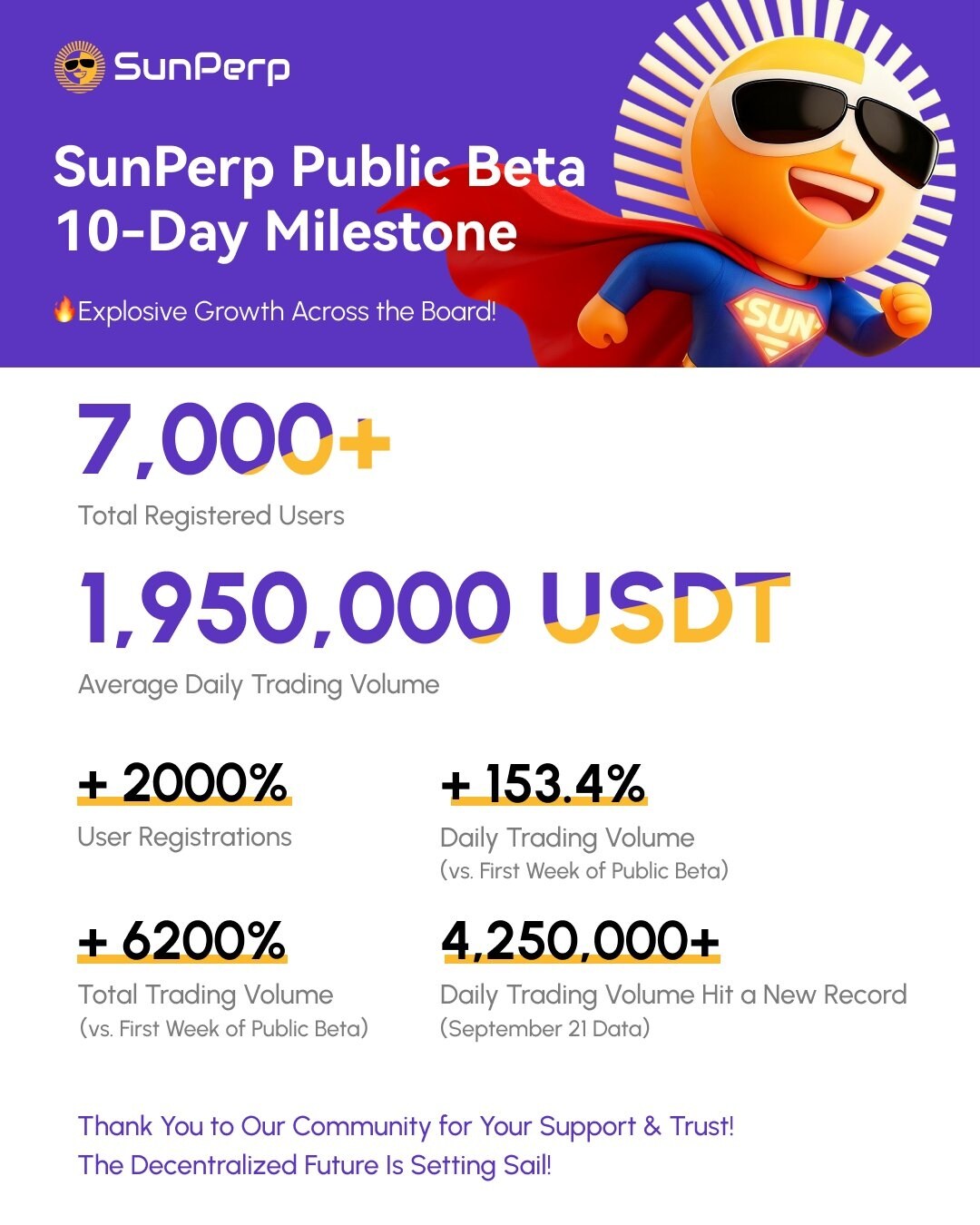
*Data shows that on the 10th day of public beta, SunPerp users have exceeded 7,000, with a cumulative trading volume of more than 19.5 million USDT, demonstrating strong market appeal and growth potential.
Extreme cost advantages and innovative incentives: With the lowest transaction fees on the entire network, "deposit and receive real money," and full gas fee rebates, this combination directly addresses the core pain points of high-frequency traders, simultaneously elevating capital efficiency and profit experience to industry-leading levels. Furthermore, SunPerp will closely link growth with user retention through innovative incentive mechanisms such as transaction mining, staking mining, points, and leaderboards.
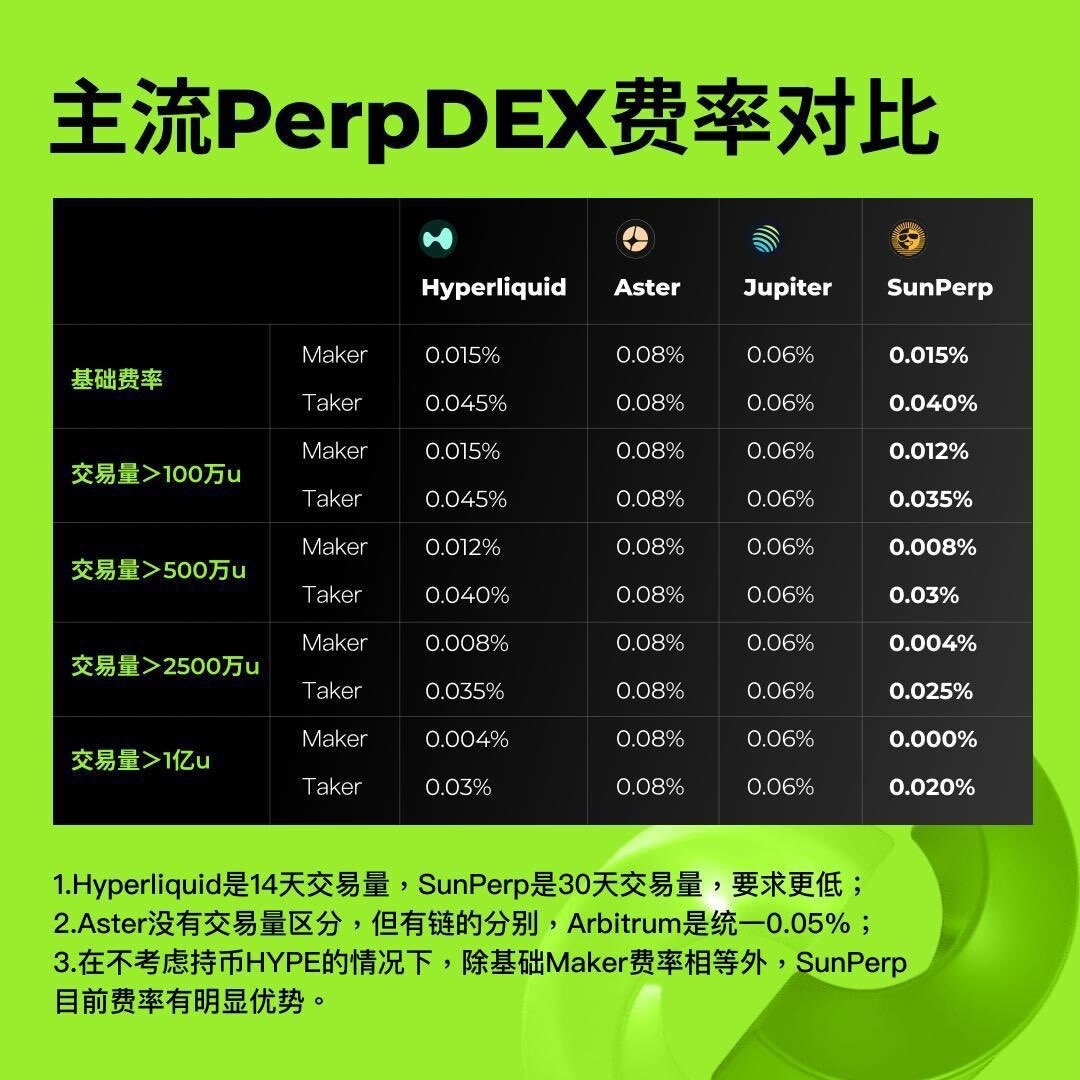
*Except for the basic Maker rate, SunPerp's current rate is significantly lower than other mainstream Perp DEXs such as Hyperliquid and Aster.
From this point of view, in the fiercely competitive Perp DEX track, SunPerp is more like a competitor with "resource plug-ins", which will determine that its starting speed and growth potential are far higher than its competitors.
More importantly, it strikes a balance between CeFi and DeFi, integrating on-chain transparency, asset efficiency, and sophisticated risk management to form a sustainable, closed-loop trading ecosystem. This combination of ecological integration, core user experience refinement, and strategic foresight makes SunPerp not only a newly launched DEX, but also a core financial engine within the TRON ecosystem, carrying the potential for long-term growth and market disruption.
The Second Half of Perp DEX: Ecosystem, Users, and Long-term Growth
At this stage, simply cool technology or low fees are no longer the only winning formula. More emphasis is placed on ecological integration capabilities, user experience optimization, and improved capital efficiency.
SunPerp's entry into the market undoubtedly brings new perspectives to the second half of Perp DEX's development. The key to its success lies in integrating resources and innovating on this foundation. SunPerp is expected to achieve long-term growth and market penetration through the following dimensions:
1. Ecosystem Expansion: Further integrate TRON and external on-chain resources to form deep collaboration across cross-chain liquidity and application scenarios, achieving the upgrade from a single trading tool to an ecological hub.
2. Deepening user engagement: Building on the foundation of high-frequency traders, we will expand into professional institutions and general user groups, and improve user stickiness through multi-tiered products, intelligent strategies, and data tools.
3. Innovation-driven: Continuously optimize cost structures and revenue mechanisms, explore more innovative ways to play, such as combined derivatives, on-chain leverage, and risk hedging tools, to improve capital efficiency and platform competitiveness.
4. Governance and Sustainability: Leveraging DAO governance and community co-construction mechanisms, we will achieve transparency in platform decision-making and user participation, creating a long-term sustainable closed-loop ecosystem.
Whether SunPerp can truly grow into the "financial engine" of the TRON ecosystem, or even become a global cross-chain infrastructure, remains to be seen. However, what is certain is that the second half of the Perp DEX is no longer a simple battle for trading functionality, but rather a competition for niches: whoever can craft a strong long-term narrative, integrate upstream and downstream resources, and cultivate user awareness will seize the initiative in the new landscape. SunPerp's entry into the market is more than just a new player; it likely heralds the entry of a new cycle driven by collaboration, innovation, and imagination.


